
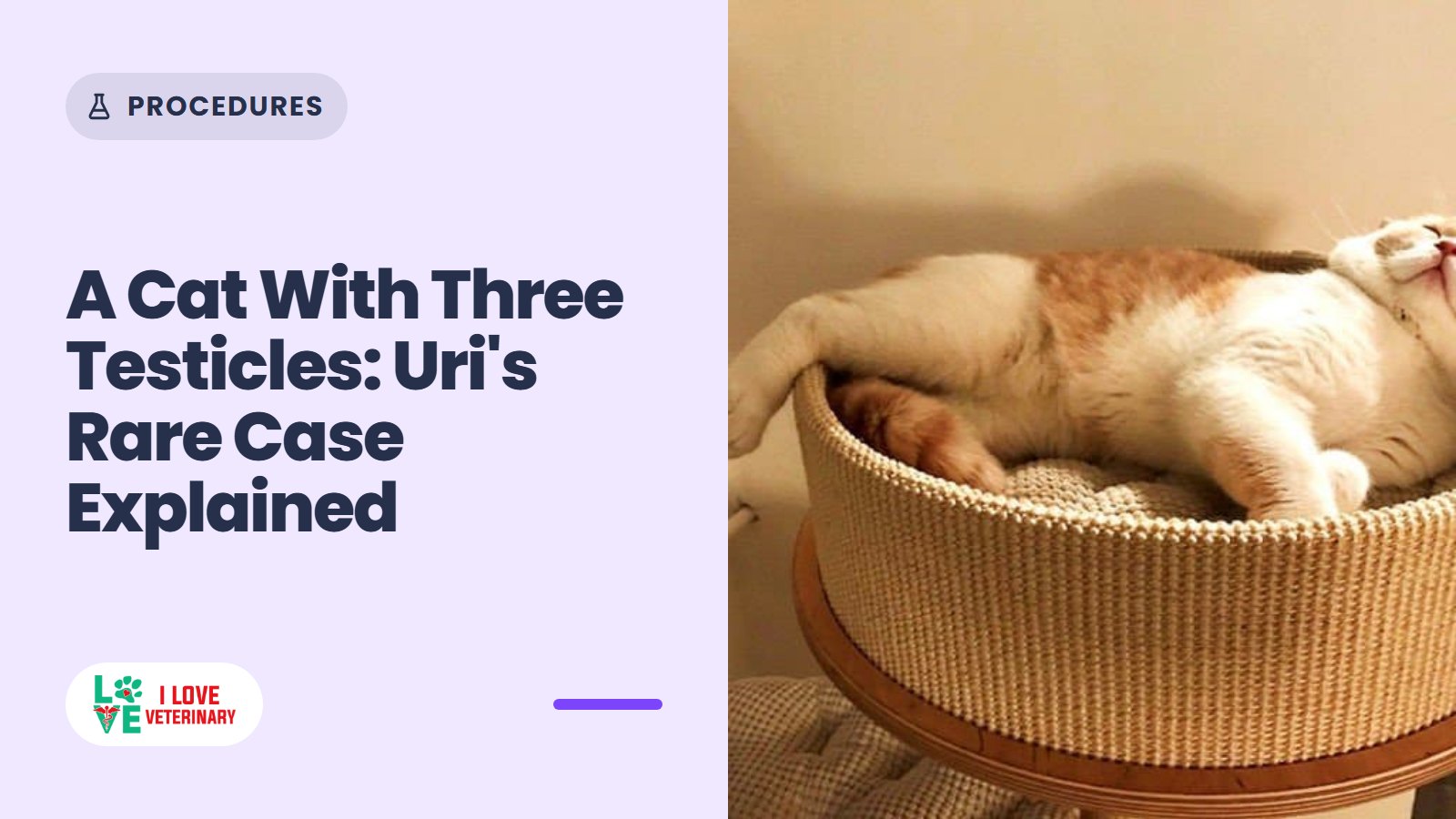
Uri was a neutered British Shorthair who kept acting like a full tomcat. Blood tests, a CT scan and a second surgery pointed to the cause: a hidden third testicle. His owner, Mirela Mlinarec, shared the story with us.
Three testicles (polyorchidism) is one of the rarest findings in veterinary medicine. A far more common version of the same problem is a testicle that never came down into the scrotum and was missed or left behind. Here is Uri's story, then what both conditions are and how vets track down hidden testicular tissue.
Uri's story

Uri was born a double cryptorchid: neither testicle had reached the scrotum. One sat in the left inguinal canal (the passage through the belly wall toward the groin), the other inside the abdomen below the bladder. His vet found and removed both. Within about three weeks, the yowling, spraying and mounting that Mirela describes as "mating everything that breathes, flies and crawls" were over.
Or so the family thought. Over the next months Uri still yowled now and then, still mounted Vai, the older neutered male he grew up with, and played rougher than before. It was easy to file under personality. Uri was stubborn, bold and sweet at the same time, the kind of cat who knows exactly how to charm his people.
Then the family moved into an apartment where another neutered male cat had lived. On the fourth day, Mirela heard Vai screaming. Uri was chasing him through the rooms, and it was not play. "He was no longer my sweet boy," she wrote.
Mirela, who has trained dogs for about two decades, put it down to the stress of the move and the smell of the previous cat. The family tried what usually helps: a pheromone diffuser, meals and play together, swapping the cats between rooms. Nothing worked. The fights got worse:
- Uri injured his claws falling from a cat tree mid-fight.
- Vai suffered a bad corneal injury.
- Mirela's husband was bitten on the arm, and the bite turned nasty.

To everyone else in the house, Uri was still a lovely cat. He targeted only Vai, sometimes gripping him by the neck. About three weeks in, the family split the apartment with a protective net.

"Something is wrong, something physical"
Six weeks after the first attack, Mirela stopped blaming the move. She remembered a story from Uri's breeder about a "castrated" male who turned aggressive until a vet found and removed a remaining testicle. Risking, as she put it, being called a hypochondriac, she asked for a testosterone test.
The lab's note said neutered toms measure from under 0.1 up to 0.5 ng/ml. Uri measured 4.1 ng/ml. For comparison, a feline reproduction review puts resting testosterone in intact toms at under 3.0 ng/ml (Little, JFMS). Mirela's summary: a "hormonal kamikaze."

That much testosterone had to come from somewhere. Uri's team weighed two candidates: testicular tissue that was still there, or an adrenal gland problem, since the adrenal glands also make small amounts of sex hormones. Two abdominal ultrasounds found nothing. As Mirela learned, these organs are tiny, and finding them takes a very good machine, a skilled vet and a sedated cat.
The family and vets also considered a deslorelin implant, a hormone implant that acts on the pituitary gland to turn testosterone down, and decided against it because it would only quiet the symptoms and could shrink a hidden testicle until it was even harder to find.
The CT scan and the answer
With no animal CT easily available in Croatia at the time, the family took Uri to a small animal hospital in Postojna, Slovenia. The CT showed something in the right inguinal canal that looked like a testicle, though the scan alone could not confirm it.

The scan also showed a penis bone (os penis), which surprised the family. That part is normal: most cats have a tiny one, about 3.5 mm long, and a 2020 CT study found it in 20 of 23 cats (JFMS, 2020).
A few days later, surgery found the tissue in the groin and removed it. Because the CT showed where to look, the surgeon did not need to open the whole abdomen. Laboklin examined the tissue and reported an atrophic (shrunken) testicle with no tumor cells.
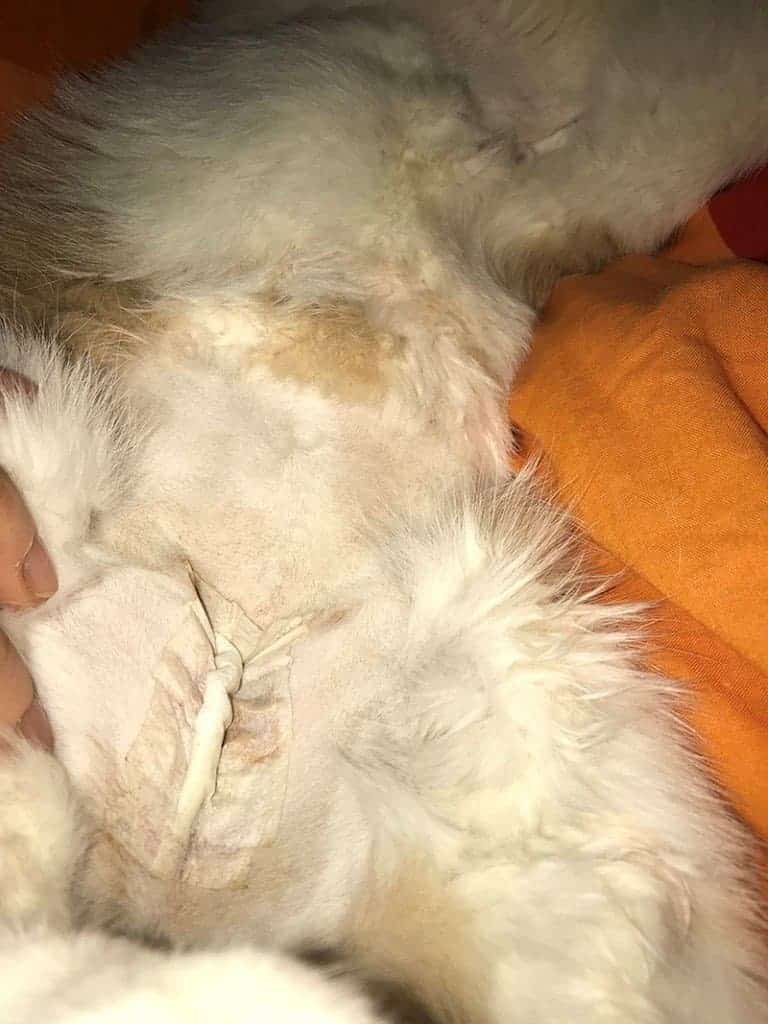
Mirela and Uri's vet pieced together a likely timeline: testosterone dropped after the first surgery, then rose again over the following months as the remaining testicle took over, until the aggression boiled over about ten months after castration. Mirela thanks the veterinarians in Croatia and the hospital team in Postojna who helped Uri along the way, and she still calls him "my dear sweetie full of life."
What polyorchidism is
Polyorchidism means having more than two testicles. Nobody knows exactly why it happens; the leading idea is that the tissue that forms the testicles divides abnormally early in embryonic development (Avargues et al.; Vet Times).
In people, three testicles is the usual form, and it is often found by chance on a scan. In animals it is rarer still. A 2022 case report counted published cases in only 2 cats, 2 dogs, 3 horses and a hummingbird before its own cat with four testicles inside the abdomen (Lohr et al., 2022). A 2019 Vet Times case added another neutered tom with a presumed extra testicle in the abdomen.
To call it polyorchidism, a pathologist has to confirm testicular tissue in more than two masses. Uri's case is consistent with it: two testicles were removed at his first surgery, and the lab identified the third as testicular tissue. We don't have a lab record for the first two, though, so a vet would keep the more ordinary explanation open too: one of the first two structures may not have been a testicle, which would make the third simply a retained testicle that was missed the first time.
The common version: a retained testicle
Cryptorchidism means one or both testicles never reach the scrotum. It is the most common reproductive disorder in male cats, it is inherited, and affected cats should not be bred (Merck Veterinary Manual).
- How common: studies put it at roughly 1% to 4% of male cats, depending on the population. It shows up more in purebreds such as Persians, Himalayans and Ragdolls; in one study of cats presented for castration, more than 18% of the Ragdolls were cryptorchid.
- When testicles should be down: they form near the kidneys and normally reach the scrotum by about 2 months of age. Vets suspect a retained testicle if one cannot be felt by 2 to 4 months; a late one rarely drops after 6 months (VCA).
- Where they get stuck: inside the abdomen, in the inguinal canal, or under the skin of the groin. Most cats have only one retained testicle, and either side can be affected.

In one study, only 22% of owners knew their cat was cryptorchid. That matters, because a cat with only the descended testicle removed keeps behaving like an intact male.
Neutered but still acting like a tom?
Retained testicles keep making testosterone, so the signs look like those of an intact male:
- urine spraying or marking (VCA)
- fighting or bullying other cats
- the strong, musky smell of an intact tom
- mounting other cats, as Uri did and as in the 2022 case report

Stress, pain and urinary tract disease can cause spraying and aggression too, so book a vet visit rather than guessing. This is what the vet may check:
- Penile spines. Intact toms have tiny barbs on the penis that depend on testosterone. They fade within about 6 to 8 weeks after neutering, so spines on a "neutered" cat point to a remaining testosterone source (Vet Times).
- A blood test. Anti-Müllerian hormone (AMH) is a hormone test vets can use: in males it is made only by testicular tissue, so it helps tell a neutered cat from one with retained tissue. A testosterone test works too. A single high result confirms it, but testosterone rises and falls during the day, so a low result may need a stimulation test, a second sample after a hormone injection (IDEXX; Little, JFMS).
- Imaging. Ultrasound can locate a testicle inside the abdomen and help the surgeon plan (AMC). When it stays hidden, as with Uri, CT can help.
- Other sources. The vet will also consider the adrenal glands and testosterone the cat picks up from somewhere outside his own body. Adrenal tumors that make sex hormones have been reported in cats, and as of a 2019 case review every reported one had been malignant, which is why ruling them out matters.

Why hidden testicular tissue should come out
Vets recommend removing retained testicles (VCA). The behavior reason is the obvious one: spraying, odor and aggression toward other cats continue as long as the tissue is there. Cryptorchid cats should also never be bred, because the condition is inherited.
The health risk is where sources differ. VCA says a retained testicle can twist and may become cancerous; a 2011 feline reproduction review says a twisted cord had not been documented in cats and testicular tumors are very rare. Either way, the behavior and breeding reasons are enough on their own.
Surgery depends on location: a small groin incision for a testicle under the skin or in the inguinal canal, an abdominal incision (or laparoscopy at some hospitals) for one inside the belly. The outlook is excellent when it is done early. If you are weighing timing, our guide to why to spay or neuter your pet covers the basics, and your vet can plan around your cat. After surgery, many cats need a cone (Elizabethan collar); Uri hated his.
Dog owners: retained testicles are more common in dogs, and they carry a real risk of twisting and of cancer. See canine cryptorchidism and testicular torsion in dogs.
FAQ
Can a cat really have three testicles?
Yes, but it is extremely rare. Only a handful of feline cases have been published, and the diagnosis needs a pathologist to confirm testicular tissue in each mass.
My neutered cat started spraying. Is it a hidden testicle?
Possibly, especially if he also smells or fights like a tom. Stress, pain and urinary disease cause spraying too. Your vet can check for penile spines and run a blood test.
Can a cat with a retained testicle still father kittens?
A cat with one descended testicle can still be fertile. Because the condition is inherited, vets advise against breeding him.
Do cats have a penis bone?
Yes. Most cats have a tiny os penis, a few millimeters long, which is why a CT scan can show it.

Sources
- Lohr BR, Lieske DE, Parry NM: Polyorchidism in a cat (J Vet Diagn Invest, 2022)
- Little S: Feline reproduction: problems and clinical challenges (J Feline Med Surg, 2011)
- VCA Animal Hospitals: Retained Testicle (Cryptorchidism) in Cats
- Merck Veterinary Manual: Reproductive Disorders of Male Cats
- Vet Times: What's your diagnosis in this case? (Adam and Armellini, 2019)
- IDEXX: Neuter status or cryptorchid testing (feline)
- The Animal Medical Center: Cryptorchidism in Cats and Dogs (Hohenhaus, 2024)
- Avargues A et al.: Polyorchidism: the case in a young male and review of the literature (Asian J Androl, 2014)
- Animals (2020): deslorelin implant study in tomcats (Ferré-Dolcet et al.)
- J Feline Med Surg: CT characterisation of the feline os penis (2020)
- Uri's case: first-hand account by his owner, Mirela Mlinarec, including the Laboklin report shown above.
This article is for general information and is not a substitute for advice from your veterinarian.