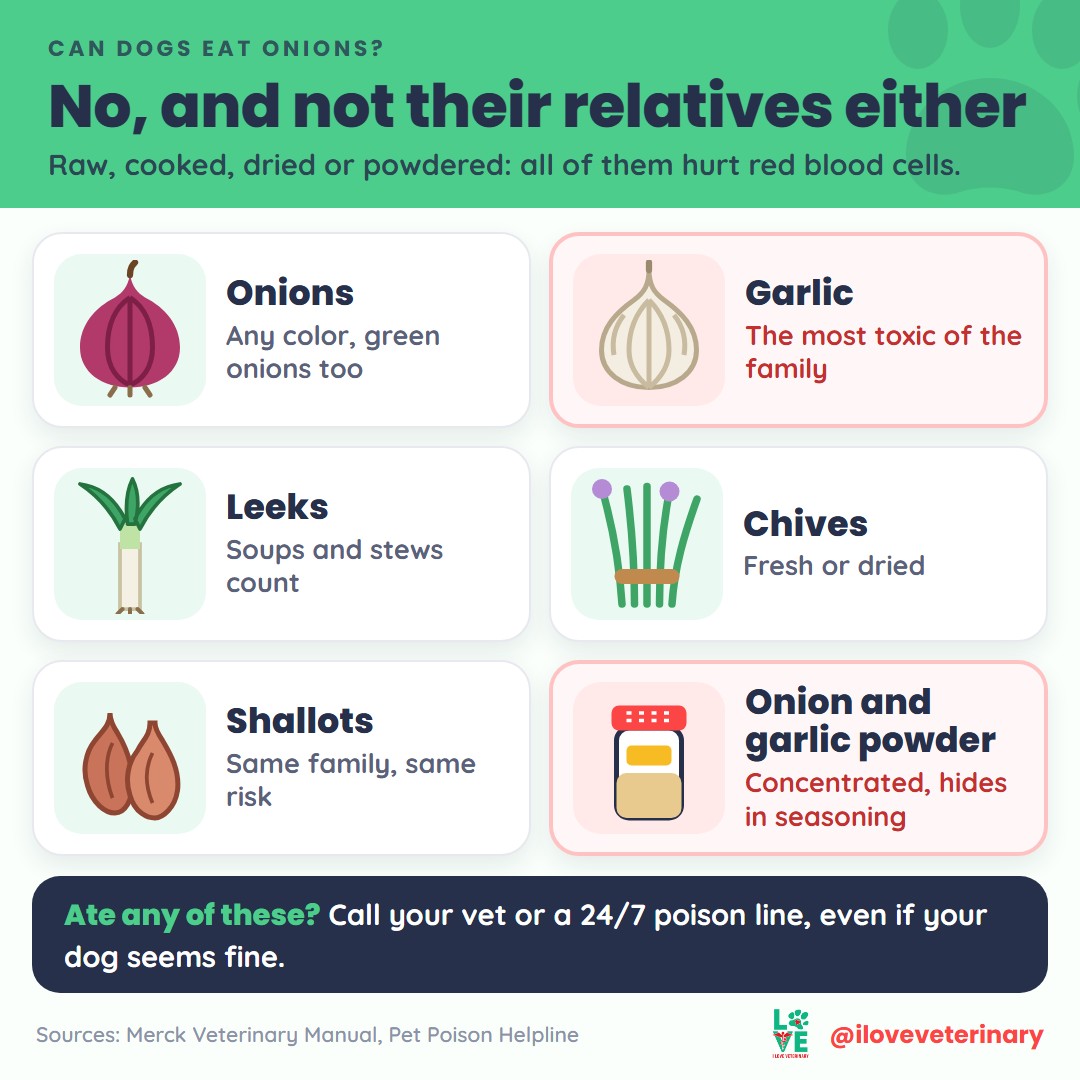
No. Dogs shouldn't eat onions in any form: raw, cooked, fried, dried, powdered, or cooked into sauces, soups and broth. Garlic, leeks, chives, shallots and green onions belong to the same family and cause the same problem: they damage a dog's red blood cells.
The tricky part is timing. A dog can look completely normal for a few days before the anemia shows. So if your dog ate onion or onion-seasoned food, call your veterinarian or a 24/7 animal poison line now, whatever your dog's size and even if your dog seems fine.
Why Are Onions Toxic to Dogs?
Onions belong to the Allium genus. When an onion is chopped, cooked or chewed, it releases sulfur-containing compounds that act as oxidants in the body, according to the Merck Veterinary Manual. The ASPCA names one of them, N-propyl disulfide, as the onion's toxic principle.
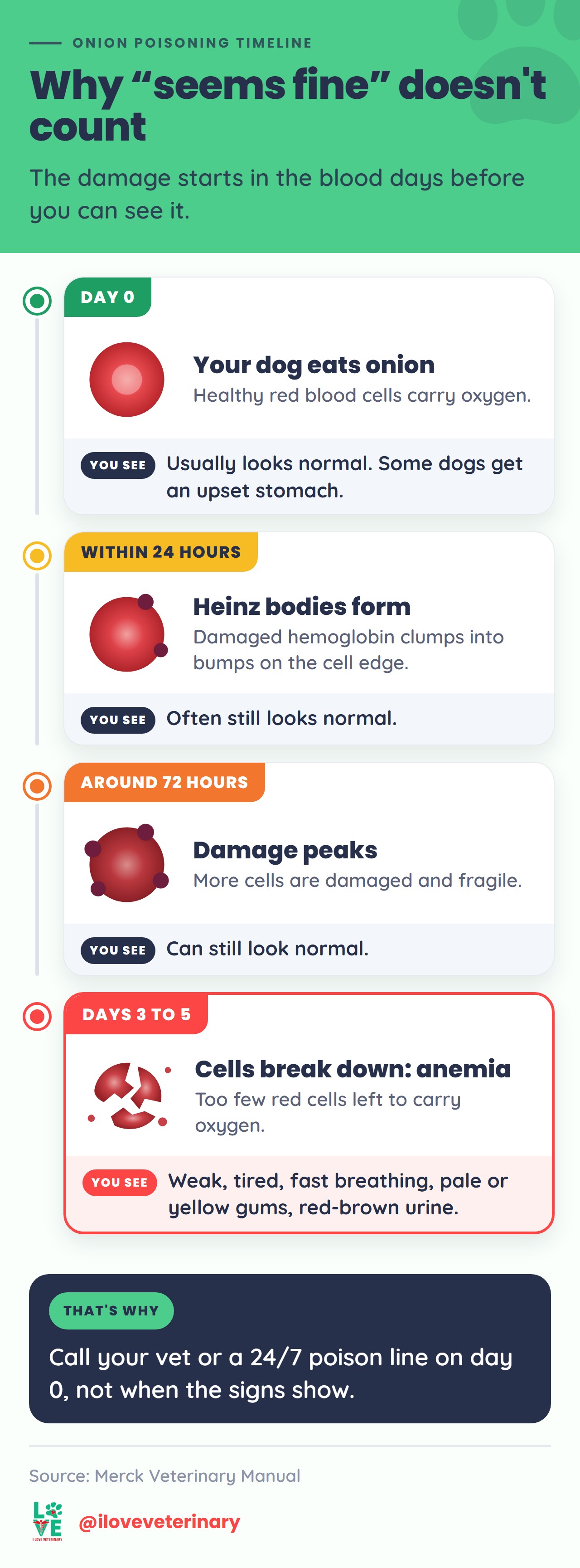
Those oxidants damage hemoglobin, the protein inside red blood cells that carries oxygen. The damaged hemoglobin clumps together and forms small bumps on the edge of the cell, called Heinz bodies. Your vet can see them on a stained blood smear under the microscope.
Red blood cells with Heinz bodies are fragile, and the body breaks them down faster than it can replace them. That is hemolytic anemia: too few red blood cells to carry oxygen around the body. A dog with it gets weak, breathes fast and tires easily.
When red cells break apart in the bloodstream, the freed hemoglobin can turn urine red or brown and can damage the kidneys afterwards. That is why your vet may also check kidney values. Our guide to the signs of kidney failure in dogs explains what those values mean.
Signs Can Take Days to Show
This is the part that trips owners up. According to Merck, the damage starts quickly, but the signs come late:
When | What is happening inside |
|---|---|
Within 24 hours | Heinz bodies start to form and methemoglobin (another form of damaged hemoglobin) rises |
Around 72 hours | Methemoglobin peaks |
Typically 3-5 days | Red blood cells break down and anemia signs appear |
Merck notes that signs are generally not seen until a lot of red blood cells have already been destroyed, usually a few days after the dog ate the onion. A dog who seems fine the evening after raiding the leftovers can still get sick later that week.
Some dogs show stomach upset sooner. Early signs can include:
- Drooling (a sign of nausea)
- Vomiting
- Diarrhea
- Not wanting to eat
- Belly pain
- Onion or garlic smell on the breath
Signs of red blood cell damage, usually a few days later:
- Weakness, tiredness, lying around more than usual
- Tiring quickly on walks or not wanting to exercise
- Fast or heavy breathing, panting at rest
- A fast heart rate
- Pale or yellow-tinged gums
- Red or brown urine
- Collapse
Any of these after a known or possible onion meal means a vet visit now, not tomorrow.
How Much Onion Is Toxic to Dogs?
Merck notes toxic effects at about 15 to 30 g of raw onion per kg of body weight, and repeated small amounts can add up. Pet Poison Helpline warns about onion and garlic eaten in large or repeated amounts. There is no safe amount to feed.
Call your vet or a poison line for any amount, even a bite, even if your dog is large and seems fine.
Two things make a small amount more dangerous than it looks:
- Garlic is stronger. Merck rates garlic 3-5 times more toxic than onion.
- Dried and powdered forms are concentrated. Merck says poisoning in dogs and cats is most often linked to dehydrated flakes, powders and dry onion soup mixes.
Nobody can judge your dog's risk from a website. The form of onion, how much went down and your dog's health all matter, and weighing them up is the poison line's job.
My Dog Ate Onion: What to Do Now
- Take away what's left and keep the packaging or recipe so you know what was in it.
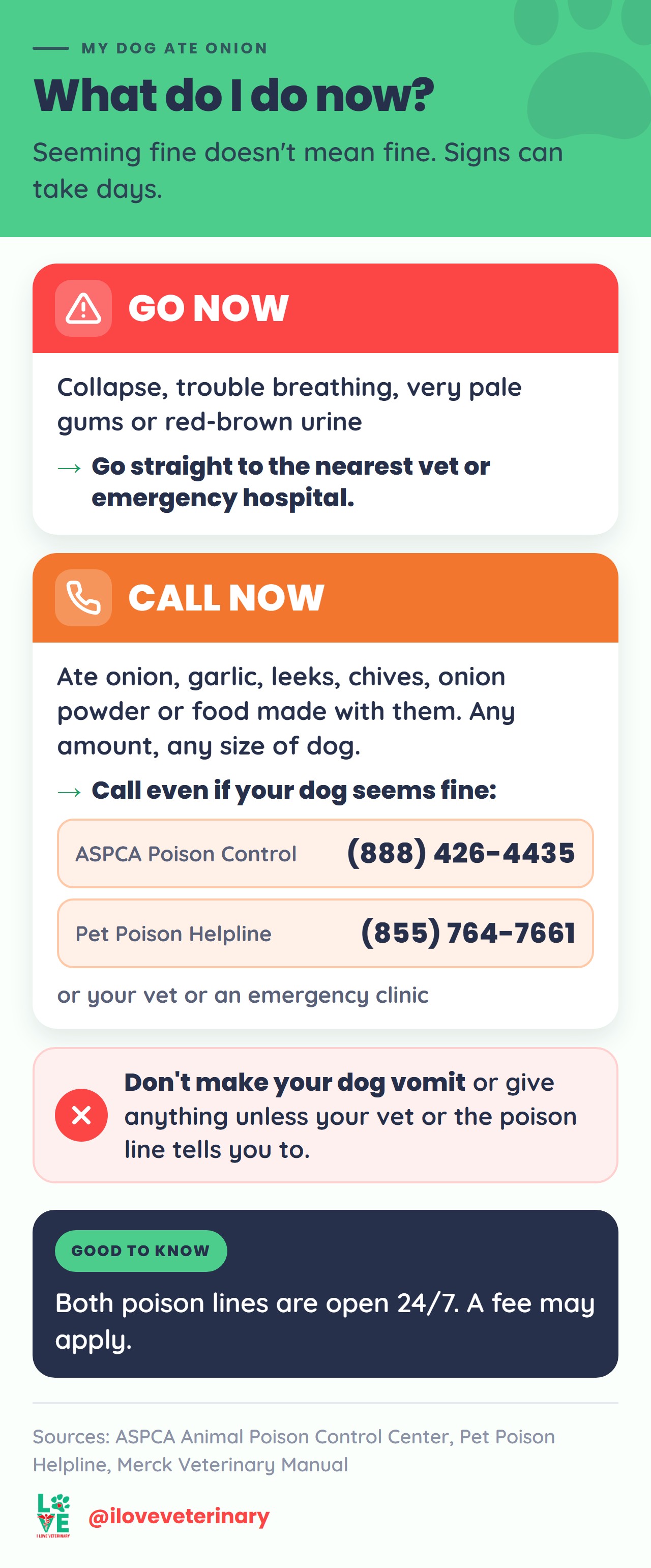
- Check your dog. Collapse, trouble breathing, very pale gums or red-brown urine: go to the nearest vet or emergency hospital now.
- Otherwise, call now, even if your dog is big or acting normal. Call your vet, an emergency clinic, the ASPCA Animal Poison Control Center at (888) 426-4435, or Pet Poison Helpline at (855) 764-7661. Both lines are open 24/7. A fee may apply.
- Don't make your dog vomit or give anything unless your vet or the poison line tells you to. The ASPCA warns that inducing vomiting at home can be dangerous.
Have this ready when you call:
- What your dog ate: raw onion, cooked onion, onion powder, garlic, or a dish (soup, sauce, broth, stuffing). Read out the label if there is one.
- Roughly how much, and how long ago.
- Your dog's weight, age and breed.
- Any health problems and medicines your dog takes.
- Any signs you've noticed so far.
What the Vet May Do
Your vet decides the treatment based on what your dog ate, how long ago, and the bloodwork. In general terms, Merck describes:
- If it was recent: emptying the stomach at the clinic to get the onion out before more is absorbed.
- Bloodwork: a red blood cell count and a blood smear to look for Heinz bodies. These may be repeated over the following days because the anemia can show up late.
- If the anemia is serious: hospital care with oxygen and, when needed, a blood transfusion. IV fluids help protect the kidneys from the freed hemoglobin.
How a dog does depends mainly on how much red blood cell damage there is, which is why the follow-up blood tests matter even when your dog looks better.
Onion's Relatives: Garlic, Leeks, Chives and Shallots
Every member of the Allium family is poisonous to dogs, cats and livestock, according to Pet Poison Helpline. The ones in most kitchens:
- Onions of every color, including sweet onions
- Green onions (scallions)
- Shallots
- Leeks
- Chives
- Garlic, the strongest of the group
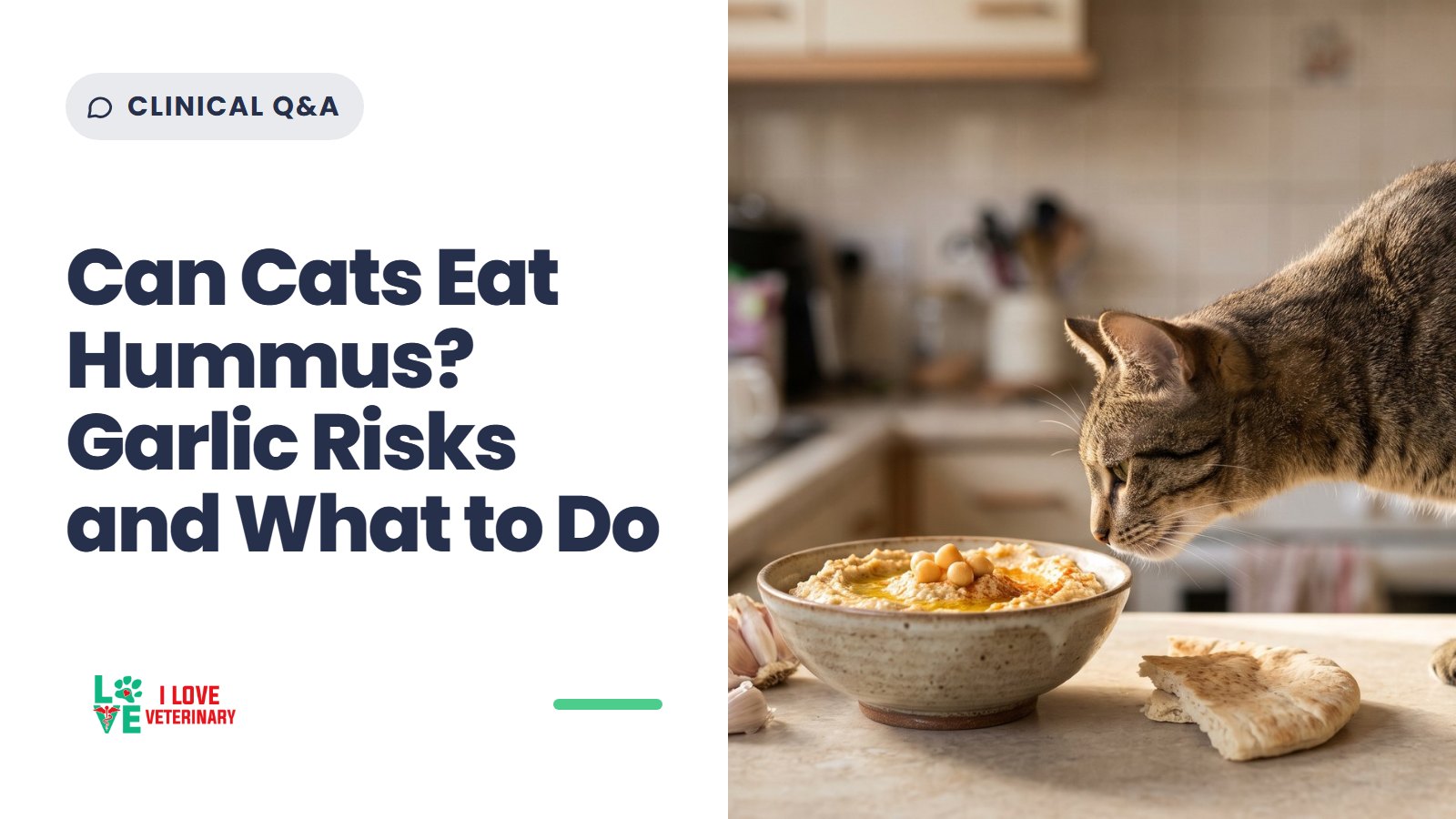
The form doesn't make them safe. Cooked onion and garlic still poison dogs, and dried flakes, garlic powder and onion powder pack more of it into less food. Garlic is the most toxic of the group, so don't give your dog garlic supplements or garlic flea "remedies".
Which Dogs Are at Higher Risk?
Every dog is at risk. Pet Poison Helpline notes that some are more sensitive, including Japanese breeds such as the Akita and Shiba Inu. Small dogs also take in more onion per pound of body weight from the same bite. That doesn't make big dogs safe, though. The advice to call is the same for every size.
What About Cats?
Cats are even more sensitive than dogs. Merck calls them the most susceptible species, so a smaller bite matters more. If you share your home with a cat, keep onion-seasoned food away from both pets, and read more about anemia in cats.
Where Onion Hides in Everyday Food
Most dogs don't eat a whole onion. They eat food with onion in it. Watch for:
- Soups, stews, stock and broth (including chicken broth)
- Gravy, pasta and tomato sauce
- Seasoned meat: burgers, meatloaf, sausages, roast chicken
- Stuffing, pies, quiche and casseroles
- Onion rings, chips and dips, dry soup mixes
- Spice blends and seasonings with onion or garlic powder
A few habits prevent most cases:
- Never give your dog food seasoned with onion or garlic, and check labels before sharing anything.
- Put leftovers in a closed bin your dog can't open or knock over.
- Keep onions and garlic off low shelves and counters within reach.
- Fence off garden beds with onions, garlic, chives or leeks.
- If you drop onion or spices, keep your dog out of the room until it's cleaned up.
- Tell family and guests not to share plates.
For other foods to keep off the menu, see our list of human foods toxic to dogs.
Veggies Your Dog Can Eat Instead
Dogs don't need vegetables if they eat a complete dog food, but a few plain veggies make good low-calorie treats. From the American Kennel Club's list:
- Carrots: a low-calorie, crunchy snack with fiber
- Green beans: raw, steamed or canned, as long as they're plain
- Broccoli: in small amounts, as an occasional treat
- Cucumbers: a cool treat on hot days
Serve them plain and cut to a safe size, with no butter, oil, salt, onion or garlic. Keep all treats under 10% of your dog's daily calories, as WSAVA recommends, and ask your vet what suits your dog.

Quick Answers
Can puppies eat onions? No. The answer is the same for puppies, and their small size means a little onion goes further.
My dog ate one small piece and seems fine. Is that OK? Call your vet or a poison line anyway. Signs of anemia usually take a few days to show, so seeming fine right now doesn't settle it.
My dog is big and only ate a little. Do I still call? Yes. Call your vet or a poison line for any amount, whatever your dog's size. They can weigh up the risk with your dog's details.
Can dogs have chicken broth with onion in it? No. Many store-bought broths and stocks contain onion or garlic. Check the label, and skip it if either is listed.
What about onion powder in food or treats? Powders are concentrated, so a small amount carries more of the toxin than fresh onion. Check ingredient lists for onion and garlic powder.
Is cooked onion safer than raw? No. Cooked, fried and dried onion all poison dogs.
Originally written by Dr. Catharina Hjorth. Updated by the I Love Veterinary editorial team.
Sources
- Merck Veterinary Manual: Garlic and Onion (Allium spp) Toxicosis in Animals
- Merck Veterinary Manual: Hematology in Hepatic Disease in Small Animals (Heinz bodies)
- ASPCA Animal Poison Control Center: Onion
- ASPCA: My Pet Ate Something! When Should I Seek Help?
- ASPCA: What to Do if Your Pet Is Poisoned
- ASPCA: Is It Ever Safe to Induce Vomiting?
- Pet Poison Helpline: Onions
- Pet Poison Helpline: Are Onions Poisonous to Dogs?
- Pet Poison Helpline: If Your Pet Eats Something Toxic, Hold the Hydrogen Peroxide
- VCA Animal Hospitals: Onion, Garlic, Chive, and Leek Toxicity in Dogs
- American Kennel Club: Fruits and Vegetables Dogs Can and Can't Eat
- WSAVA: Feeding Treats to Your Dog
This article is for general information and is not a substitute for advice from your veterinarian.