Horse people have a word for almost everything, and they use those words fast. A client calls because her gelding's hoof smells bad and she thinks it's thrush. A colleague asks whether the new foal got its colostrum. If you work in a mixed or equine practice, or you just bought your first horse, the vocabulary arrives before anyone explains it.
This glossary groups the horse terms owners and vet teams hear most: what to call a horse by age and sex, how height is measured, the points of the horse (with the anatomy names vets use), coat colors and markings, gaits, hoof words, and the health terms that should make you pick up the phone.
Horse Ages and Sexes
This is where most mix-ups happen. A "colt" is not any baby horse, and a "mare" is not the same thing as a "filly."
Term | Meaning | Usual age |
|---|---|---|
Foal | A young horse of either sex, still with or recently with its mother | Under 1 year |
Weanling | A foal that has been weaned from its dam | Under 1 year |
Yearling | A horse in its second year | 1 to 2 years |
Filly | A young female | Usually under 4 |
Colt | A young intact (not castrated) male | Usually under 4 |
Mare | An adult female | Usually 4 and older |
Stallion | An adult intact male, also called a stud or an "entire" | Usually 4 and older |
Gelding | A castrated male | Any age |
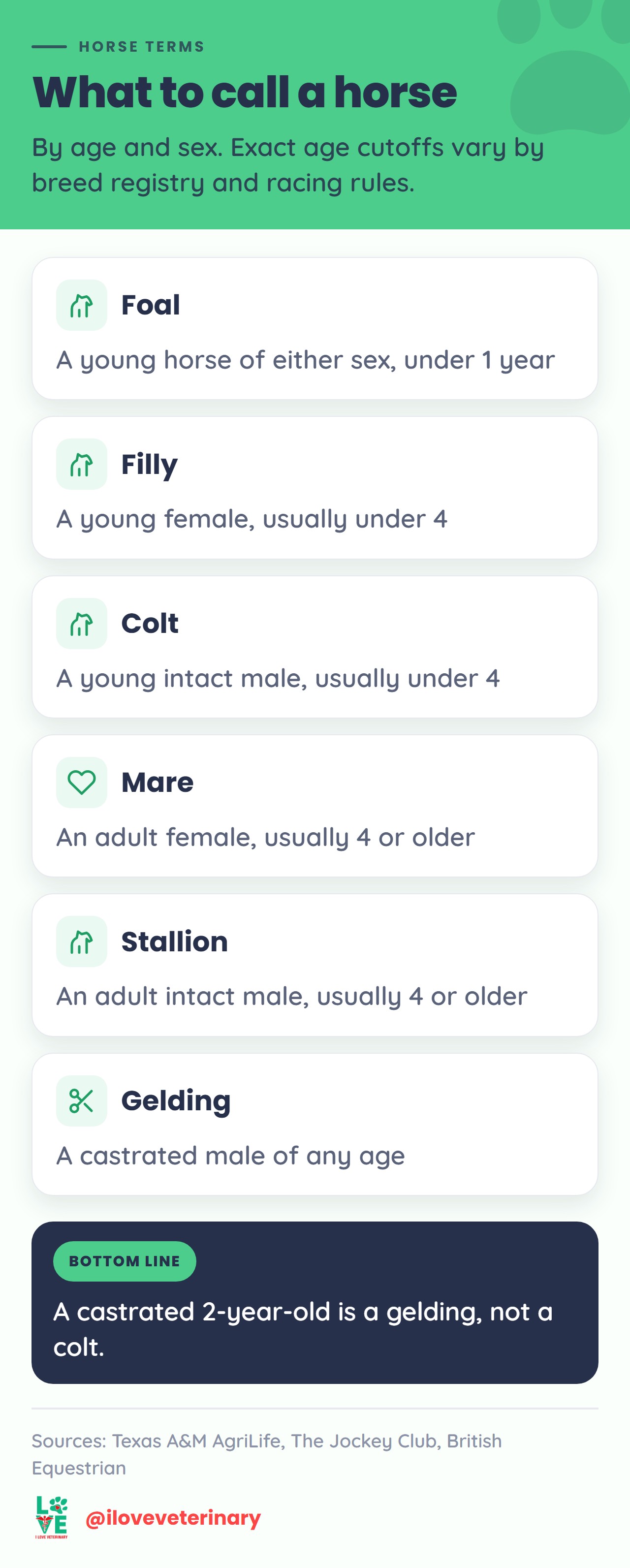
Two more words show up in breeding and pedigree talk: the dam is a horse's mother and the sire is its father.
The age cutoffs are less fixed than many glossaries suggest. Many breed and general horse references draw the filly/colt line at 4. A Texas A&M equine course sheet describes a mare as "usually over age three" and defines a foal as a young horse still nursing, usually under six months. UK horse racing calls a female a filly up to age 4 and a mare from age 5. So when the age matters for a record, a registration or a sale, use the horse's actual age and let the breed registry or racing rules decide the label.
Gelding is the one term with no age attached. A castrated 2-year-old is a gelding, not a colt. For more on the mare's side of things, see our guide to the horse gestation period.
Height: Hands and Horse vs Pony
Horses are measured in hands. One hand equals 4 inches, and height is measured from the ground to the top of the withers, the bony ridge at the top of the shoulders just in front of where the saddle sits.
Heights are written in hands and inches, so "15.2 hh" means 15 hands and 2 inches (62 inches). The ".2" is extra inches, not a decimal.
The usual dividing line between a horse and a pony is about 14.2 hands (58 inches). Adults above that height are generally called horses and smaller ones ponies, though breed societies and show rules set their own exact limits.
Points of the Horse (and What Vets Call Them)
Owners describe a problem by the barn name. Radiograph requests, records and textbooks use the anatomy name. This table connects the two.
Barn term | Where it is | Anatomy name |
|---|---|---|
Poll | The top of the head, where the ears sit | Poll (same word in clinical use) |
Crest | The top line of the neck, running from the poll to the withers | Crest of the neck |
Withers | The ridge at the top of the shoulders | Spinous processes of the first five or six thoracic vertebrae |
Knee (front leg) | The joint between the forearm and the cannon | Carpus |
Cannon | The long bone below the knee or hock | Third metacarpal (front) or third metatarsal (hind) bone |
Fetlock | The joint at the bottom of the cannon, above the pastern | Metacarpophalangeal joint (front leg) |
Pastern | The section between the fetlock and the hoof | Long and short pastern bones (first and second phalanx) |
Stifle | The joint high on the hind leg, where femur meets tibia | Stifle joint |
Hock | The large joint midway down the hind leg | Tarsus |
The horse's "knee" (carpus) is the same group of bones as our wrist, and the hock (tarsus) matches our ankle. In conformation terms, the elbow, forearm and knee of the front leg are counterparts of the stifle, gaskin and hock behind.
Conformation is the overall way a horse is put together: the shape and proportion of its body and legs. Judges, buyers and vets all assess it, because a horse's build affects how it moves and how well it holds up to work.
For a fuller tour of the body, our horse anatomy guide goes system by system.
Coat Colors and Markings
Colors and markings are how horses are identified on registration papers, health certificates and vet records, so the words are more precise than they look. These definitions follow the University of Kentucky extension guide to horse identification.
Common colors
- Bay: a tan to reddish brown body with a black mane and tail, and usually black lower legs.
- Chestnut: a dark red or reddish brown body; the mane and tail are red or flaxen rather than black. Chestnut vs bay comes down to those black points.
- Black: true black all over, with no lighter areas.
- Gray: a mix of white and colored hairs over dark skin. Gray horses are often born solid or nearly solid colored and turn whiter with age, so a gray foal can look nothing like its future self.
- Palomino: a golden body with a white mane and tail.
- Buckskin and dun: both yellowish or gold; a dun usually has a dark stripe down its back (a dorsal stripe).
- Roan: white hairs mixed through the body color, but not on the head and legs.
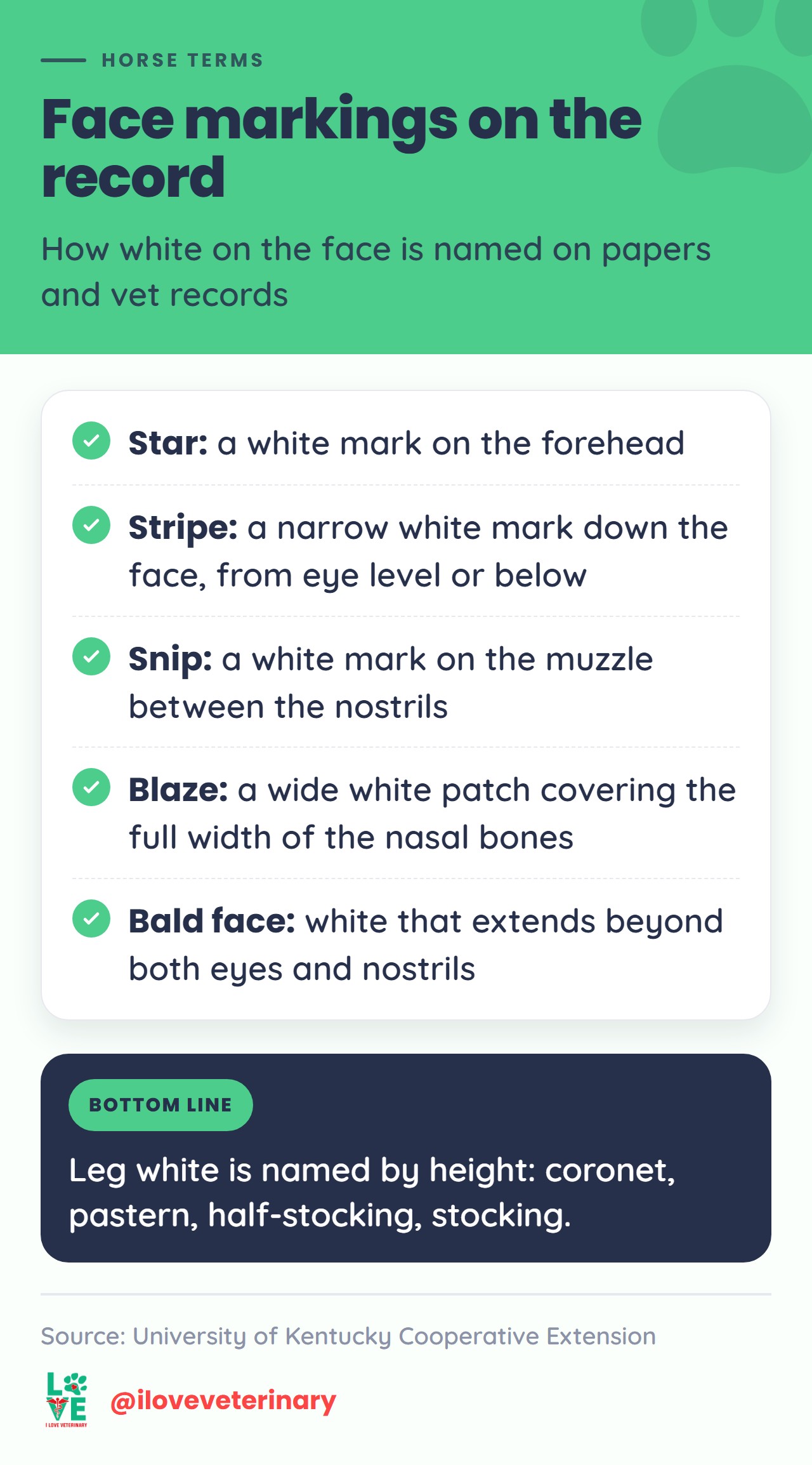
Face markings

- Star: a white mark on the forehead.
- Stripe: a narrow white mark down the face, starting at eye level or below.
- Snip: a white mark on the muzzle between the nostrils.
- Blaze: a wide white patch down the face covering the full width of the nasal bones.
- Bald face: white that extends beyond both eyes and nostrils.
Leg markings are named by how high the white goes: a coronet covers just the band at the top of the hoof, a pastern reaches up the pastern, a half-stocking runs to the middle of the cannon, and a stocking reaches the knee or hock.
Gaits
A gait is a pattern of leg movement. Horses have four natural gaits, and the number of beats you hear is the easiest way to tell them apart.
- Walk: a four-beat gait, each foot landing separately.
- Trot: a two-beat gait in which diagonal legs move together. Western riders call a slower, relaxed trot a jog.
- Canter: a three-beat gait. Western riders call a slower canter a lope.
- Gallop: the fastest gait, with four beats.
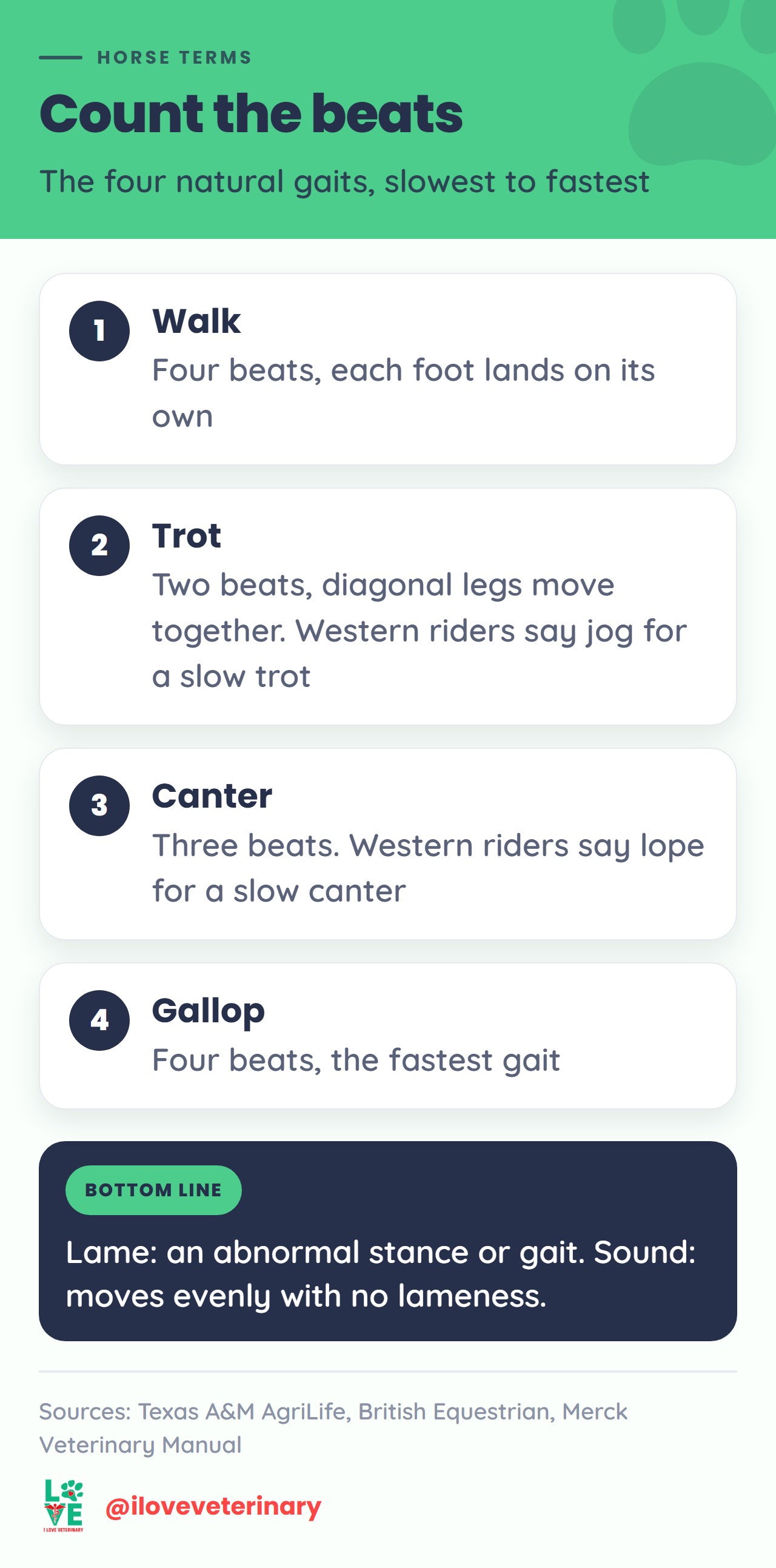
Two words matter more at the vet than in the arena. A lame horse has an abnormal stance or gait, and pain is the most common cause. Lameness is a sign, not a diagnosis: the vet's job is to find where it comes from. A sound horse moves evenly with no lameness.
Hoof Terms

Each leg ends in a single toe. Below the fetlock, three bones stack in a line: the long pastern bone, the short pastern bone and the coffin bone (also called the pedal bone, or P3). The coffin bone sits inside the hoof and gives it its shape. The hoof wall is the hard, horny casing around it.
- Frog: the V-shaped, spongy cushion in the middle of the underside of the hoof. It helps absorb concussion.
- Coronet (coronary band): the band where the hairline meets the top of the hoof wall. All hoof growth starts here.
- Chestnuts and ergots: small horny growths on the legs. Chestnuts sit on the inside of each leg; the ergot sits at the back of the fetlock joint. Chestnuts are thought to be a leftover of an ancient toe pad, and they are distinctive enough to be used in horse identification.
- Farrier: the trained professional who trims hooves and fits horseshoes.
Health Terms You'll Hear at the Vet
These are the words clients use on the phone, and several of them describe emergencies. If you're an owner and you suspect any of them, call your veterinarian.
- Colic: strictly, abdominal pain. It is a broad label for many conditions, from mild gas pain to a twisted intestine that needs emergency surgery. Common signs include pawing, looking back at the flank, lying down and rolling, sweating, stretching out as if to urinate, a poor appetite and passing fewer droppings. A horse rarely shows all of them. Only an exam can tell how serious an episode is.
- Laminitis: inflammation of the laminae, the interlocking layers that attach the coffin bone to the inside of the hoof wall. Its hallmark is severe lameness with bounding digital pulses (a strong, easy-to-feel pulse in the lower leg). The University of Georgia's equine program advises calling a vet as soon as laminitis is suspected.
- Founder: often used as another word for laminitis, but more precisely it means the damage has gone further and the coffin bone has rotated or sunk inside the hoof. Severe cases carry a guarded to poor outlook, which is why speed matters.
- Thrush: a degenerative condition of the frog with a strong foul smell and a thick black discharge. The exact cause isn't known, but anaerobic bacteria are thought to play the key role. It can show up even in well-kept horses.
- Scours: a farm word for diarrhea in young animals, used for foals as well as calves. Diarrhea that starts when a foal is 6 to 10 days old, about when the mare has her first heat after foaling, has its own name: foal heat diarrhea. A foal with diarrhea that is dull or not nursing needs a vet quickly.
- Colostrum: the mare's first milk. It carries the antibodies a newborn foal needs, and the foal gets them through nursing in its first several hours of life. Merck advises that newborn foals receive colostrum, preferably within the first 30 to 90 minutes after birth. Your veterinarian can test whether the foal took in enough.
Learning the Language
You don't need every term on day one. Start with the ages and sexes, the points of the leg and the health words, because those are the ones that end up in records and on the phone. The rest comes with time around horses.
If equine work is where you want to end up, here's how to become an equine veterinarian. And for the lighter side of the job, take a look at our infographic, You know you are a large animal vet when….
Originally written by Amber LaRock. Updated by the I Love Veterinary editorial team.
Sources
- Texas A&M AgriLife (Clay Cavinder, Ph.D.): Basic Horse Terminology
- The Jockey Club: Types of racehorse
- British Equestrian: Jargon buster
- University of Kentucky Cooperative Extension: Methods of Identification for Horses (ASC-146)
- Kentucky 4-H Horse Volunteer Certification Resource Manual: Conformation, External and Skeletal Parts
- Washington 4-H Horse Judging Manual (EM4797)
- Merck Veterinary Manual: Description and Physical Characteristics of Horses
- Merck Veterinary Manual: Overview of Lameness in Horses
- Merck Veterinary Manual: Overview of Colic in Horses
- Merck Veterinary Manual: Laminitis in Horses
- University of Georgia Equine: Tips for Preventing and Managing Pasture Laminitis in Horses
- Merck Veterinary Manual: Thrush in Horses
- Merck Veterinary Manual: Immune-deficiency Diseases in Horses
- IVIS, Manual of Equine Neonatal Medicine: Diarrhea (J. E. Madigan)
- Penn State Extension: Neonatal Calf Diarrhea (Scours)
This article is for general information and is not a substitute for advice from your veterinarian.