
MiraLax is a human laxative. The FDA approved it for people, not cats, so any use in a cat is extra-label: your veterinarian decides whether your cat gets it and how much. Vets do reach for it often, because it is nearly tasteless, mixes into wet food and softens stool gently.
If you came here for a number: veterinary references give one small starting amount per cat, not per pound, and the vet adjusts it until the stool is soft. The chart and calculator below show that range with their sources. Read the disclaimer first, and never use the bottle cap to measure it. That cap holds a human dose.
MiraLax for Cats at a Glance
Type | Osmotic Laxative |
Form | Powder for oral administration. Available in different-sized bottles |
Effects | MiraLax is a human medication that can also treat constipation in cats. It works by softening stool and making it easier for cats to defecate. |
Potential | Diarrhea |
Risk | Intestinal obstruction |
Vet | No |
FDA Approval | Approved for humans. Not approved for use in cats |
Brand | MiraLax, ClearLax, GaviLax, GlycoLax, PEG 3350, HealthyLax |
/ Potential Side Effects | Diarrhea Flatulence Dehydration / Risk Factors | Intestinal obstruction Dehydration Kidney disease / Vet Prescription Required | No / FDA Approval | Approved for humans. Not approved for use in cats / Brand Names | MiraLax, ClearLax, GaviLax, GlycoLax, PEG 3350, HealthyLax -->
What Is MiraLax and How Does It Work in Cats?
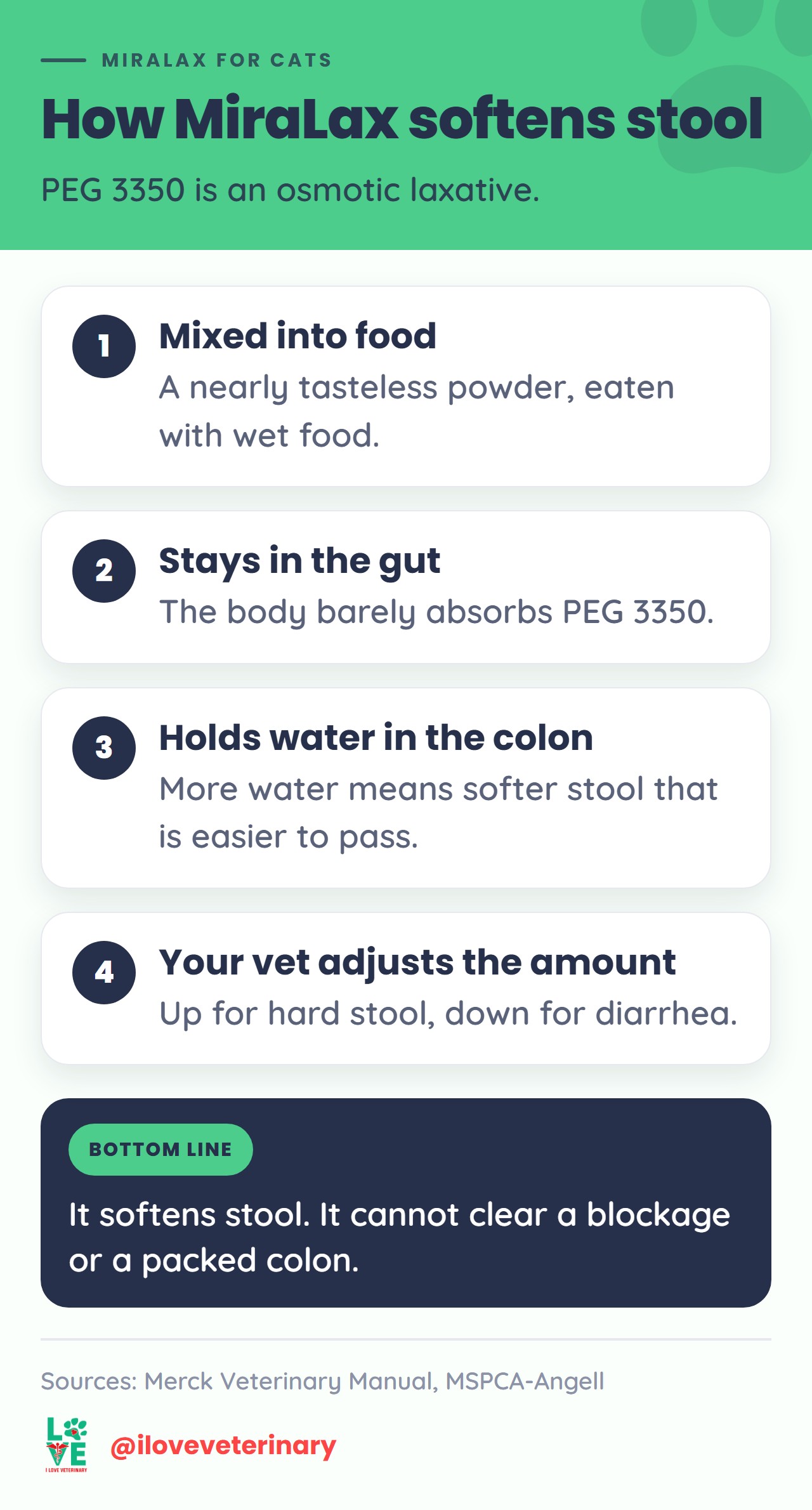
MiraLax is polyethylene glycol 3350, usually shortened to PEG 3350. It is an osmotic laxative: the gut barely absorbs it, so it stays in the bowel and holds water there. More water in the colon means softer stool that is easier to pass. It does not force the colon to contract the way stimulant laxatives do, which is one reason vets like it for cats that need help for weeks or months.
The Merck Veterinary Manual lists it alongside lactulose as an option for constipated cats. At MSPCA-Angell, emergency specialist Dr. Kiko Bracker notes it may be replacing lactulose in many practices, mostly because cats accept it. Lactulose's taste and texture make it hard to give, and that hurts follow-through at home.
Is it safe? In the only published safety study we found in cats, healthy cats ate it daily for four weeks without losing weight or appetite. That is reassuring, but it was six healthy cats, not constipated seniors with kidney disease. Your vet weighs your cat's own health before saying yes.
MiraLax Dosage Chart for Cats
For information only. These are typical published dose ranges, not a prescription and not medically verified for your pet. Your veterinarian sets the dose after examining your pet. Never start, stop or change a medicine without their OK.
Species | Use | Typical starting amount | Per kg / per lb | How often | Route | Source |
|---|---|---|---|---|---|---|
Cat (adult) | Constipation: softening stool, including long-term management of recurrent constipation | 1/8 to 1/4 teaspoon of PEG 3350 powder per cat, adjusted by your vet until the stool is soft | Not dosed by weight: the published starting amount is the same for any adult cat | Every 12 hours | By mouth, mixed into food |
Dose calculator · MiraLax (polyethylene glycol 3350)
MiraLax dose calculator for cats
Not a prescription. For information only. These are typical published dose ranges, not a prescription and not medically verified for your pet. Your veterinarian sets the dose after examining your pet. Never start, stop or change a medicine without their OK.
Only give what your vet prescribed.
All doses in this calculator
| Pet | Use | Typical dose | How often | Route | Source |
|---|---|---|---|---|---|
| Cat | Constipation: softening stool, including long-term management of recurrent constipation | 2 to 12 kg (4.41 to 26.5 lb): 1/8 to 1/4 teaspoon of PEG 3350 powder per cat (the same starting amount at any adult weight), adjusted by your vet until the stool is softExtra-label: your vet decides. Published sources give one amount per cat, not per kg or lb. Never use the bottle cap to measure: it holds a 17 g human dose. Kittens and cats outside 2 to 12 kg: ask your vet. | every 12 hours | by mouth, mixed into food | Merck Veterinary Manual (2025); MSPCA-Angell |
Only give what your vet prescribed, at the dose they set. Kittens are not covered: we found no published starting amount for them, so that decision is your vet's alone. The calculator covers adult cats from 2 to 12 kg (about 4.4 to 26 lb). That range is our choice, not a published limit; for a cat outside it, ask your vet.
Why there is no chart by weight
People search for a MiraLax chart by weight because most medicines scale with body size. This one, in published veterinary guidance, does not. Merck, MSPCA-Angell and internist Dr. Anthony Carr all describe a per-cat starting amount; Carr suggests 1/4 teaspoon twice daily as a starting point, inside the same range. Then the vet adjusts it, because the amount that works varies from cat to cat.
So a 10 lb cat and a 15 lb cat start in the same place. What changes the plan is the stool: hard stools mean the vet may raise the amount, diarrhea means they lower it. The calculator above shows the same range at any adult weight for that reason.
Two practical details trip people up:
- The cap is a human dose. The MiraLax bottle cap is marked to hold 17 grams of powder, the adult human dose on the label. A cat's starting amount is a small fraction of a measuring teaspoon. Use the measuring tool your vet tells you to.
- Check the label with your vet. Generic and store brands (GlycoLax, ClearLax and others) sell the same active ingredient, PEG 3350. Show your vet the exact product before you use it, so you both know what is in the bottle.
What the 2011 cat study found
The only published safety study of oral PEG 3350 in cats we found is small but useful. Tam and colleagues (2011) gave six healthy adult cats PEG 3350 mixed into their food twice a day for four weeks, adjusting each cat's amount to reach a soft but formed stool.
- They started at 1.9 g per meal and doubled it if nothing changed within 48 hours.
- The daily amount each cat settled on ranged from about 0.8 g to 3.8 g.
- Four of the six cats needed their amount lowered because of diarrhea.
- Every cat ate the medicated food, and none lost weight or ate less.
- One cat vomited now and then, with no link to the dose.
- Three cats had a mild rise in blood potassium, with no signs of illness.
Don't copy these study amounts as a dose. The study used PEG 3350 with added electrolytes (a product called Colyte), not MiraLax, and the cats were young and healthy. Its main lesson for owners is the spread: the right amount differs between cats by several times, which is why your vet titrates (adjusts step by step) instead of handing you a fixed number.
How Vets Have You Give It
MiraLax powder has almost no taste or smell, so most vets have owners mix it into a portion of wet food. MSPCA-Angell describes it this way, and the cats in the 2011 study ate it in their food without complaint. If your cat is a picky eater or eats dry food only, ask your vet or vet tech how they want it given. Don't improvise with syringes or broths.
Keep fresh water easy to reach. PEG 3350 pulls water into the gut, and a cat that does not drink enough can become dehydrated on it.
Track what comes out. Note how often your cat passes stool and how it looks. Your vet adjusts the amount from that report.
Side Effects of MiraLax in Cats
Most side effects come from the stool getting too soft. Reported in cats:
- Soft stool or diarrhea. The most common one, and a sign the amount needs lowering. High amounts cause diarrhea.
- Dehydration, especially in cats that do not drink much or that already lose water through kidney disease.
- A mild rise in blood potassium (hyperkalemia). It showed up in half the study cats, none of which showed signs of illness.
- Occasional vomiting, seen in one study cat.
People with a polyethylene glycol allergy are told not to take it; if your cat has ever reacted to a medicine, tell your vet.
Too Much MiraLax: Signs and When to Call
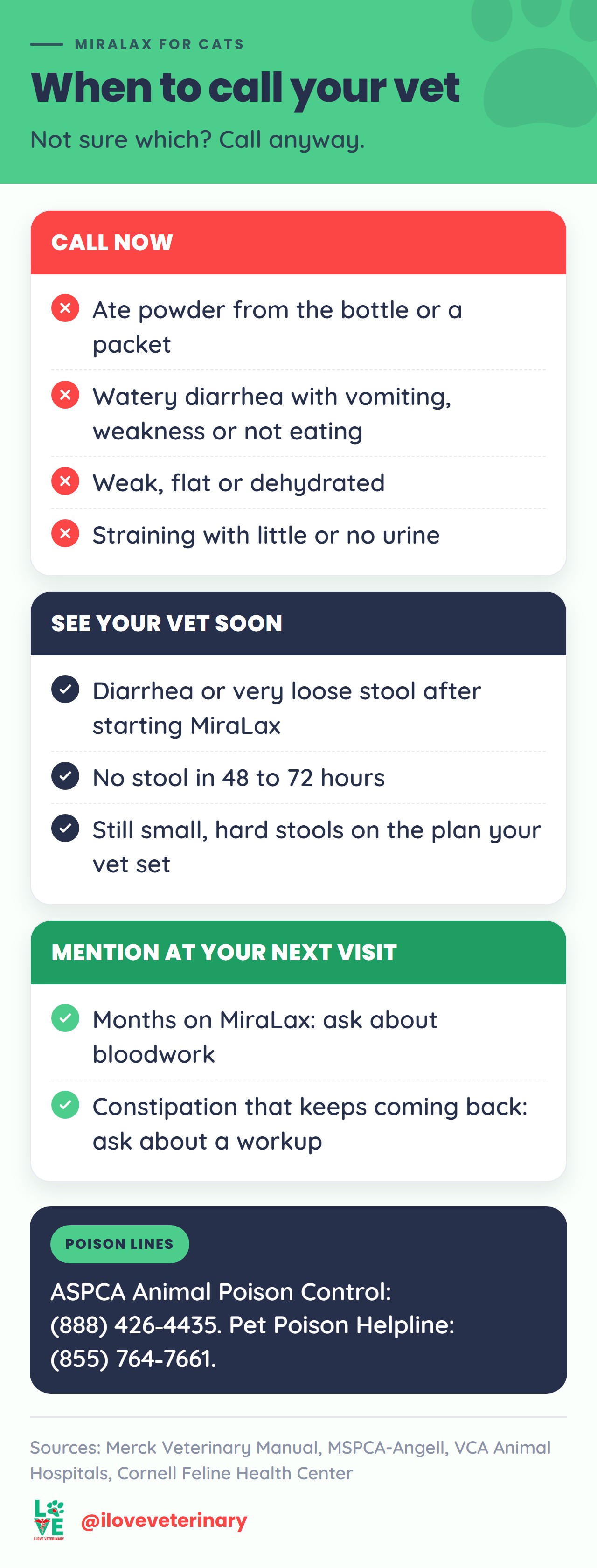
A cat that gets far too much, or gets into the bottle, can lose a lot of water through diarrhea. Use the tiers below.
Call now (your vet, an emergency clinic, or a poison line):
- Your cat ate a large amount of powder or chewed into a bottle or packet.
- Watery diarrhea with lethargy, refusal to eat, or repeated vomiting.
- Your cat seems weak, flat or dehydrated.
- Your cat strains and passes little or no urine. See the urinary blockage section below.
ASPCA Animal Poison Control: (888) 426-4435. Pet Poison Helpline: (855) 764-7661.
See your vet soon:
- Diarrhea or very loose stool after starting MiraLax.
- Still no stool, or only small hard stools, after the plan your vet set. VCA advises calling if a cat has not passed stool within 48 to 72 hours.
Mention at your next visit:
- Your cat has been on MiraLax for months. Ask whether bloodwork to check hydration and electrolytes makes sense.
- Constipation keeps coming back. Ask about a workup to find the cause.
Is It Constipation or a Urinary Blockage?
Rule this out before you think about any laxative. A constipated cat strains in the litter box, goes in and out, and may cry. It may pass small, hard, dry stools or none at all, and some cats eat less or vomit. A cat with a blocked urethra does much the same straining. VCA points out that constipated cats go in and out of the box much like cats with urinary problems, so from the outside the two are easy to confuse.
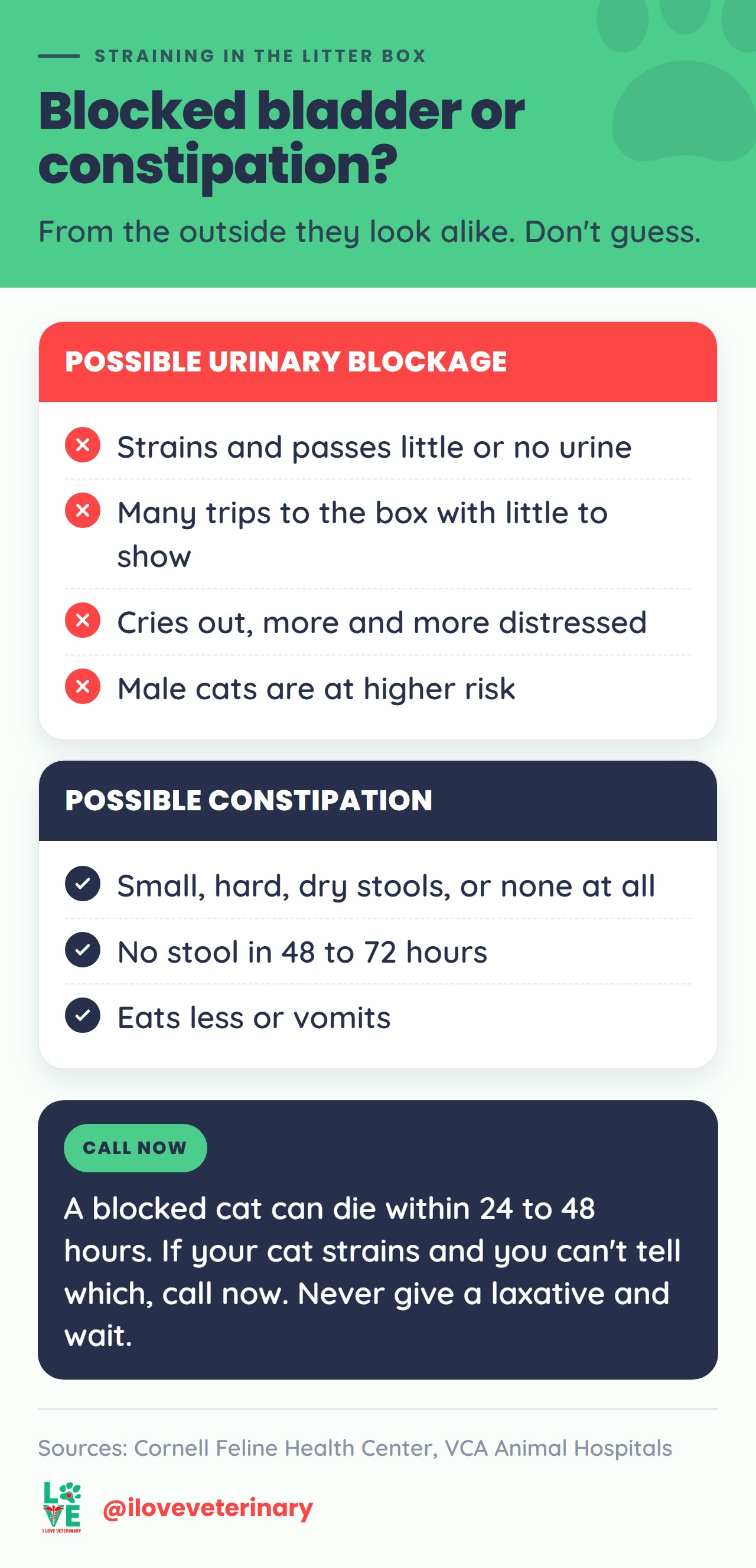
A urinary blockage is an emergency. Cornell's Feline Health Center warns that a completely blocked cat can die in less than 24 to 48 hours. Male cats are at higher risk because their urethra is longer and narrower.
Call now if your cat:
- strains and passes little or no urine;
- makes frequent trips to the box with little to show for it;
- cries out in pain or seems more and more distressed;
- is male and straining, and you cannot tell whether it is urine or stool.
Don't give MiraLax and wait to see. Learn more in our guide to feline lower urinary tract disease, and for the stool side, see how to help a cat with constipation.
When MiraLax Is Not the Right Choice
MiraLax softens stool the colon can still move. It cannot fix every cause of constipation, and in some cats it makes things worse.
- Dehydrated cats. Merck advises avoiding laxatives in dehydrated animals because they can deepen dehydration. Constipated cats can be dehydrated, so the vet rehydrates first, sometimes with IV fluids in the hospital.
- A possible blockage. If your cat may have swallowed string, a toy or bones, or has a mass or narrowed pelvis from an old fracture, the vet needs to rule out an obstruction before any laxative.
- Severe impaction (obstipation). When stool is packed so hard it cannot pass at all, a laxative at home will not shift it. Vets use enemas, removal under anesthesia, or a hospital-only PEG solution given slowly by feeding tube over many hours.
- Repeat constipation. Cats that keep getting constipated need a workup to find the cause. Merck recommends bloodwork including a thyroid level, a urinalysis, a neurological exam and imaging to find the cause. Megacolon, a stretched and weakened colon most often seen in middle-aged male cats, is a common one. Some cats eventually need surgery to remove part of the colon.

One warning for anyone thinking about a drugstore enema: phosphate enemas must never be used in cats. Merck warns they can cause severe, life-threatening electrolyte imbalances.
Cats That Need Extra Care
- Cats with kidney disease. Cats with chronic kidney disease are more prone to constipation in the first place, and they dehydrate easily, so fluid lost to a laxative hits them harder. The 2011 study authors recommend monitoring electrolytes and hydration in cats on PEG 3350, especially with kidney disease.
- Cats on diuretics or ACE inhibitors. These drugs also affect fluid and electrolytes; the same authors flag them for closer monitoring.
- Cats on other medicines. Some drugs, including opioids, diuretics and antihistamines, can cause constipation themselves. Give your vet the full list, supplements included, so they can judge timing and combinations.
Storage
Follow the product label: store the powder at room temperature, 68 to 77°F (20 to 25°C), and do not use it if the foil seal under the cap is missing, opened or broken. Keep it in the original container, out of reach of children and pets. If a pet gets into it, call your vet or the ASPCA Animal Poison Control Center.
Alternatives Your Vet May Suggest
MiraLax is one tool. Depending on the cause, your vet may start with or add:
- Diet and fiber. Merck calls fiber the preferred first step for mild constipation: a high-fiber or fiber-supplemented diet, or psyllium, wheat bran or pumpkin added to canned food. MSPCA-Angell notes some cats with advanced megacolon do better on low-residue diets instead, so ask before adding fiber.
- Lactulose, a prescription osmotic laxative and the one Merck rates as most effective of its group, though many cats dislike it.
- Cisapride, a drug that helps the colon contract. In the US it comes from compounding pharmacies.
- Hairball control for long-haired cats: regular grooming, hairball diets or hairball remedies.
- More water and movement. Wet food, easy access to fresh water, a clean litter box, weight control and play.
Your vet chooses the product and dose for each of these.
MiraLax for Cats: Quick Answers
Can cats take MiraLax long term?
Yes, under a vet's care. Vets use it as a daily stool softener for cats with recurrent constipation, and the authors of the 2011 study concluded it suits long-term use. Long-term use is also when hydration and electrolyte checks matter most.
How much MiraLax for a 10 lb cat?
The published starting range is the same for any adult cat: 1/8 to 1/4 teaspoon every 12 hours in food (Merck, MSPCA-Angell). Your vet confirms the amount and adjusts it for your cat.
How fast does MiraLax work in cats?
There is no good published answer for cats. In the 2011 study, vets waited 48 hours before increasing the amount. If your cat has not passed stool within 48 to 72 hours, call your vet.
Can I mix MiraLax with dry food?
Ask your vet. The sources describe mixing it into wet food, which hides it well and adds water.
The Bottom Line
MiraLax is a gentle, cat-friendly laxative that many vets use, but it is still a human drug used extra-label. The starting amount is small and per cat, the vet adjusts it, and the cap on the bottle is never the measure. And if your cat is straining, especially a male cat, rule out a urinary blockage before you think about laxatives.
Originally written by Dr. Catharina Hjorth. Updated by the I Love Veterinary editorial team.
Sources
- Merck Veterinary Manual: Constipation, Obstipation, and Megacolon in Small Animals (Collier, 2025)
- MSPCA-Angell: Feline Megacolon and Deobstipation (Bracker)
- dvm360: Constipation in cats (Proceedings) (Carr, 2010)
- Journal of Feline Medicine and Surgery: Safety and palatability of polyethylene glycol 3350 as an oral laxative in cats (Tam, Carr and Myers, 2011)
- Cornell Feline Health Center: Feline Lower Urinary Tract Disease
- VCA Animal Hospitals: Constipation in Cats
- DailyMed: MiraLax (polyethylene glycol 3350) Drug Facts label
- ASPCA Animal Poison Control Center
- Pet Poison Helpline
This article is for general information and is not a substitute for advice from your veterinarian.