

Cancer that starts in a dog's lungs is uncommon, but vets are seeing it more often than they did 20 years ago. The Merck Veterinary Manual puts that down to dogs living longer, better detection and, possibly, more exposure to cancer-causing agents in the environment. Far more common is cancer that began somewhere else, such as a bone or mammary tumor, and spread to the lungs. Where the cancer started decides which tests come next, whether surgery is an option and what the outlook is.
The signs are easy to mistake for something milder: a cough that won't go away, weight loss, low energy or faster breathing in an older dog. About one dog in four shows no signs at all. One sign is never something to wait on: a dog that is struggling to breathe needs a vet now.

Primary vs Metastatic Lung Cancer in Dogs
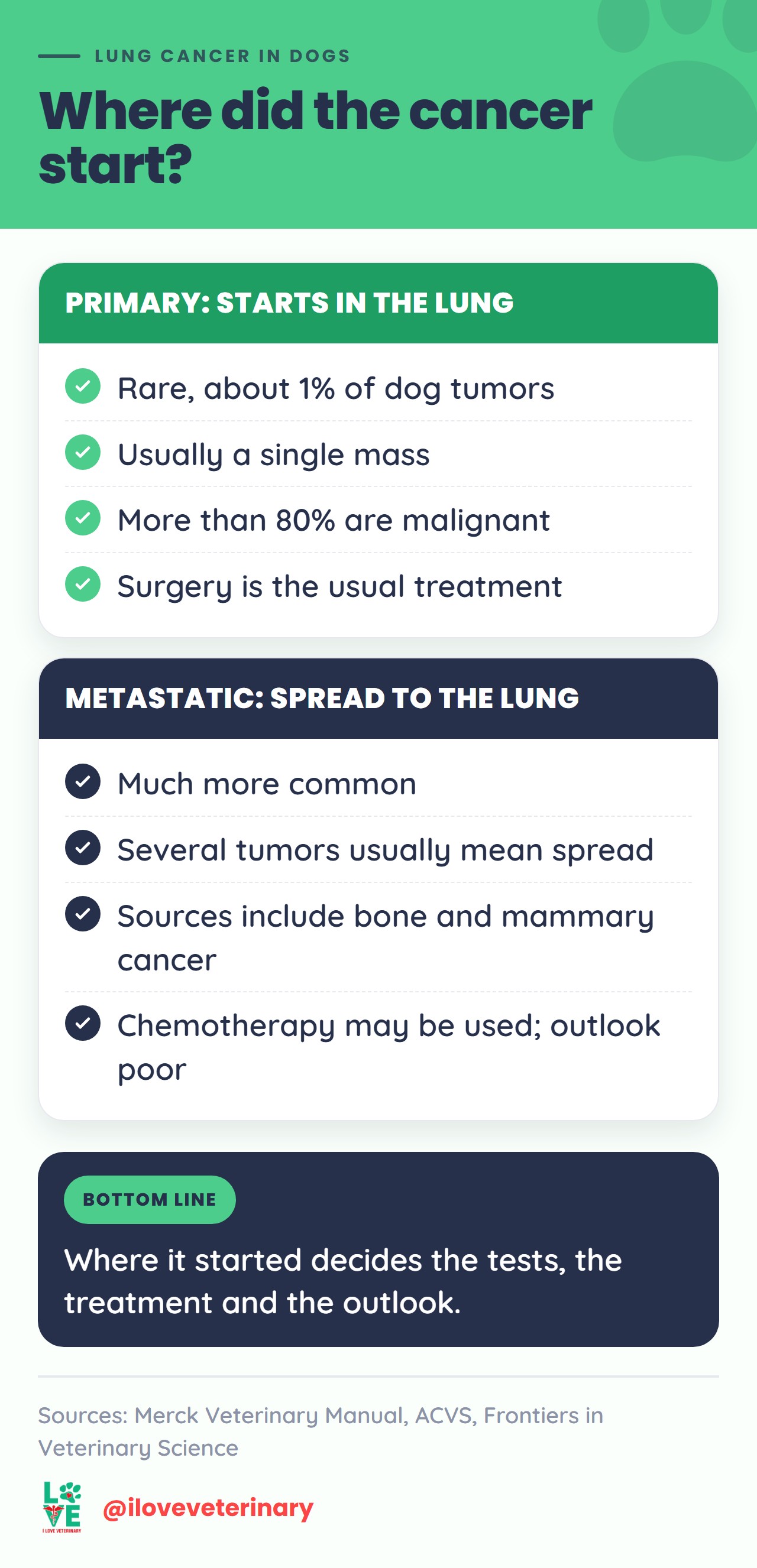
Primary lung cancer starts in the lung tissue itself. It is rare, about 1% of all canine tumors, according to a review in Frontiers in Veterinary Science, and Merck says more than 80% of primary lung tumors are malignant. It can spread to other parts of the lungs, the lymph nodes, bones and brain.
Metastatic lung cancer started in another organ and reached the lungs through the blood or lymph. Merck describes it as much more common in dogs than primary lung cancer. Bone cancer (osteosarcoma) and mammary cancer are familiar sources.
Most primary lung tumors are carcinomas that grow from the glands and cells lining the airways (adenocarcinoma or bronchogenic carcinoma). Less often a tumor grows from the lung's supporting tissue: the American College of Veterinary Surgeons (ACVS) lists fibrosarcoma, chondrosarcoma and hemangiosarcoma. Our explainer on carcinoma vs sarcoma in dogs covers what the names mean. Histiocytic sarcoma, a cancer of immune cells, can also form in the lung, most often in Bernese Mountain Dogs and Miniature Schnauzers (Frontiers review).
Not every lump in the lung is cancer. Benign growths and granulomas (pockets of inflammation) have been reported too, which is one reason vets want a sample before calling a mass cancer.
Which Dogs Get Lung Cancer?
Mostly older ones: Merck gives an average age at diagnosis of 10 to 12 years.
Breed risk is less settled. Merck says all breeds and both sexes appear to be equally affected. ACVS says flat-faced (brachycephalic) breeds such as Bulldogs and Pugs are at greater risk, and the Frontiers review names Boxers, Dobermans, Australian Shepherds, Irish Setters and Bernese Mountain Dogs among breeds that could be at higher risk. Treat a "high-risk breed" label as a reason for awareness, not worry.
The cause isn't known. ACVS says dogs living with smokers or around pollutants such as asbestos are at increased risk; the Frontiers review adds that the secondhand smoke link has not been conclusively proven in dogs. Keeping smoke away from your dog costs nothing either way.
Signs of Lung Cancer in Dogs
Merck lists coughing, weight loss, lethargy and labored breathing as the most common signs. Fever, wheezing and lameness can also appear, and coughing up blood is uncommon (3 to 9% of dogs in the Frontiers review).
Sign | What you may notice |
|---|---|
Cough | A chronic cough that lasts or keeps coming back |
Shortness of breath | Fast or labored breathing, sometimes open-mouthed or wheezy, even at rest. Collapse means call your vet immediately (Lap of Love) |
Lethargy | Less interest in usual activities and sleeping a lot |
Appetite loss | Eating less, leading to weight loss |
Regurgitation | Food coming back up soon after eating, when a large tumor presses on nearby structures (ACVS) |
Keep these in mind when you read that list:
- Many dogs show nothing. About 25% of dogs with a primary lung tumor have no signs (Merck, ACVS); their tumors turn up on chest X-rays taken for another reason.
- Cough points to primary cancer. In a study of 210 dogs with primary lung tumors, 52% were coughing. Merck notes coughing is less common when cancer has spread to the lungs.
- A limp can be a lung sign. Hypertrophic osteopathy, swelling and a bony reaction along the toes and lower leg bones, is linked to tumors in the chest (ACVS).
None of these signs is specific to cancer. Lung tumors can mimic bronchitis or heart failure (Lap of Love), and a cough has many other causes; see the most common reasons for a dog cough. That is exactly why a cough that lingers in an older dog deserves a vet visit rather than a guess.
When to Call Your Vet
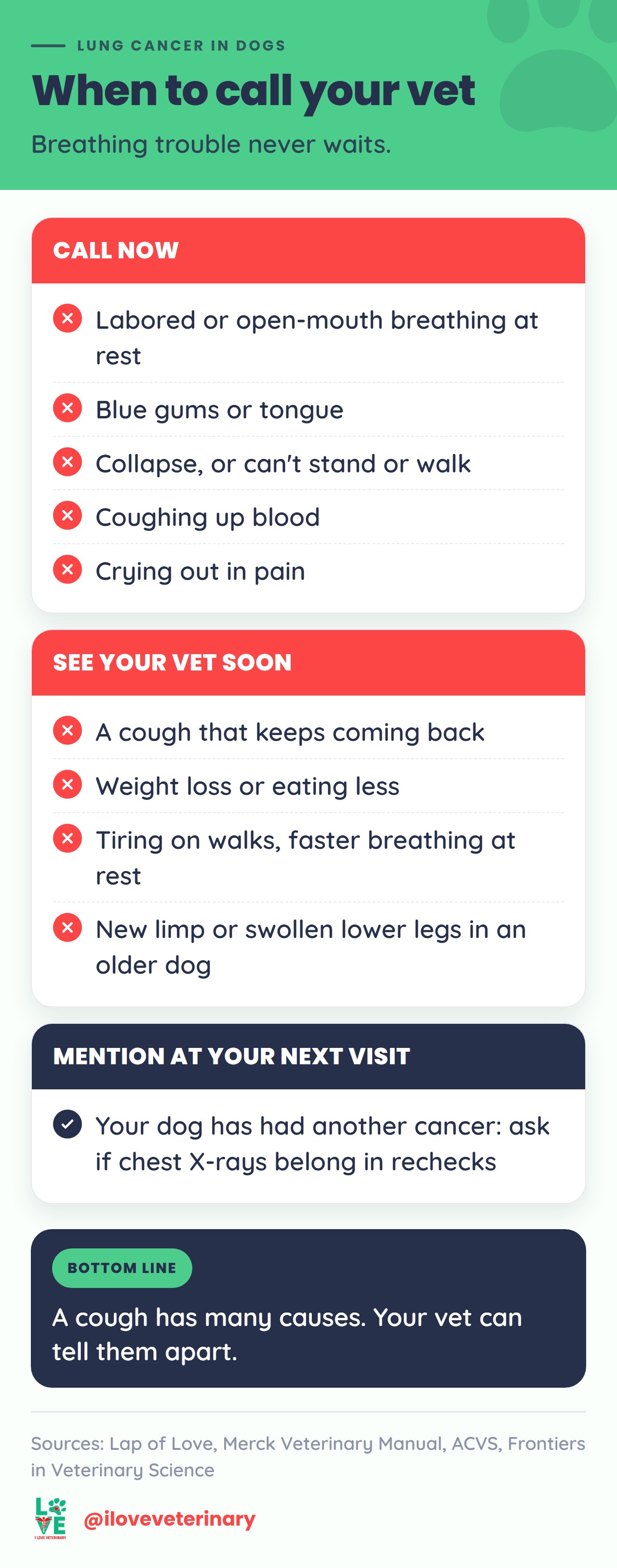
Call now:
- Labored breathing, or open-mouth breathing at rest
- Blue gums or tongue
- Collapse, or your dog can't stand or walk
- Coughing up blood
- Crying out in pain
Lap of Love advises contacting your veterinarian immediately for labored breathing, blue gums or tongue, collapse, inability to walk or crying out in pain. Coughing up blood is uncommon (Frontiers review) but always worth a call.
See your vet soon:
- A cough that keeps coming back
- Weight loss you can't explain, or a drop in appetite
- Tiring on walks, or faster breathing at rest than usual
- New lameness or swollen lower legs in an older dog
Mention at your next visit:
- Your dog has had another cancer, such as osteosarcoma or a mammary tumor: ask whether chest X-rays belong in the recheck plan.
How Vets Diagnose Lung Cancer in Dogs
Diagnosis answers three questions: is it a tumor, did it start in the lung, and has it spread? Your vet starts with a history and an exam, listening to the heart and lungs, counting the breathing rate and checking gum color.
Chest X-rays
Chest X-rays are the first imaging step; in the 210-dog study they were the method that most often led to the diagnosis. A primary tumor is usually a single mass, while several tumors usually mean cancer that spread from somewhere else (ACVS). If you're nervous about the visit, here is what to expect with dog X-rays.
X-rays have a real limit. ACVS notes that lung tumors are hard to see until they are about half an inch across, and Merck says more than 40% of dogs with metastatic lung tumors have tumors too small to see on X-rays. A clear chest film is good news, but it can't rule out small spread.
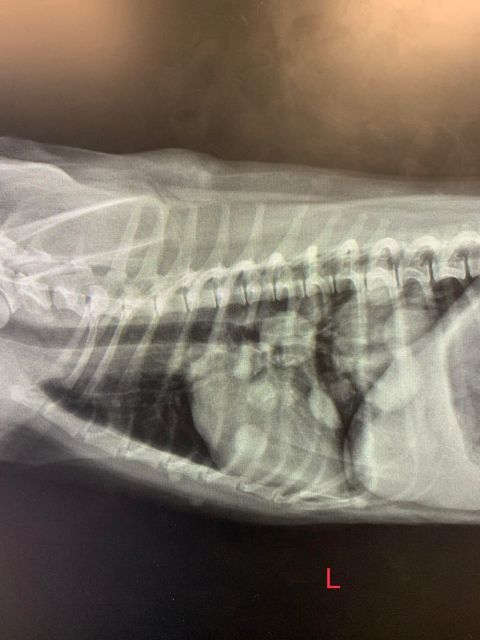
This clinical case shows how that plays out. The dog had osteosarcoma, a bone cancer. Chest X-rays before surgery in August 2023 showed no visible spread, and the affected leg was amputated.

Two months later, the same dog's X-rays showed obvious lung metastases. The spread was most likely already there in August as micrometastases, too small (under 1 cm) to see.

That is metastatic lung cancer, not primary. For the original tumor, see osteosarcoma in dogs and cats.
CT scan, samples and other tests
CT (computed tomography) finds smaller nodules than X-rays and gives a better look at the lymph nodes near the airways; the Frontiers review calls it the imaging method of choice for staging and surgical planning.
Imaging shows a mass, but only cells or tissue show what it is. A mass that is large or near the chest wall can often be sampled with a needle, and in some dogs the diagnosis is confirmed only after the tumor is removed. Blood and urine tests check for other illness that could affect anesthesia, and an abdominal ultrasound looks for a tumor elsewhere that may have spread to the lungs (ACVS). The Frontiers review says bronchoalveolar lavage, a wash of the airways, is not recommended for diagnosing lung tumors in dogs.
Staging Lung Cancer in Dogs
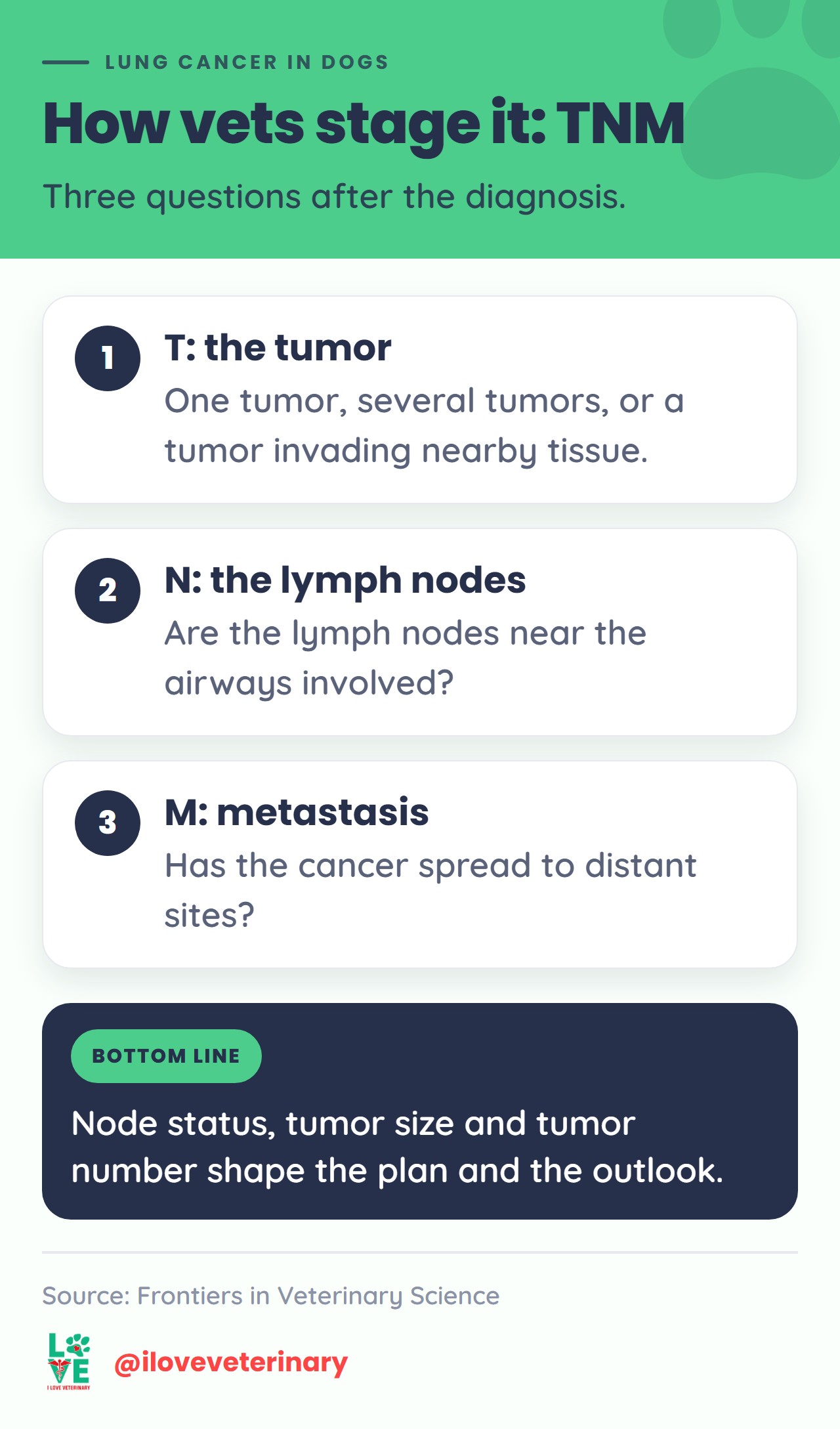
Staging describes how far the cancer has gone. Vets use a TNM system:
- T (tumor): a single tumor, several tumors, or a tumor invading nearby tissue
- N (nodes): whether the lymph nodes near the airways are involved
- M (metastasis): whether the cancer has spread to distant sites
Lymph node status, tumor size and the number of tumors are major prognostic factors, and they shape whether surgery makes sense (Frontiers review).
Treatment Options for Lung Cancer in Dogs
Treatment depends mainly on whether the cancer is primary or metastatic, how many tumors there are, the lymph nodes and your dog's overall health. Lap of Love recommends building the plan with your veterinarian and a veterinary oncologist.
Surgery for a single primary tumor
For a single primary tumor, Merck calls surgery the recommended treatment in most cases. The surgeon removes the affected lung lobe (lobectomy), usually with the nearby lymph nodes, through an incision in the side of the chest or, for some tumors, through small incisions with a camera (thoracoscopy).
Dogs stay in the hospital with a chest tube until they breathe well and their pain can be managed with oral medication, then rest at home while the incision heals. Anesthesia carries more risk in older dogs with lung disease, but ACVS notes that most dogs survive the surgery. Depending on the tumor type, chemotherapy may follow, and later chest X-rays check for recurrence.
When surgery isn't the main option
Multiple lung tumors usually mean metastatic disease (ACVS). Merck says tumors that can't be removed, or that have spread, may be treated with chemotherapy, and radiation may help with some tumor types. Some specialty centers offer stereotactic radiation, which aims high-dose beams precisely at the tumor. The Frontiers review notes that how well chemotherapy, targeted drugs and radiation work in canine lung cancer is still debated, so ask your oncologist what the realistic goal is: longer survival, slower growth or comfort. Your veterinarian or oncologist chooses any medication and dose.
Life Expectancy: What the Studies Report
These numbers are hard to read, so take them for what they are: averages or medians from published sources. A median means half the dogs in a study lived longer than that figure. Use them to guide the conversation with your vet, not as a forecast for your dog.
Situation | What the source reports | Source |
|---|---|---|
Single primary tumor, no lymph node spread | Average survival 12 months | Merck Veterinary Manual |
Lymph nodes involved, or several tumors present | Survival time shortened to 2 months | Merck Veterinary Manual |
Primary tumor removed, no sign of spread | Median survival 12 to 16 months | Lap of Love |
Lymph nodes clear vs lymph nodes involved | Median 285 to 452 days vs 26 to 167 days, across several studies | Frontiers review |
No signs at diagnosis vs signs at diagnosis | Median 545 days vs 240 days in one study | Frontiers review |
ACVS reports the best outlook for small, well-differentiated papillary carcinomas found before any signs appeared and with no lymph node spread. For metastatic lung cancer, Merck describes the outlook as poor, because spread to the lungs happens late in the course of a malignant tumor. Untreated survival has little published data: in one study cited in the Frontiers review, dogs with advanced primary lung carcinoma that received no treatment had a median survival of 60 days.
Caring for a Dog With Lung Cancer
Whether or not you choose treatment, comfort becomes the focus at some point. Lap of Love suggests easy access to food and water and a comfortable resting spot, giving prescribed medications consistently, no smoking indoors, and watching breathing rate and effort, gum color, appetite, energy and signs of pain. Check with your vet before giving any supplement or over-the-counter product, CBD included.
Deciding whether to treat is personal, and there's no single right answer. Talk with your vet early about quality of life and what you would want if breathing becomes hard, so decisions about hospice or euthanasia aren't made in a crisis.
Can Lung Cancer in Dogs Be Prevented?
There is no proven way to prevent primary lung cancer in dogs. What you can do:
- Keep your home smoke-free. ACVS calls not smoking the best prevention available, and smoke comes indoors on hair and clothing even when owners smoke outside.
- Ask your vet about spaying. Early spaying lowers the risk of mammary tumors, one of the cancers that can spread to the lungs.
- Keep up with checkups. Many lung tumors are found on X-rays before any signs appear, and dogs with no signs at diagnosis tend to do better.
FAQ
Do all dogs with lung cancer cough?
No. About a quarter of dogs with a primary lung tumor show no signs (Merck, ACVS), and coughing is less common when cancer has spread to the lungs from elsewhere.
How long can a dog live with lung cancer?
It depends mostly on where the cancer started and whether it has spread. Merck reports an average of 12 months for a single primary tumor with no lymph node spread, and 2 months when lymph nodes are involved or several tumors are present.
Originally written by Dr. Kaylee Ferreira. Updated by the I Love Veterinary editorial team.
Sources
- Merck Veterinary Manual (dog owners): Cancers and Tumors of the Lung and Airway in Dogs
- American College of Veterinary Surgeons: Lung Lobe Tumors
- Frontiers in Veterinary Science: Canine lung carcinoma, a descriptive review (Marcinowska et al.)
- Lap of Love Veterinary Hospice: Lung Tumors
- JAVMA: Classification of primary lung tumors in dogs, 210 cases (Ogilvie et al., 1989)
- Acta Veterinaria Scandinavica: Survey radiography and computerized tomography imaging of the thorax in female dogs with mammary tumors (Otoni et al., 2010)
This article is for general information and is not a substitute for advice from your veterinarian.