
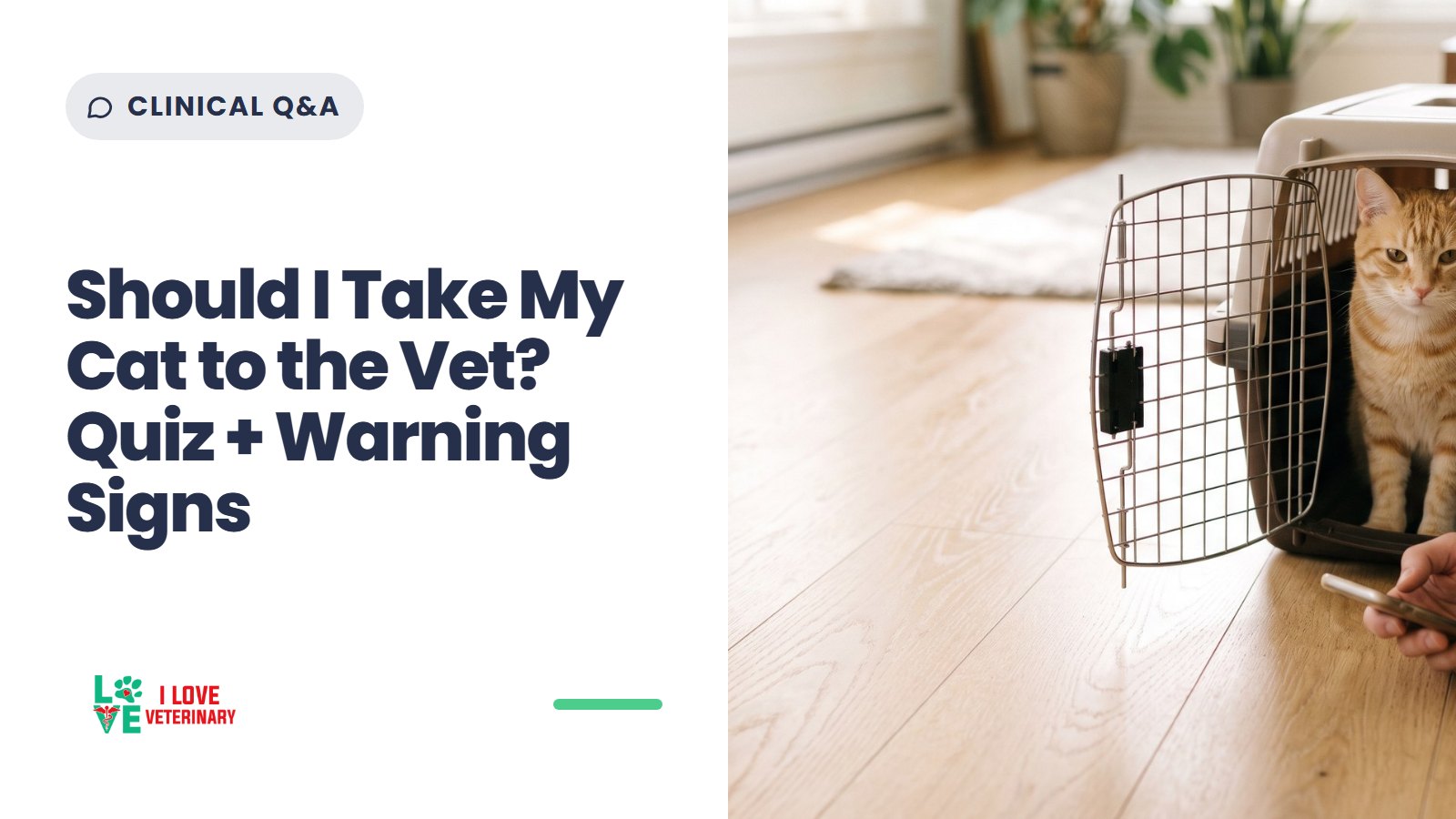
Cats are experts at hiding when they feel unwell, so it can be hard to know whether a change is a wait-and-see moment or a drive-to-the-clinic moment. Answer a few quick questions about what you're seeing and this checker will tell you how fast to get your cat to a vet.
Symptom checker · 11 questions · about 2 min
Should I take my cat to the vet?
Answer each question based on what you see right now. The most serious signs come first, and your result is based on the most urgent answer you give.
This checker is a guide to help you decide how fast to act, not a diagnosis, so call your vet any time you're unsure.
This checker is a guide to help you decide how fast to act, not a diagnosis, so call your vet any time you're unsure.
What you told us
How the checker sorts your answers
The checker does not add up points. It looks for the single most urgent thing you report and gives you that result, because one serious sign outweighs five reassuring ones. If nothing urgent comes up, it says so: keep watching, and call your vet if anything changes. Otherwise you land in one of three levels, and the sections below explain each one in plain words.
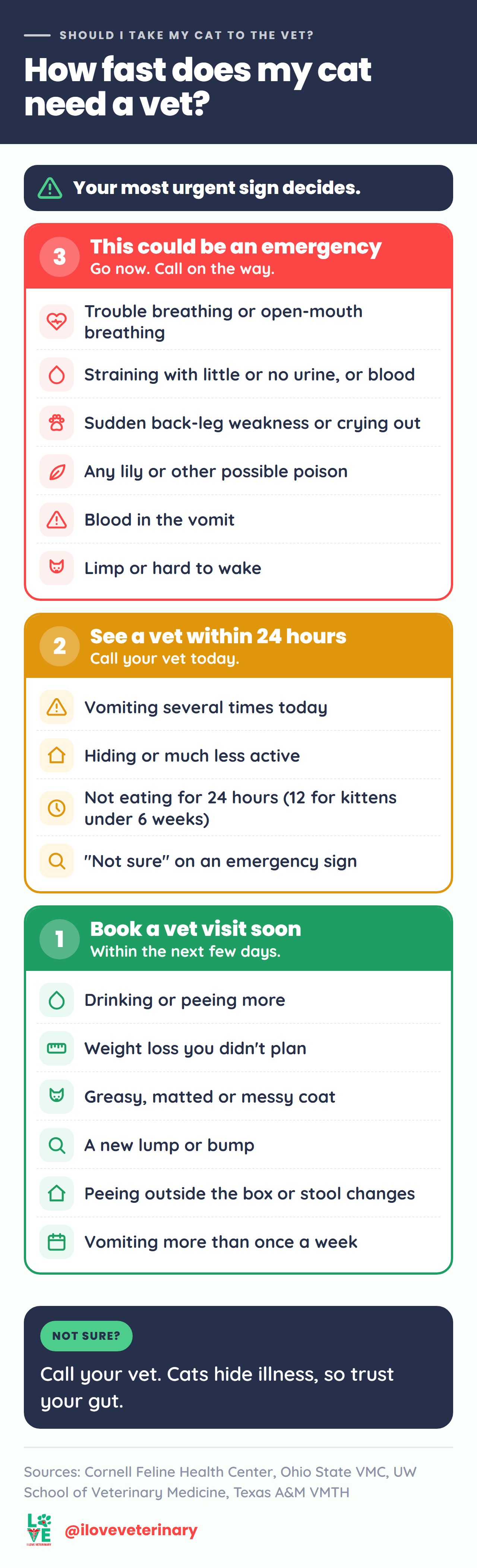
It is a guide to how fast to act, not a diagnosis. If your gut says something is wrong, call your vet whatever the result says.
This could be an emergency: go now
Call your vet or the nearest emergency clinic and head in if your cat has any of these:
- Trouble breathing. Labored or fast breathing while resting, or breathing with the mouth open. In cats this can mean fluid in or around the lungs, for example from heart disease.
- Straining in the litter box with little or no urine, or peeing blood. A blocked bladder (urethral obstruction) is an absolute emergency, and a fully blocked cat may die in less than 24 to 48 hours. Male cats, including neutered males, are at greater risk. Our guide to feline lower urinary tract disease explains the causes.
- Sudden back-leg trouble. Dragging the back legs, suddenly unable to use them, or crying out in pain. A blood clot from heart disease can block blood flow to the hind legs.
- Possible poisoning, even a little. Even a tiny amount of lily can cause life-threatening kidney failure in cats. Human painkillers such as acetaminophen, dog flea products and antifreeze are also dangerous. See our list of plants toxic to cats.
- Blood in the vomit.
- Limp, collapsed or hard to wake, or having a seizure.
- Pale, white or blue gums.
- Trauma, such as a fall from a height or being hit by a car.
- A sudden eye problem: an eye injury, or a squinting, red eye.
Don't wait to see if it passes. Call the clinic as you get ready so the team can prepare for your arrival.
See a vet within 24 hours: call today
These signs need a vet today. Call your regular clinic, and if they can't fit your cat in soon, ask them where to go instead.
- Vomiting several times today. Repeated vomiting wears a cat down quickly.
- Hiding or much less active than usual. A sudden drop in energy, or a cat who suddenly hides, can be a sign of pain or illness.
- Eating little or nothing for 24 hours. Not eating can seriously affect an adult cat's health in as little as 24 hours. For kittens under 6 weeks old, 12 hours without food can be dangerous.
- "Not sure" on any of the emergency signs above. If you can't tell whether your cat is straining or breathing fast, a vet needs to check today.
Vomiting that comes with lethargy, weakness or a poor appetite needs prompt attention, Cornell's Feline Health Center advises. And if things get worse while you wait, or your cat becomes limp or hard to wake, treat it as an emergency.
Book a vet visit soon
These are the quieter signs, the ones that are easy to explain away. None of them means waiting at home is fine. They mean booking a visit within the next few days and telling the clinic what you've noticed.
- Drinking more water or peeing more. These are common early signs of chronic kidney disease and diabetes. More on why a cat drinks a lot of water.
- Weight loss you didn't plan, especially if your cat is still eating well or is even hungrier than usual, a typical pattern in diabetic cats. Some diabetic cats also start standing or walking flat on their hocks (the back of the hind leg).
- A greasy, matted or messy coat. A cat who stops grooming is often unwell.
- A new lump, bump or a sore that won't heal. Only your vet can tell a harmless lump from one that needs treatment. See cat cysts and other lumps.
- Litter box changes: peeing outside the box, harder or softer stool.
- Vomiting more than once a week. Cornell's Feline Health Center recommends a vet check for cats who vomit that often. A hairball every week or two can be normal; regular vomiting is not. Our guide to why cats throw up covers the common causes.
If any of these get worse or new signs appear, call sooner.
Why cats are so hard to read
Cats rarely look sick until they are quite sick. The 2021 AAHA/AAFP Feline Life Stage Guidelines describe signs of illness and pain as "often difficult to detect in the sometimes reclusive or stoic cat." Some of the most serious feline conditions are quiet at first: many cats with hypertrophic cardiomyopathy (a common heart disease) don't appear ill, and cats with chronic kidney disease often show no obvious signs in the early stages.
That's why small changes in routine count. Watch for:
- eating or drinking more or less than usual
- changes in how and where they use the litter box
- grooming less, or over-grooming one spot
- weight loss or weight gain
- hiding more, or avoiding people or other pets
- any other change in their usual behavior, including in a senior cat who "is just getting old"
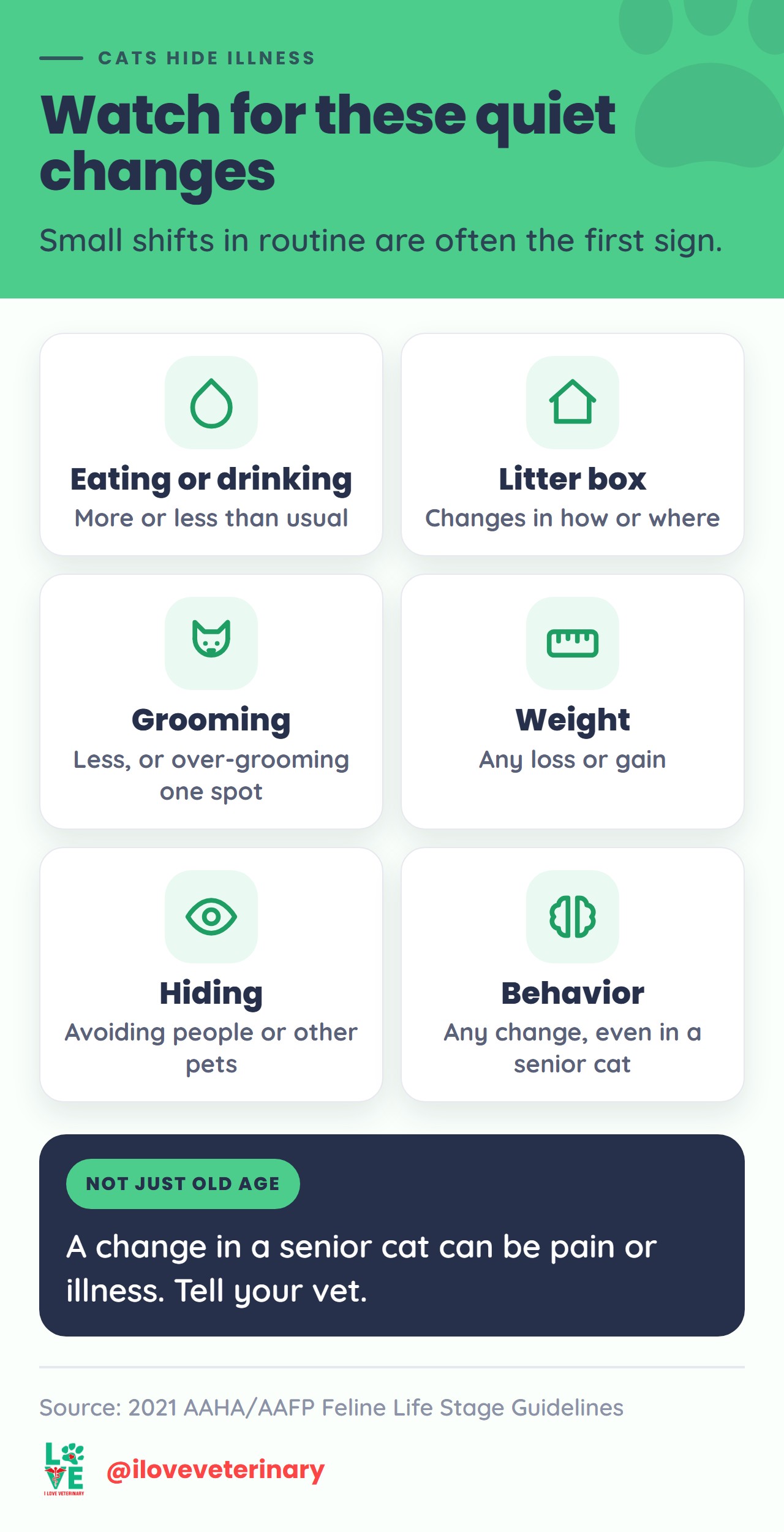
The guidelines specifically ask vets to teach owners that subtle behavior changes are not "just old age." A change you put down to age may be pain or illness, and that deserves a vet's look.
Pain can also show in the face. The Feline Grimace Scale, developed at the Université de Montréal, is a validated tool that both vet teams and cat owners can use to spot acute pain from changes in a cat's facial expression.
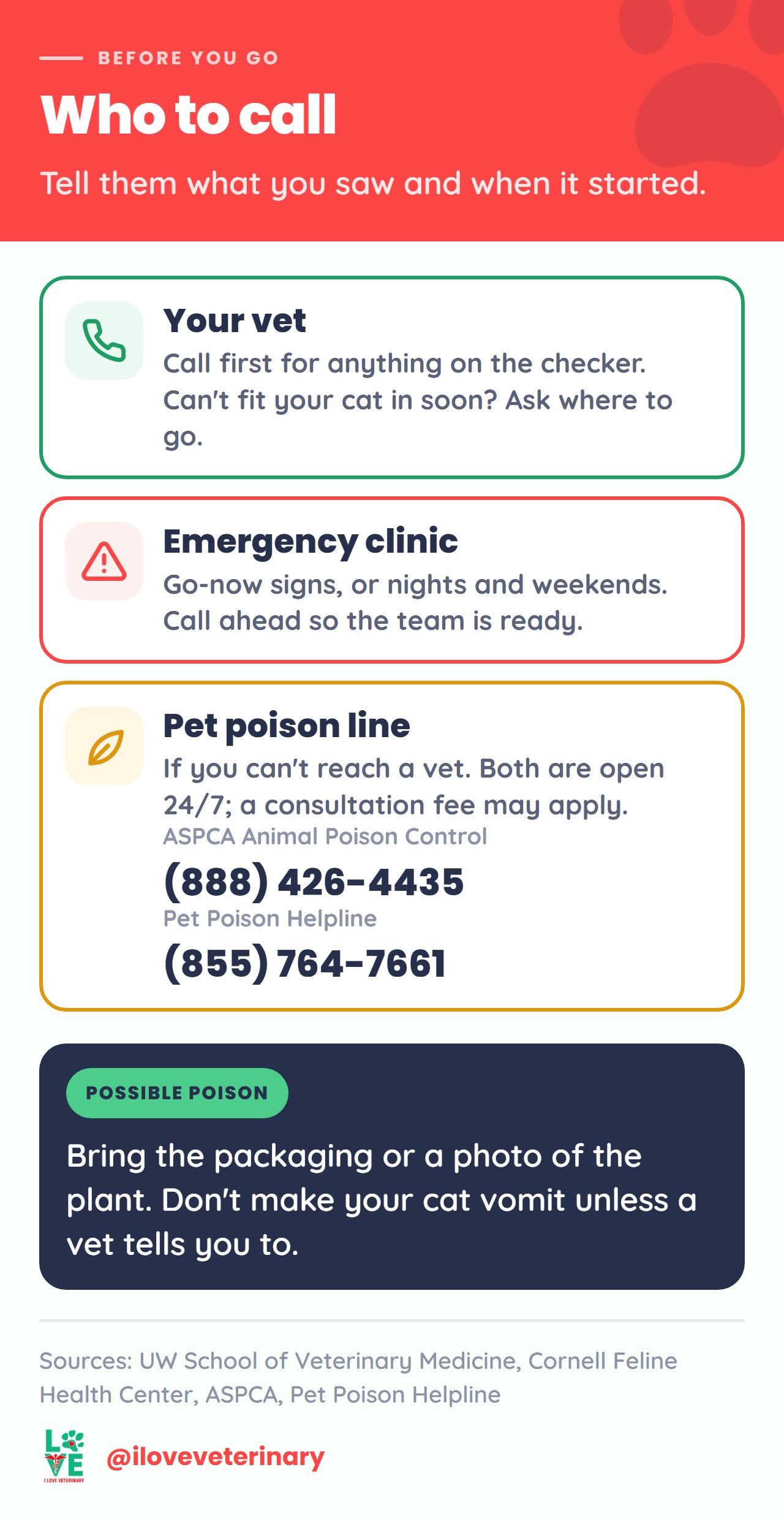
Before you go: what to tell the vet
A quick call makes the visit faster and safer.
- Call ahead, even for an emergency, so the team is ready.
- Say what you saw and when it started: how many times your cat vomited, the last time they peed or ate, when the limping began.
- If poison is possible, bring the packaging or a photo of the plant. Don't make your cat vomit unless a vet tells you to.
- If you can't reach a vet, call a poison line: ASPCA Animal Poison Control at (888) 426-4435 or Pet Poison Helpline at (855) 764-7661. Both are open 24/7, and a consultation fee may apply.
- Bring a list of any medicines or supplements your cat takes.
How often should a cat see the vet if they seem fine?
At least once a year for every adult cat, and at least every 6 months for seniors (10 years and older), per the 2021 AAHA/AAFP Feline Life Stage Guidelines. Because cats hide illness so well, a checkup gives your vet the chance to spot changes, such as weight loss, before your cat shows anything at home.
FAQ
Can I wait until morning?
Not for anything in the emergency list. A blocked bladder, breathing trouble or a possible lily exposure can't wait for regular clinic hours. For the "call today" signs, call tonight: your vet's after-hours line or an emergency clinic can tell you whether your cat needs to come in now.
My cat is hiding but still eating. Should I worry?
Sudden hiding is worth a same-day call even if your cat eats. Pain and illness often show up first as behavior changes, and a full bowl doesn't rule them out.
Is a hairball a reason to go to the vet?
An occasional hairball every week or two can be normal. Vomiting more than once a week, or vomiting with lethargy or less appetite, is a reason to call.
What if I can't afford a vet visit right now?
Call anyway, and mention cost at the start so the clinic can talk you through options. Cost is worth raising early, but it should never delay a call about an emergency sign. Our guide on what to do if you can't afford a vet lists low-cost clinics, vet schools and assistance funds.
Is there a version of this checker for dogs?
Yes. Try our dog vet checker.
Sources
- Feline Lower Urinary Tract Disease (Cornell Feline Health Center)
- Hypertrophic Cardiomyopathy (Cornell Feline Health Center)
- Common Cat Hazards (Cornell Feline Health Center)
- Vomiting (Cornell Feline Health Center)
- Anorexia (Cornell Feline Health Center)
- Chronic Kidney Disease (Cornell Feline Health Center)
- Feline Diabetes (Cornell Feline Health Center)
- Warning Signs of Cancer (Cornell Feline Health Center)
- Help! Is This a Pet Emergency? (AAHA)
- Emergency Medicine (Texas A&M Veterinary Medical Teaching Hospital)
- What Constitutes a Pet Emergency? (Ohio State University Veterinary Medical Center)
- When to Seek Emergency Care for your Pet (University of Wisconsin School of Veterinary Medicine)
- ASPCA Animal Poison Control (ASPCA)
- Pet First Aid client brochure (AVMA)
- 2021 AAHA/AAFP Feline Life Stage Guidelines (Journal of Feline Medicine and Surgery)
- Pet Poison Helpline
- Feline Grimace Scale (Université de Montréal)
This article is for general information and is not a substitute for advice from your veterinarian.