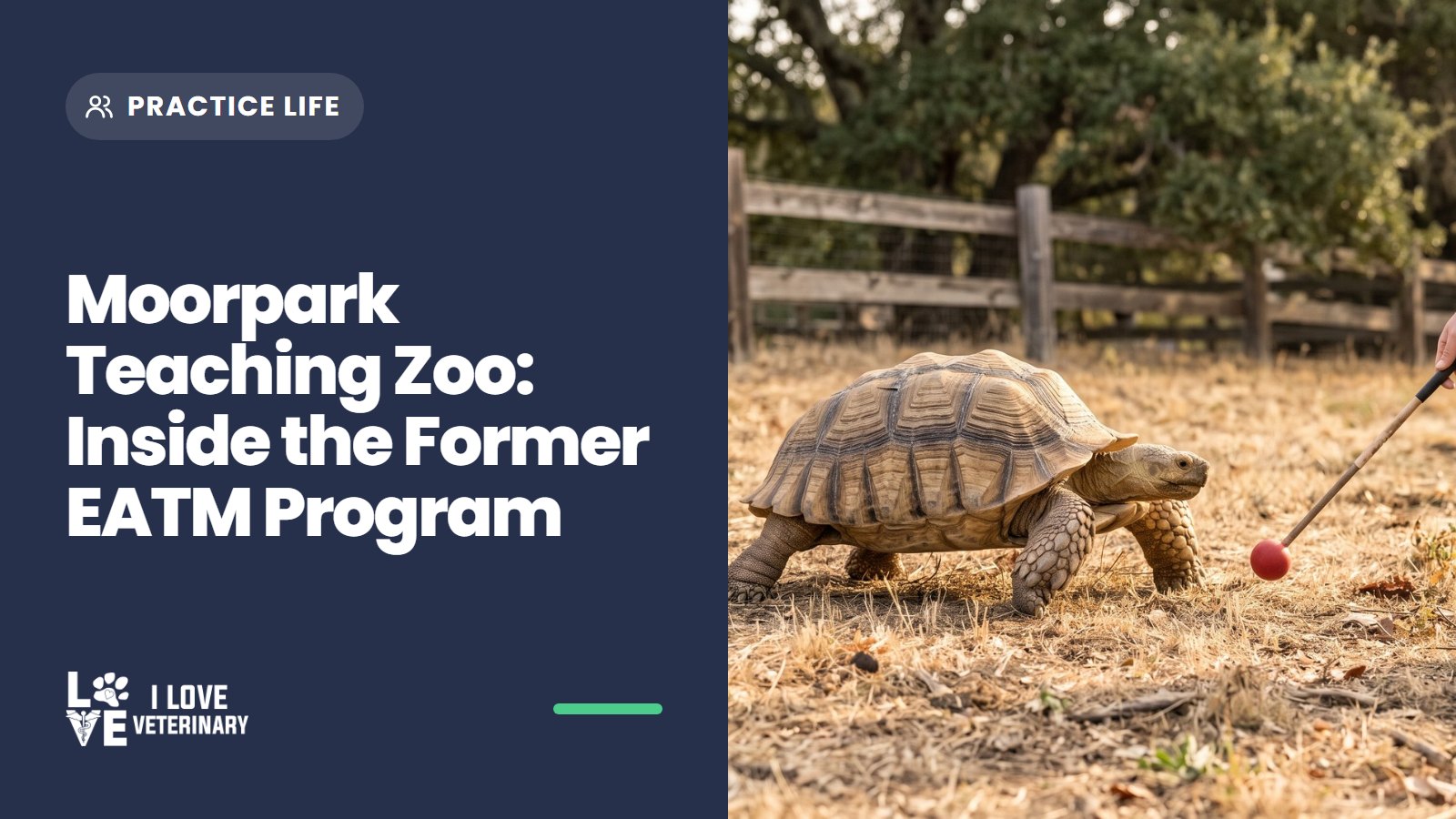
The Moorpark Teaching Zoo is a working zoo on the campus of Moorpark College in Moorpark, California, run largely by the students of the college's Animal Care and Training program. If you know it as EATM (Exotic Animal Training and Management) or as America's Teaching Zoo, you are in the right place: the program is now called Animal Care and Training (ANCT), and the zoo calls itself The Teaching Zoo at Moorpark College.
It is one of only two zoos in the United States located on a college campus, home to about 125 animals on 5 acres. We first featured it in 2021 in our Vet Clinic of the Week series, after a staff member nominated the zoo's veterinary team. Below is what prospective students and vet-team readers ask about now: what students do all day, what they learn about animal health, how to get in, and where it leads.

Quick facts
Zoo name today | The Teaching Zoo at Moorpark College (formerly known as America's Teaching Zoo) |
Program name today | Animal Care and Training (ANCT), formerly Exotic Animal Training and Management (EATM) |
Where | Moorpark College, 7075 Campus Road, Moorpark, CA 93021 (Ventura County) |
Started | A major since 1974, begun by professor Bill "Briz" Brisby with one animal, Kiska the wolf |
Current site | 5 acres on campus since 1990 |
Animals | About 125 (college figure) |
Program length | 22 months, one cohort a year starting in August |
Award | Certificate of Achievement in Animal Care and Training, or an Associate in Science degree with general education |
Admission | Application January 1 to March 15, then a random lottery |
Open to the public | Saturdays and Sundays, 11:00 am to 4:30 pm |
The Los Angeles Times reported in 2025 that the zoo had 120 animals of 110 species, and named the only other collegiate teaching zoo in the country: Santa Fe College Teaching Zoo in Gainesville, Florida.

What students do at the Teaching Zoo
The college calls the zoo the program's "living classroom", and the label fits. Students run the daily care of the collection alongside a small professional staff, on top of a full class load.
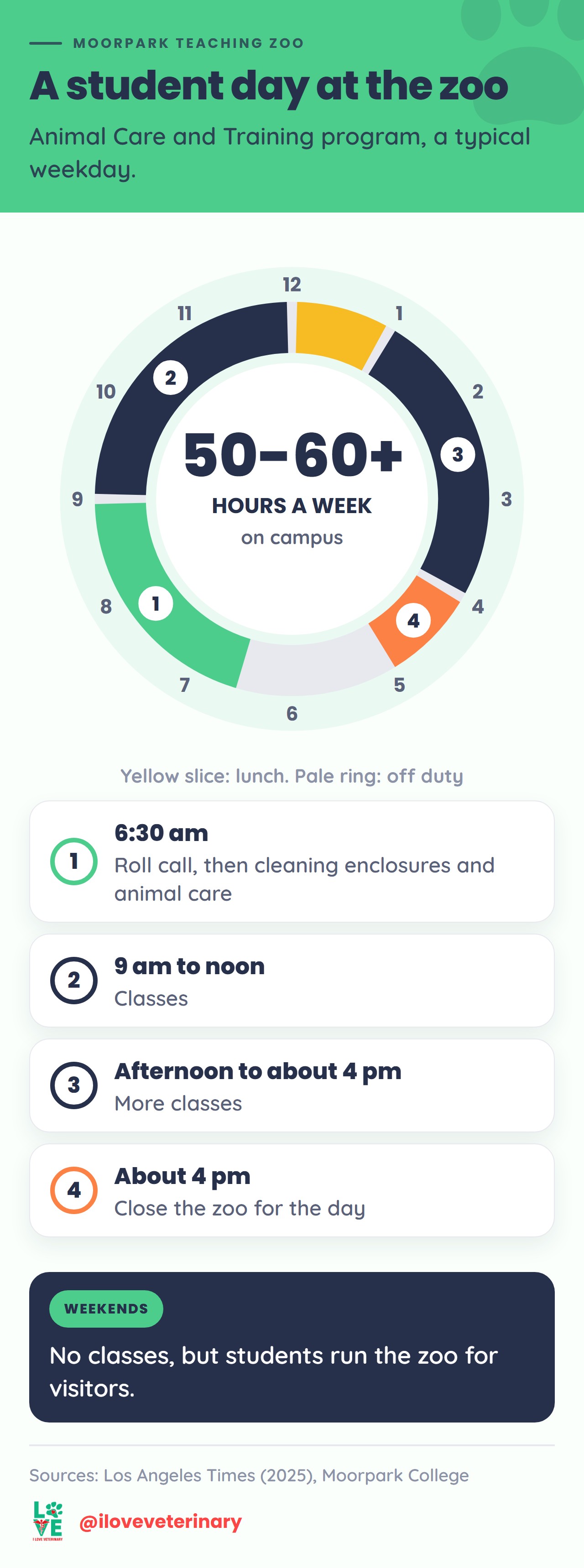
A typical day, as the Los Angeles Times described it in 2025, starts with roll call at 6:30 am, then cleaning enclosures and other animal care tasks. Classes run from 9:00 am to noon and again after lunch until about 4:00 pm, when students start closing the zoo for the day.
Weekends bring no classes, but students operate the zoo for visitors, including the training demonstrations, keeper talks and student-run wildlife presentations. Each student does a stint with carnivores, herbivores, birds and primates, so everyone ends up caring for animals they would not have picked. Inside Higher Ed reported in 2022 that each student is responsible for a set of animals every semester; one second-year student's list ran from a coyote and a porcupine to a gibbon.
The college says students typically spend about 50 to 60 or more hours a week on campus. Because the animals need care every day, Inside Higher Ed added, students get only about three days off a month and often work holidays.

What students learn about animal health
ANCT is an animal care and training program, but a lot of it touches what vet teams do every day. The 2026-2027 college catalog lists these courses in the certificate:
- Animal Health and Safety (ANCT M18)
- Elementary Veterinary Care I and II, with a lab (ANCT M23A, M23AL, M23B)
- Anatomy and Physiology of Mammals (ANCT M12)
- Animal Nutrition (ANCT M19)
- Avian and Herptile Care (ANCT M24), for birds, reptiles and amphibians
- Animal behavior, animal care and handling, animal training, wildlife conservation and wildlife education, with labs
The program page is frank about the medical side. Students sometimes nurse sick animals, including giving medications. They may help evaluate the quality of life of geriatric or sick animals and may assist with humane euthanasia, which the program says it helps students process. Close contact with exotic species also carries a real risk of zoonotic disease (infections that pass between animals and people).
The part vet techs will appreciate most is the training. The program emphasizes operant conditioning, which means teaching animals with rewards, and much of that training goes into husbandry behaviors: behaviors that let animals take part in their own care. Inside Higher Ed watched a 2022 final in which a student had trained a hyena named Kadogo to present her paw for a blood draw, rewarded with her favorite ground meat. Other students showed they could brush a miniature horse's teeth or ask a porcupine to stand up so her belly could be checked. A cooperative patient is a safer one, for the animal and for the people treating it.

How to get into the program
Admission to ANCT is separate from admission to Moorpark College, and you need both. Here is the process as the college lays it out (dates are "subject to change", so check the program page before you plan around them):
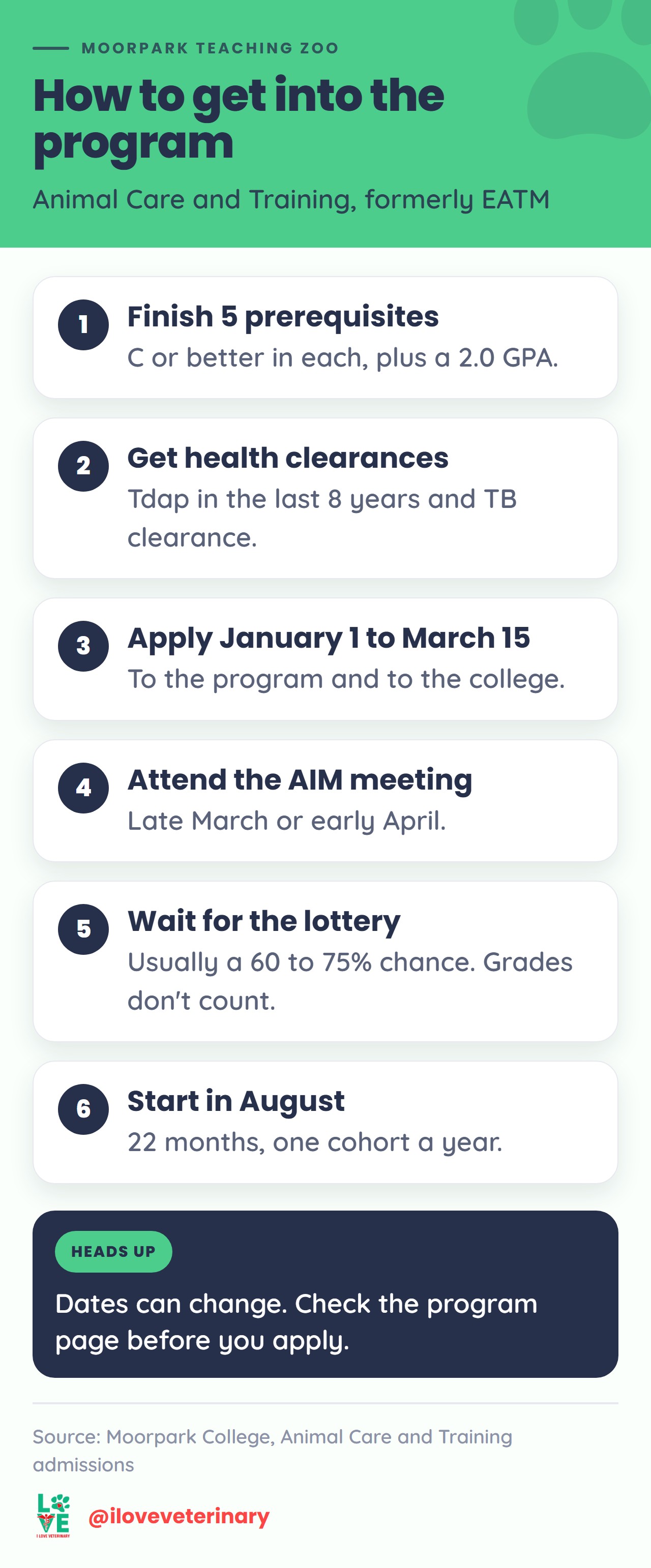
- Finish the prerequisites. Five courses with a "C" or better at an accredited college: biology or zoology with a lab, freshman English composition, public speaking (an acting class also counts), a college math course (or a listed equivalent), and a safety and/or first aid course. You also need a 2.0 cumulative GPA. Up to 2 courses can still be in progress when you apply, with transcripts due by June 30.
- Get your health clearances. Proof of a Tdap vaccine given in the last 8 years and tuberculosis clearance.
- Apply between January 1 and March 15. Submit the online ANCT application, apply to Moorpark College, and send your transcripts. Everything has to be in by March 15.
- Attend the Applicant Information Meeting (AIM) in late March or early April. Only applicants with complete files by March 15 are invited.
- Wait for the lottery. Selection is random, not based on grades, experience or education. The college says the chance of admission is usually about 60 to 75 percent, and an alternate list fills any spots that open up.
- Accept by June 1 and start in August. Classes start in the second week of August, and the program runs 22 months.
A few program courses (Applied Wildlife Conservation, Animal Behavior and its lab, and Animal Diversity) can be taken at Moorpark before you start, still with a "C" or better. The college notes that about 40 percent of students already hold an associate degree and 25 percent a bachelor's, and ages range from 18 to 50 and up.
Is it right for you? The honest demands
The college publishes its own list of what the program asks of students, and it is worth reading before you apply:
- Time: a continuous two-year commitment and about 50 to 60 or more hours a week on campus. Holding a regular job at the same time is hard.
- Grades: a "C" in every required course, or you are dismissed from the program.
- Physical work: lifting up to 50 pounds, working outdoors in heat, cold and rain, and walking about 3 to 6 miles a day around the zoo.
- Safety: the zoo houses potentially dangerous animals, and the rules are strict.
- People skills: students present animals to large crowds in wildlife education shows, and almost all zoo work is done in teams.
- Housing and costs: Moorpark College has no on-campus housing, and there are extra costs for uniforms, books, trips and internships. The college's cost page lists its current estimates.
Not everyone makes it through. The Los Angeles Times reported in 2025 that about 150 people apply each year, the program admits 60, and about 45 graduate.

Certificate or associate degree
Everyone who completes the program earns a Certificate of Achievement in Animal Care and Training (60.5 to 61 units in the 2026-2027 catalog). Students who also complete Moorpark's general education requirements earn an Associate in Science degree. The college warns that fitting general education classes into the program is tough, so many students finish them first.
Where graduates work
The catalog describes entry-level jobs in zoos, oceanariums, animal parks, government facilities, wildlife rehabilitation centers and the entertainment industry. Part of the program is a set of internships the college calls "Projects", and the Los Angeles Times reported that the program has relationships with more than 100 zoos and other facilities it can tap for them.
The same report gave real examples: zookeeping, animal training for film and TV, wildlife conservation, and even flying hawks to keep pests away at landfills. One 2023 graduate now works with dolphins after an internship the college helped arrange. If you want exotic work from the vet side, see our list of exotic externship sites for vet techs.
ANCT, vet tech or zoo vet: which path?
Many people find this program while looking for a veterinary job with exotic animals. The three routes train you for different work.
Path | What it trains you for | Where to learn more |
|---|---|---|
ANCT at Moorpark | Animal care, husbandry, training and wildlife education in zoos, parks and similar facilities | Moorpark College program pages |
Veterinary technician | Nursing, anesthesia, lab, imaging and other technical medical care under a veterinarian, with credentialing rules set by each state | |
Zoo veterinarian | Diagnosis, surgery and preventive medicine for a zoo collection, after vet school |
ANCT is an animal care and training credential, not a veterinary technology degree. If you want to be a credentialed vet tech who works in a zoo, start with the vet tech route. If you want to be the person who trains the animals to cooperate with that vet tech, Moorpark is built for exactly that.
From the 2021 nomination: the zoo's vet team
This post began as a Vet Clinic of the Week nomination, written by a member of the zoo's staff in early 2021. At the time, a veterinarian and two registered veterinary technicians (RVTs) cared for the collection. Staffing may have changed since; the college does not list its veterinary staff online.
The nominator wanted the team recognized for "the most amazing, tireless work" with a large exotic collection and about 100 students. What stood out:
- The team checked on every animal every day and had to know each one's normal behavior, because exotics hide illness. In the wild, as the nominator put it, any sign of vulnerability can make an animal prey.
- The zoo was known for its geriatric collection, many of them retired from other facilities or confiscated as illegal pets. The Los Angeles Times described the same pattern in 2025, including a tiger confiscated from a private owner.
- Because students train the animals for husbandry behaviors, the zoo's hyena had learned to cooperate with a voluntary jugular blood draw, "making our Vet and RVTs job much easier!"
- Staff bought the RVTs lunch, gave them presents and made them posters during Vet Tech Appreciation Week. For a team that treats camels, big cats and hyenas, a Real Vet Techs Treat More Than One Species mug would fit right in.
And on whether their patients have pet insurance: "No insurance in the zoo world!"
Visiting the Teaching Zoo
The zoo is open to the public on Saturdays and Sundays from 11:00 am to 4:30 pm, with last ticket sales at 3:45 pm. The zoo recommends buying tickets in advance and accepts cards only. The daily schedule includes a training demonstration, keeper talks, a student-run wildlife presentation in the Wildlife Theater and an afternoon feeding demonstration. Residents include Neil and Karma, the Bengal tigers at Rajah's Retreat, Ira the African lion, and Clarence, a Galapagos tortoise the zoo lists as 102 years old.
Pets are not allowed on zoo grounds (service dogs are welcome under the zoo's guidelines), and weekend parking is free. For tickets, events and the current schedule, see the zoo's website. Prospective students can request a tour; the college suggests a weekend, when students run the show.
FAQ
Is EATM the same as Animal Care and Training?
Yes. Moorpark College renamed the Exotic Animal Training and Management (EATM) program to Animal Care and Training (ANCT). Alumni and many websites still use EATM.
Is it a vet tech program?
No. It trains students in animal care, husbandry, training and wildlife education, and includes elementary veterinary care courses. To become a credentialed vet tech, follow the vet tech route in the comparison above.
Can I volunteer at the zoo?
The zoo runs an adult volunteer program (18 and over, with 12 hours of training), but it has paused new volunteer applications for now. Check the zoo's volunteer page for when it reopens.
Sources
- Moorpark College: Animal Care and Training Program
- Moorpark College: About the Program, admissions and FAQs
- Moorpark College: Demands of the ANCT Program
- Moorpark College: Prerequisite requirements
- Moorpark College: Financial considerations and estimated costs
- VCCCD Catalog 2026-2027: Animal Care and Training, Certificate of Achievement
- VCCCD Catalog 2026-2027: Animal Care and Training, Associate in Science
- The Teaching Zoo at Moorpark College: Plan Your Visit
- The Teaching Zoo at Moorpark College: Volunteer
- Inside Higher Ed: Lions and Tigers and Porcupines, Oh My! (December 2022)
- Los Angeles Times via Tribune News Service: Teaching zoo trains students for animal careers (November 2025)
- The 2021 Vet Clinic of the Week nomination submitted to I Love Veterinary by a member of the zoo's staff