
A 5-year-old dog is about 36 in human years if it is small, medium or large, and about 45 if it is a giant breed. A 1-year-old is already around 15, which goes some way to explaining the chewed shoes.
So the old "multiply by 7" rule is off at both ends. It makes young dogs too young, and it treats a Chihuahua and a Great Dane as if they age at the same speed. Enter your dog's age and size below for its number, or read it off the chart.
Dog age calculator
How old is your dog in human years?
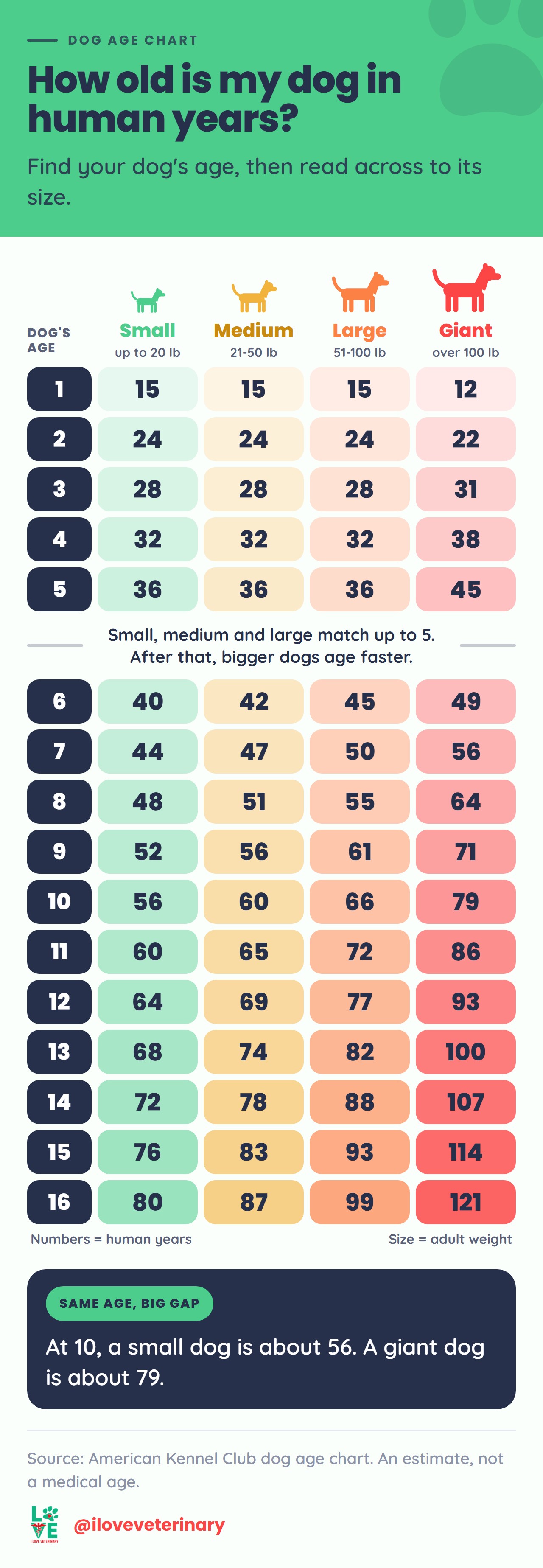
The full chart, ages 1 to 16
| Dog age | Small20 lb or less | Medium21 to 50 lb | Large51 to 100 lb | Giantover 100 lb |
|---|---|---|---|---|
| 1 | 15 | 15 | 15 | 12 |
| 2 | 24 | 24 | 24 | 22 |
| 3 | 28 | 28 | 28 | 31 |
| 4 | 32 | 32 | 32 | 38 |
| 5 | 36 | 36 | 36 | 45 |
| 6 | 40 | 42 | 45 | 49 |
| 7 | 44 | 47 | 50 | 56 |
| 8 | 48 | 51 | 55 | 64 |
| 9 | 52 | 56 | 61 | 71 |
| 10 | 56 | 60 | 66 | 79 |
| 11 | 60 | 65 | 72 | 86 |
| 12 | 64 | 69 | 77 | 93 |
| 13 | 68 | 74 | 82 | 100 |
| 14 | 72 | 78 | 88 | 107 |
| 15 | 76 | 83 | 93 | 114 |
| 16 | 80 | 87 | 99 | 121 |
Source: American Kennel Club dog age chartA chart estimate, not a medical age. Breed, genes and health matter too, and other published charts give lower numbers for the first few years.
Don't know your dog's age? Here is how to tell a dog's age from its teeth, eyes and coat.
Dog age chart: human years by size
Find your dog's adult weight, pick the column, then read across from its age. The chart is from the American Kennel Club, which sorts dogs into four sizes by adult weight: small (20 lb or less), medium (21-50 lb), large (51-100 lb) and giant (over 100 lb).
Dog's age | Small | Medium | Large | Giant |
|---|---|---|---|---|
1 | 15 | 15 | 15 | 12 |
2 | 24 | 24 | 24 | 22 |
3 | 28 | 28 | 28 | 31 |
4 | 32 | 32 | 32 | 38 |
5 | 36 | 36 | 36 | 45 |
6 | 40 | 42 | 45 | 49 |
7 | 44 | 47 | 50 | 56 |
8 | 48 | 51 | 55 | 64 |
9 | 52 | 56 | 61 | 71 |
10 | 56 | 60 | 66 | 79 |
11 | 60 | 65 | 72 | 86 |
12 | 64 | 69 | 77 | 93 |
13 | 68 | 74 | 82 | 100 |
14 | 72 | 78 | 88 | 107 |
15 | 76 | 83 | 93 | 114 |
16 | 80 | 87 | 99 | 121 |
Ages in human years. Source: American Kennel Club.
A few things the table doesn't tell you:
- It's an estimate. No chart can say how a single dog is aging, and breed, health and lifestyle all move the real number.
- Mixed breeds go by size. Use your dog's adult weight, not a guess at the breed mix.
- Charts disagree most in the first few years. At least one widely shared chart, credited to a veterinarian, puts a 1-year-old at around 7 human years. From about age 6 on, it lands within a year or two of this one.
Why "1 dog year = 7 human years" is wrong
The 7-year rule has been the popular math since the 1950s. The AKC's best explanation for it is simple division: people lived to about 70, dogs to about 10. A Kansas State University veterinarian told the Wall Street Journal he suspected it started as a way to get owners to bring their pets in at least once a year. Whatever its origin, it isn't biology.
Dogs grow up fast and then slow down. The AVMA's rule of thumb, as quoted by the AKC, goes like this for a medium-sized dog:
- The first year equals about 15 human years.
- The second year adds about 9, so a 2-year-old is about 24.
- Each year after that adds about 5.
That rule and the AKC chart are close but not identical: for a medium dog at 5, the rule gives 39 and the chart gives 36. Both are honest estimates, which is the point. Here is how far apart the common methods land for the same 5-year-old dog:
Method | 5-year-old dog in human years |
|---|---|
Times 7 | 35 |
AKC chart (small, medium, large) | 36 |
AKC chart (giant) | 45 |
AVMA rule of thumb (medium dog) | 39 |
UCSD DNA formula (Labradors) | about 57 |
The 7-year rule only looks right at 5 by coincidence. At age 1 it says 7 when the chart says 15, and at 10 it says 70 for every dog, when the chart ranges from 56 for a small dog to 79 for a giant one.
Why big dogs age faster
Across most mammals, bigger species live longer: an elephant outlives a mouse. Dogs flip that rule. Breeds differ in average life expectancy by a factor of about two, and a 2013 study of death records from 74 breeds found the main reason: large dogs age faster. They don't start aging earlier, and their baseline risk is only slightly higher. Once aging begins, it runs at a quicker pace. Why that happens is still an open question.
You can see it in the chart. A giant dog starts a little behind (12 at age 1, 22 at age 2), catches up by 3, and from there pulls away from everyone else. By 10, a giant dog is about 79 while a small dog of the same age is about 56.
The Dog Aging Project, a long-term research project on aging in companion dogs, is working on exactly these questions.
The DNA "dog years" formula: a fun curiosity, for Labradors
You may have seen a headline formula for dog years. It comes from researchers at the University of California San Diego, who posted their study in 2019 and published it in the journal Cell Systems in 2020. As a body ages, small chemical tags called methyl groups build up on its DNA in a fairly predictable pattern, a kind of molecular clock. The team matched the dog clock to the human one and got this:
Human age = 16 x ln(dog's age) + 31
"ln" is the natural logarithm, the "ln" button on a scientific calculator. By the formula, a 2-year-old dog is about 42, a 5-year-old about 57 and a 10-year-old about 68.
Read the fine print before you plan a 31st birthday party for your yearling:
- Only Labrador retrievers were tested (104 of them, aged about 1 month to 16 years). The authors say breeds with different lifespans could need different formulas.
- It's steep at the start. By our own math, it puts a 1-year-old at 31, more than double the chart's 15.
For everyday decisions, use the size chart. If you're curious which breeds make up your mixed-breed dog, that's a different kind of test: see our guide to dog DNA tests.
Your dog's life stage matters more than the number
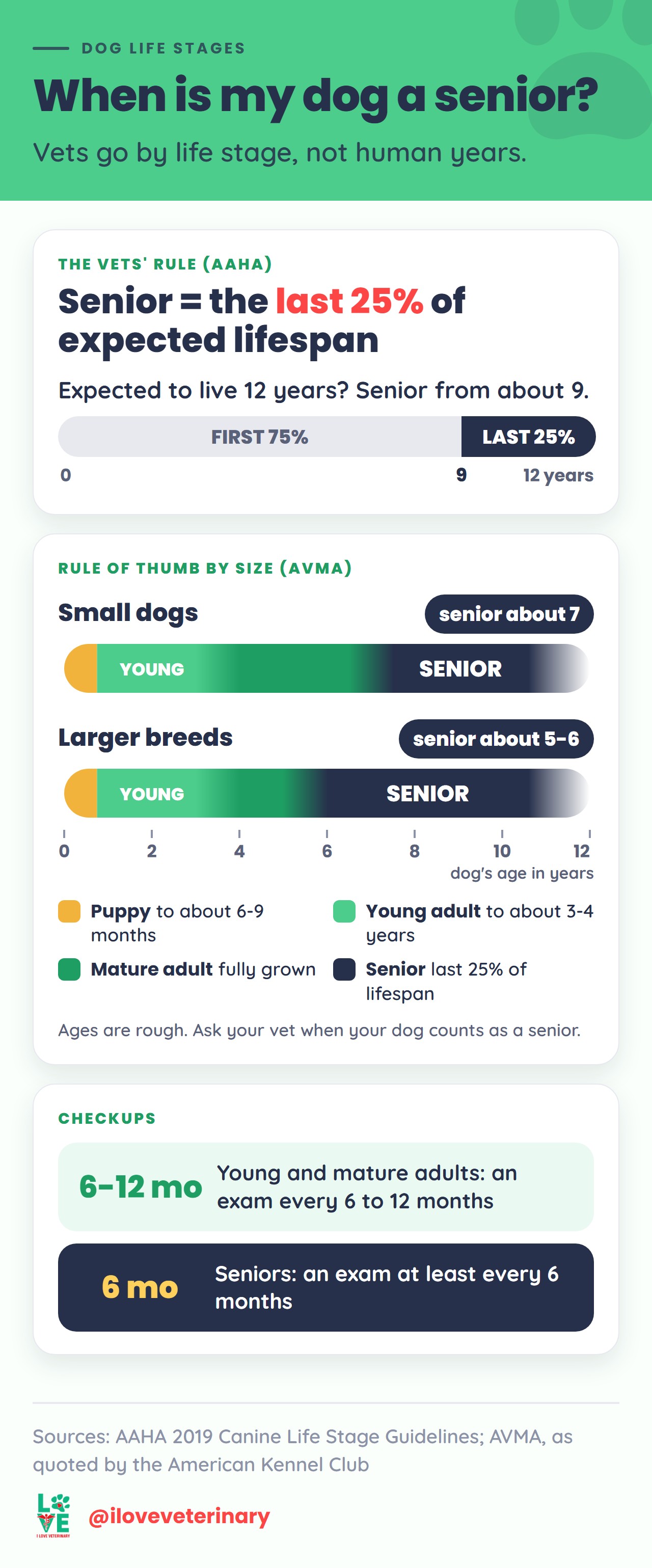
Veterinarians don't plan care around human years at all. The American Animal Hospital Association's 2019 Canine Life Stage Guidelines skip human-age conversions on purpose and define life stages by age and by how the dog's body is changing.
Life stage | What defines it (AAHA) | Typical age |
|---|---|---|
Puppy | Birth until rapid growth stops | About 6-9 months, varies with breed and size |
Young adult | Growth done, until the dog is physically and socially mature | Until about 3-4 years in most dogs |
Mature adult | Fully mature, until the last quarter of expected lifespan | Depends on breed and size |
Senior | The last 25% of expected lifespan | Depends on breed and size |
End of life | The terminal stage | Depends on the illness |
AAHA deliberately gives no fixed age for "senior", because dogs vary too much late in life. The rule is the last quarter of your dog's expected lifespan. For example, a dog expected to live about 12 years becomes a senior at around 9 (that's our arithmetic: 12 x 0.75). Your veterinarian can help estimate your dog's expected lifespan from its breed and size.
If you want a rough rule of thumb, the AVMA (as quoted by the AKC) says small dogs are generally considered senior at about 7, and larger breeds at about 5 to 6. PetMD's veterinarians put it later: older than 11 in most small breeds and closer to 8 in larger ones. That spread is why AAHA uses the lifespan rule instead of a single age.
What changes when your dog becomes a senior
The biggest change is how often your dog sees the vet. AAHA recommends exams every 6 to 12 months for young and mature adults, and at least every 6 months for seniors, with routine lab work your veterinarian recommends. More frequent visits give your vet a better chance to catch age-related problems early.
AAHA names four areas that decline in older dogs: mobility, vision, hearing and thinking. At home, it tends to look like this:
- Mobility: slower on stairs, reluctant to jump into the car or onto the couch.
- Vision: bumping into things, especially in dim light.
- Hearing: not reacting to the doorbell or to you walking in. A dog that doesn't hear you coming can startle and snap, and may not hear cars.
- Thinking and behavior: seeming lost at home, changes in sleep, new accidents in the house.
Tell your vet about any of these changes rather than writing them off as "just old age". For day-to-day comfort at home, our guide on how to take care of a senior dog goes deeper.
Worth asking at your dog's next checkup:
- What life stage is my dog in, and when do you expect it to become a senior?
- How often should we come in now?
- Which tests do you recommend at this age?
- Is my dog's weight right for its size and age?
Don't know your dog's age?
If you adopted your dog as an adult, your veterinarian can estimate its age from a physical exam. Teeth give the clearest clues in young dogs, while adult teeth are still coming in during the first months of life. After that, vets look at wear and tartar on the teeth, graying around the muzzle and eyes, a bluish haze in the eye lens, muscle tone, and behavior. Expect a range ("probably 6 to 8") rather than a birthday. Pick a number in that range, then use the chart.
Quick answers
How old is a 2-year-old dog in human years? About 24 for small, medium and large dogs, and about 22 for giant breeds.
Is a 10-year-old dog old? On the AKC chart, a 10-year-old is about 56 (small) to 79 (giant) in human years. By the AAHA rule, any dog expected to live 13 years or less is already a senior at 10 (our arithmetic), which means checkups at least every 6 months. Ask your vet where your dog stands.
Do small dogs really live longer? Yes, on average. Life expectancy across breeds varies by about a factor of two, and the main reason is that large dogs age faster once aging starts.
Does the DNA formula work for my dog? It was built from Labrador retrievers only, so treat it as a curiosity. For other breeds and mixed breeds, the size chart is a better guide.
Sources
- American Kennel Club: How to Calculate Dog Years to Human Years (age chart by size; AVMA rule of thumb and senior ages, quoted; origin of the 7-year rule)
- AAHA: 2019 AAHA Canine Life Stage Guidelines (Creevy et al., JAAHA 2019)
- Cell Systems: Quantitative Translation of Dog-to-Human Aging by Conserved Remodeling of the DNA Methylome (Wang et al., 2020)
- bioRxiv: the 2019 preprint of the UCSD dog aging study
- The American Naturalist: The Size-Life Span Trade-Off Decomposed: Why Large Dogs Die Young (Kraus et al., 2013)
- PetMD: How Old Is My Dog? How to Determine a Dog's Age
- Dog Aging Project
This article is for general information and is not a substitute for advice from your veterinarian.