Flagyl is the human brand name for metronidazole, an antibiotic that also kills some parasites. Vets prescribe it to dogs for Giardia, for infections caused by bacteria that live without oxygen, and sometimes for gut disease. One metronidazole liquid, Ayradia, has been FDA-approved for Giardia in dogs since 2023. The tablets most dogs go home with are human drugs used "extra-label", so your vet picks the dose from your dog's weight and the reason it is needed.
Two things have changed since this drug became a clinic staple. Current evidence says most dogs with simple, short-lived diarrhea get better just as well without it. And at high doses or on long courses it can upset the brain and balance system, a side effect every owner should know by sight. Both are explained right after the dosage chart.
Metronidazole Dosage Chart for Dogs
How to read it: the dose is milligrams (mg) of metronidazole per kilogram (kg) or per pound (lb) of body weight, given each time. "Every 12 hours" means twice a day. Every row is for dogs, by mouth. Only the first row is a US-approved dog product. The other US rows are extra-label use, and the UK label row is approved in the UK and EU, not in the US.
Only give what your vet prescribed, at the dose they set.
For information only. These are typical published dose ranges, not a prescription and not medically verified for your pet. Your veterinarian sets the dose after examining your pet. Never start, stop or change a medicine without their OK.
Use | Dose per kg | Dose per lb | How often | Course and notes | Source |
|---|---|---|---|---|---|
Giardia, FDA-approved liquid (Ayradia) | 25 mg/kg | 11.3 mg/lb | Every 12 hours | FDA-approved US label. 5 days. Give into the mouth or in a small amount of food. | |
Giardia, tablets or capsules (most commonly used range) | 10-25 mg/kg | 4.5-11.3 mg/lb | Every 12 hours | Extra-label. 5 to 8 days. | |
Chronic gut inflammation (chronic enteropathy, IBD) that did not respond to diet changes | 10-15 mg/kg | 4.5-6.8 mg/lb | Every 12 hours | Extra-label. A 3 to 4 week trial; how much it helps in most chronic enteropathies is uncertain. | |
UK label (Metrobactin), not approved in the US: Giardia or Clostridium gut infections; anaerobic infections of the urinary and genital tract, mouth, throat and skin | 25 mg/kg | 11.3 mg/lb | Every 12 hours | 5 to 7 days. The label also allows the same daily total once a day (50 mg/kg). | |
Dogs with liver disease, including hepatic encephalopathy (brain signs caused by liver failure) | Your vet sets the dose | Merck lists lower doses for these dogs, but the UK label says not to use metronidazole in liver disorders at all. Your vet weighs this. | |||
Acute diarrhea with no cause found, dog otherwise bright and well | No routine dose | High-certainty evidence: antibiotics make no clinically relevant difference in mild to moderate cases (see below). |
Dose calculator · Metronidazole
Metronidazole (Flagyl) dose calculator for dogs
Not a prescription. For information only. These are typical published dose ranges, not a prescription and not medically verified for your pet. Your veterinarian sets the dose after examining your pet. Never start, stop or change a medicine without their OK.
Only give what your vet prescribed.
All doses in this calculator
| Pet | Use | Typical dose | How often | Route | Source |
|---|---|---|---|---|---|
| Dog | Giardia, FDA-approved liquid (Ayradia) | 25 mg per kg (11.3 mg per lb)FDA-approved US label. 5 days. Give into the mouth or in a small amount of food. | every 12 hours | by mouth (liquid) | Ayradia label (FDA, DailyMed) |
| Dog | Giardia, tablets or capsules (most commonly used range) | 10 to 25 mg per kg (4.54 to 11.3 mg per lb)Extra-label. 5 to 8 days. | every 12 hours | by mouth | CAPC Giardia guidelines |
| Dog | Chronic gut inflammation (chronic enteropathy, IBD) that did not respond to diet changes | 10 to 15 mg per kg (4.54 to 6.8 mg per lb)Extra-label. A 3 to 4 week trial; how much it helps in most chronic enteropathies is uncertain. | every 12 hours | by mouth | Merck Veterinary Manual |
| Dog | UK label (Metrobactin), not approved in the US: Giardia or Clostridium gut infections; anaerobic infections of the urinary and genital tract, mouth, throat and skin | 25 mg per kg (11.3 mg per lb)5 to 7 days. The label also allows the same daily total once a day (50 mg/kg). | every 12 hours | by mouth | UK VMD, Metrobactin product leaflet |
Per-lb values are calculated from the per-kg doses (1 kg = 2.2046 lb) and rounded; the Ayradia row uses the label's own figure.
What the chart doesn't show at a glance:
- The approved product is a liquid for one job. Ayradia is approved for Giardia duodenalis only. Every other US use, and every Flagyl or generic tablet, is extra-label. That is legal and common, but it means there is no US dog label to check the tablet dose against.
- Watch the daily total, not just the dose. The US Giardia label and the UK label both work out to 50 mg/kg a day for about a week. In a 2018 study of 26 dogs with metronidazole neurotoxicity, the median dose was 21 mg/kg twice a day over a median of 35 days, and the authors suggest caution above 40 mg/kg a day, whatever the course length. High doses and long courses are where trouble clusters, which is why your vet keeps the course as short as the problem allows.
- Liver disease changes the picture. The drug is broken down mainly in the liver. Merck lists lower doses for dogs with liver dysfunction, while the UK label rules it out in liver disorders, so the chart leaves this one to your vet. If your dog has liver disease, ask which way they went and why.
- The label may not match the chart exactly. Tablets come in fixed strengths, so the prescribed amount is often rounded to something you can actually give. A small difference is normal. A big one is a reason to call the clinic, not to change the dose yourself.
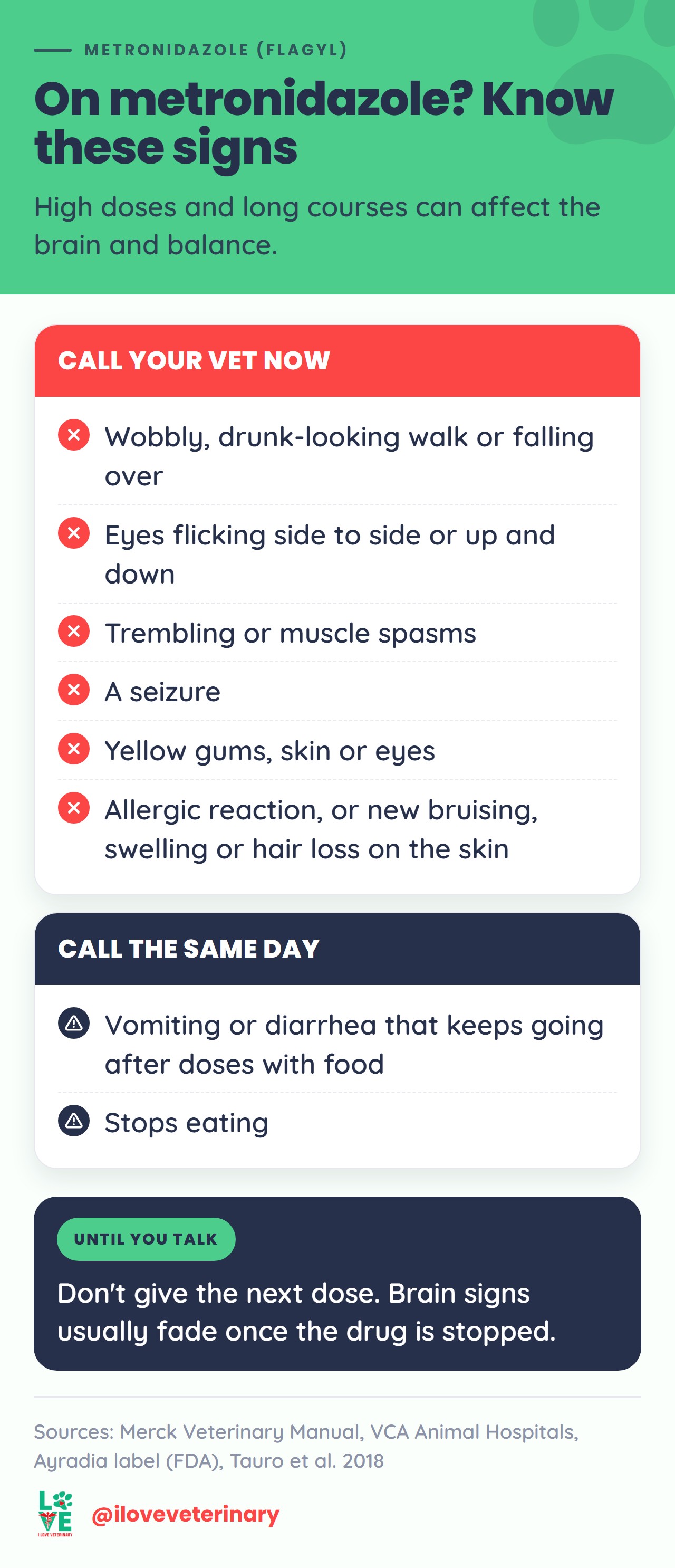
Call your vet now if your dog on metronidazole walks like it's drunk, falls over, has eyes flicking side to side or up and down, trembles or has a seizure. Don't give the next dose until you have spoken to them.
If your dog got into the bottle (some tablets and the liquid are flavored) or was given too much, call your vet or an animal poison line right away: the ASPCA Animal Poison Control Center at (888) 426-4435 or the Pet Poison Helpline at (855) 764-7661.
What Is Metronidazole (Flagyl)?
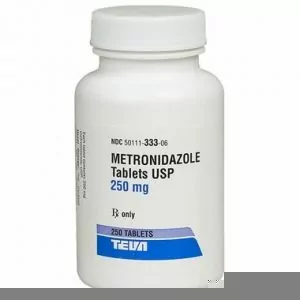
Metronidazole is a nitroimidazole, a drug class with two talents: it kills certain bacteria and it kills certain single-celled parasites (protozoa). Flagyl is the best-known brand; most dogs get a generic tablet or a liquid.
Is metronidazole FDA-approved for dogs? One product is. In October 2023 the FDA approved Ayradia, a flavored metronidazole oral suspension, for Giardia duodenalis infection in dogs. Before that, the FDA notes, vets had been prescribing a metronidazole product made for people. They still do for every other use: human tablets and capsules given to dogs are extra-label, which US law allows on a vet's prescription. You may still read that metronidazole is "not approved for any animal". That was true before 2023, and it is still true for the tablets.
What Is Metronidazole Used for in Dogs?
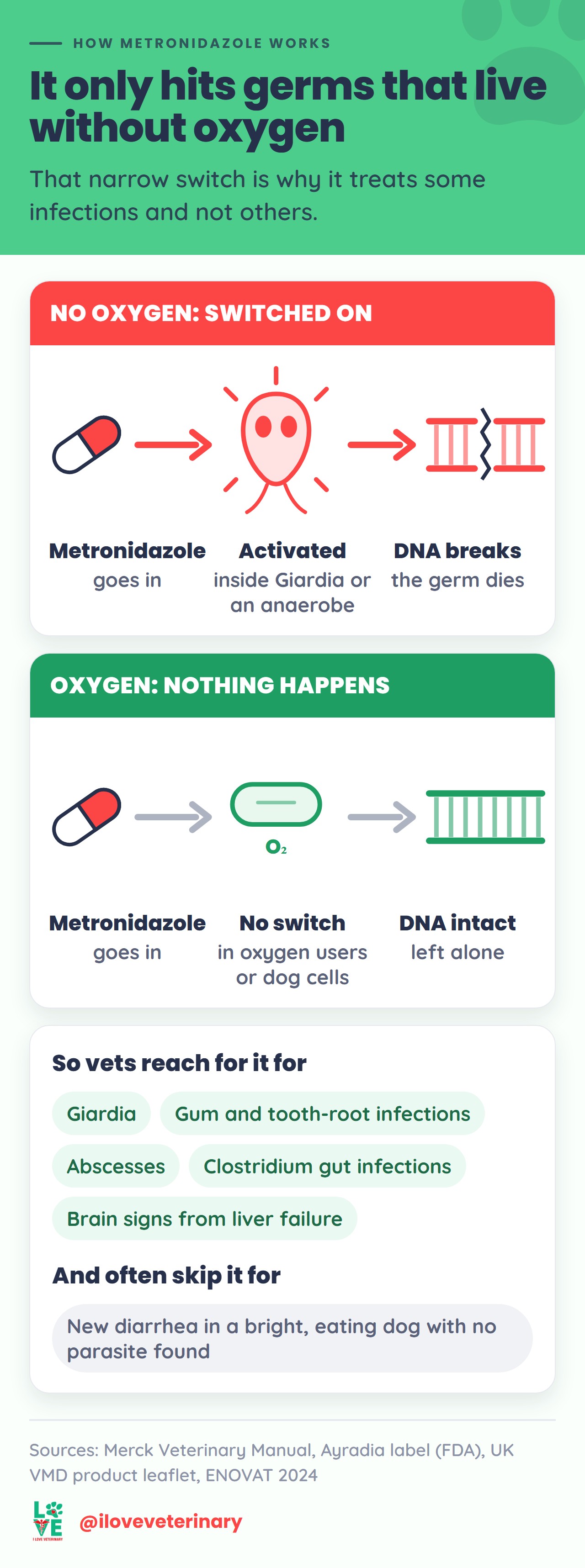
Metronidazole works only against organisms that live without oxygen (anaerobes) and certain protozoa, so the list is specific. According to the Merck Veterinary Manual, the UK product label and CAPC, vets use it for:
- *Giardia infection. The one FDA-approved use. It is not the only option: fenbendazole (Panacur) is the first-line choice in Europe and also clears Giardia* in dogs. Your vet chooses.
- Other protozoa, such as trichomonads.
- Anaerobic bacterial infections: abscesses in the belly, infections of the gums and tooth roots (periodontitis), bone infections, and infections of the urinary and genital tract, throat and skin.
- *Clostridium gut infections (C. perfringens or C. difficile*), listed on the UK label.
- Infections of the brain and spinal cord, because metronidazole crosses the blood-brain barrier and reaches abscesses.
- Hepatic encephalopathy, the brain signs caused by liver failure.
- Chronic gut inflammation that hasn't improved with diet changes, as a 3-4 week trial. Merck notes that how much antibiotics help in most of these dogs is uncertain.

It does nothing against bacteria that need oxygen. Like every animal antibiotic, it is the right drug only when it matches the organism.
Does My Dog Need Metronidazole for Diarrhea?
Usually not, if the diarrhea is new, your dog is bright and eating, and tests haven't found a parasite such as Giardia. For decades metronidazole was the reflex prescription for an upset gut, especially in North America. A 2023 review concluded it may be used inappropriately in many of those cases. Here is what changed vets' minds:
- It barely shortens the illness. In a 2020 placebo-controlled trial, diarrhea cleared in about 2.1 days with metronidazole versus 3.6 days without it. The authors noted that most dogs recover within several days either way.
- Diet did better in colitis. In a 2022 trial of 59 dogs with acute colitis (large-bowel diarrhea, often with mucus), an easily digestible diet led to firm stools in a median of 5 days. Adding metronidazole stretched that to 8.5 days and worsened the gut-bacteria balance. Our guides to colitis in dogs and stress colitis explain this kind of diarrhea.
- It leaves a mark on the gut. Two weeks of metronidazole in healthy dogs changed their gut bacteria, and the changes had not fully recovered 4 weeks after the last dose.
- The guideline now says so. A 2024 systematic review for the European ENOVAT guideline found high-certainty evidence that antibiotics make no clinically relevant difference for dogs with mild or moderate acute diarrhea. The guideline itself, as summarized by Vet Times, recommends against antibiotics for these dogs, with or without blood in the stool. It keeps them for severely ill dogs, such as those with a fever or that don't respond to fluids, and metronidazole is not among the drugs it suggests for them.
So if your vet sends you home with a bland diet, fluids advice and a recheck plan instead of a pill, that is current best practice, not a shortcut. Call back if your dog vomits repeatedly, stops eating, seems weak or depressed, has a lot of blood in the stool, or doesn't improve in the time your vet gave you.
How Does Metronidazole Work?
Metronidazole is a harmless passenger until it gets inside an organism that lives without oxygen. Anaerobic bacteria and protozoa have the chemistry to "switch it on". Once activated, it binds their DNA, breaks the strands and kills the cell. Bacteria that use oxygen lack that switch, so the drug leaves them alone, and the dog's own cells are not the target either.
It is absorbed well from the gut, spreads into most tissues, including abscesses and the brain, and is broken down mainly in the liver. In dogs, about half of a dose is gone in roughly 4.5 hours.
How to Give Metronidazole to Your Dog

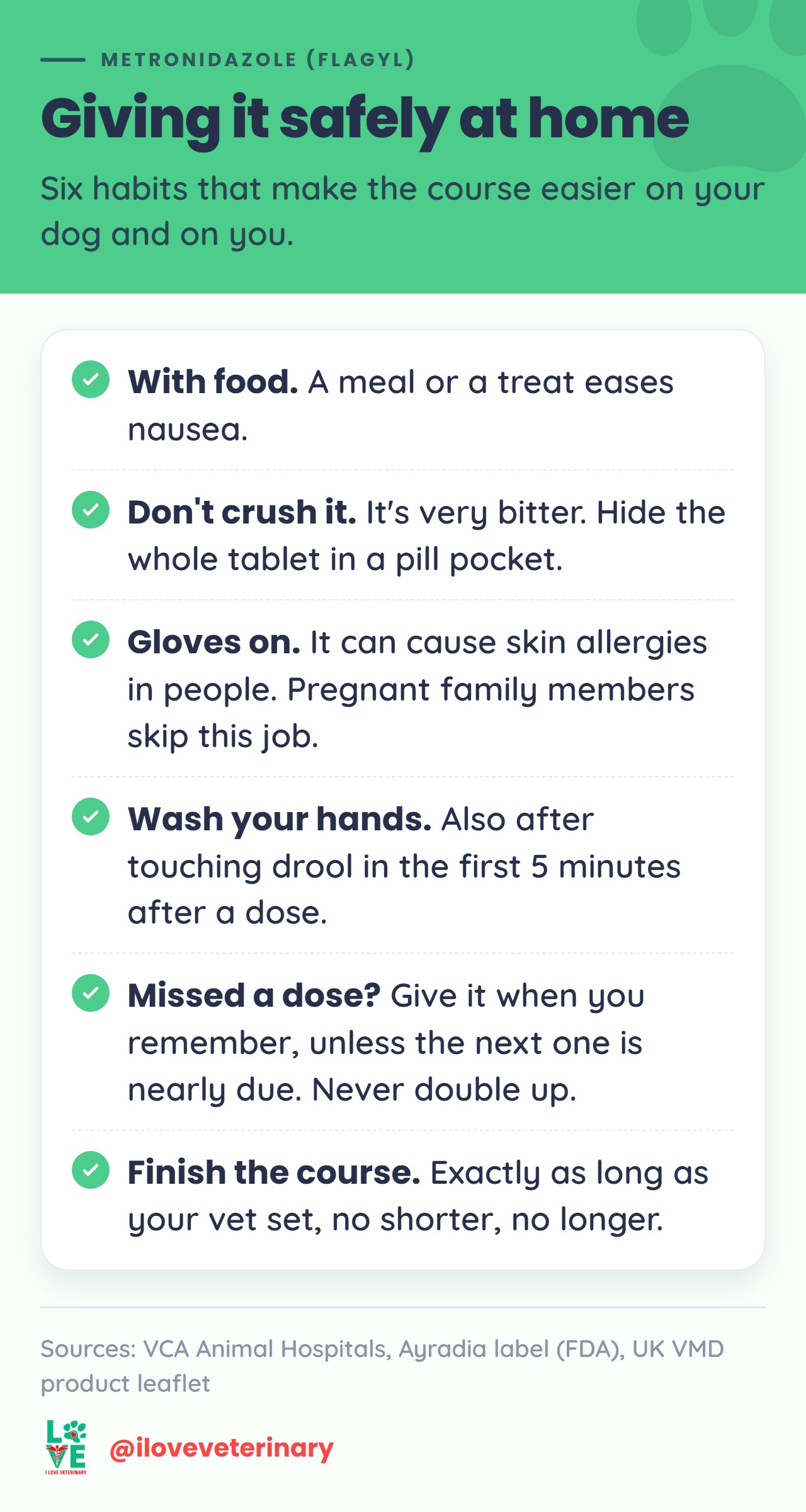
- With food. It eases nausea. The Ayradia liquid can go straight into the mouth or into a small amount of food.
- Don't crush the tablets. Metronidazole is very bitter. Crushed into dinner, it is the fastest way to get a dog who refuses the whole bowl. A pill pocket or a small treat works better.
- Measure liquids with the syringe that came with them, and shake the bottle well first.
- Protect the people giving it. Metronidazole can cause allergic skin reactions in people and may harm an unborn baby. Wear gloves when you handle tablets, keep pregnant family members away from the job, and wash your hands afterward. The Ayradia label adds: wash your hands if you touch your dog's saliva in the first 5 minutes after a dose. If your dog vomits, clean it up with gloves on.
- Expect improvement over a few days. The drug starts working within 1-2 hours, but visible improvement usually takes a few days. Give it for exactly as long as your vet prescribed.
Forms of Metronidazole
- Tablets and capsules, the usual human generics.
- Liquid suspension, including Ayradia, the flavored FDA-approved one for dogs.
- Compounded liquids made by a pharmacy, sometimes as metronidazole benzoate, which tastes less bitter. Check the label for how to store them.
- Injection, given only by your vet in the hospital.
Metronidazole Side Effects in Dogs
Most dogs take a short course without trouble. The common side effects, per VCA and the US label:
- Nausea, vomiting or diarrhea (in the Ayradia field study, 14.3% of treated dogs vomited)
- Drooling, often from the bitter taste
- Less appetite
- Tiredness
- Reddish-brown urine, from harmless pigments; it looks alarming but is a known effect
The one to know by sight: neurotoxicity. At high doses or on long courses, metronidazole can affect the cerebellum and balance system. Signs include:
- a wobbly, drunk-looking walk or falling over (ataxia)
- eyes flicking side to side or up and down (nystagmus)
- trembling or muscle spasms
- weakness
- seizures
It is usually reversible. In the 26-dog study, signs went away a median of 3 days after the drug was stopped, and vets have treatments that speed recovery. An older report of five dogs on very high doses was grimmer: three took months to recover and two were euthanized.
Call your vet now if you see any of the signs above, yellow gums, skin or eyes, signs of an allergic reaction, or new bruising, swelling, scaling or hair loss on the skin. Don't give the next dose until you have spoken to them.
Call your vet the same day if vomiting or diarrhea continues after doses given with food, or your dog stops eating.
Rarer effects listed on the product labels include liver injury and a drop in white blood cells (neutropenia), which is one reason your vet may want bloodwork on a long course.
Does Metronidazole Make Dogs Sleepy?
It can. Tiredness is on VCA's list of side effects. Mild sleepiness in a dog who is otherwise eating and walking normally is worth mentioning at your next call. Sleepiness that comes with stumbling, flicking eyes or weakness is the neurotoxicity picture above, and it means calling now.
Which Dogs Should Not Take Metronidazole?
The labels and VCA flag:
- Dogs allergic to metronidazole or related drugs: do not use.
- Pregnant and nursing dogs. Lab studies raised concerns about birth defects, and the drug passes into milk. The UK label advises against use, and VCA says not to use it. See our dog pregnancy guide if you're not sure.
- Dogs with liver disease. The UK label rules it out in liver disorders; the US label and VCA say use with caution. Our guide to elevated liver enzymes in dogs explains the bloodwork.
- Weak or debilitated dogs: VCA lists them as do-not-use.
- Puppies: use with caution.
- Dogs with kidney disease: the drug's effects can last longer, so your vet factors it in.
If your dog has ever had seizures or balance problems, tell your vet before the first dose. It helps them read any new signs during treatment.
Metronidazole Drug Interactions
Tell your vet about everything your dog takes, including supplements. The interactions on the labels:
- Warfarin and other blood thinners. Metronidazole slows their breakdown, which raises the bleeding risk.
- Phenytoin and cyclosporine. Metronidazole can slow their breakdown in the liver too, so levels rise.
- Phenobarbital. Works the other way: it speeds up the breakdown of metronidazole, which can leave too little of it to work.
- Cimetidine, a stomach-acid reducer, slows the breakdown of metronidazole, raising its level.
- Certain chemotherapy drugs.
Missed a Dose?
Give it when you remember, then carry on with the usual schedule. If the next dose is nearly due, skip the missed one. Never give two doses at once.
Storing Metronidazole
Keep tablets, capsules and the liquid in a tightly closed container, away from light, below 86°F (30°C). Some compounded liquids need the fridge: follow the pharmacy label. Store it where your dog can't reach it, because flavored tablets and liquids are tempting, and away from children.
Where to Get Metronidazole
Only on a prescription from your vet, filled by the clinic or a pharmacy. Don't use leftover pills from a previous illness, another pet's prescription, or tablets sold without one: you can't know whether the dose, the drug or the diagnosis is right.
Metronidazole and Antibiotic Resistance
Every unnecessary course gives bacteria a chance to adapt. The US label puts it plainly: antibiotics given without a proven or strongly suspected infection are unlikely to help and raise the risk of resistant bacteria. The UK label asks vets to test which bacteria are involved and what they respond to whenever possible.
What helps:
- Use metronidazole only for the dog and the problem it was prescribed for.
- Give it for exactly the time your vet set; don't stop early or stretch it on your own.
- Don't pressure your vet for an antibiotic for simple diarrhea. As the evidence above shows, often the better treatment is no antibiotic at all.
Questions to Ask Your Vet
- What is it treating, and was a test (such as a Giardia test) done?
- Is this the approved liquid or an extra-label tablet?
- How long is the course, and when should my dog be better?
- My dog has liver disease, kidney disease or a seizure history: does that change the dose?
- What should make me call you straight away?
Summary
Metronidazole, sold to people as Flagyl, is a useful drug with a narrow job: anaerobic bacteria and protozoa such as Giardia. In the US one liquid is approved for Giardia in dogs; every other use is extra-label, so your vet sets the dose. It is no longer the automatic answer to diarrhea, and the evidence backs vets who skip it. Give it with food, handle it with gloves, and learn the wobbly-walk and flicking-eyes signs that mean calling your vet now.
Originally written by Amber LaRock. Updated by the I Love Veterinary editorial team.
Sources
- FDA: FDA Approves First Treatment for Giardia duodenalis in Any Animal Species (2023)
- DailyMed: Ayradia (metronidazole oral suspension) for dogs, product label
- Merck Veterinary Manual: Nitroimidazoles Use in Animals
- Merck Veterinary Manual: Giardiasis in Animals
- Merck Veterinary Manual: Chronic Enteropathies in Small Animals
- CAPC: Giardia guidelines
- UK Veterinary Medicines Directorate: Metrobactin tablets for dogs and cats, product leaflet (2025)
- VCA Animal Hospitals: Metronidazole
- Jessen et al., Veterinary Journal (2024): ENOVAT guidelines for antimicrobial use in canine acute diarrhoea
- Scahill et al., Veterinary Journal (2024): Antimicrobial and nutraceutical treatment for canine acute diarrhoea, systematic review for ENOVAT
- Vet Times (2025): Canine acute diarrhoea, the ENOVAT review on use of antimicrobials
- Ellis et al., Topics in Companion Animal Medicine (2023): The use of metronidazole in acute diarrhea in dogs
- Langlois et al., JVIM (2020): Metronidazole treatment of acute diarrhea in dogs, a randomized placebo-controlled trial
- Rudinsky et al., JAVMA (2022): Nutritional management is superior to metronidazole for acute colitis in dogs
- Pilla et al., JVIM (2020): Effects of metronidazole on the fecal microbiome and metabolome in healthy dogs
- Tauro et al., Australian Veterinary Journal (2018): Metronidazole-induced neurotoxicity in 26 dogs
- Evans et al., JVIM (2003): Diazepam as a treatment for metronidazole toxicosis in dogs, 21 cases
- Dow et al., JAVMA (1989): Central nervous system toxicosis associated with metronidazole treatment of dogs
- ASPCA Animal Poison Control Center
- Pet Poison Helpline
This article is for general information and is not a substitute for advice from your veterinarian.