
Veterinary charts run on shorthand. Some of it is official, on the approved lists teaching hospitals keep: BAR for a bright, alert, responsive patient, BID for twice a day, NPO for nothing by mouth. Some of it is hallway humor that should never reach a medical record. This cheat sheet sorts the two and groups the official ones the way you meet them on a chart.
The ones you will see first, on almost any small-animal chart:
- BAR: bright, alert, responsive
- WNL: within normal limits
- Hx / Tx / Sx: history / treatment / surgery
- PO: by mouth (per os)
- BID: twice a day
- NPO: nothing by mouth
- OD / OS: right eye / left eye
- R/O: rule out
Every abbreviation in the reference tables below was checked against published lists: the approved-abbreviations protocol of Kansas State University's Veterinary Health Center, the University of Illinois Veterinary Medicine Library guide and the Merck Veterinary Manual. Teaching hospitals like Kansas State keep an approved list for their records, so if your clinic has one, it wins.
The printable cheat sheet below puts the groups you will use most on one page, meanings only.

How a Veterinary Chart Reads: SOAP
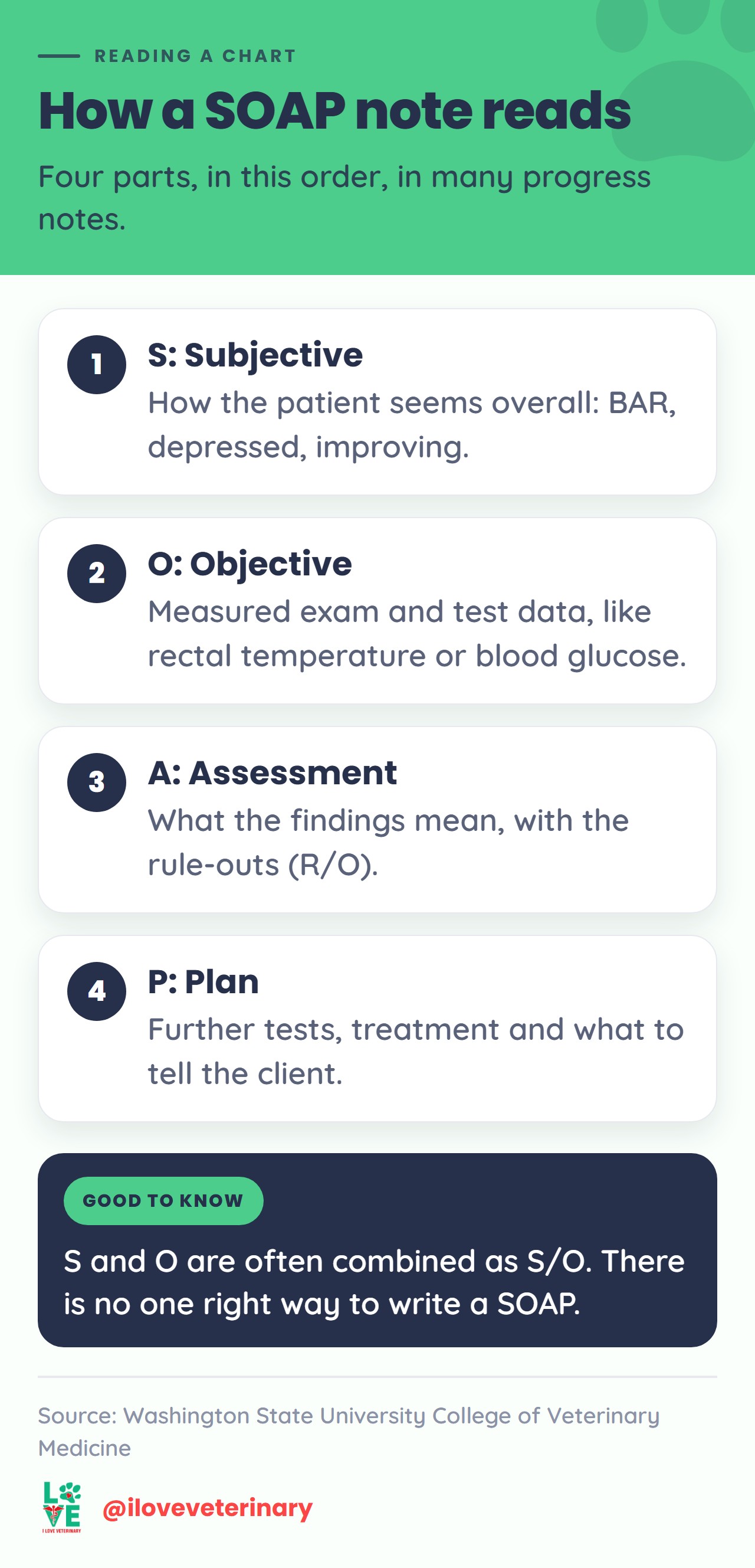
Many progress notes follow the SOAP format, which vet schools teach as part of the problem-oriented medical record. Washington State University's SOAP guide breaks it down like this:
Letter | Stands for | What goes there |
|---|---|---|
S | Subjective | How the patient seems overall, e.g. BAR, depressed, improving, no change |
O | Objective | Measurable data from the physical exam and tests, e.g. rectal temperature, blood glucose |
A | Assessment | What the findings mean, including the differential diagnoses (rule-outs) |
P | Plan | Further tests, treatment and what to tell the client |
S and O often blur together, so many notes combine them as S/O. WSU is also blunt that there is no one right way to write a SOAP; services and clinicians each have their own style.
The abbreviations that hold a SOAP note together:
Abbreviation | Meaning |
|---|---|
Hx, H/O | History, history of |
PE | Physical exam |
DDx | Differential diagnosis |
R/O | Rule out |
Dx | Diagnosis |
Px | Prognosis or physical exam (lists differ, so check which one your clinic uses) |
Tx, TRT | Treatment |
Rx | Prescription |
Sx | Surgery |
RECK | Recheck |
TNT, NT | Toe nail trim |
O / P | Owner / patient |
So "Hx V/D, R/O FB" reads as: history of vomiting and diarrhea, rule out a foreign body.
Patient Status and Exam Abbreviations
Abbreviation | Meaning |
|---|---|
BAR | Bright, alert, responsive |
QAR | Quiet, alert, responsive |
WNL | Within normal limits |
NSF | No significant findings |
NED | No evidence of disease |
BCS | Body condition score |
TPR | Temperature, pulse, respiration |
HR | Heart rate |
RR | Respiratory rate |
MM | Mucous membranes (gum color) |
CRT | Capillary refill time |
BP | Blood pressure |
PLR | Pupillary light response |
QAR marks a patient that is quieter than usual but still alert and responsive, a small step down from BAR. MM and CRT tend to be read together: the Merck Veterinary Manual lists mucous membrane color and capillary refill time among the signs used to judge blood flow (perfusion).
Frequency Abbreviations (What SID, BID and PRN Mean)
These describe how often something happens on a treatment sheet or label. They say nothing about which drug or how much: your veterinarian chooses both for each patient. Several come from Latin, which is why the letters don't match the English.
Abbreviation | Meaning | Latin root |
|---|---|---|
SID, QD | Once a day, every 24 hours | |
BID | Twice a day | bis in die |
TID | Three times a day | ter in die |
QID | Four times a day | quater in die |
q | Every (q4h means every 4 hours) | quaque |
qod | Every other day | |
PRN | As needed | pro re nata |
ad lib | As much as desired | ad libitum |
NPO | Nothing by mouth | nil per os |
On the Kansas State list, SID and QD mean the same thing: once a day. If a label or discharge sheet is unclear to you as an owner, call the clinic and ask. Don't guess at a schedule.
Route Abbreviations
The route tells you how something is given.
Abbreviation | Meaning |
|---|---|
PO | By mouth (per os) |
IV | Intravenous, into a vein |
IM | Intramuscular, into a muscle |
SC, SQ | Subcutaneous, under the skin |
ID | Intradermal, into the skin |
IP | Intraperitoneal, into the abdominal cavity |
IO | Intraosseous, into the bone |
IN | Intranasal, into the nose |
CRI | Constant-rate infusion |
SC and SQ mean the same thing. Kansas State's list accepts both, so you will see both depending on who wrote the note.
Eye and Ear Abbreviations
More Latin, and the easiest place to slip.
Eyes | Meaning | Ears | Meaning |
|---|---|---|---|
OD | Right eye (oculus dexter) | AD | Right ear |
OS | Left eye (oculus sinister) | AS | Left ear |
OU | Both eyes | AU | Both ears |
The pattern is the same for both: D for right, S for left, U for both. AS also has a second meaning, covered under the double meanings further down.
Lab Test and Diagnostic Abbreviations
Abbreviation | Meaning |
|---|---|
CBC | Complete blood count |
Chem | Chemistry panel |
BUN | Blood urea nitrogen |
ALT | Alanine aminotransferase (a liver enzyme) |
ALP | Alkaline phosphatase |
PCV | Packed cell volume |
HCT | Hematocrit |
UA | Urinalysis |
SG | Specific gravity (of urine, on a UA) |
T4 | Thyroid hormone level |
C/S | Culture and sensitivity |
FNA | Fine-needle aspiration |
Bx | Biopsy |
Rads | Radiographs (X-rays) |
U/S | Ultrasound |
ECG | Electrocardiogram |
Echo | Echocardiogram |
HWT, 4Dx | Heartworm test |
FeLV | Feline leukemia virus |
FIV | Feline immunodeficiency virus |
PCR | Polymerase chain reaction |
STT | Schirmer tear test |
For what a heartworm test is looking for and why it matters, see our guide to heartworm in dogs.
Common Condition Shorthand
Abbreviation | Meaning |
|---|---|
HBC | Hit by car |
V/D | Vomiting and diarrhea |
PU/PD | Polyuria/polydipsia (urinating and drinking more than normal) |
FB | Foreign body |
UTI | Urinary tract infection |
URI | Upper respiratory tract infection |
FLUTD | Feline lower urinary tract disease |
IVDD | Intervertebral disk disease |
GDV | Gastric dilatation volvulus |
CHF | Congestive heart failure |
DJD, OA | Degenerative joint disease, osteoarthrosis |
KCS | Keratoconjunctivitis sicca (dry eye) |
DM | Diabetes mellitus |
DKA | Diabetic ketoacidosis |
FAD | Flea allergy dermatitis |
FIP | |
HWD | Heartworm disease |
DA2PP | Canine vaccine: distemper, adenovirus, parainfluenza, parvovirus |
FVRCP | Feline vaccine: rhinotracheitis, calicivirus, panleukopenia |
Anatomy and Direction Terms
Not abbreviations, but they sit next to them in exam notes and radiograph reports. Charts shorten left and right to L and R. The rest are usually written out. Definitions follow the University of Minnesota veterinary anatomy guide:
Term | Direction |
|---|---|
Cranial | Toward the head |
Caudal | Toward the tail |
Rostral | Toward the nose (used on the head) |
Dorsal | Toward the back |
Ventral | Toward the belly |
Medial | Toward the midline |
Lateral | Away from the midline, toward the side |
Proximal | Toward the body (on limbs and tail) |
Distal | Away from the body (on limbs and tail) |
Palmar | Ground surface of the front paw |
Plantar | Ground surface of the hind paw |
Cranial and caudal work almost everywhere on the body; on the head itself, rostral replaces cranial. Test yourself with our directional terminology quiz.
Same Letters, Two Meanings
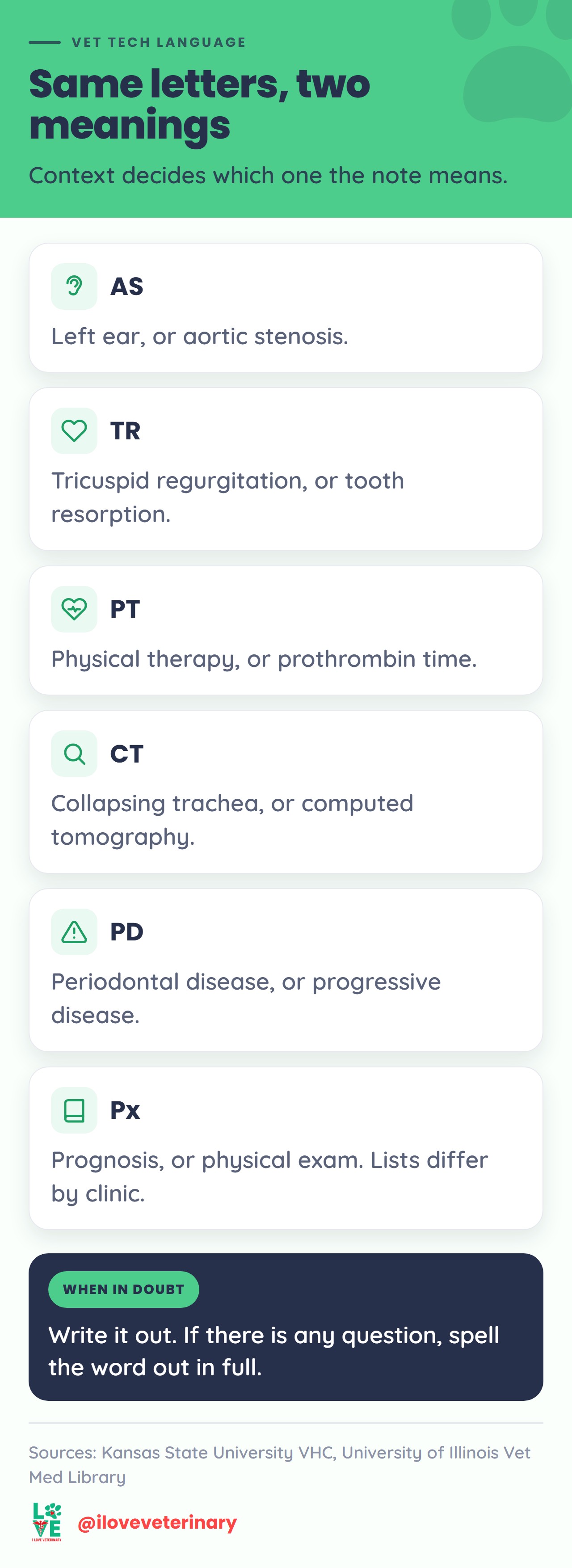
This is the section worth memorizing. Each pair below appears on real veterinary lists, and context is the only thing telling them apart:
- AS: left ear, or aortic stenosis (both on the Kansas State list)
- PD: periodontal disease, or progressive disease in cancer care
- PT: physical therapy, or prothrombin time (a clotting test)
- CT: collapsing trachea, or computed tomography
- TR: tricuspid regurgitation, or tooth resorption
- VSD: ventricular septal defect, or ventral slot decompression (a spinal surgery)
- Px: prognosis on the Kansas State list, physical examination in the Illinois guide; which one you meet varies by clinic
- MM: mucous membranes on an exam sheet, but multiple myeloma on the Kansas State list
- RR: respiratory rate on an exam sheet, but internal root resorption in dental charting
A dermatology note that says "AS: mild discharge" and a cardiology consult that says "AS" are talking about very different things. Kansas State's protocol settles it in one line: if there is any question, the word should be written out in full.
Vet Tech Slang (Not for the Medical Record)
Every clinic also has its own private language. It's part of the job's humor, and you'll pick it up fast. None of these appear on the approved lists we checked, and Kansas State's protocol is clear that "imaginative abbreviations which mean something to only a few individuals have no place in the medical record." Say them in the treatment room; write the real finding in the chart.
Slang | What people mean |
|---|---|
ADR | Ain't doing right (in the chart, describe what you actually saw) |
ROBO | Rolled over by owner |
ART | Achieving room temperature |
SBI | Something bad inside |
WPWW | Will poop without warning |
HWP | Heartworm prevention |
AG | Anal gland expression |
TGH | To go home |
RTG | Ready to go |
N/C | New client, or no charge, depending on the clinic |
Studying for the VTNE
If you are studying for the VTNE, the exam has its own accepted abbreviation list from the AAVSB, and it even covers dental formula letters (I, C, P, M for incisor, canine, premolar, molar; see our guide to dental formulas in animals). Pair this cheat sheet with our VTNE prep tips.
If you liked this article, read "Vet Tech Appreciation Week" on our blog.
Sources
- Kansas State University Veterinary Health Center: Approved Abbreviations (Official Protocol)
- University of Illinois Veterinary Medicine Library: Veterinary Abbreviations & Acronyms Guide
- Merck Veterinary Manual: Abbreviations
- Merck Veterinary Manual: The Fluid Resuscitation Plan in Animals
- Merck Veterinary Manual: Initial Triage and Resuscitation of Small Animal Emergency Patients
- Washington State University College of Veterinary Medicine: The Problem Oriented Medical Record and the "Academic" SOAP
- University of Minnesota Veterinary Anatomy: Directions
- AAVSB: VTNE Accepted Abbreviations
- Journal.vet: Veterinary Abbreviations in Clinical Notes
This article is for general information and is not a substitute for advice from your veterinarian.