

The Western Veterinary Conference, now called WVC Vegas, is four days of continuing education (CE) at Mandalay Bay in Las Vegas, with more lectures, labs and exhibit-hall sessions than any one person can attend. The next one runs February 28 to March 3, 2027. Whether the trip pays off depends less on the conference than on your plan, so this guide covers what WVC is, who can go, and how to turn those four days into the CE hours and skills you actually need.
What is WVC?
WVC is the annual veterinary conference run by Viticus Group, a Las Vegas nonprofit that also runs year-round hands-on training for veterinary and human health professionals. The organization started in 1928 in Logan, Utah, as the Intermountain Livestock Sanitary Association. It moved to Las Vegas in 1963, became the Western Veterinary Conference in 1965, officially shortened its name to WVC in 2014, and renamed the organization Viticus Group in 2019. The conference kept the WVC name.
The organizer calls it one of the largest veterinary conferences in the world. Its 97th Annual Conference drew more than 21,000 attendees, from veterinarians, vet techs and practice managers to students, educators and industry people. Since 2026 there is also a smaller late-summer edition, WVC Nashville.
When and where is the next WVC?
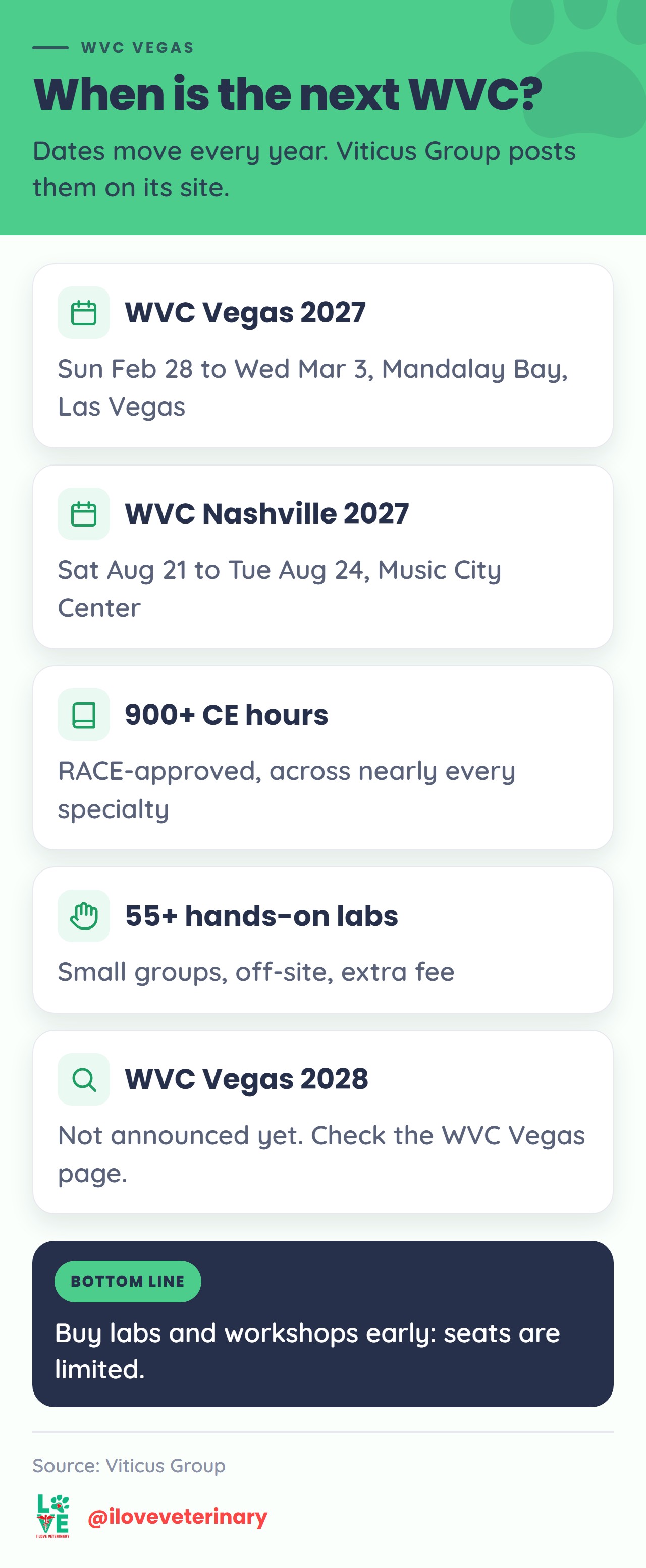
WVC dates move from year to year (the 2026 conference ran February 14 to 18; the 2027 one starts two weeks later), so check the organizer's dates before you book anything. Here is what Viticus Group has published so far:
Event | Dates | Venue |
|---|---|---|
WVC Vegas 2027 | Sunday, February 28 to Wednesday, March 3, 2027 | Mandalay Bay Convention Center, Las Vegas, NV |
WVC Nashville 2027 | Saturday, August 21 to Tuesday, August 24, 2027 | Music City Center, Nashville, TN |
WVC Vegas 2028 | Not announced yet | Check the WVC Vegas page |
WVC Vegas 2027 at a glance
- Theme: "United in Purpose."
- Education: 900+ hours of RACE-approved CE across nearly every specialty, plus more than 55 hands-on labs and 18+ workshops, learning tracks and Side Quests (education overview).
- Exhibit Hall: open Monday, March 1 and Tuesday, March 2 (9:00 a.m. to 5:00 p.m.) and Wednesday, March 3 (9:00 a.m. to 2:00 p.m.).
- Alumni receptions: vet school alumni events are set for Monday evening, March 1.
- Registration: open now on the organizer's site. Labs and workshops are sold separately.
Who can attend
WVC is a professional conference, not a public event. The eligibility rules cover:
- Veterinarians, whatever their licensure or employment status. Recent graduates and retired vets register as veterinarians, and so do residents and interns.
- DVM students, with a current school ID at badge pickup.
- Vet techs, vet assistants, practice managers and administrative staff. Admin staff must work at a veterinary facility.
- Vet tech students in AVMA-accredited programs, second year or later, with a letter from their program director on school letterhead confirming enrollment.
Everyone with a badge must be 18 or older. Guest badges for a partner or friend can't be bought on their own; you add one to your own registration. A guest badge covers the Exhibit Hall, evening entertainment and shuttles, not the lectures. Someone who only wants to walk the Exhibit Hall registers as a General Participant.
What you can learn at WVC
The program mixes formats, and the difference matters for planning: some are first-come and some are sold separately.
- Lectures and symposia. The bulk of the CE hours. Open to every registered attendee, first-come, first-served, no sign-up.
- Hands-on labs. Small-group training at Viticus Group's own education centers, about a 10-minute shuttle ride from Mandalay Bay (pickup near the Shark Reef entrance). The 2027 list runs from canine and feline oral surgery and soft tissue surgery to point-of-care ultrasound, equine lameness and turtle surgery. Extra fee, limited seats.
- Workshops. Smaller, interactive sessions at the convention center, also extra and capped. The 2027 lineup includes vet tech sessions on dental charting, anesthesia and bandaging.
- Learning Tracks. Curated lecture paths built by the education team around a topic.
- Side Quests. Ten themed lecture series (exotics, dentistry, emergency care, career skills and more). Finish one and you get a collectible badge. It is a game layer, but a handy way to keep your schedule focused.
- KNACK Tracks (Keys to Navigating and Applying Clinical Knowledge). Small-group sessions that end with a skills assessment. Pass it and you earn a KNACK badge on top of the RACE-approved CE. Extra fee, and some sell out.
- Exhibit Hall Learning Hubs. Short drop-in CE sessions on the show floor, between booths.
How to plan your CE hours at WVC
With hundreds of hours on offer, the risk isn't running out of sessions. It's ending the week with a pile of interesting lectures that don't cover what your license renewal needs. Work through it in this order.
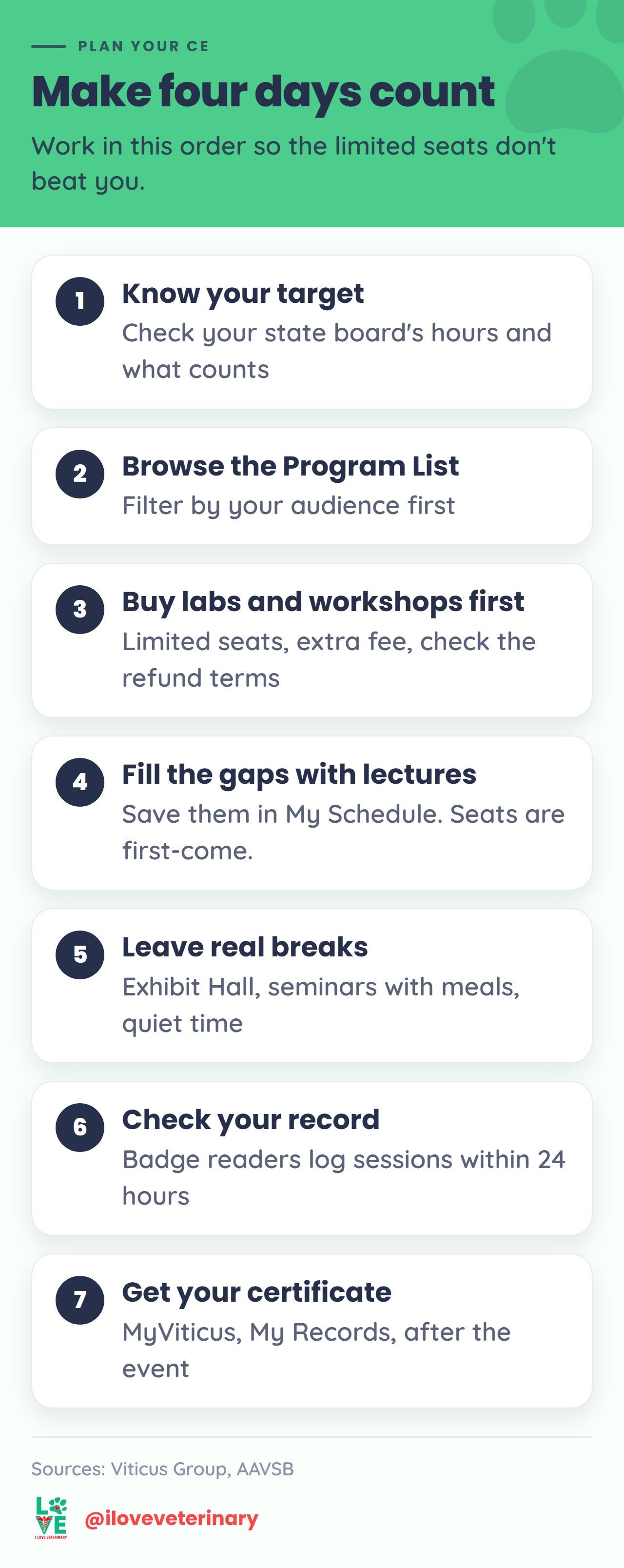
- Know your CE target first. Your state board sets how many hours you need, over what period, and which kinds of hours count. Check its current rules before you browse anything. WVC's CE is RACE-approved. RACE is the AAVSB's approval program for veterinary CE, and an approved course helps you meet license and credential requirements. Done when: you can write down your hour target and any category limits.
- Browse the Program List. The scientific program is public, and you can filter it by date, area, audience, type and speaker. Filter by your audience (veterinarian, technician, practice management) before anything else.
- Buy the limited sessions first. Labs, workshops and KNACK Tracks have capped seats and cost extra, so they come before lectures. Read the cancellation terms before you pay: lab refunds shrink as the date gets closer, and there is no refund inside 30 days. Done when: your paid sessions show up in My Schedule, which happens automatically once you buy them.
- Fill the gaps with lectures. Save the ones you want to My Schedule in your account or the Viticus Group app. Seats aren't reserved, so get to rooms that look popular a few minutes early.
- Leave real breaks. Block time for the Exhibit Hall, where you'll find new products, the Learning Hubs and career services. Industry seminars come with a complimentary breakfast or lunch, first-come, with limited seats. And block time for nothing at all: the 2027 Exhibit Hall has a quiet Zen Garden, a Cat Café and therapy dogs for a reason. Four days of back-to-back CE is a lot, and pacing yourself is part of protecting yourself from burnout.
- Check your record during the week. Session rooms have passive badge readers that log your attendance, and your My Record page updates within 24 hours. You can also mark sessions yourself. If a session you attended doesn't appear, sort it out while you still remember the room and time.
- Download your certificate afterward. After the conference, log in to MyViticus, open My Records and print your CE certificate or the record of sessions your board wants. Conference notes stay available in your account for six months, which helps with anything you only half caught.
One catch: CE certificates aren't issued to DVM students, vet tech students, retired veterinarians, general attendees or guests. They get a participation certificate instead.
Tips by role
Veterinarians
The hands-on labs are the part you can't get from a webinar, so plan your week around one or two of them. If you're leaning toward a specialty, a lab or KNACK Track in that area is a practical way to test the interest. Our overview of veterinary specialties covers the formal routes.
Vet techs
Look past the lecture list. The 2027 program includes tech-specific workshops (dental charting, anesthesia, bandaging) and point-of-care ultrasound labs written for technicians. In the 2027 Exhibit Hall, The Nest is a three-day home base for vet techs to recharge and meet peers. If you're thinking about a vet tech specialty (VTS), choose labs in that area so your CE pulls double duty. New to the field? Our guide to life as a vet tech covers the basics.
Students
Bring your current school ID (and, for vet tech students, the program director's letter). You won't get CE credit, so skip the certificate stress and go for breadth: sit in on specialties you haven't seen yet. For 2027, the Exhibit Hall Career Corner offers complimentary headshots, LinkedIn profile reviews and career coaching. If your school hosts an alumni reception, it's an easy way to meet practicing vets from your own school.
Practice managers
Qualifying practice management sessions can count toward the Certified Veterinary Practice Manager (CVPM) credential through VHMA. The 2027 workshops include practice ownership finances, team accountability and clinic social media. Our piece on veterinary practice management is a good primer for newer managers.
Before you go
- Register on the WVC Vegas registration page. Standard registration covers the CE sessions, general sessions, evening entertainment and the Exhibit Hall; labs and workshops are extra. Techs, assistants, practice managers and students each have their own category, so pick the right one.
- If your clinic is paying, the organizer has a ready-made "convince your boss" letter you can adapt.
- For 2027, Maritz is the official housing provider, with rooms at Mandalay Bay and nearby hotels on the hotel and travel page. The organizer warns that other companies offering WVC rooms may be illegitimate or non-refundable, so book through the official link.
- Wear business casual and comfortable shoes, and bring a sweater, because session rooms run cool. Labs require scrubs and closed-toe shoes.
- Las Vegas in February averages a high around 63°F and a low around 34°F, so pack a jacket for the evenings.
- Meals aren't included in registration. Plan on the convention center food court, the Exhibit Hall concessions or the industry seminars that serve breakfast or lunch.
If you do only three things now, block the dates, check your board's CE rules, and buy your labs before they sell out. The lectures will still be there.
Originally written by Sharmaine. Updated by the I Love Veterinary editorial team.
Sources
- Viticus Group: WVC Vegas 2027
- Viticus Group: WVC Vegas 2027 Education
- Viticus Group: WVC Vegas 2027 Hands-On Labs
- Viticus Group: WVC Vegas 2027 Workshops
- Viticus Group: Education Side Quests
- Viticus Group: KNACK Tracks
- Viticus Group: WVC Vegas 2027 Exhibit Hall
- Viticus Group: WVC Vegas 2027 Registration
- Viticus Group: Hotel and Travel Information
- Viticus Group: WVC Alumni Receptions
- Viticus Group: WVC Nashville
- Viticus Group: A History of Excellence
- Viticus Group Support: Who is eligible to attend the Annual Conference?
- Viticus Group Support: WVC Vegas participant badge types and eligibility
- Viticus Group Support: Do I sign up for each session I want to attend?
- Viticus Group Support: How do I browse the scientific program?
- Viticus Group Support: How do I keep track of the sessions I attended?
- Viticus Group Support: How do I access my CE certificate?
- Viticus Group Support: How long are conference notes available?
- Viticus Group Support: Cancellation and refund policy
- Viticus Group Support: Where and when is WVC Vegas 2026?
- Viticus Group Support: How many people attend the Annual Conference?
- Viticus Group Support: Can I bring a guest?
- Viticus Group Support: Are meals included?
- Viticus Group Support: What should I wear?
- Viticus Group Support: Las Vegas weather in February
- Viticus Group Support: Convince your boss
- AAVSB: About Approved CE (RACE)