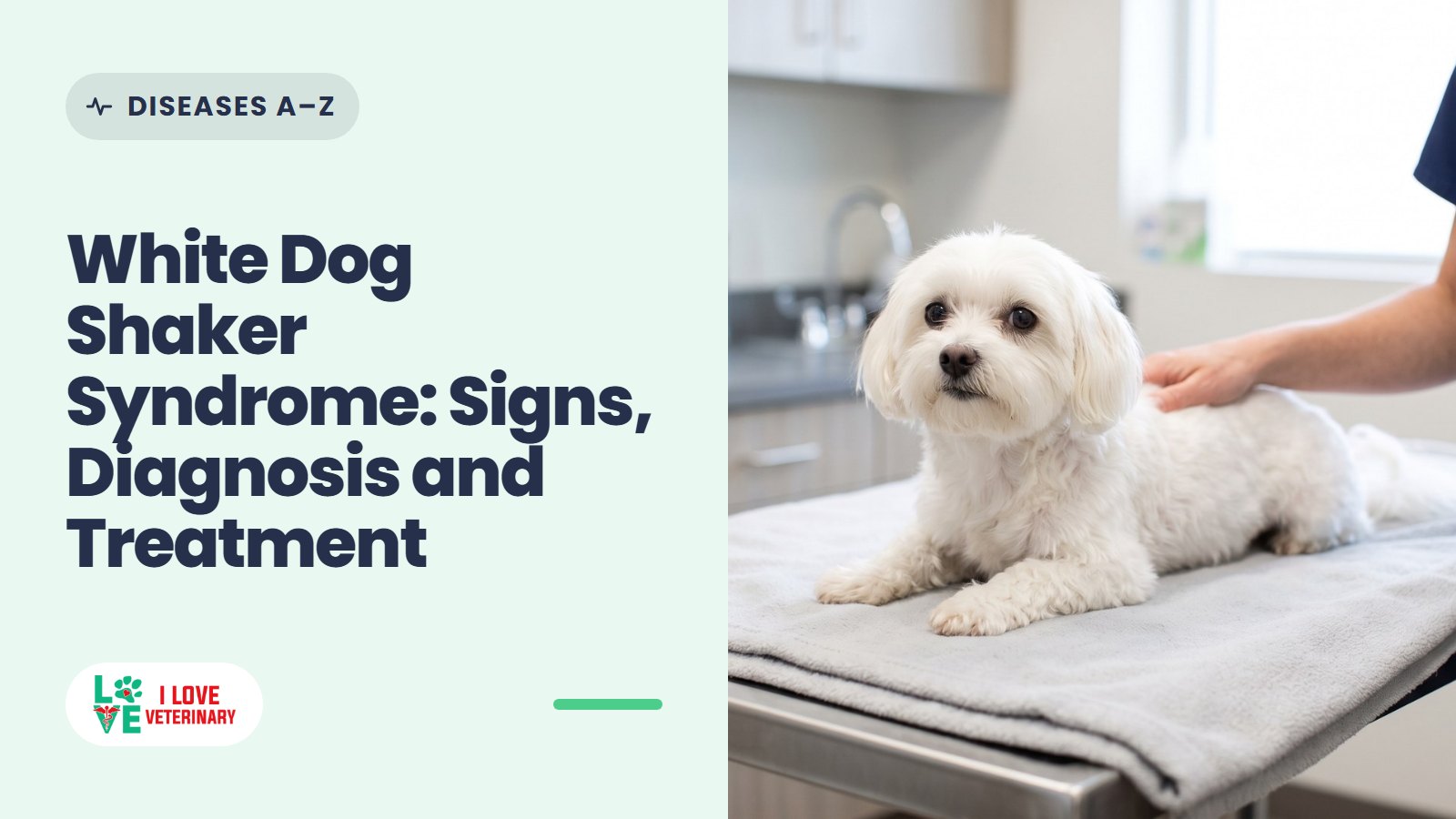
Does your dog's head look like a bobblehead figurine on the dashboard? Dogs with tremors don't have "Barkinson's", but a young, small dog that suddenly starts shaking all over could have white dog shaker syndrome.
White dog shaker syndrome is an inflammatory condition of the brain that causes fine, whole-body tremors, mostly in young, small dogs. It usually responds well to steroid treatment from a veterinarian, and most dogs do well. Shaker syndrome is not the most likely cause of sudden shaking, though. In a 2025 study of 198 dogs with whole-body tremors, poisoning came up more often than shaker syndrome. If your dog's shaking started suddenly, call your vet now. The Call now list is further down this page.
Why Is My Dog's Head Bobbing?
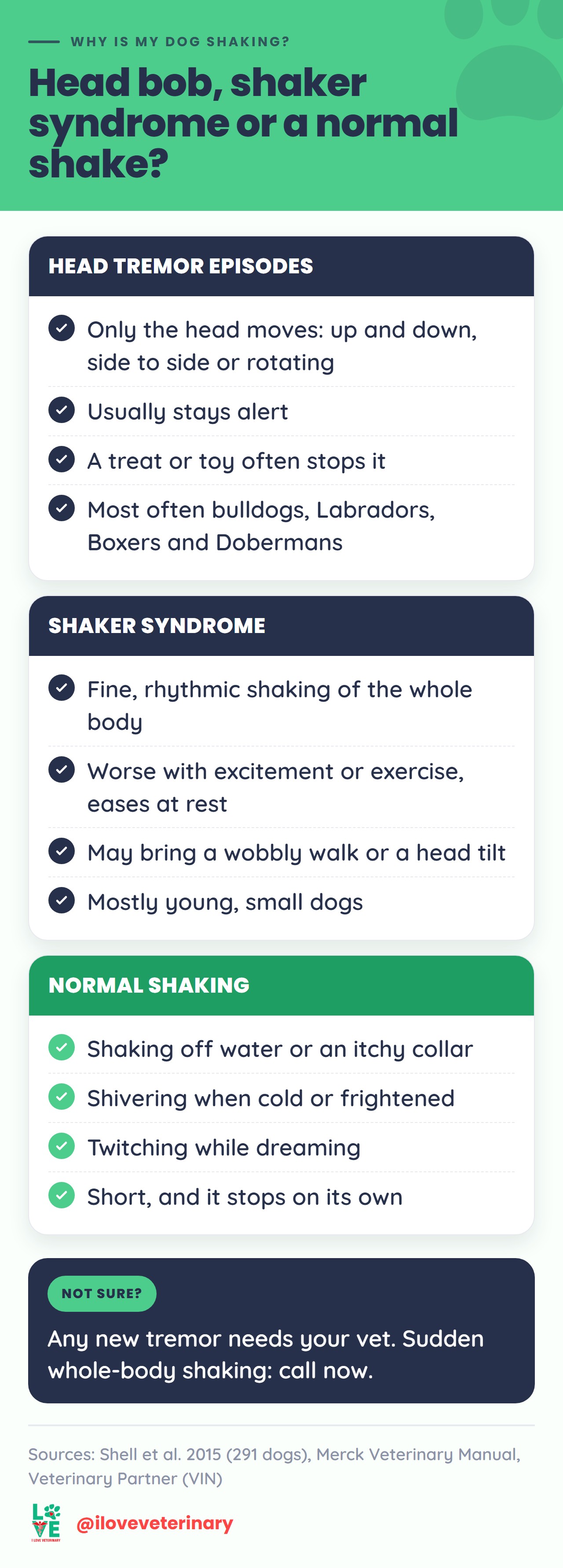
Head bobbing on its own is usually a different condition. Idiopathic head tremor syndrome causes episodes of up-and-down, side-to-side or rotating head movements while the rest of the body stays still. In a study of 291 dogs, bulldogs, Labrador Retrievers, Boxers and Doberman Pinschers made up 69% of cases. Most dogs stayed alert during an episode, and a distraction such as a treat or toy stopped the bobbing in 87% of them.
White dog shaker syndrome is different: the tremor involves the whole body, not just the head, and it gets worse when the dog is excited or moving. Both conditions need a vet to look at them, because other diseases can look similar.
Not every shake is a tremor, either. Dogs shiver when they are cold or frightened, twitch while dreaming, and shake off water or an itchy collar. A tremor is rhythmic, involuntary and keeps going. If you are unsure which you are seeing, our guide on why dogs shake covers the everyday reasons and the medical ones.

What Is White Dog Shaker Syndrome?
White dog shaker syndrome is a tremor disorder caused by mild inflammation in the brain, most of it in the cerebellum, the part of the brain that coordinates movement. The Merck Veterinary Manual describes mild tremors that are most obvious during excitement or exercise.
It was first described in small white dogs such as the Maltese, West Highland White Terrier and Bichon Frise, which is where the name comes from. Since then it has been reported in dogs of many breeds, sizes and coat colors, which is why recent studies use the more neutral name idiopathic generalized tremor syndrome.
You may see it called:
- Steroid-responsive tremor syndrome
- Idiopathic generalized tremor syndrome (IGTS)
- Shaker dog syndrome
- Little white shaker syndrome
- Idiopathic cerebellitis
Most affected dogs are young adults that weigh under about 33 pounds (15 kg). In a UK study of 75 dogs, the median age was 17 months, with a range from 6 months to about 10 years, and about two thirds were female.
Signs of White Dog Shaker Syndrome
The signs usually start suddenly and can get worse over the following days. Look for:
- Fine, rhythmic shaking of the whole body, sometimes most obvious in the head.
- Tremors that get worse with excitement, stress, handling or exercise.
- Tremors that ease when the dog rests, and may stop during sleep.
- A wobbly or wide-based walk, or trouble judging steps.
- A head tilt or nystagmus, which means involuntary, rhythmic eye movements.
- A reduced blink when a hand moves toward the eye, which your vet checks as the "menace response".
- Poor appetite, vomiting or a mild fever in some dogs.
In severe cases the shaking makes it hard to eat, drink or walk. Most dogs stay alert and aware, and seizures are possible but rare. None of these signs tells you at home whether the cause is shaker syndrome or a poison, so a new tremor always needs your vet.
If you can, take a short video of an episode on your phone. It shows your vet exactly what happens at home, even if your dog is calmer at the clinic.

What Else Causes Tremors in Dogs?
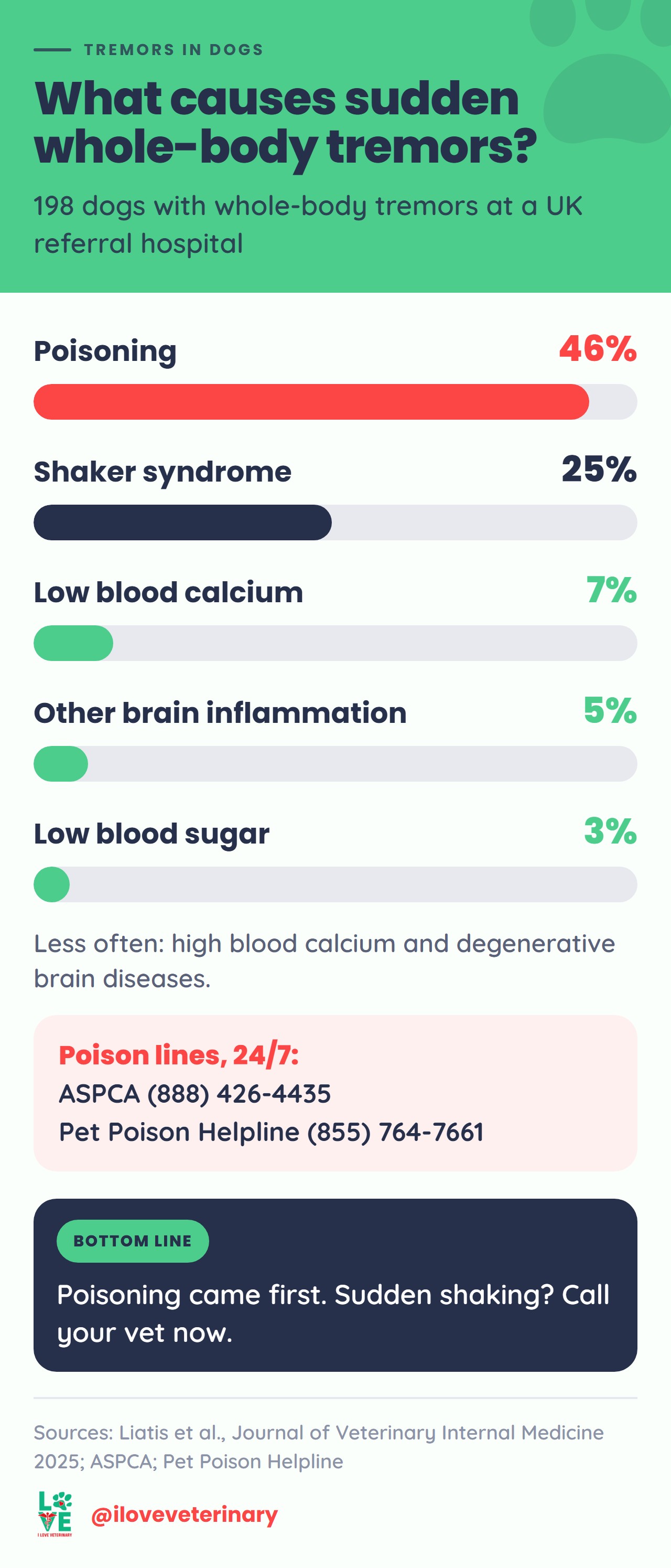
Shaker syndrome is only one of several causes of whole-body tremors, and it is not the most common. A 2025 study of 198 dogs with whole-body tremors at a UK referral hospital found:
- Poisoning: 46% of dogs. The toxins included moldy food (tremor-causing mycotoxins), slug and snail bait (metaldehyde), certain parasite-control drugs (avermectins), cannabis, chocolate, permethrin insecticide and a diet bar with xylitol and caffeine. In about a third of the poisoned dogs, the toxin was never identified.
- Shaker syndrome: about 1 in 4 dogs (25%).
- Low blood calcium: about 7%. This can affect nursing mother dogs.
- Other kinds of brain inflammation (meningoencephalitis of unknown origin): about 5%.
- Low blood sugar: 3%. Our article on hypoglycemia symptoms in dogs explains who is at risk.
- High blood calcium and degenerative brain diseases, less often.
Infections such as canine distemper can also cause twitching and tremors, especially in unvaccinated dogs.
Moldy food is easy to overlook. Pet Poison Helpline lists garbage, compost piles, old bread, cheese and nuts as common sources. For more toxins that affect the nervous system, see what toxins can cause seizures in dogs.
What causes shaker syndrome itself?
Nobody knows for sure. The leading theory is that the immune system attacks the brain, causing mild inflammation in the cerebellum. That fits with the way most dogs improve on steroids, which calm the immune system. A 2024 study of 33 dogs found antibodies against nerve tissue in a few of them, which supports the immune theory for at least some dogs.
Because certain breeds show up often, a genetic part is possible, but no inheritance pattern has been proven.
When to Call Your Vet
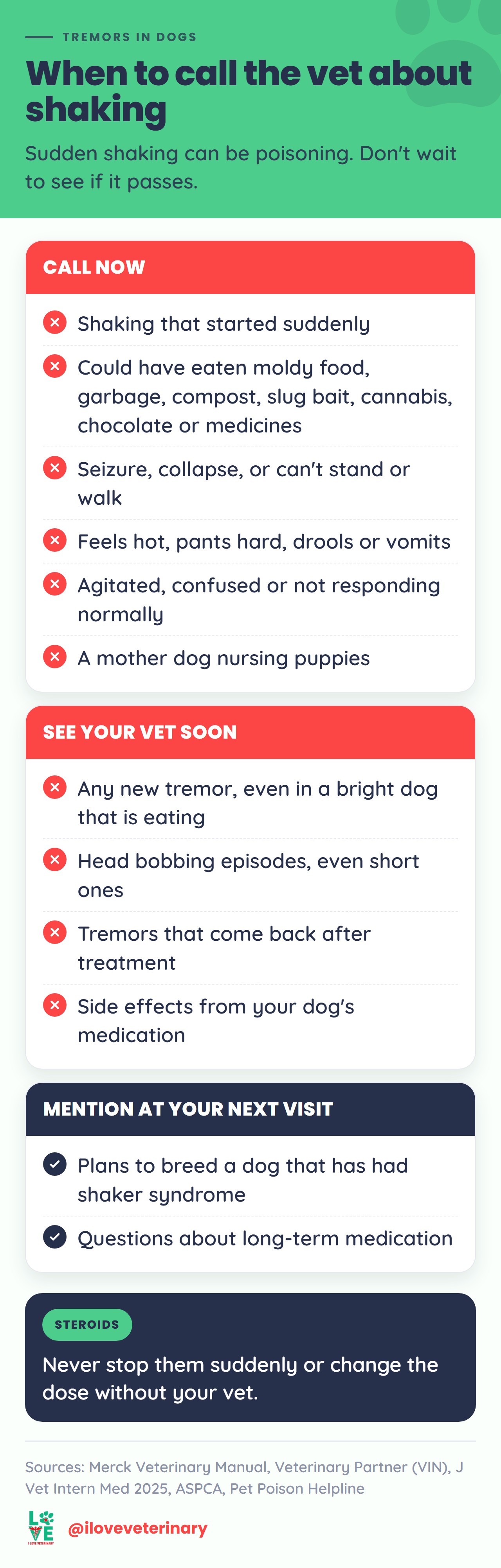
Call now
Call your vet or an emergency clinic right away if your dog has tremors and:
- The shaking started suddenly, especially if your dog could have eaten something it shouldn't (moldy food, garbage, compost, slug bait, cannabis, chocolate or medicines).
- Your dog has a seizure, collapses or can't stand or walk.
- Your dog feels hot, pants hard, drools or vomits. Severe tremors can push body temperature up to dangerous levels.
- Your dog seems agitated, confused or doesn't respond to you normally.
- Your dog is a mother nursing puppies.
If you suspect poisoning, you can also call ASPCA Animal Poison Control at (888) 426-4435 or Pet Poison Helpline at (855) 764-7661. Both answer 24 hours a day, and a consultation fee may apply. Don't wait to see whether the tremors pass on their own.
See your vet soon
Call today to book a visit for:
- Any new tremor, even if your dog seems bright and is eating.
- Head bobbing episodes, even if they stop quickly.
- Tremors that come back after treatment, or side effects from your dog's medication.
Mention at your next visit
- Plans to breed a dog that has had shaker syndrome.
- Questions about long-term medication, which your vet checks at regular rechecks.
How Vets Diagnose Shaker Syndrome
There is no single test for white dog shaker syndrome. It is a diagnosis of exclusion: your vet rules out the other causes first, and shaker syndrome is what remains.
That process usually starts with questions. Your vet will want to know when the shaking started, whether it is getting worse, and anything your dog could have eaten, chewed or been treated with. The answers matter. In the 198-dog study, poisoned dogs more often showed agitation, drooling, wide pupils and changes in awareness, while dogs with shaker syndrome more often had a head tilt, abnormal eye movements, a wobbly walk and a poor appetite.
Next comes a full physical and neurological exam, then tests such as:
- Blood tests, including blood sugar, calcium and other electrolytes, plus liver and kidney values.
- A urine test.
- Tests for infections such as distemper, depending on your dog's vaccine history and where you live.
If those are normal, your vet may refer your dog to a veterinary neurologist. An MRI scan of the brain can rule out problems such as tumors (see our guide to cancer in dogs) and other brain diseases. A spinal tap collects a small sample of the fluid around the brain and spinal cord. In dogs with shaker syndrome, the MRI is usually normal and the fluid often shows mild inflammation.
Not every dog needs the full workup. When the history and tests point that way, and poisoning and metabolic causes have been ruled out, some vets start a trial of steroids and watch the response. A quick improvement supports the diagnosis, but it does not prove it on its own, since other inflammatory brain diseases can also respond to steroids.
How Vets Treat White Dog Shaker Syndrome
The main treatment is a corticosteroid, an anti-inflammatory steroid medicine that also calms the immune system. In the two recent studies of 75 and 33 dogs, every dog received prednisolone. Your veterinarian chooses the drug and the dose for your dog.
Response is often fast. In a study of 24 dogs with generalized tremors, 80% of dogs responded to immune-suppressing treatment within 3 days. Most dogs improve within one to two weeks. Once the tremors are controlled, your vet lowers the dose slowly over time. This is called a taper. The goal is the smallest amount that keeps the tremors away, or no medication at all.
Some dogs also get a short-term sedative or muscle-relaxing medicine at the start to calm severe tremors. Dogs that respond poorly to steroids, or have strong side effects, may need another immune-suppressing medicine.
Long-term steroid use can cause side effects. According to the Merck Veterinary Manual and the 2024 study, these include:
- Drinking and peeing more.
- A bigger appetite.
- Tiredness.
- Muscle loss and thinning hair.
- A higher risk of infections, including urinary tract infections.
- Signs of Cushing's syndrome caused by the medicine itself.
Never stop steroids suddenly or change the dose on your own. After long-term use, the body makes less of its own steroid hormones, and a sudden stop can cause a dangerous crisis with weakness, vomiting and diarrhea. If you notice side effects, call your vet. They can adjust the plan safely.
There is no proven home treatment for shaker syndrome. Talk to your vet before giving any supplement or calming product.
Outlook for Dogs With Shaker Syndrome
The outlook is good for most dogs. Many can come off medication after the taper, and others stay well on a low long-term dose.
Relapses do happen. In the 75-dog UK study, about 1 in 5 dogs had tremors come back at some point, and about 1 in 8 kept mild signs over time. A relapse is usually managed by restarting or adjusting treatment, so call your vet at the first sign of shaking.
Which Breeds Get Shaker Syndrome?
The condition was first described in small white breeds, and these still come up often:
- Maltese
- West Highland White Terrier
- Bichon Frise
- Poodle
The breed picture has widened. In the 75-dog UK study, crossbreeds were the largest group (41%), followed by West Highland White Terriers (15%) and Cocker Spaniels (11%). In an earlier US study of 24 dogs, more than half were nonwhite mixed breeds. Small dogs dominate, but dogs up to about 57 pounds (26 kg) have been diagnosed.
Can White Dog Shaker Syndrome Be Prevented?
There is no known way to prevent it. The cause is unknown, and no genetic test or proven inheritance pattern exists. If you own an affected dog and are thinking about breeding, talk to your veterinarian or your breed club first.
What you can control is the more common cause of sudden tremors: keep garbage, compost, moldy food, slug bait, cannabis, chocolate and medicines out of your dog's reach.
Summary
White dog shaker syndrome causes whole-body tremors, mostly in young, small dogs, and it usually responds well to steroids prescribed and tapered by a veterinarian. Because poisoning causes sudden tremors more often, any new shaking deserves a call to your vet, and sudden shaking deserves a call now. With treatment and regular checkups to watch for medication side effects, most dogs go on to live good lives.
Originally written by Dr. Kaylee Ferreira. Updated by the I Love Veterinary editorial team.
Sources
- Merck Veterinary Manual: Meningitis, Encephalitis, and Encephalomyelitis in Animals
- Liatis T, Bhatti SFM, De Decker S. Generalized Tremors in Dogs: 198 Cases (2003-2023). Journal of Veterinary Internal Medicine, 2025
- Phillipps S, et al. Idiopathic generalised tremor syndrome in dogs. Veterinary Record, 2022
- Kajin F, et al. Canine idiopathic generalized tremor syndrome, immune-mediated? Frontiers in Veterinary Science, 2024
- Wagner SO, Podell M, Fenner WR. Generalized tremors in dogs: 24 cases (1984-1995). JAVMA, 1997
- Shell LG, et al. Clinical and Breed Characteristics of Idiopathic Head Tremor Syndrome in 291 Dogs. Veterinary Medicine International, 2015
- Veterinary Partner (VIN): Tremoring or Shivering in Dogs
- Merck Veterinary Manual: Corticosteroids in Animals
- Merck Veterinary Manual: Metaldehyde Poisoning in Animals
- ASPCA Animal Poison Control
- Pet Poison Helpline: The Dangers of Mycotoxins in Dogs
- VCA Animal Hospitals: Shaker Syndrome in Dogs
This article is for general information and is not a substitute for advice from your veterinarian.