
Testicular torsion happens when the spermatic cord, the bundle that carries blood to a testicle, twists and cuts off that blood supply. In a dog with both testicles in the scrotum, it shows up as a sudden, painful, swollen testicle. In a dog with a testicle that never came down, it shows up as sudden belly pain, because the twisted testicle is inside the abdomen where you can't see it.
Either way, it is an emergency. Call your veterinarian or the nearest emergency hospital now.
Symptoms of Testicular Torsion in Dogs
Torsion is rare in dogs, and its signs overlap with other emergencies, so the clue is often the combination: an intact (not neutered) male plus sudden pain.
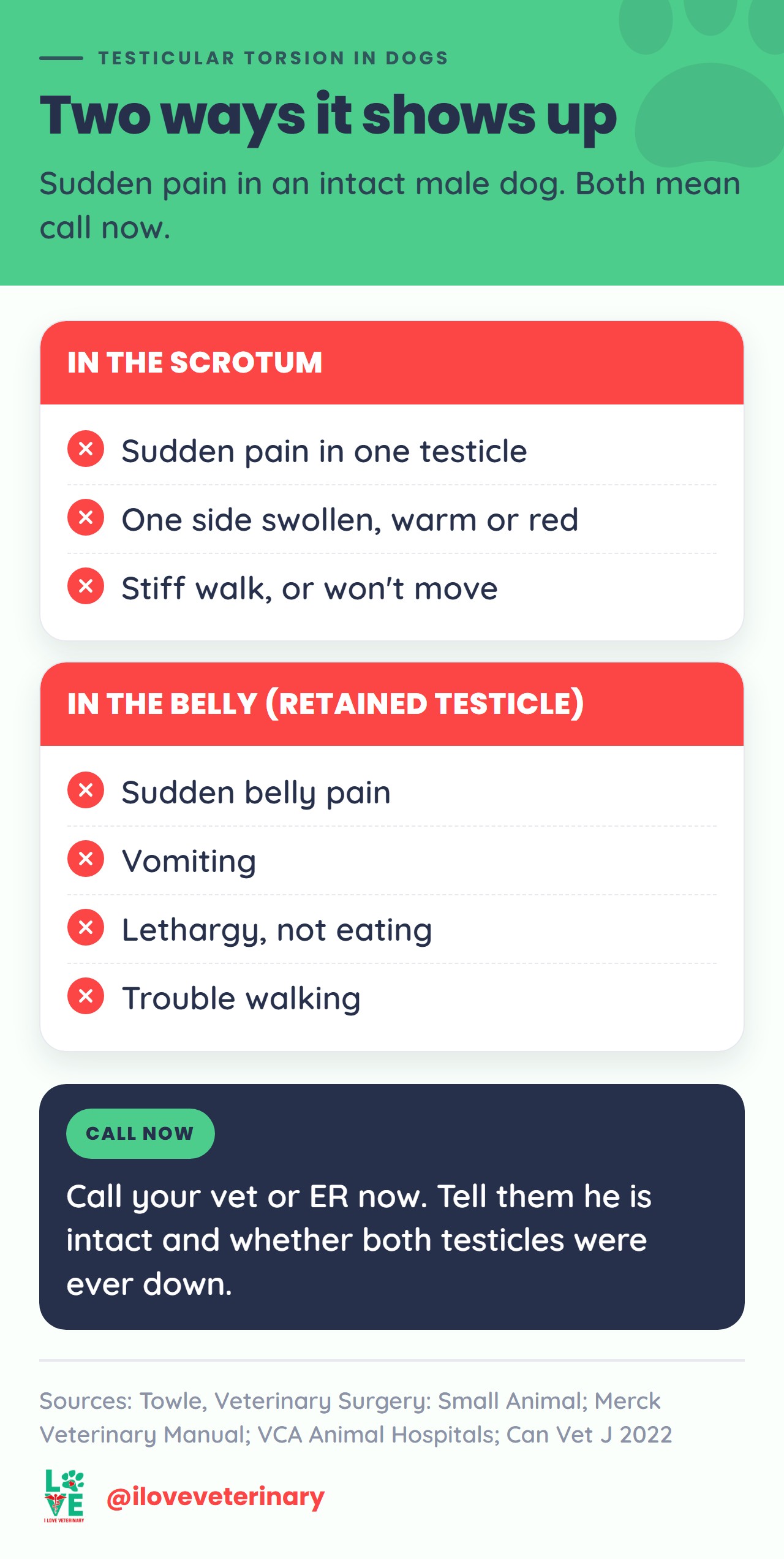
When the twisted testicle is in the scrotum:
- Sudden pain in one testicle, sometimes spreading toward the belly
- One side of the scrotum swollen, warm or red
- A stiff walk, or not wanting to move
When the twisted testicle is retained in the belly (the more common situation in reported cases):
- Sudden belly pain or discomfort
- Vomiting
- Lethargy and not eating
- Trouble walking
- Signs of shock
Either form can also bring a fever.
Dogs with a twisted retained testicle sometimes show only vague signs at first, like vomiting and lethargy. That is why the testicle history matters so much (more on that below).
What to Do Right Now
- Call your vet or an emergency hospital now. Damage from a twisted cord becomes irreversible within hours, according to the Merck Veterinary Manual.
- Tell them he is an intact male and whether both testicles have always been in the scrotum. A dog with a retained testicle and belly pain needs torsion on the list from the start.
- Don't wait to see if it passes. A twisted cord can sometimes untwist on its own, so pain that eases is not proof the problem is over. Let the vet check.
What Is Testicular Torsion?
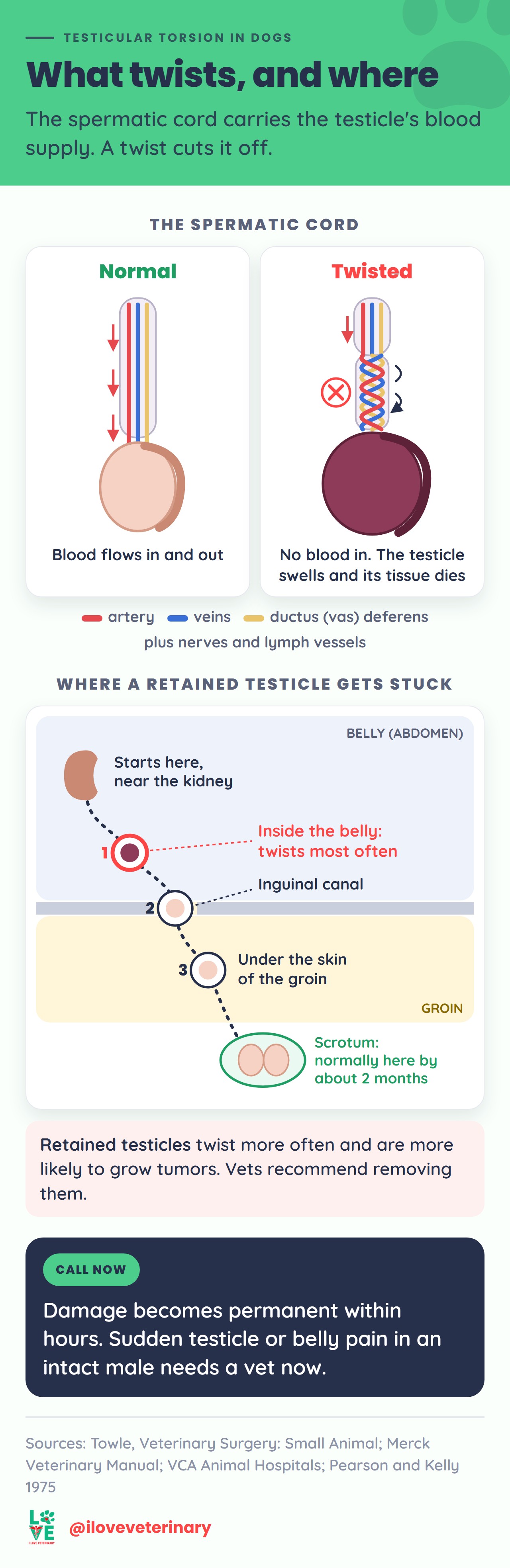
Each testicle hangs from a spermatic cord. Inside that cord run the testicular artery, a web of veins (the pampiniform plexus), lymph vessels, nerves and the ductus deferens, also called the vas deferens, the tube that carries sperm from the epididymis toward the prostate and urethra. The epididymis is the tightly coiled tube attached along the testicle that collects sperm and leads into the ductus deferens.
When the testicle rotates, the cord wraps around itself like a wrung towel. A partial twist slows blood flow; a complete twist stops it. Without blood, the testicle swells and the tissue starts to die. In a scrotal torsion, all of this happens inside the scrotum, the skin sac that holds the testicles, so you see the swelling.
That damage becomes permanent within hours, which is why torsion is an emergency. Some dogs also go into shock, and the surgery textbook Veterinary Surgery: Small Animal is blunt about the stakes: without prompt diagnosis and surgery, death can occur.
Which Dogs Are at Risk?
Dogs with a retained testicle are the main risk group. A retained (undescended) testicle is called cryptorchidism. Puppies' testicles start near the kidneys and are normally down in the scrotum by about two months of age, according to VCA Animal Hospitals. If one is still missing after that, it is probably stuck somewhere along the way:
- inside the abdomen, near the kidney
- in the inguinal canal, the passage through the belly wall into the groin
- under the skin in the groin, between the canal and the scrotum
Retained testicles twist more often than testicles in the scrotum. In a 1975 review of 13 dogs with torsion, 11 had the twisted testicle inside the abdomen. Retained testicles are also more likely to grow tumors, and a heavy, tumor-enlarged testicle is even more prone to twisting. Tumors appeared to be behind most cases in that review. Torsion of a normal-sized retained testicle can still happen, mostly in young dogs: one published case was a 14-week-old puppy with belly pain.
Read more in our guide to cryptorchidism in dogs.
Scrotal torsion is less common, but it happens. It has been reported in dogs with both testicles down, including young dogs.
Cryptorchidism occurs in all breeds. Toy and small breeds are at higher risk, and breeds reported with more cases include Chihuahuas, Yorkshire terriers, Pomeranians, poodles, miniature Schnauzers, Shetland sheepdogs, Siberian huskies, shih tzus, German shepherds and boxers. Any intact male with a retained testicle is at risk, whatever his breed.
Swollen Testicle: Torsion or Something Else?
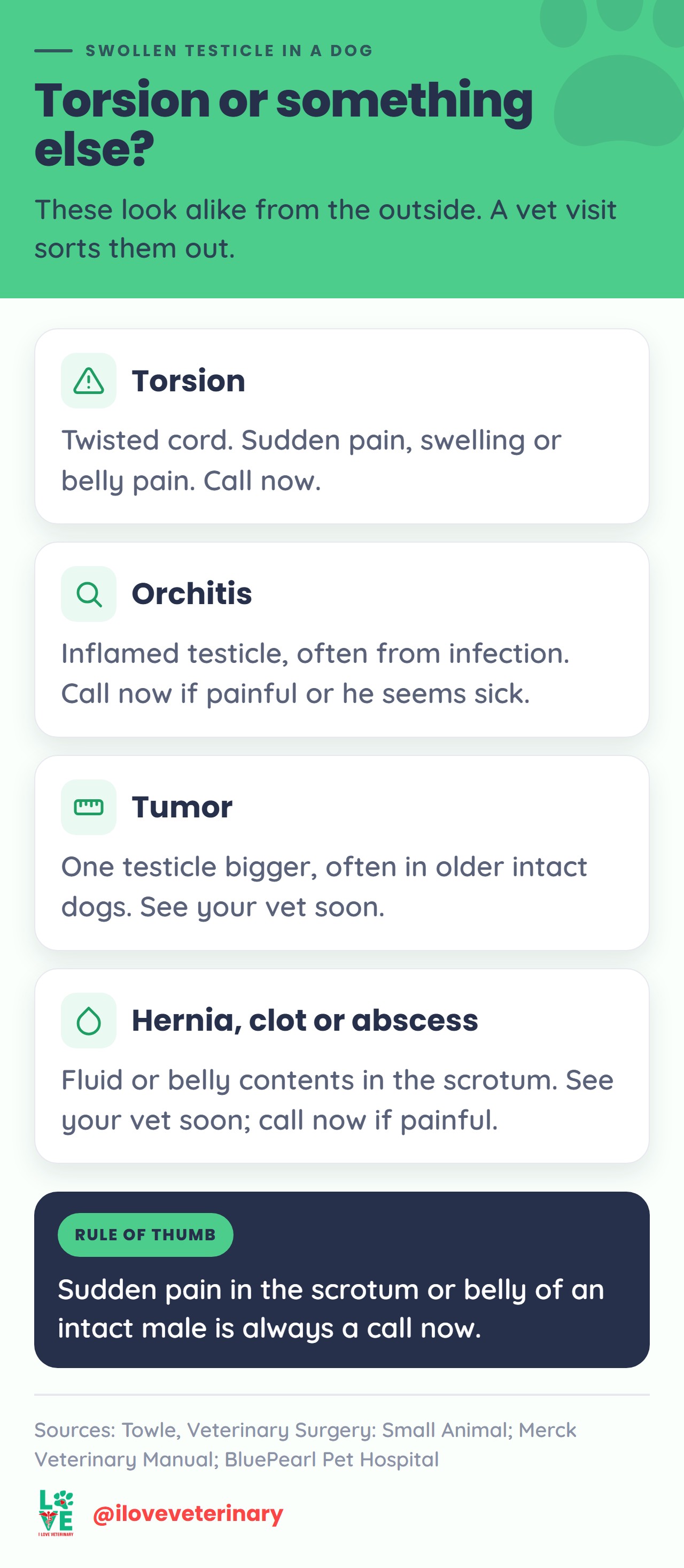
A swollen or painful testicle has several possible causes, and torsion, infection and tumors can look alike from the outside. A vet visit sorts them out.
Possible cause | What it is | How soon to see a vet |
|---|---|---|
Testicular torsion | Twisted spermatic cord; sudden pain, swelling or belly pain | Call now |
Orchitis or epididymitis | Inflammation of the testicle or epididymis, often from infection or injury; pain, swelling, fever, stiff walk | Call now if painful or he seems sick; otherwise see your vet soon |
Testicular tumor | Swelling in one or both testicles, or one testicle bigger than the other, often in older intact dogs | See your vet soon |
Scrotal hernia, blood clot (hematoma) or abscess | Belly contents, blood or pus collecting in the scrotum | See your vet soon; call now if painful |
Infections behind orchitis include bacteria such as Brucella canis, viruses such as canine distemper, fungi, and rickettsial infections such as Rocky Mountain spotted fever. Vets recommend testing dogs with orchitis for brucellosis. For tumors, see our guide to testicular cancer in dogs.
How Vets Diagnose Testicular Torsion
The vet starts with the history (is he intact, were both testicles ever down, when did the pain start) and a physical exam. The area is often too painful to handle, so some dogs need sedation or anesthesia to be examined properly. In the belly form, the vet may feel an abnormal mass in the abdomen.
Tests that help:
- Ultrasound with color Doppler. This is the key test. It finds a retained testicle and shows blood flow; a completely twisted cord shows no flow. It also helps rule out look-alikes such as a hernia, blood clot or tumor.
- Blood work and urinalysis to check how sick he is and look for other problems.
- X-rays can sometimes show a mass but often miss a retained or twisted testicle.
- CT scan when the ultrasound is unclear.
Sometimes the final answer only comes at surgery, when the surgeon sees the twisted cord.
Treatment: Emergency Surgery
Surgery is the treatment for testicular torsion. The surgeon removes the twisted testicle. A testicle retained in the belly is reached through an incision in the abdomen. If he is a breeding dog with both testicles down, ask your vet about the options.
Because cryptorchidism is likely inherited and retained testicles are prone to tumors, vets generally recommend removing both testicles in a dog with a retained testicle, which means neutering him. If an infection or tumor is part of the picture, your vet treats that too, and the removed testicle may be sent to a lab to check for a tumor.
Recovery and Outlook
The outlook is good when the twisted testicle is found and removed quickly. Dogs whose torsion started from a tumor have an outlook that depends on the tumor type; surgery cures most testicular tumors. The twisted testicle itself is lost.
Going home after surgery usually looks like this:
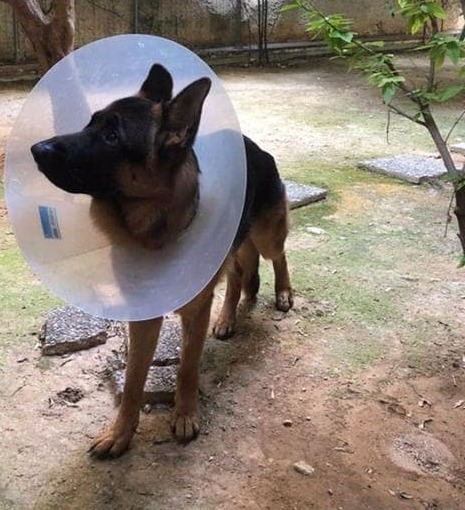
- A cone or recovery suit so he can't lick or chew the incision.
- Rest. Keep him calm and confined, with short leash walks for bathroom breaks only, for as long as your vet says. No running, jumping, stairs or rough play.
- Incision checks. Look at the incision for redness, swelling or discharge. Mild redness and swelling early on can be normal; anything getting worse is not.
- Keep it dry and clean. No baths, and put nothing on the incision unless your vet tells you to.
- Call your vet if the incision looks worse, or if he seems unwell or is getting worse instead of better.
Your vet's discharge instructions come first; they are written for his surgery.
Can You Prevent Testicular Torsion?
You can lower the risk a lot:
- Make sure both testicles come down. Puppy exams check this. If one is still missing after about two to four months of age, your vet may diagnose cryptorchidism, though some wait until around six months to be sure.
- Neuter a dog with a retained testicle. The Merck Veterinary Manual recommends removing retained testicles in all companion animals, because the condition is likely inherited and raises the risk of testicular tumors. VCA notes the outlook is excellent when it's done early, before problems develop. Dogs with a retained testicle should not be bred.
- For other dogs, neutering removes the risk entirely, since there is no testicle left to twist. The right age to neuter depends on your dog; talk it through with your vet.
- Know what normal looks like. If you notice one side of the scrotum bigger, firmer or tender, or a testicle that seems to be missing, book a vet visit. Sudden pain means call now.
Testicular Torsion FAQ
Can a neutered dog get testicular torsion? Not if both testicles were removed. But a dog can look neutered and still have a testicle inside his belly. If your dog has no visible testicles but acts like an intact male, your vet can run hormone tests to check whether a retained testicle is still there.
Can testicular torsion fix itself? A twisted cord can sometimes untwist on its own, but that doesn't mean the testicle is safe. Any episode of sudden testicle or belly pain in an intact male needs a vet.
Can puppies get testicular torsion? Yes, though it is rare. One reported case was a 14-week-old puppy with a retained testicle who came in for sudden lethargy and belly pain.
Is testicular torsion painful for dogs? Yes. Sudden pain is the hallmark sign, whether it shows in the scrotum or the belly.
Originally written by Alianna Munakata. Updated by the I Love Veterinary editorial team.
Sources
- Merck Veterinary Manual: Orchitis and Epididymitis in Dogs and Cats
- Merck Veterinary Manual: Reproductive Disorders of Male Dogs
- Merck Veterinary Manual: Male Genital Abnormalities of Animals
- Towle HA, Testes and Scrotum, Veterinary Surgery: Small Animal (Veterian Key)
- VCA Animal Hospitals: Retained Testicle (Cryptorchidism) in Dogs
- VCA Animal Hospitals: Surgical Discharge Instructions for Dogs
- Slaughter SA et al., Computed tomography of testicular torsion in a juvenile dog with unilateral cryptorchidism, Can Vet J 2022
- Pearson H, Kelly DF, Testicular torsion in the dog: a review of 13 cases, Vet Rec 1975
- Quartuccio M et al., Sertoli cell tumors and spermatic cord torsion in two cryptorchid dogs, J Vet Sci 2012
- Viliotti TAA et al., Testicular Torsion in the Scrotum of a Young Canine, Acta Scientiae Veterinariae 2018
- Computed Tomographic Features in a Case of Bilateral Neoplastic Cryptorchidism with Suspected Torsion in a Dog, Front Vet Sci 2016
- BluePearl Pet Hospital: Testicular Tumors in Dogs
This article is for general information and is not a substitute for advice from your veterinarian.