
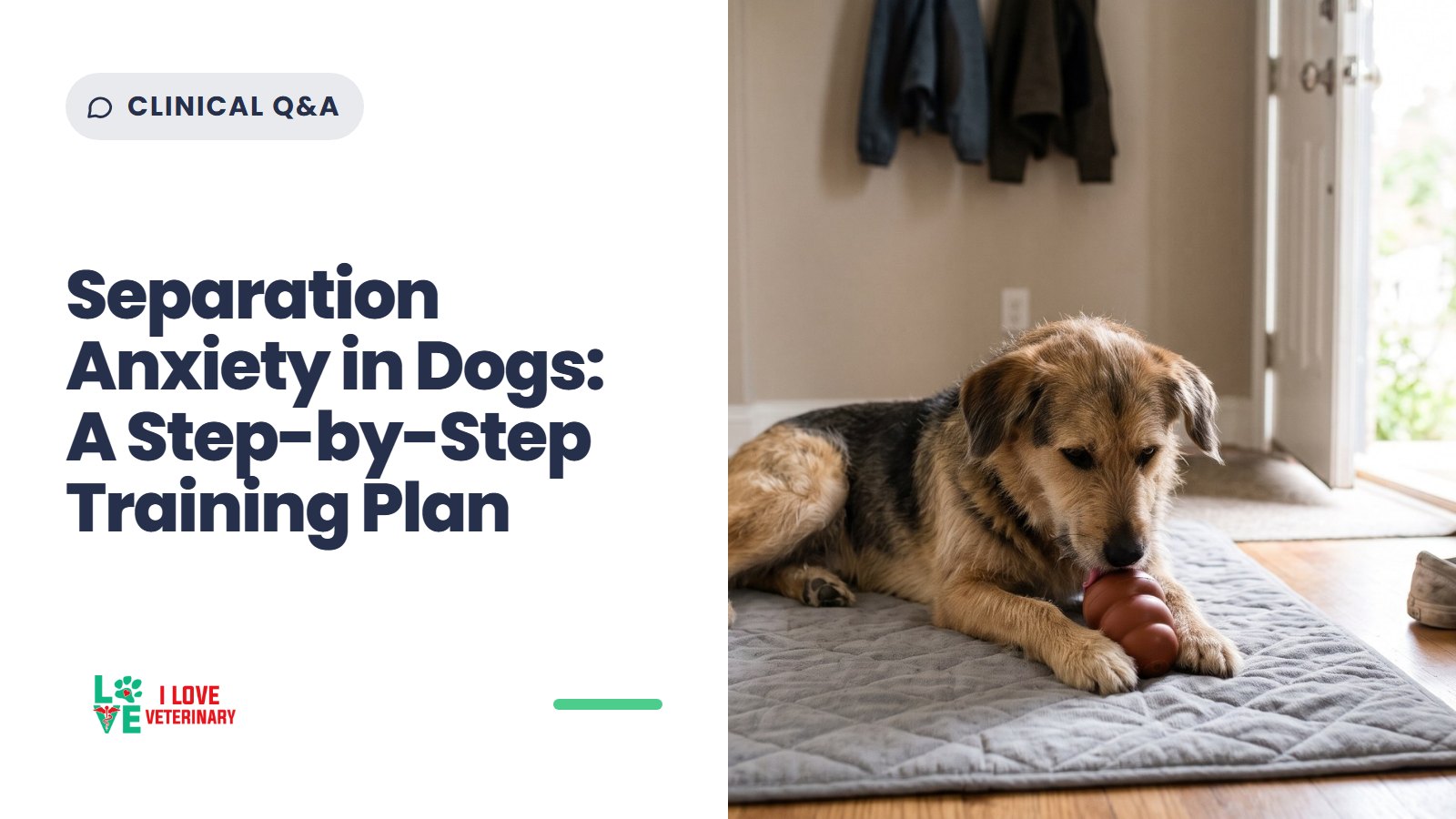
Dog separation anxiety training works by teaching your dog that being alone is safe, in steps so small your dog never panics. You start with absences of a few seconds, build up slowly, and back off the moment you see stress. Get a vet check first, never punish, and expect it to take weeks to months rather than days.
Is It Separation Anxiety? Signs to Look For
Separation anxiety is distress a dog feels when it is apart from the people it is attached to, or when it expects to be. It is a panic response, not spite or bad manners.
Common signs when your dog is alone:
- Barking, howling or whining that keeps going with nothing outside to set it off
- Chewing or digging at doors, door frames and windows, sometimes with broken teeth or torn nails
- Peeing or pooping indoors in a dog that is house trained when you're home
- Pacing in the same path or circles
- Escape attempts, drooling, trembling, or refusing food left for them
Timing is a clue. Signs usually start within the first 15 to 30 minutes after you leave, according to the Merck Veterinary Manual. Many dogs also get anxious while you get ready (shoes, keys, bag) and greet you as if you had been gone for a year.
What sets it off
The ASPCA lists the situations most often linked to it: a new home or family (including adoption from a shelter), a sudden change in schedule, a move, or losing a family member to death or a move away. A single frightening event while alone can also trigger it.
Loving your dog didn't cause it. Merck notes that dogs who follow their people around are at no greater risk than dogs who don't. Some studies have linked very intense attachment to separation problems, so the research isn't settled, and either way the fix is the same: training.
Separation Anxiety vs Boredom (and Other Look-Alikes)
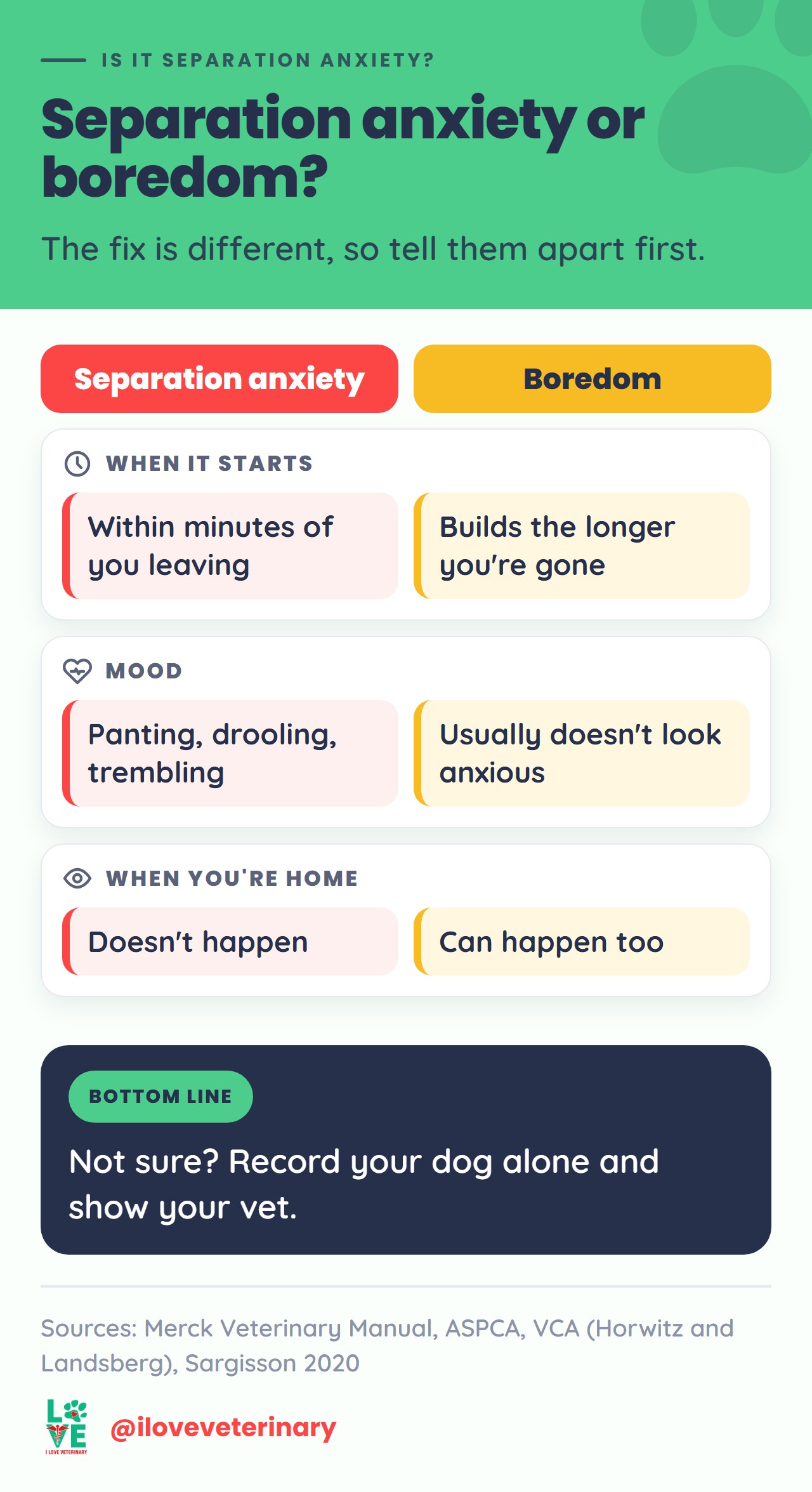
Plenty of dogs wreck a cushion when left alone and don't have separation anxiety. The fix is different, so it pays to tell them apart.
What you see | Likely separation anxiety | Other causes to rule out |
|---|---|---|
When it starts | Within minutes of you leaving, peaking early | Boredom builds the longer the dog is alone |
Mood | Panting, drooling, trembling, frantic | Bored dogs usually don't look anxious |
When you're home | Doesn't happen | Happens when you're home too: think house training, play, or a medical cause |
Barking | Constant, no outside trigger | Reacting to noises, people or dogs outside (why dogs bark) |
Peeing indoors | Only when alone | Incomplete house training, marking, or a medical problem like urinary incontinence |
Panic in a crate or closed room | Upset with no one home at all | Confinement anxiety: distress at being shut in, even with people around |
Veterinary behaviorists Debra Horwitz and Gary Landsberg put the rule of thumb simply on VCA Animal Hospitals: if the behavior also happens while you're home, look at other causes first. Noise fears (storms, fireworks) can look like separation trouble too.
Before You Start: Vet Check and a Camera
See your vet first. House soiling can come from a urinary infection, bladder stones, diabetes, kidney disease and other medical problems, and some medicines make dogs pee more. Rule those out before you treat it as behavior.
Record your dog alone. Merck calls video "an invaluable diagnostic tool", and veterinary behaviorist Melissa Bain calls it imperative. A phone or pet camera shows what happens after the door closes, how fast it starts, and the quiet signs (pacing, panting, lip licking) that leave no chewed door behind. Later, it tells you whether training is working.
Dog Separation Anxiety Training, Step by Step
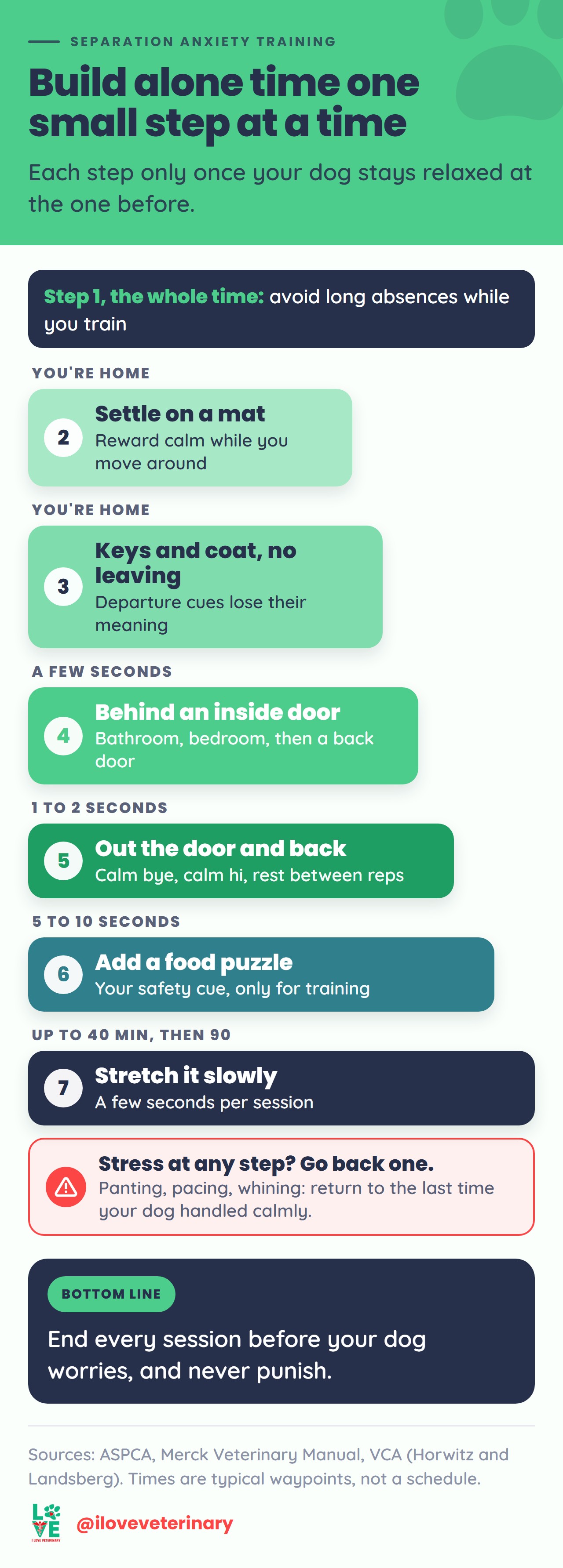
The method is called desensitization and counterconditioning: you expose your dog to tiny, bearable versions of being alone (desensitization) and pair them with something good, like food (counterconditioning). A 2020 review of the research found this combination the most effective behavioral treatment.
The idea that holds it together is staying under threshold. Your dog's threshold is the point where calm turns into worry, and every session should end before your dog reaches it.
- Avoid long absences while you train. Try not to leave your dog alone longer than it can handle, because each panic undoes progress. Merck advises leaving these dogs alone as rarely as possible. The ASPCA suggests a friend, family member or sitter at home, doggy daycare, or taking your dog to work. Most dogs with separation anxiety are fine as long as someone is with them, and it doesn't have to be you.
- Teach a relaxed "settle" on a mat or bed. Reward your dog for lying calmly on its spot while you move around the house, then while you step further away. As Horwitz and Landsberg put it, a dog that can't relax while you're home is unlikely to relax when you leave.
- Take the sting out of departure cues. If your dog worries when you pick up keys or put on shoes, do those things many times a day without leaving. Put on your coat and watch TV, or grab your keys and sit down. The ASPCA warns this takes many weeks, because your dog has had years to learn what those cues mean. If your preparations don't bother your dog, skip ahead.
- Practice out-of-sight stays at inside doors. Ask for a stay and step behind the bathroom door for a moment. Build up the seconds, then move to a bedroom door, then an outside door you rarely use, and only then the door you usually leave by.
- Start real departures at 1 to 2 seconds. Step outside, close the door, come back in before your dog can worry. Keep exits and returns low-key: a calm "bye", a calm "hi". Wait a few minutes between reps, until your dog is fully relaxed again.
- Add a safety cue. Once your dog handles absences of 5 to 10 seconds, the ASPCA suggests a food puzzle with part of a meal, given just before you step out. Merck describes a similar "safety signal": a new object or sound, like a particular radio station, never linked to a bad departure. Use it only for training absences.
- Stretch the time slowly. Add a few seconds per session, or every couple of sessions, and watch the camera. Most anxious behavior happens in the first 40 minutes alone, the ASPCA notes, so getting from seconds to 40 minutes is the long part. After that the jumps can usually get bigger, and a dog that stays relaxed for about 90 minutes can often handle longer stretches. Treat those numbers as typical waypoints; your dog sets the pace.
Step 7 is where most plans fail. Owners want progress, add minutes instead of seconds, and the dog panics. One panicked rep can set you back, so slow really is fast here.
How to Tell When to Back Up
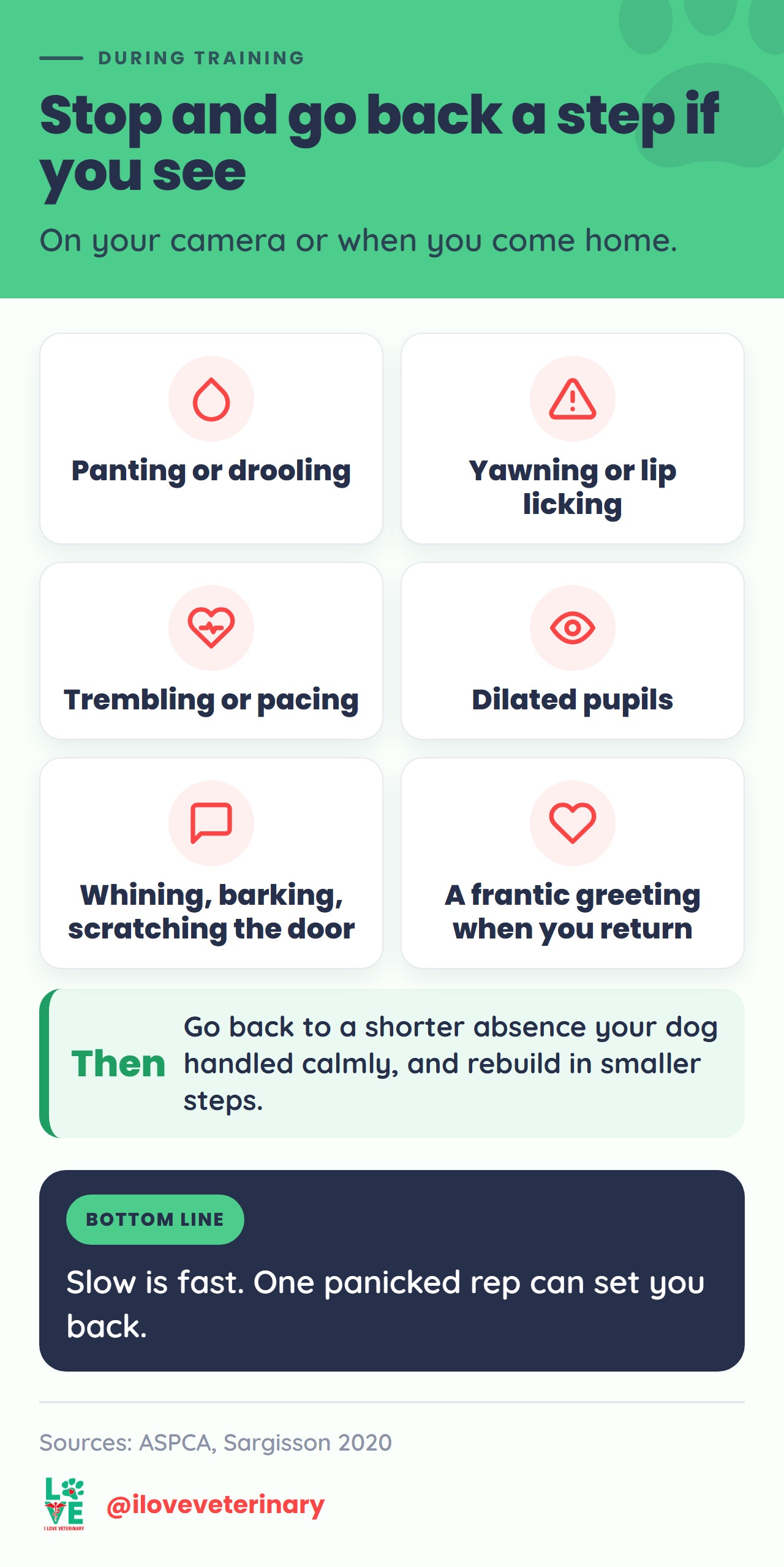
Stop the session and go back to a shorter absence your dog handled well if you see any of these, on camera or when you return:
- Panting or drooling
- Yawning or lip licking
- Trembling or pacing
- Dilated pupils
- Whining, barking or scratching at the door
- A frantic, over-the-top greeting
These are normal stress signals, and our guide to displacement behaviors in dogs explains more of them.
How Long Does It Take?
Each dog reacts differently, so there are no standard timelines, the ASPCA says. It can take a few weeks with several sessions a day on weekends and two a day on weekdays; Merck notes it can take months. Track the longest absence your dog handles calmly on camera, and expect setbacks.
Mild Cases: The Food Puzzle Trick
If your dog is only mildly uneasy, counterconditioning alone may be enough. Every time you leave, give a food puzzle with part of your dog's meal that takes 20 to 30 minutes to finish. Pick it up when you get home, so it only exists when you're gone.
The catch, as the ASPCA points out: very anxious dogs often won't eat when left alone. A toy that's still full when you come back means your dog needs the full plan.
Exercise, sniff walks and training games help any dog relax, but they don't cure separation anxiety. In one study of shelter dogs, advice to exercise before leaving and give a food toy did not prevent separation problems after adoption.
What Not to Do
- Don't punish or scold. Chewed doors and puddles are panic, not revenge. Punishment after the fact can't be linked to the behavior and can make anxious dogs worse. The 2020 review advises avoiding it.
- Don't use bark collars or other aversive tools. The American Veterinary Society of Animal Behavior says methods that rely on force, pain or discomfort should not be used to treat behavior problems. Our post on dog "dominance" explains why reward-based training wins.
- Don't shut a panicking dog in a crate. More on this below.
- Don't rush. Long absences during training rehearse the panic.
- Don't make a big production of leaving or coming home. Excited goodbyes and greetings sharpen the contrast between "you're here" and "you're gone". Say hello calmly and wait for your dog to settle before giving more attention.
- Don't give any behavior medicine your vet didn't prescribe.
Should You Use a Crate?
Some dogs settle in a crate and treat it as a safe den. A dog that panics in one should not be crated. Research has found crating doesn't reduce separation problems and can add stress, and dogs can hurt themselves trying to escape. Veterinary behaviorists on VCA warn that crates "can promote intense escape attempts."
Watch your dog in the crate while you're home. Heavy panting, drooling, frantic escape attempts or nonstop barking mean no crate. The ASPCA suggests one room behind a baby gate instead.
Medication: When Your Vet May Suggest It
For moderate to severe separation anxiety, your vet may prescribe anti-anxiety medicine to use alongside training. Two medicines, clomipramine and fluoxetine, are FDA-approved for separation anxiety in dogs, both meant to be used with a behavior plan. Some veterinary behaviorists use medication early on to lower anxiety enough for training to work.
Medication is a support, not a shortcut. Studies show it rarely removes the problem on its own. Your vet chooses the medicine and dose, watches for side effects, and decides when and how to stop.
Who Can Help
The ASPCA says moderate and severe cases need a trained, experienced professional, because a dog's reactions can be hard to read. Who to ask:
- Your veterinarian, first, for the medical check and medication questions
- A board-certified veterinary behaviorist (DACVB), a vet who specializes in behavior
- A Certified Applied Animal Behaviorist (CAAB)
- A professional dog trainer with real experience treating fear with desensitization and counterconditioning. Ask directly: a general trainer certification doesn't guarantee that skill.
Separation Anxiety in Dogs FAQ
Can puppies get separation anxiety?
New puppies often cry when first left alone, and research shows this usually settles quickly after adoption. To lower the risk later, the 2020 review points to plenty of new experiences and people outside the home, and a steady routine. A puppy whose distress grows instead of fading is worth raising with your vet.
Will getting a second dog help?
Probably not. The 2020 review found that another dog in the household doesn't prevent separation problems. Dogs with separation anxiety usually settle when a person is with them, and another dog doesn't count.
Sources
- ASPCA: Separation Anxiety
- Merck Veterinary Manual: Behavior Problems of Dogs
- VCA Animal Hospitals (Horwitz and Landsberg): Separation Anxiety in Dogs
- Today's Veterinary Practice (Bain): Algorithmic Approach, Separation Anxiety in Dogs
- Sargisson, Veterinary Medicine: Research and Reports (2020): Canine separation anxiety, strategies for treatment and management
- American Veterinary Society of Animal Behavior: Position Statement on Humane Dog Training
This article is for general information and is not a substitute for advice from your veterinarian.