Most cats and dogs that hiss, swat, growl or snap at the vet are scared, sore or both. So the modern answer is not a bigger towel or a tighter hold. Vets handle aggressive patients by planning the visit before the animal arrives, using the least restraint that keeps everyone safe, and switching to anti-anxiety medication or sedation before a fight starts, not after.
Here is that approach for cats first, then dogs, based on the 2022 AAFP/ISFM Cat Friendly Veterinary Interaction Guidelines and the 2015 AAHA Canine and Feline Behavior Management Guidelines.

Why cats and dogs get aggressive at the vet
A clinic means strange smells, slippery tables, other animals and people who reach for you. A review of the research found that "a great majority of dogs and cats show signs of fear" at the vet. In one study cited by AAHA, 106 of 135 dogs (78.5%) were fearful on the exam table and 13.3% had to be dragged or carried in.
Three things sit behind most bites and scratches:
- Fear and anxiety. AAHA calls fear one of the most common causes of aggression.
- Pain. A sore ear, a bad tooth or arthritic joints make handling hurt. Degenerative joint disease gets more common as cats age, so the AAFP/ISFM guidelines ask teams to check older cats for pain before a procedure.
- Frustration. The animal tried to hide or escape and was stopped.
The AAFP/ISFM guidelines describe three ways a cat copes with fear: inhibition (freezing, going quiet), avoidance (hiding or trying to flee) and repelling (growling, hissing, striking, biting). The frozen cat is easy to handle, but it is still scared. When hiding and freezing don't work, the cat is more likely to move on to repelling.
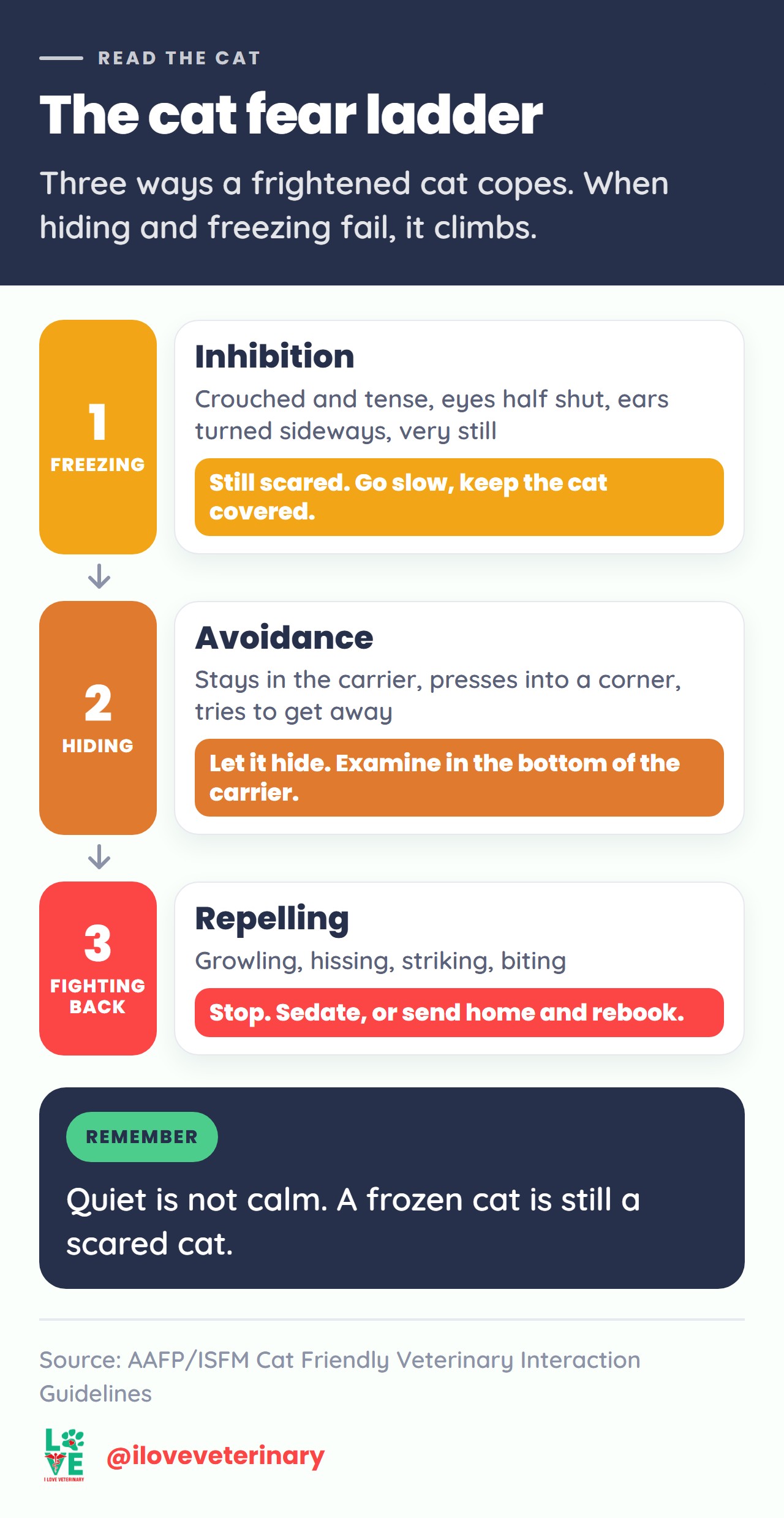
So a cat that is "being bad" is protecting itself, and the guidelines suggest telling owners exactly that so nobody feels the cat is naughty.
Read the warning signs early
Aggression rarely comes out of nowhere. Catch the early signals and you can change the plan before anyone gets hurt.
Signal | Cats | Dogs |
|---|---|---|
Freezing or going still | Crouched, body tense, eyes half shut, ears turned sideways | Stiff body, stops moving, stops taking treats |
Trying to get away | Hiding in the carrier, pressing into a corner | Pulling toward the door, hiding behind the owner |
Face and body | Splayed whiskers, flattened ears, dilated pupils | Lip licking, yawning, averted eyes, ears back, tail tucked, panting, trembling |
Final warnings | Growling, hissing, swatting | Growling, lifted lip, snapping |
Sources for the table: AAFP/ISFM 2022, AAHA 2015 and Clinician's Brief. Some dogs bite without obvious warning, so everyone in the room should know these signs.

Don't punish a growl. AAHA notes that punishment raises bite risk and can suppress the warnings, which makes the animal more dangerous next time.
Before the visit: set it up so the fight never starts
Book it well. AAHA suggests a protocol for reactive patients: text the owner when the exam room is ready so they can walk straight in, have the veterinarian already in the room, use a side or back door, and book the first or last appointment of the day, when delays are less likely. Clinician's Brief adds quiet booking times and letting dogs wait in the car.
Help the owner with the carrier. Carrier training with treats is the gold standard. At a minimum, the AAFP/ISFM guidelines advise spraying a synthetic feline pheromone in the carrier and car about 15 minutes before leaving, covering the carrier and keeping it stable. They quote the Center for Pet Safety's advice to put most carriers on the floor behind the front seats. A removable top half makes everything later easier. More than 75% of cat owners in one survey said nobody had given them travel advice, so this is an easy win for the front desk.
Ask about pre-visit medication. For patients with a history of fear or aggression, the veterinarian may prescribe an anti-anxiety medication for the owner to give at home before the visit. For cats, the AAFP/ISFM guidelines call gabapentin an excellent feline anxiolytic with the strongest evidence; the evidence for trazodone in cats is mixed. For dogs, the Riemer review lists trazodone among the pre-visit options. Your veterinarian chooses the drug and the dose for each patient. Medication supports good handling; it never replaces it.
How vets handle an aggressive cat, step by step
Have a quiet room, treats, clean towels and every piece of equipment ready before you touch the cat, and wash off perfume or the smell of other animals.
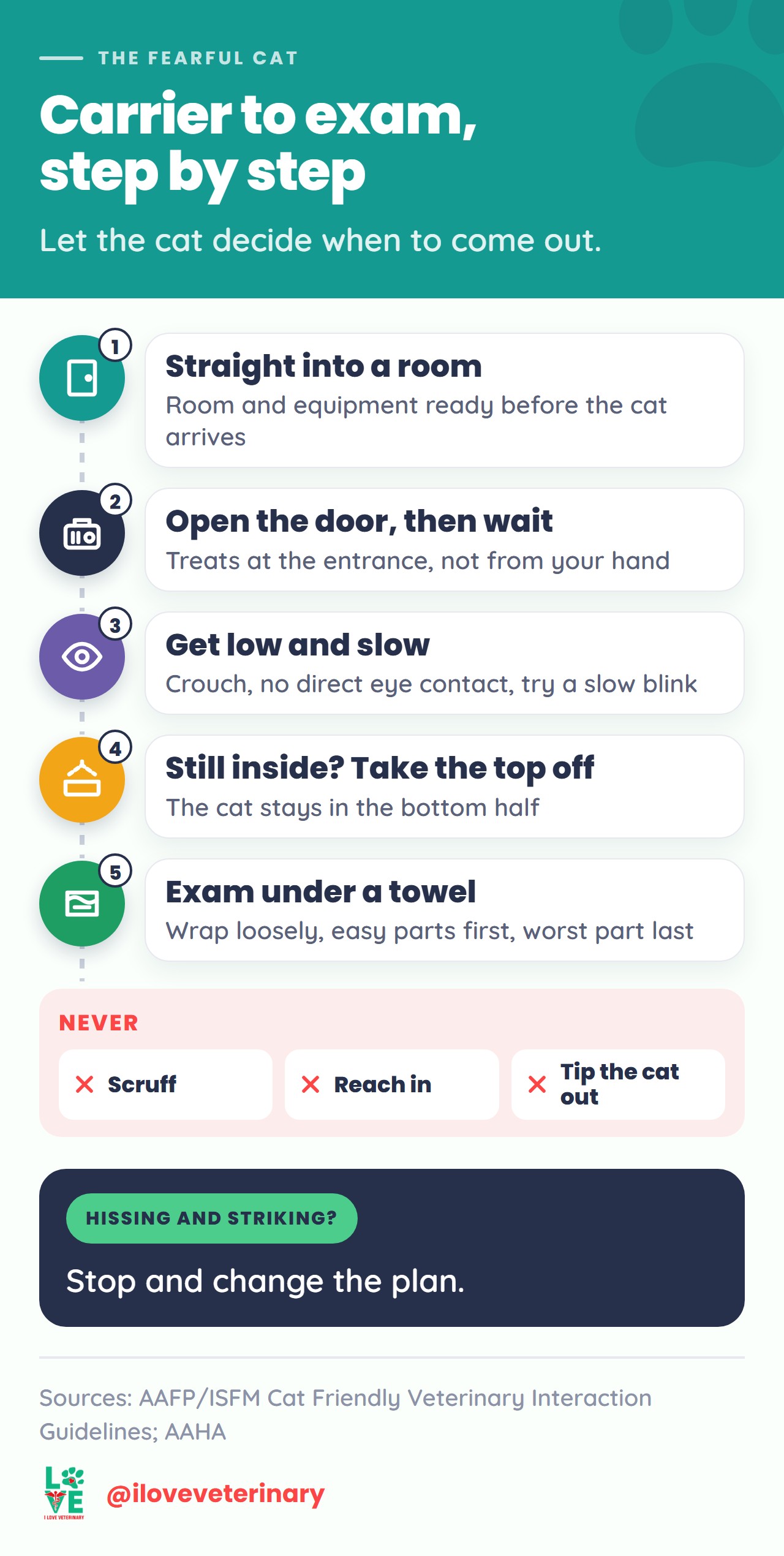
- Get the cat into a room fast. Skip the waiting room and start as soon as the cat arrives.
- Watch before you touch. Open the carrier door, take the history and let the cat decide whether to come out. Don't reach in or tip the cat out.
- Make yourself small and boring. Crouch to the cat's level, don't lean over it, avoid direct eye contact, try a slow blink, move slowly and speak softly.
- Use treats passively. Put them at the carrier entrance or on the table rather than offering them from your hand.
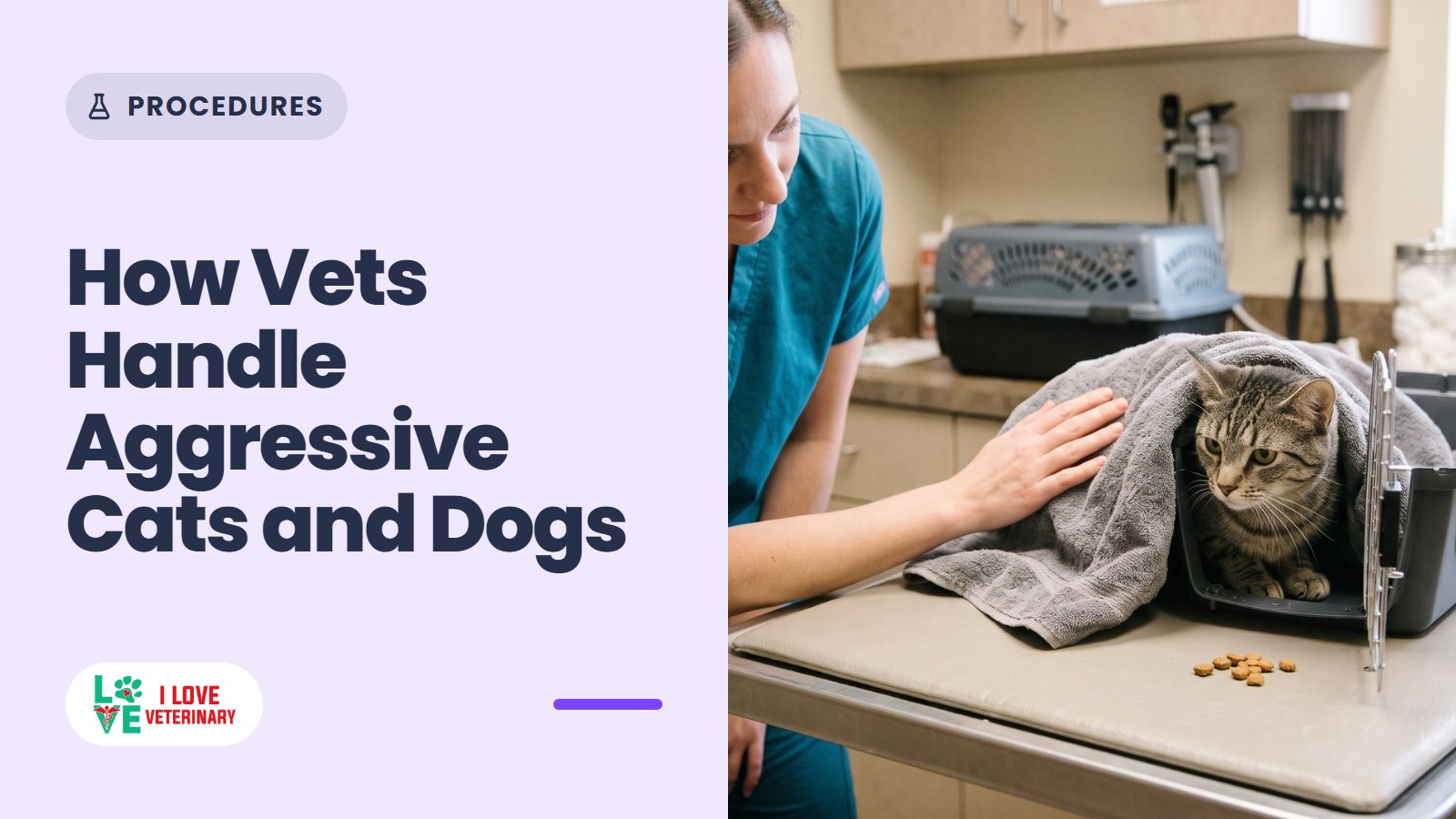
- If the cat stays in, take the top off. Examine in the bottom half of the carrier with a towel draped over the cat so it still feels hidden. This towel wrapping video from International Cat Care shows the idea.
- Wrap loosely, don't pin. The guidelines show towels used to "loosely wrap (rather than tightly restrain)" an anxious cat. Most cats prefer touch around the head and cheeks.
- Do the easy parts first. Save whatever the cat will mind most for last.
- Keep reading the cat. If it moves from freezing to hissing and striking, stop and change the plan.
Why vets don't scruff cats anymore
In a study the AAFP/ISFM guidelines cite, cats held with full-body, scruff or clip restraint all showed more signs of fear than cats handled minimally, with full-body and clip restraint worst. The guidelines now say scruffing "is no longer recommended for cats at any life stage", kittens included.
AAHA lists scruffing calm cats and stretching cats as inappropriate restraint, and adds a practical reason: the stress of physical restraint can make sedatives work less well afterwards. Their summary is hard to beat: "less is truly more."
When the cat says no
Some cats can't be examined awake without real fear, and pushing on makes the next visit worse. The AAFP/ISFM guidelines give four branches:
- If repelling is the main response, sedation is more appropriate than more hands.
- If the cat is already extremely worked up and nothing is urgent, send it home and rebook, with pre-visit medication and carrier training first.
- If it can't wait, leave the cat somewhere quiet and secluded for at least an hour where possible, then sedate, with everything ready so handling is short.
- Feral or community cats aren't handled awake at all. Keep traps and carriers covered.
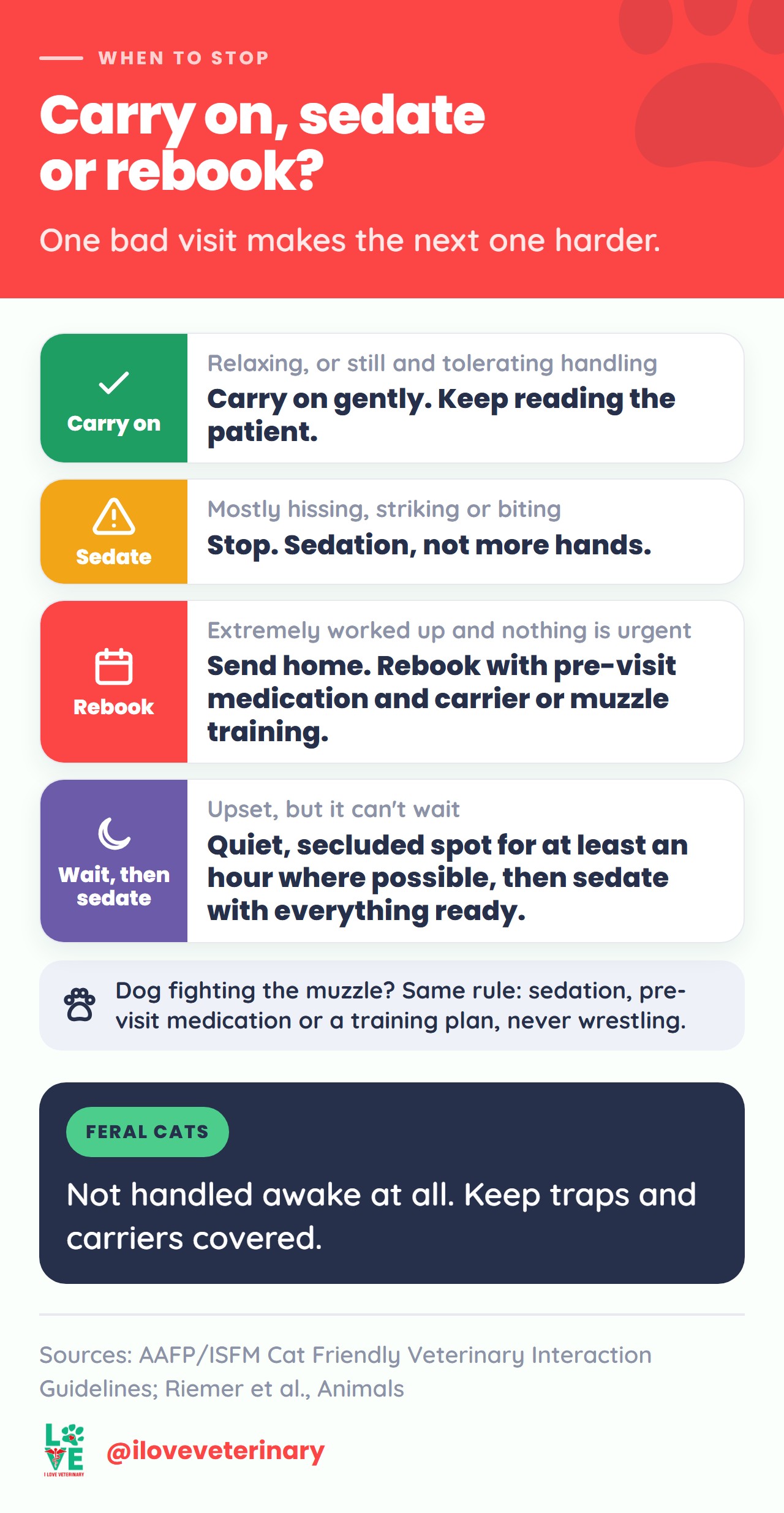
If the owner resists, the guidelines say the veterinarian should advocate for the cat. As the Riemer review puts it, "the use of sedation is preferable to creating a traumatic experience."
How vets handle an aggressive dog
Vets handle aggressive dogs with the same plan as cats: bring the dog straight into a quiet room, approach side-on without reaching over its head, use a trained, well-fitted basket muzzle, examine on the floor with the worst part last, and sedate or rebook before the dog has to fight.
Arrival. AAHA recommends at least 1 to 1.5 body lengths between dogs in the waiting area, separate areas for dogs and cats where possible, and non-slip floors.
Approach. Avoid what dogs read as threats: direct eye contact, walking straight at them, reaching over the head, loud voices, sudden movements and petting they didn't ask for. Get low, turn a little sideways, and keep your face out of the dog's face. Leave yourself a way out.
Where and in what order. Many dogs are calmer on the floor than on the table, and a non-slip mat helps on any surface. Do the least invasive steps first and the most reactive ones last. Keeping the owner in the room usually helps, though a very anxious owner can make some dogs worse, so note what works for each patient. In a study reported in the Riemer review, dogs examined in a busy treatment area without their owners had heart rates about 20 beats per minute higher than in an exam room with them.
Muzzles: the right kind, used the right way
A muzzle makes everyone safer, and AAHA notes staff tend to use less restraint on a muzzled dog.
- Pick a basket muzzle. AAHA says well-fitted basket muzzles prevent bites and still let dogs pant, drink and take treats. Soft nylon muzzles that hold the mouth closed are only for very short jobs like a single injection, because dogs need to pant.
- Fit matters. Too small hurts; too large and the dog can still bite.
- Train it. Smear a treat inside and let the dog put its own nose in. Owners can practice at home too.
- A muzzle is not a license to wrestle. The Riemer review is blunt: muzzles must not be used to push a procedure through on a struggling dog. That dog needs sedation, pre-visit medication or a training plan.
Other tools, and the last resort
- Towels cover the eyes or control the head in small dogs. Elizabethan or inflatable collars help with flat-faced dogs that can't wear a muzzle well.
- Head collars give gentle head control in dogs used to them; stop if the dog panics.
- A slip lead or harness stays on during handling so a frightened dog can't bolt.
- Sedation or general anesthesia is the answer for dogs that can't be handled safely awake. Sedation works best given before fear peaks, and AAHA advises that fractious dogs under sedation keep a well-fitted basket muzzle on.
Catch poles and crush cages are for emergencies only, when there is no other safe option; the Riemer review treats them as a last resort.
Records and team habits that prevent bites
The best handling plan is the one written down. AAHA recommends a behavioral assessment in every exam and the permanent record, and the AAFP/ISFM guidelines suggest a pop-up note with pre-visit medication, preferences and emotional state.
- Write what works: floor or table, owner in or out, favorite treat, muzzle trained or not, "sedate for nails".
- Ask the owner what sets their pet off. They often know.
- Put a cage sign on hospitalized patients, and don't lean into the kennel or block the door.
- Train everyone, front desk included, because the visit starts at the door. Fear Free certification teaches the same ideas (Considerate Approach, Gentle Control, Touch Gradient) as a structured course for the whole team.
- Try happy visits: a quick stop for treats and a hello, no needles, so the clinic means something good.
- Refer serious aggression cases to a board-certified veterinary behaviorist, as AAHA advises.
Handling a frightened animal well is a real skill, and vet techs are usually the ones doing it. If your team lives in the land of fur, slobber and scratches, our Fur, Slobber, Scratches crewneck was made for you.
What owners can do to help
- Tell the clinic when you book that your pet is scared or has bitten before.
- Practice with the carrier or muzzle at home, with treats, long before the visit.
- Ask whether pre-visit medication makes sense, and give only what your veterinarian prescribed.
- Stay calm and let the team lead. Sedation or rebooking is a kindness, not a failure.
FAQ
Do vets sedate aggressive cats? Yes, when needed. The AAFP/ISFM guidelines prefer sedation over more restraint when a cat is mainly hissing, striking or biting. If nothing is urgent, rebooking with pre-visit medication is often better.
Can a vet refuse to see an aggressive animal that day? Both sets of guidelines support stopping a non-urgent visit that could only go ahead by force. The usual answer is a plan: pre-visit medication, sedation, or a rebooked visit.
Why is my dog fine at home but aggressive at the vet? Usually fear or pain. Strange smells, restraint and a sore spot that gets touched are enough to push a normally gentle dog into growling.
Sources
- Rodan I, Dowgray N, Carney HC, et al. 2022 AAFP/ISFM Cat Friendly Veterinary Interaction Guidelines: Approach and Handling Techniques. J Feline Med Surg 2022;24(11):1093-1132
- American Association of Feline Practitioners: Cat Friendly Veterinary Interaction Guidelines
- Hammerle M, Horst C, Levine E, et al. 2015 AAHA Canine and Feline Behavior Management Guidelines. JAAHA 2015;51:205-221
- Riemer S, Heritier C, Windschnurer I, et al. A Review on Mitigating Fear and Aggression in Dogs and Cats in a Veterinary Setting. Animals 2021;11(1):158
- Amat M, Camps T, García-Morato C, Manteca X. Handling Aggressive Dogs. Clinician's Brief
- Fear Free: Veterinary Professional Certification
- International Cat Care: Towel wrapping a cat (video)
This article is for general information and is not a substitute for advice from your veterinarian.