
A healthy cat's breath shouldn't smell bad. When it does, the cause is usually dental disease: plaque and tartar irritating the gums and the tissue under them. Less often, the smell comes from somewhere other than the mouth, and a sweet or urine-like odor can be a sign of diabetes or kidney disease.
Either way, bad breath that keeps coming back is worth a vet visit. The medical term is halitosis, and Cornell's feline experts call it a common complaint of cat owners. If you've been meaning to book a dental check, February is National Pet Dental Health Month, a good nudge to do it.
Is bad breath in cats ever normal?
Sometimes, briefly. A cat that just ate canned tuna or another strong-smelling food can have pungent breath for a while, and that fades on its own.
What isn't normal is an odor that stays. The Cornell Feline Health Center is clear on this: consistent bad breath should be checked by a veterinarian, because an exam is usually the only way to find the cause.
What your cat's breath smell can tell you
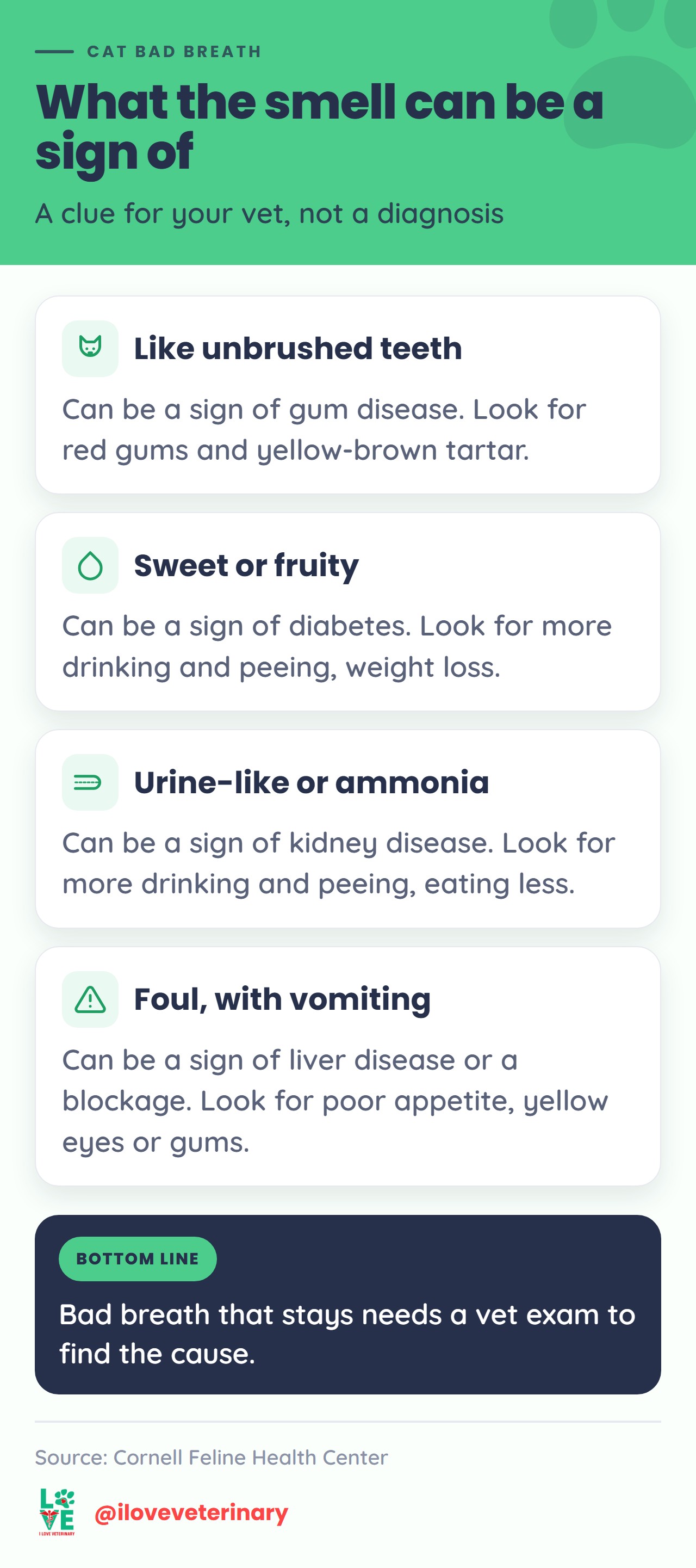
A smell is a clue, not a diagnosis. These are the patterns Cornell describes, and each one is something your vet checks rather than something to decide at home:
Smell | Can be a sign of | Other signs to look for |
|---|---|---|
Bad breath like a person who hasn't brushed | Periodontal (gum) disease | Red, swollen gums; yellow-brown tartar along the gumline |
Sweet or fruity | Diabetes | Drinking and urinating more, weight loss |
Urine-like or ammonia | Kidney disease | Drinking and urinating more, eating less |
Foul, with vomiting | Liver disease or an intestinal blockage | Poor appetite, swollen belly, yellow eyes or gums |
The same smell can have more than one cause, and Cornell notes that a veterinary exam is usually needed to find out which.
If you've noticed your cat is suddenly thirstier, our guide to why a cat drinks a lot of water covers the other causes your vet will consider. You can read more about kidney disease in cats and liver disease in cats in our deeper guides.
The most common cause: dental disease
By far the most common reason for bad breath in cats is periodontal disease, according to Cornell. It's also very common: Merck Veterinary Manual puts it at up to 70% of cats by age 2, and Cornell reports that 50 to 90% of cats older than 4 have some form of dental disease.
Here is how it builds:
- Plaque forms on the teeth every day. It's a soft film of bacteria.
- If it isn't brushed away, it hardens into tartar (calculus) within a few days, and a toothbrush can no longer remove it.
- Bacteria at the gumline inflame the gums. This is gingivitis: the gum edge turns from coral-pink to red, swells and bleeds easily. Bad breath is common at this stage, and gingivitis can be reversed with a proper cleaning.
- Left alone, the infection moves below the gumline into the ligaments and bone that hold the teeth. This is periodontitis, and teeth can loosen and be lost.
The smell itself comes from the bacteria. VCA Animal Hospitals explains that bacteria in diseased gums produce smelly sulfur compounds.
Most of this disease sits under the gums, where you can't see it. A mouth can look fairly clean from the outside and still be sore underneath.
Other mouth problems that cause bad breath in cats
Tooth resorption
Tooth resorption (once called FORL, or feline odontoclastic resorptive lesions) is the most frequently seen dental abnormality in cats, according to Merck. The tooth structure breaks down from the inside, and the cause is unknown. It can be very painful.
Cats hide it well. Cornell and Merck list the clues owners are most likely to notice:
- Swallowing food without chewing, or food falling out of the mouth
- Tilting the head and chewing on one side
- A sudden preference for soft food
Your vet confirms it with dental X-rays under anesthesia, and affected teeth usually need to be removed.
Stomatitis
Stomatitis (also called gingivostomatitis) is severe, long-lasting inflammation of the gums and the lining of the mouth. Cornell describes it as relatively uncommon, but it is miserable for the cats that have it.
Signs include bad breath, drooling, blood in the saliva, pawing at the mouth and trouble eating. Merck adds that some cats cry out or jump when they yawn, or walk up to the food bowl hungry and then back away. Treatment is decided by your vet and often includes removing many or all of the teeth. Our guide to stomatitis in cats covers it in more depth, and our post on why cats drool explains the other causes of drooling.
Mouth tumors
Oral cancer is less common, but it is one reason consistent bad breath should never be ignored. Squamous cell carcinoma is by far the most common malignant mouth tumor in cats, according to Merck. Bad breath, drooling and reluctance to eat are common signs, and the tumor may bleed or the face may swell as it grows. A biopsy is needed to diagnose it, and the outlook is best when it is found early.
Something stuck in the mouth
Cornell notes that food, a strand of hair or a piece of string can lodge between teeth or under the gums, decompose and infect the tissue around it. Leave the removal to your vet.
When to call your vet
Bad breath alone is rarely an emergency, but what comes with it changes the timing.
- Book a regular appointment: bad breath that doesn't go away, yellow-brown tartar, red gum edges, or no dental check in the last year.
- See your vet within a day or two: a sweet, fruity or urine-like smell, especially with more drinking, more urinating or weight loss; drooling; dropping food or chewing on one side; a lump or sore in the mouth.
- Call now: your cat won't eat, the face or jaw is swollen, the mouth is bleeding, or your cat is pawing at its mouth or crying out in pain.
What the vet does
Expect your vet to look at the whole cat, not just the teeth. If the smell is sweet or urine-like, or your cat is drinking more, your vet may recommend tests for illnesses such as diabetes or kidney disease.
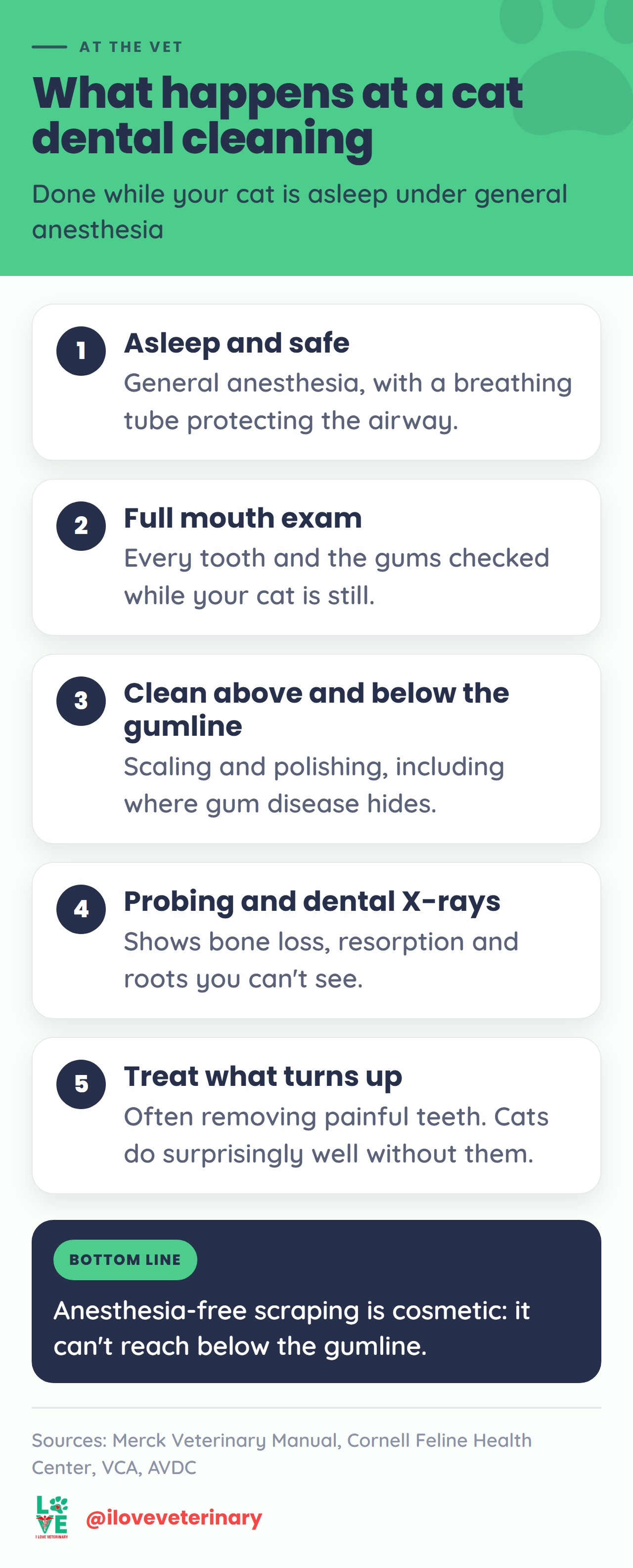
For the mouth, a real dental assessment happens under general anesthesia. Merck, Cornell, VCA and the American Veterinary Dental College describe the same core steps:
- A full exam of the mouth while your cat is asleep and comfortable, with a breathing tube protecting the airway.
- Cleaning above and below the gumline (scaling and polishing). The part under the gums is where periodontal disease lives.
- Probing around each tooth, plus dental X-rays. These show bone loss, resorption and roots that can't be seen from outside.
- Treatment of what turns up, which often means extracting painful or badly damaged teeth. Cats do surprisingly well without them, Merck notes.
If the cause is outside the mouth, such as diabetes or kidney disease, your vet will treat that illness.
A few questions worth asking at the visit:
- Does my cat need dental X-rays, and which teeth look painful?
- Is there any sign of tooth resorption or stomatitis?
- Given the smell, should we check for diabetes or kidney disease?
- Which home care fits my cat's mouth right now?
Why anesthesia-free cleaning isn't recommended
You may see "anesthesia-free" dental cleaning offered. The American Veterinary Dental College (AVDC) considers it inappropriate. Scraping tartar off the visible tooth surface in an awake cat is, in its words, purely cosmetic: it can't reach below the gumline, it can't include X-rays or a full exam, and the sharp tools can injure a cat that moves. Merck makes the same point for owners: cleaning without anesthesia may make the tooth look better but does not treat the plaque below the gumline.
How to keep your cat's breath fresh at home
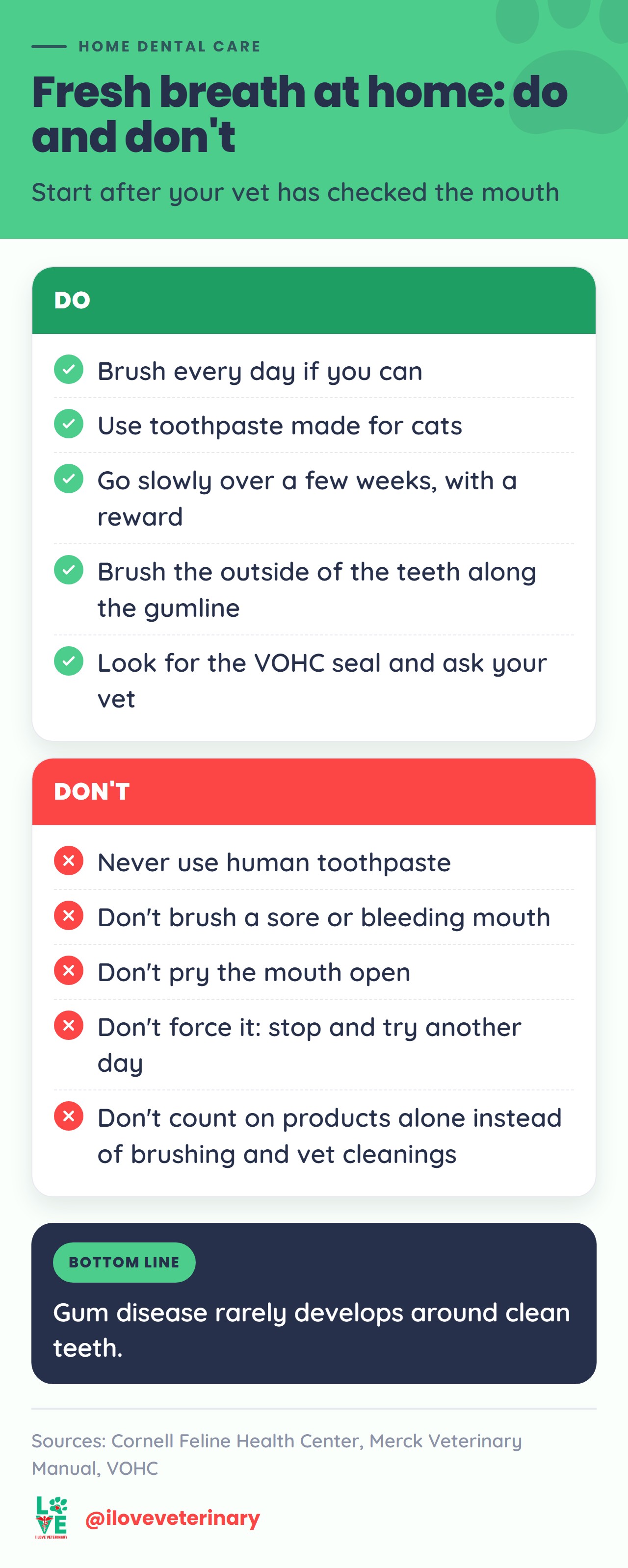
Home care doesn't fix existing dental disease, so start after your vet has checked the mouth. Once the mouth is healthy, daily plaque removal is what keeps it that way. As Merck puts it, gum disease rarely develops around clean teeth.
Brush every day if you can. Cornell and Merck both recommend daily brushing. Plaque left on the teeth hardens into tartar within a few days, so a weekly brush leaves too long a gap.
Use toothpaste made for cats. Never use human toothpaste. Cornell warns that human products can be toxic to cats.
Go slowly. Cornell's approach takes a few weeks:
- Let your cat sniff and lick a little cat toothpaste from your finger, then give a reward.
- Dab a little on one of the long front teeth (the canines), then reward.
- Let your cat lick the paste from the toothbrush.
- Gently brush the outside surfaces of the teeth along the gumline. Lift the lip without prying the mouth open. Cornell says you can skip the tongue side of the teeth.
Linking each session to something your cat loves, such as a favorite canned food, helps. If your cat fights it, stop and try again another day.
Don't brush a painful mouth. Cornell advises against brushing cats with stomatitis because it hurts. If your cat flinches, bleeds or pulls away when you touch the gums, ask your vet to check the mouth first.
Look for the VOHC seal. The Veterinary Oral Health Council reviews dental diets, treats, water additives and other products and lists the ones shown to reduce plaque or tartar. Ask your vet which, if any, suits your cat. They help, but they don't replace brushing or professional cleanings.
National Pet Dental Health Month: a good time to book
The American Veterinary Medical Association (AVMA) sponsors National Pet Dental Health Month every February. It's a natural reminder to book the dental check you've been putting off. Our post on National Pet Dental Health Month explains what the month covers and how to brush a dog's teeth too.
Sources
- Cornell Feline Health Center: Bad Breath: Sign of Illness?
- Cornell Feline Health Center: Feline Dental Disease
- Cornell Feline Health Center: Tooth Resorption
- Cornell Feline Health Center: Gingivostomatitis
- Merck Veterinary Manual: Dental Disorders of Cats
- Merck Veterinary Manual: Disorders of the Mouth in Cats
- Merck Veterinary Manual: Periodontal Disease in Small Animals
- VCA Animal Hospitals: Halitosis in Cats
- American Veterinary Dental College: Companion Animal Dental Scaling Without Anesthesia
- Veterinary Oral Health Council: Accepted Products
- AVMA: Pet Dental Care
This article is for general information and is not a substitute for advice from your veterinarian.