Enalapril is a prescription ACE inhibitor: it relaxes blood vessels and stops the body from holding on to extra salt and water, which takes load off a struggling heart. Vets prescribe it for dogs with heart failure, high blood pressure, or kidney disease that leaks protein into the urine.
If your dog's bottle says "enalapril" and you were expecting "Enacard", that's not a mix-up. Enacard, the version made for dogs, is no longer sold in the US, so dogs now get the same generic enalapril people take, prescribed by the vet. This page gives you the published dose ranges with their sources, a calculator to check the numbers, the rechecks your vet will want, and the signs that mean you should call.
What Is Enalapril Used For in Dogs?
Heart failure. This is the most common reason a dog goes home on enalapril. The 2019 ACVIM guidelines for mitral valve disease, the leaky valve behind most canine heart disease, list an ACE inhibitor such as enalapril as a standard long-term drug once a dog is in heart failure (Stage C). It usually goes home alongside furosemide, which clears fluid, and pimobendan, which helps the heart pump, often with spironolactone too. Your vet decides which heart medicines to combine. The old Enacard label also covered heart failure from dilated cardiomyopathy, where the heart muscle itself weakens.
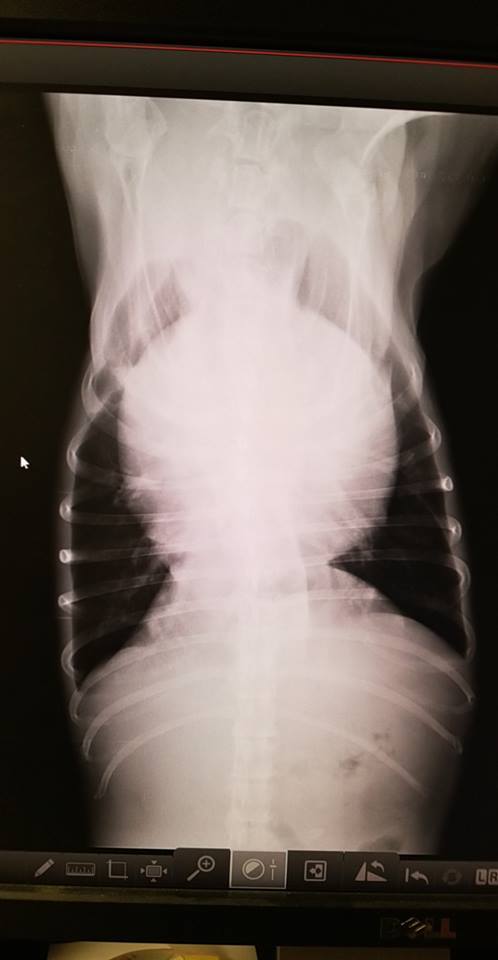
Before heart failure, it's a judgment call. For a dog with a heart murmur and an enlarged heart but no signs yet (Stage B2), the ACVIM panel split: 5 of 10 specialists recommend an ACE inhibitor, and the evidence is rated weak. The Merck Veterinary Manual notes there is no proof that ACE inhibitors delay heart failure in dogs without signs. If your vet prescribes it at this stage, it's a reasonable choice, not the only one.
High blood pressure. The ACVIM hypertension guidelines name drugs like enalapril as the usual first choice for hypertensive dogs, partly because many of them also have kidney disease. Blood pressure is brought down gradually over weeks, not overnight. In severe hypertension, enalapril alone isn't strong enough and vets add amlodipine.
Protein in the urine. In some kidney diseases, the kidney's tiny filters (glomeruli) leak protein. Enalapril widens the small vessel that drains blood out of each filter, which lowers the pressure inside it and reduces the leak. Kidney specialists now often start with a related drug type (an angiotensin receptor blocker such as telmisartan) and add an ACE inhibitor only when protein loss stays high, so your dog may get either.

How Enalapril Works
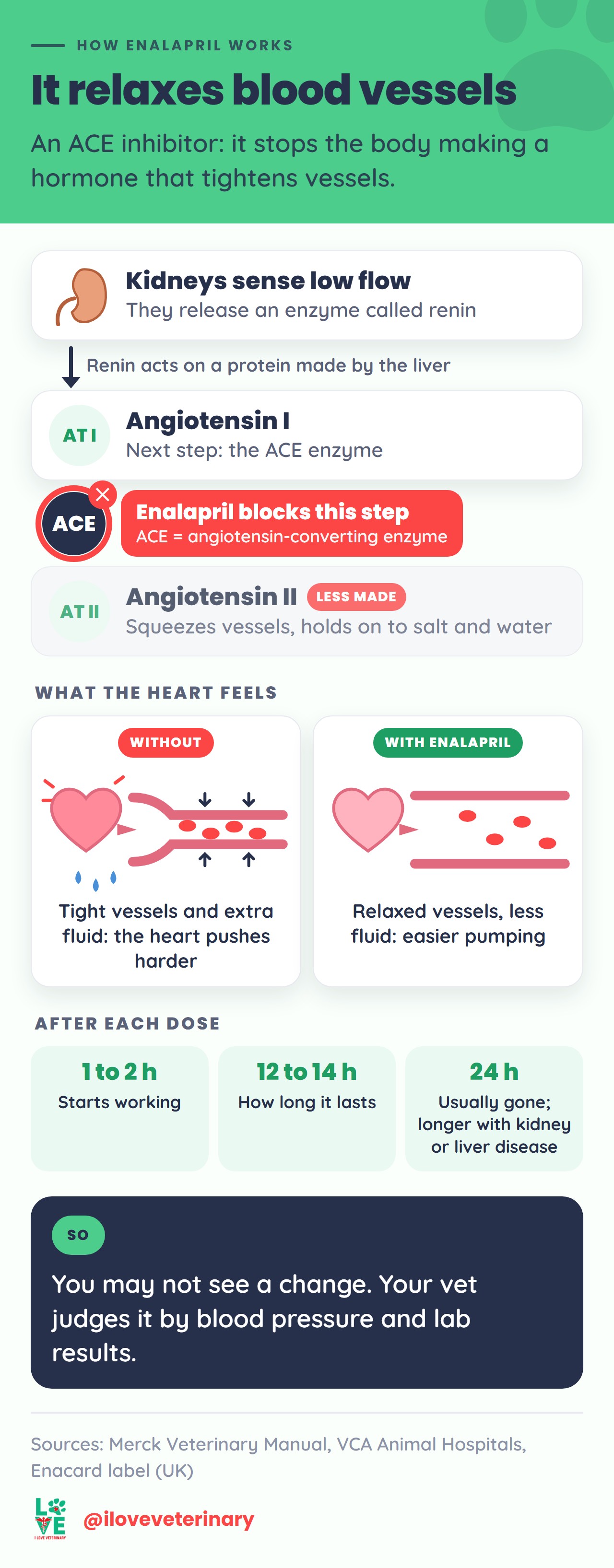
When blood flow to the kidneys drops, they release an enzyme called renin. Renin turns a protein made by the liver into angiotensin I, and a second enzyme turns that into a hormone called angiotensin II. Angiotensin II squeezes blood vessels and tells the body to keep salt and water. In a healthy dog that props up blood pressure. In a dog with a failing heart, it means more fluid and tighter vessels for the heart to push against.
Enalapril blocks that second enzyme, the angiotensin-converting enzyme (hence "ACE inhibitor"). Vessels relax, less fluid is held back, and the heart's workload drops. In dogs with heart failure, the Enacard label credited it with better exercise tolerance and longer survival when added to standard treatment.
What that means day to day:
- Enalapril is a prodrug. The liver converts it to its active form, enalaprilat.
- It starts working within 1 to 2 hours, but you usually won't see a change. Your vet judges it by blood pressure and lab results.
- Each dose lasts about 12 to 14 hours. That's why many dogs take it twice a day for round-the-clock effect.
- The kidneys clear it, so it can build up in dogs with severe heart failure or kidney failure. This is one reason the vet checks kidney values.
Enalapril Dosage Chart for Dogs
Why the first row says "former US label". The FDA approved Enacard tablets for heart failure in dogs in 1994. In 2024 the maker asked the FDA to withdraw the approval because the product was no longer made or sold, and the FDA withdrew it. Enacard is still licensed in the UK, and its label remains the most detailed dosing guide on record. US dogs now get human generic enalapril tablets or liquid, prescribed extra-label (outside a veterinary label), which is legal and common in vet medicine.
Only give what your vet prescribed, at the dose they set.
For information only. These are typical published dose ranges, not a prescription and not medically verified for your pet. Your veterinarian sets the dose after examining your pet. Never start, stop or change a medicine without their OK.
Use | Dose per kg | Dose per lb | How often | Route | Source |
|---|---|---|---|---|---|
Heart failure: former US label (Enacard, withdrawn 2024) | 0.5 mg/kg | 0.23 mg/lb | Once a day; if there's no response after 2 weeks, your vet may go to twice a day | By mouth | |
Heart failure from mitral valve disease, long-term (Stage C) | 0.5 mg/kg | 0.23 mg/lb | Every 12 hours | By mouth | |
Heart failure, general veterinary reference range | 0.25 to 0.5 mg/kg | 0.11 to 0.23 mg/lb | Every 12 to 24 hours | By mouth | |
High blood pressure | 0.5 mg/kg | 0.23 mg/lb | Every 12 to 24 hours | By mouth | |
Protein in the urine (glomerular disease) | 0.5 to 2 mg/kg per day; your vet sets it, starting low | 0.23 to 0.91 mg/lb per day | Once a day, or the daily amount split into two doses | By mouth |
Dose calculator · Enalapril (formerly sold for dogs as Enacard)
Enalapril dose calculator for dogs
Not a prescription. For information only. These are typical published dose ranges, not a prescription and not medically verified for your pet. Your veterinarian sets the dose after examining your pet. Never start, stop or change a medicine without their OK.
Only give what your vet prescribed.
All doses in this calculator
| Pet | Use | Typical dose | How often | Route | Source |
|---|---|---|---|---|---|
| Dog | Heart failure: former US label (Enacard, withdrawn 2024) | 0.5 mg per kg (0.23 mg per lb)The FDA approved Enacard for dogs in 1994 and withdrew the approval in 2024 because the product was no longer made; US dogs now get generic enalapril prescribed extra-label. The UK Enacard label still carries this dose. Going to twice a day (1 mg/kg a day in total) is your vet's decision, with close watching for 48 hours after starting or any increase. | once a day; if there's no response after 2 weeks, your vet may go to twice a day | by mouth | Former US Enacard label: FDA approval notice (1994), 21 CFR 520.804; UK Enacard label (VMD SPC) |
| Dog | Heart failure from mitral valve disease, long-term (Stage C) | 0.5 mg per kg (0.23 mg per lb)The ACVIM heart specialists' standard dose, usually alongside other heart medicines your vet chooses. Expect kidney values and potassium to be rechecked, usually within 1 to 2 weeks of starting or any dose change. | every 12 hours | by mouth | ACVIM consensus guidelines for myxomatous mitral valve disease in dogs (Keene et al., 2019) |
| Dog | High blood pressure | 0.5 mg per kg (0.23 mg per lb)The usual dose from the guideline's drug table. The text of the same guideline allows 0.5 to 2 mg/kg every 12 hours, so your dog's dose may be higher. Blood pressure is lowered gradually over weeks; severe cases need a second drug. | every 12 to 24 hours | by mouth | ACVIM consensus statement on systemic hypertension in dogs and cats (Acierno et al., 2018) |
What the chart can't show:
- The label step-up is the vet's call. The Enacard label starts once a day and moves to twice a day (1 mg/kg a day in total) only if the dog hasn't responded after 2 weeks, with close watching for 48 hours after the start and after any increase.
- The blood pressure row uses the guideline's drug table. The text of the same ACVIM statement allows 0.5 to 2 mg/kg every 12 hours, so a hypertensive dog's dose can sit higher than the table value.
- Different jobs, different ranges. A heart dog, a hypertensive dog and a dog losing protein can all be on enalapril at different doses. The kidney range goes highest because the vet raises it every 2 weeks until protein loss falls, as long as kidney values, potassium and blood pressure allow.
- Your dog's dose may sit outside these ranges for good reasons: other medicines, kidney function, how your dog responded. That's not an error to fix at home.
- Cats are dosed differently. This chart is for dogs.
Never Change the Dose on Your Own
Enalapril sits in a balance your vet manages with blood work: too little and the heart or blood pressure isn't helped, too much and blood pressure drops or the kidneys get less blood flow. So:
- Don't stop it suddenly unless your vet tells you to.
- Don't add or double doses. If you miss one, give it when you remember, then wait the usual time before the next. If it's nearly time for the next dose, skip the missed one. Never give two at once.
- Watch closely for the first 48 hours after starting and after any dose increase. The label asks for exactly that, because this is when low blood pressure shows up.
Giving Enalapril at Home
- With or without food. If your dog vomits after a dose on an empty stomach, give the next ones with food or a treat.
- Keep a full water bowl out at all times.
- For a liquid, measure with the syringe the pharmacy gave you. A liquid or a compounded version may be used when the tablet sizes don't fit your dog's dose.
- Store it at room temperature, below 86 °F (30 °C), away from moisture and light.
- Protect the people too. Wash your hands after handling tablets. If a person swallows one, get medical advice. Enalapril can harm a developing baby, so anyone pregnant should avoid handling or taking it.

Rechecks: Kidney Values, Potassium and Blood Pressure
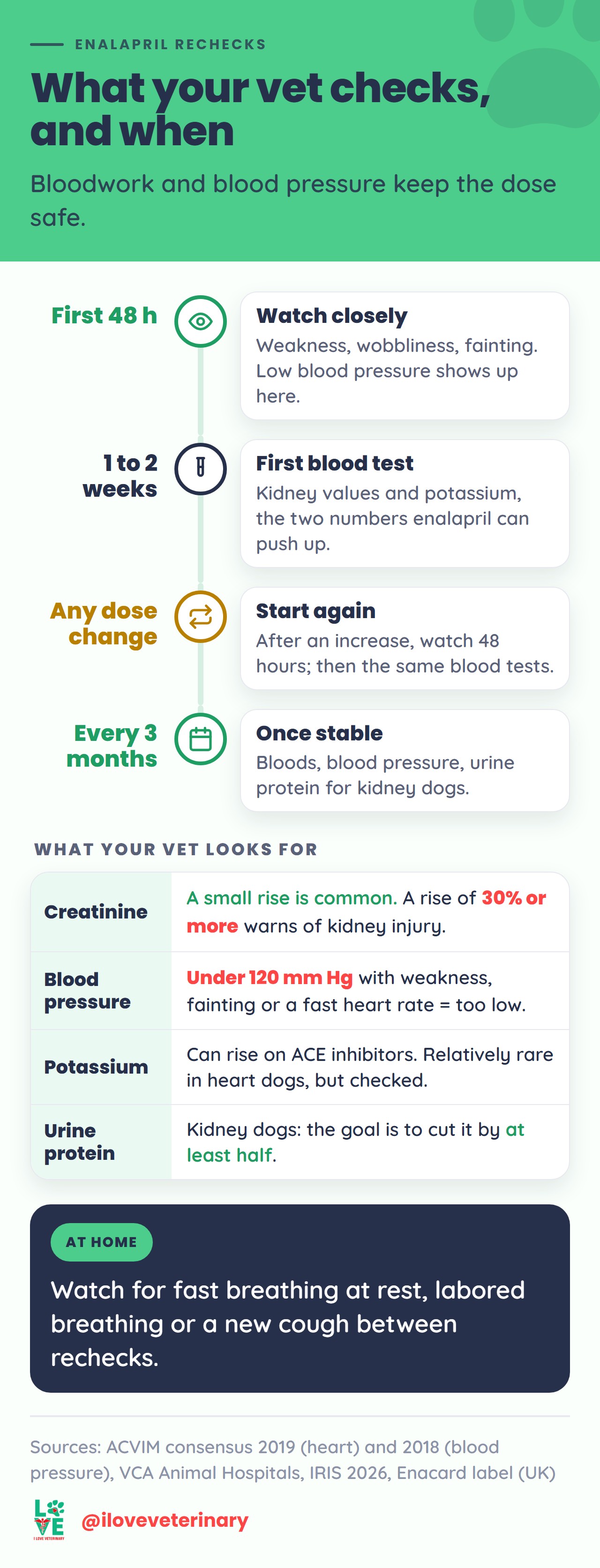
Expect blood tests soon after enalapril starts, usually within 1 to 2 weeks of starting or any dose change, then about every 3 months once your dog is stable (ACVIM, VCA).
What your vet is looking for:
- Kidney values. A small rise in creatinine (a kidney waste marker) is common and usually fine. ACVIM treats a rise of 30% or more from the starting value as a warning of kidney injury, and the label tells vets to lower or stop the diuretic or enalapril if kidney values climb or blood pressure falls too far.
- Potassium. ACE inhibitors can raise it. In heart dogs on standard treatment, ACVIM calls high potassium relatively rare, but it's worth checking.
- Blood pressure. Under 120 mm Hg with weakness, fainting or a fast heart rate means it's too low. Hypertensive dogs need lifelong treatment and a pressure check at least every 3 months once stable.
- Urine protein. For kidney patients, the goal is to bring the urine protein-to-creatinine ratio down by at least half, ideally below 0.5.
At home, keep watching for heart failure signs: faster breathing at rest, labored breathing, coughing. If your dog is also on furosemide, counting sleeping breaths is the best early warning; the furosemide guide linked above shows how. For dogs with kidney disease, know the signs of kidney failure too.
Side Effects of Enalapril in Dogs
Most dogs handle enalapril well. In the Enacard trials, side effects were usually mild and passed without stopping the drug.
Common: loss of appetite, vomiting, diarrhea, tiredness.
Linked to low blood pressure: weakness, wobbliness, dizziness, drowsiness, disorientation, fainting or collapse.
Kidney trouble (azotemia): waste products building up in the blood, seen on blood tests and sometimes as poor appetite, vomiting or lethargy. In the Enacard trials, it happened in about 9% of dogs on enalapril plus standard treatment and about 8% on standard treatment alone. Risk is higher with existing kidney disease or dehydration, and in dogs that also take a diuretic.
Less common: high potassium, fever, rash. Cough is a well-known side effect in people, but not in dogs, so a new or worse cough points to the heart or airways and needs a call.
When to call your vet
Call now (or go to the emergency vet):
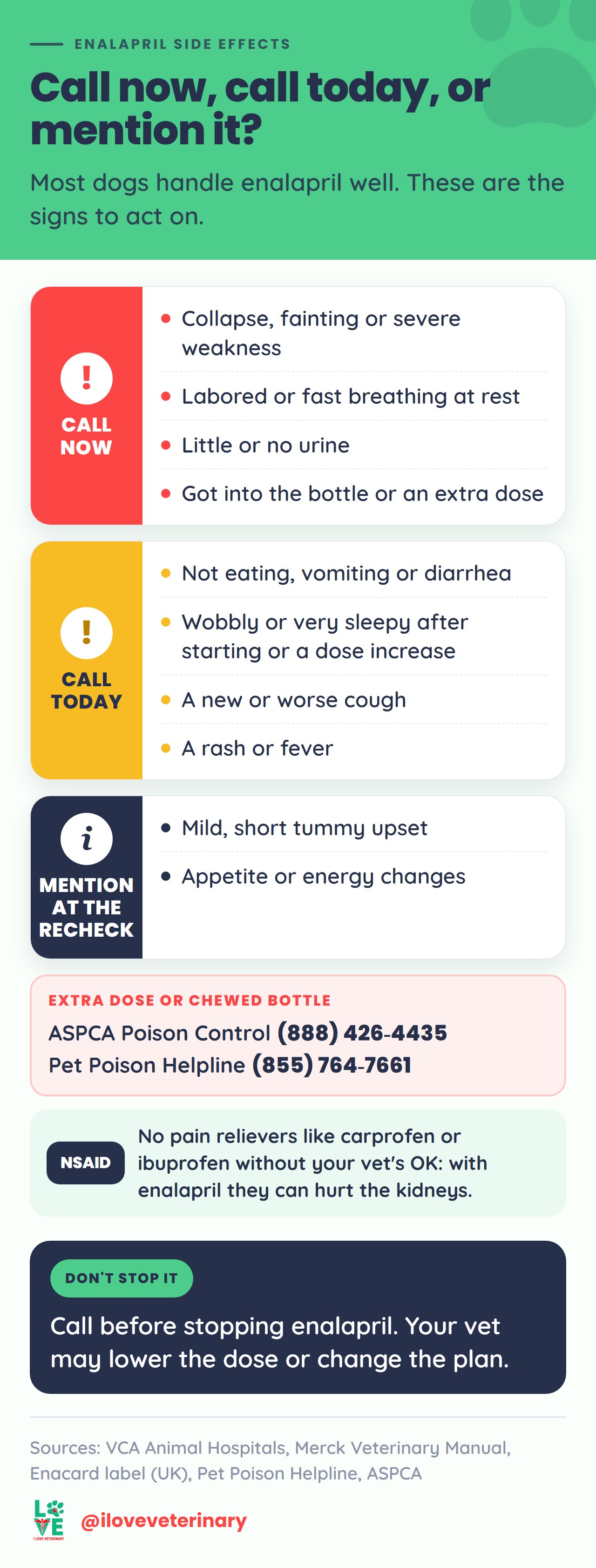
- Collapse, fainting or severe weakness.
- Labored breathing or fast breathing at rest.
- Little or no urine.
- Your dog chewed into the bottle or got an extra dose. Overdose signs include tiredness, weakness, low blood pressure, a fast heart rate, vomiting and diarrhea. Call your vet or a poison line: ASPCA Animal Poison Control Center (888) 426-4435 or Pet Poison Helpline (855) 764-7661.
Call today:
- Not eating, or vomiting or diarrhea, especially more than once. These can dehydrate a dog quickly, and dehydration plus enalapril strains the kidneys. Know the signs of dehydration.
- Wobbly, unusually sleepy or "off" in the first days on the drug or after a dose increase.
- A new or worse cough.
- A rash or fever.
Mention at the next recheck:
- Mild, short-lived tummy upset, appetite changes, how your dog's energy has been.
Call rather than stopping it on your own. Your vet may lower the dose, pause it while your dog rehydrates, or change the plan.
Drug Interactions and Who Shouldn't Take It
Tell your vet about every medicine, supplement and vitamin your dog gets, including anything you buy over the counter. These need extra care with enalapril:
- NSAID pain relievers, including dog drugs like carprofen (Rimadyl) and meloxicam and human ones like ibuprofen. Together with an ACE inhibitor they can cause acute kidney injury, and they blunt enalapril's effect on blood pressure. Never add one without your vet's OK, and remind any new vet that your dog is on enalapril.
- Diuretics and other blood vessel relaxers (furosemide, amlodipine, sildenafil). They're often prescribed together on purpose, but the combination can push blood pressure too low, so your vet adjusts and monitors.
- Potassium. Supplements, salt substitutes, and potassium-sparing diuretics such as spironolactone can raise potassium. Your vet decides which heart medicines to combine and checks potassium at the rechecks.
- Others on the caution list. Anesthetics, antacids, steroids, digoxin, diphenhydramine, opioids and erythropoietin.
Not for dogs that:
- Are allergic to enalapril.
- Have acute kidney injury.
- Are dehydrated or low on blood volume. Kidney guidelines say to correct dehydration first, because kidney filtration can drop sharply.
- Have certain heart conditions where the heart can't push blood out properly, such as aortic stenosis (a narrowed outflow valve).
Your vet takes extra care if your dog:
- Has kidney disease or liver disease.
- Has low blood sodium or a blood cell disorder.
- Is pregnant, nursing or used for breeding. The label doesn't recommend it in pregnant dogs.
- Is going under anesthesia. Tell the surgical team about enalapril ahead of time.
Quick Answers
How fast does enalapril work in dogs? It acts within 1 to 2 hours, but you may not see a difference. Your vet tracks it with blood pressure, lab work and how the heart signs settle.
How long does one dose last? About 12 to 14 hours, which is why many dogs take it twice a day. Its effect should be gone within 24 hours, longer in dogs with liver or kidney disease.
Is enalapril the same as Enacard or Vasotec? Same drug. Vasotec is a human brand; Enacard was the dog brand, no longer sold in the US since 2024. Most US dogs get generic enalapril.
Can my dog take enalapril for life? Yes, many do, with rechecks. Dogs with heart failure or high blood pressure usually stay on it long-term.
My dog started coughing. Is it the enalapril? Probably not. Cough isn't a recognized enalapril side effect in dogs, so call your vet: it may be the heart.
Originally written by Arais. Updated by the I Love Veterinary editorial team.
Sources
- Federal Register: Oral Dosage Form New Animal Drugs; Enalapril Maleate Tablets (FDA approval of Enacard), 1994
- Code of Federal Regulations: 21 CFR 520.804 Enalapril (2024 edition)
- Federal Register: Withdrawal of approval of Enacard (enalapril maleate) Tablets, 2024
- UK Veterinary Medicines Directorate: Enacard Tablets for Dogs, Summary of Product Characteristics
- Keene BW et al. ACVIM consensus guidelines for the diagnosis and treatment of myxomatous mitral valve disease in dogs. J Vet Intern Med, 2019
- Acierno MJ et al. ACVIM consensus statement: systemic hypertension in dogs and cats. J Vet Intern Med, 2018
- Merck Veterinary Manual: Angiotensin-converting Enzyme Inhibitors for Use in Animals
- Merck Veterinary Manual: Glomerular Disease in Dogs and Cats
- International Renal Interest Society (IRIS): Treatment Recommendations for CKD in Dogs, 2026
- VCA Animal Hospitals: Enalapril
- PetMD: Pimobendan and Enalapril for Dogs
- Tufts Cummings School CardioRush: Cardiology Drug Formulary
- Pet Poison Helpline: ACE Inhibitors
- ASPCA Animal Poison Control Center
This article is for general information and is not a substitute for advice from your veterinarian.