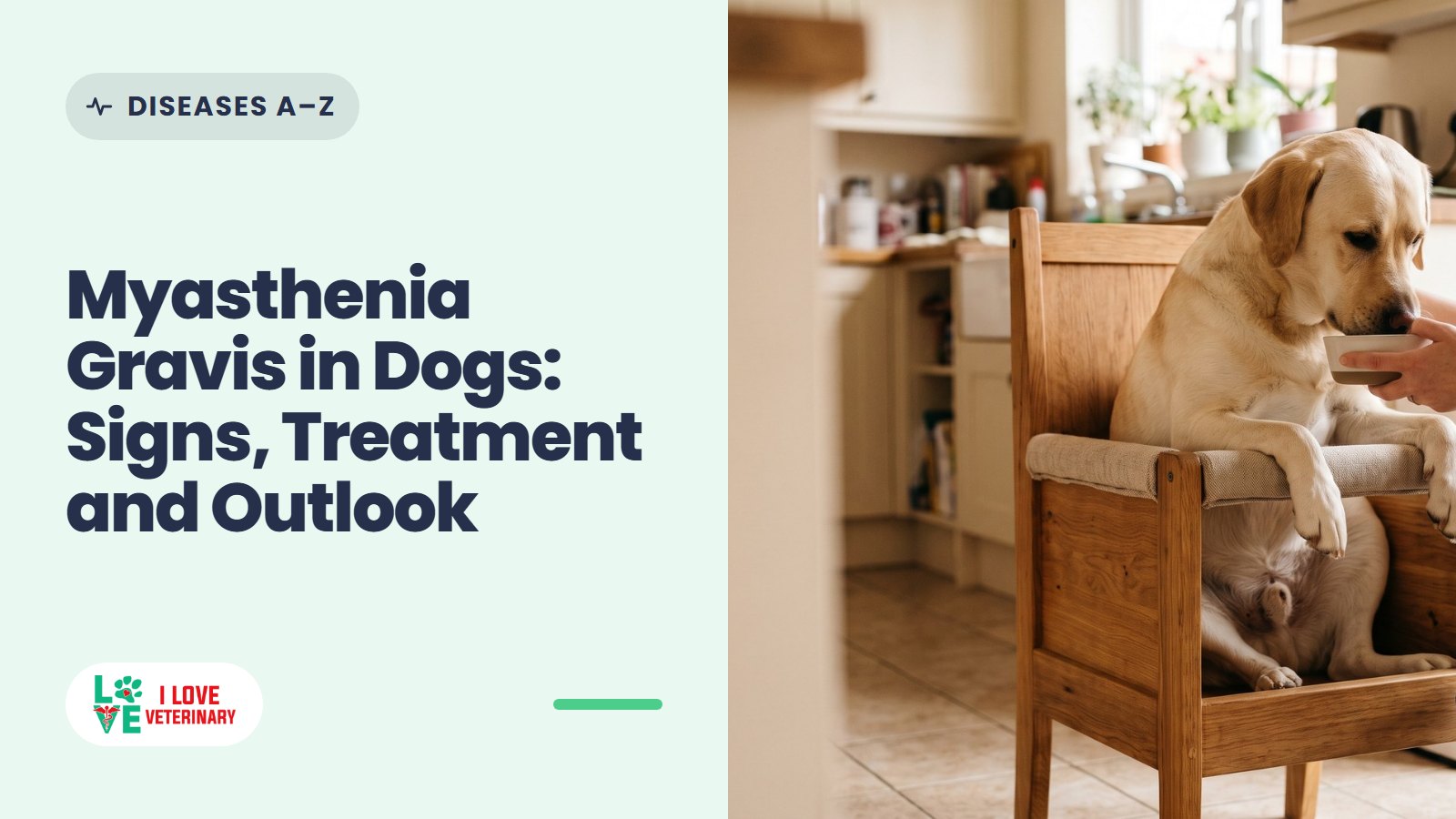
Myasthenia gravis (MG) is a breakdown in the signal between nerves and muscles. A dog with MG tires quickly, often on a walk, and gets stronger again after a rest. Many affected dogs also develop a floppy, widened esophagus (megaesophagus), so food comes back up instead of reaching the stomach.
Most dogs have the acquired form, where the immune system attacks the muscle's signal receivers. It is treatable, and some dogs go into full remission. The biggest danger is food or water going down the wrong way and causing aspiration pneumonia, a lung infection that needs a vet right away.
What Myasthenia Gravis Does to a Dog's Muscles
To move a muscle, a nerve releases a chemical messenger, acetylcholine, which the muscle picks up through receptors at the neuromuscular junction. With fewer working receptors, the first signals still get through, but the muscle fades with repeated use. That is why weakness builds with exercise and eases with rest.
In dogs, most of the esophagus is made of the same kind of muscle as the legs. When MG weakens it, the esophagus can't push food down, and the dog regurgitates (Today's Veterinary Practice).

The two forms behave very differently:
Acquired MG | Congenital MG | |
|---|---|---|
Cause | The immune system makes antibodies that destroy acetylcholine receptors | Inherited defect: the junction never works normally |
How common | Most cases | Rare |
Typical age | 1-4 years or 9-13 years | Signs at 6-8 weeks |
Breeds at higher risk | Akita, German shepherd, golden retriever, Labrador retriever, Newfoundland, Scottish terrier, Great Dane (any breed can get it) | Jack Russell terrier, English springer spaniel, smooth fox terrier, smooth-haired miniature dachshund |
Outlook | Often treatable; some dogs go into remission | Generally poor; the miniature dachshund form can resolve with age |
Congenital Myasthenia Gravis
Congenital MG is genetic: puppies are born with faulty neuromuscular junctions, and weakness with play usually shows up around 6 to 8 weeks of age (VCA). It occasionally turns up in mixed breeds too.
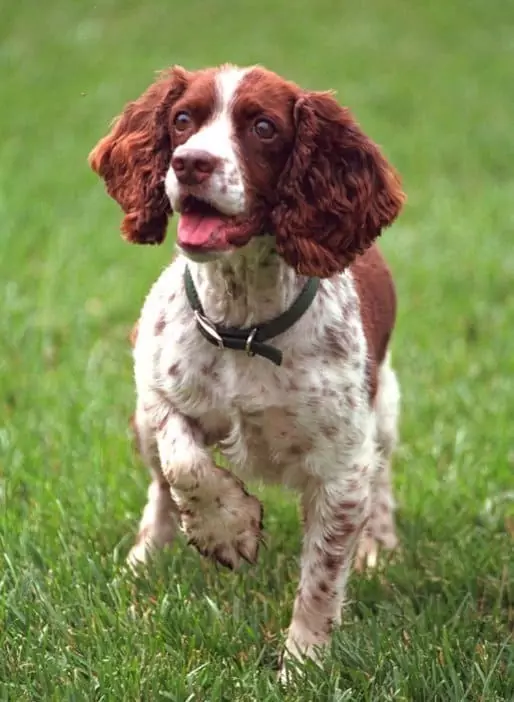
Most congenital cases have no effective treatment, and the outlook is poor. The exception: miniature dachshunds get a congenital form that resolves as the puppy grows (Veterinary Partner).

Acquired Myasthenia Gravis
Acquired MG is an autoimmune disease: the dog's own antibodies attack the acetylcholine receptors. It usually starts in young adults (1 to 4 years) or older dogs (9 to 13 years). Any breed can get it, but Akitas, German shepherds, golden and Labrador retrievers, Newfoundlands and Scottish terriers are overrepresented (Cornell).
Sometimes there is a trigger. Cornell lists hypothyroidism, cancer and a tumor of the thymus gland in the chest (a thymoma). In many dogs no cause is found.
Vets describe three forms (Merck Veterinary Manual):
- Generalized (most common): weakness, stiffness or tremors with exercise that settle with rest, often with megaesophagus.
- Focal: weakness of the face, throat or esophagus only. The legs seem normal, so regurgitation may be the only sign.
- Fulminant (least common): sudden, severe paralysis and megaesophagus that can quickly reach the breathing muscles. It is an emergency and often fatal.
Signs of Myasthenia Gravis in Dogs
Signs usually come on over days to weeks:
- Bringing food or water back up (regurgitation), often soon after eating
- Weakness or tiring early on walks that gets better with rest
- A short, choppy stride, weak back legs or stiff limbs
- Trouble swallowing or drooling more than usual
- A changed or weak bark
- Not blinking fully, or eyes that don't close all the way
- Collapse, or labored breathing
Regurgitation is not vomiting. Vomiting comes with heaving and belly contractions; with regurgitation, food just slides back out of the mouth without that effort (VCA). A short phone video of an episode helps your vet tell them apart.
Not every dog looks weak. In some, megaesophagus and regurgitation are the only signs, which is why Veterinary Partner recommends testing any dog with megaesophagus, unexplained weakness or swallowing trouble for MG.

Aspiration Pneumonia: The Emergency to Know
A dog with a weak esophagus or throat can inhale saliva, food, water or regurgitated material. That causes aspiration pneumonia, a serious lung infection. In a 2025 study of 167 dogs with MG, it was the most common cause of death or euthanasia (Dos Santos et al., 2025).
Call your vet or an emergency clinic now if a dog with MG or megaesophagus shows any of these (Merck Veterinary Manual):
- Coughing
- Fast or labored breathing
- Fever, tiredness or not wanting to eat
- Bluish or gray gums or tongue
- Nasal discharge
Don't wait to see if the cough settles. Severe cases need oxygen, IV fluids and hospital care.
How Vets Diagnose Myasthenia Gravis
Exam and routine tests. Your vet will do a full physical and neurological exam, blood work and thyroid testing, partly to rule out other causes of weakness. Many dogs with MG have a weak or tiring blink reflex.
The acetylcholine receptor (AChR) antibody test. This blood test is the standard for diagnosing acquired MG. Veterinary Partner says it detects about 98% of affected dogs, and results can take a couple of weeks. A level below 0.6 nmol/L counts as normal, the cutoff used in a 2021 study of 94 dogs (Forgash et al.).
A negative result does not always rule MG out. False negatives happen early in the disease and in dogs already given immune-suppressing medicine (Merck), and in a 2025 series from three referral centers, 22% of dogs diagnosed with MG were antibody-negative. Your vet may repeat the test.
A test injection in the clinic. For years vets used edrophonium (Tensilon), a short-acting drug that briefly blocks the enzyme that breaks down acetylcholine. A dog with MG can walk strongly for a few minutes afterwards. Edrophonium is no longer available in the US, so vets now use a related drug, neostigmine, given by injection in the clinic while they watch the dog's strength for about half an hour. A good response supports the diagnosis but doesn't prove it, because other muscle diseases can respond too (Today's Veterinary Practice).
Chest X-rays. X-rays look for megaesophagus, aspiration pneumonia and a thymoma. A thymoma is found in a minority of dogs with MG: about 3 to 4% in Veterinary Partner's figures and 9% in the 2025 referral series.
Specialist nerve tests. A veterinary neurologist can measure how a muscle's response fades with repeated nerve stimulation.
Treatment for Myasthenia Gravis in Dogs
There is no single protocol: your vet tailors treatment to the form of MG, the esophagus and the lungs.
Medicines that strengthen the nerve signal
The main treatment is an anticholinesterase drug. It slows the enzyme that breaks down acetylcholine, so the messenger lingers and has more time to reach the receptors that still work. Pyridostigmine is the most common choice; neostigmine is an injectable option for dogs that can't take medicine by mouth (Merck).
Your vet chooses the drug and dose and adjusts it over time. Worth knowing: the side effects of these drugs (drooling, regurgitation, diarrhea, urinary accidents, watery eyes, weakness) can look a lot like MG itself (Today's Veterinary Practice). If signs come back or change, call your vet rather than giving more or less.
Immune-suppressing medicines
If the anticholinesterase alone isn't enough, vets may add drugs that calm the immune attack: corticosteroids, or others such as azathioprine, mycophenolate or cyclosporine. They are not the first step. Dogs often get weaker when steroids are started, and these drugs are avoided or used with great care in dogs with aspiration pneumonia, diabetes or high blood pressure (Veterinary Partner).
Surgery for a thymoma
When a thymoma is behind the MG, removing it is recommended. Some dogs get worse after surgery, but complete removal may improve the outlook (Cornell).
Hospital care and newer options
Dogs with pneumonia, severe weakness or fulminant MG may need oxygen, antibiotics, IV fluids and intensive care. A dog that can't keep food or water down may get a feeding tube into the stomach until things improve. Any related problem, such as hypothyroidism, gets treated too.
Plasma exchange (filtering antibodies out of the blood) and IV immunoglobulin are standard in human MG, but only a few published dog cases describe them.
Feeding a Dog With Megaesophagus: Upright Meals
For many dogs with MG, feeding is the daily job. Gravity carries food down the esophagus, so less of it comes back up or gets inhaled.

- Feed upright. A Bailey chair (a dog high chair that holds the dog sitting up, front legs higher than back legs) or elevated food and water bowls keep the esophagus vertical. Some owners simply hold the dog upright.
- Keep the dog upright after meals. Sources give 10 to 30 minutes after meals, as your vet advises (Merck, Cornell).
- Feed small, frequent meals of a high-calorie food, as your vet recommends.
- Find the texture that stays down. Some dogs do best with soft "meatballs", others with a gruel or with dry food. Some also need thickened water.
- Watch after every meal for coughing or fast breathing, the early signs of aspiration pneumonia.
Our megaesophagus guide goes deeper on daily management and the other causes of a widened esophagus.
Outlook: Will My Dog Recover?
Many dogs with acquired MG improve, and some recover completely. Older studies reported that most dogs went into remission; newer studies report lower rates:
- 2001, 53 dogs: 47 (89%) went into spontaneous remission, on average within 6.4 months, on an anticholinesterase alone (Shelton and Lindstrom).
- 2021, 94 US dogs: 31% reached full clinical remission, and another 41% improved or were sign-free on treatment (Forgash et al.).
- 2025, 167 dogs: 18% reached complete, lasting remission, after a median of about two years (Dos Santos et al.).
The 2025 authors think follow-up length explains part of the gap: the 2001 study followed dogs for 18 months or more, while many dogs in their series died early, mostly from aspiration pneumonia. Both newer studies point the same way: dogs without megaesophagus or regurgitation do much better. Younger age also helped in the 2021 study. A thymoma or fulminant MG makes the outlook harder, while the outlook for dogs that never develop pneumonia is generally good (Merck).
Your vet tracks progress with strength checks, chest X-rays and repeat antibody tests, and treatment can usually stop once the antibody level is back in the normal range. Megaesophagus doesn't always resolve, so some dogs need upright feeding for life.
When to Call Your Vet
What you see | What to do |
|---|---|
Coughing, fast or labored breathing, fever, blue or gray gums | Call now (possible aspiration pneumonia) |
Sudden weakness that keeps getting worse, can't stand, struggling to breathe | Call now |
Regurgitating food or water, new or more often | See your vet soon |
Tiring early on walks, short choppy steps, weak back legs | See your vet soon |
Signs coming back or changing while on medicine | See your vet soon: call, and don't change the dose yourself |
A changed bark, more drooling, not blinking fully | See your vet soon |
Questions about vaccines, diet or a feeding chair | Mention at your next visit |

FAQ
Can a dog with myasthenia gravis be vaccinated?
Ask your vet about timing: Veterinary Partner advises postponing vaccines while MG is active, because vaccination has been shown to make it worse.
Can cats get myasthenia gravis?
Yes, but it is uncommon. Cats rarely develop megaesophagus, a thymoma is more often involved, and they tend to respond better to immune-suppressing medicine than to anticholinesterase drugs (Merck, Veterinary Partner).
Sources
- Merck Veterinary Manual: Acquired Myasthenia Gravis in Dogs and Cats
- Merck Veterinary Manual: Dilatation of the Esophagus (Megaesophagus) in Small Animals
- Merck Veterinary Manual: Pneumonia in Dogs (Aspiration Pneumonia)
- Cornell Richard P. Riney Canine Health Center: Myasthenia gravis
- Today's Veterinary Practice: Acquired Myasthenia Gravis in Companion Animals (2024)
- Shelton GD, Lindstrom JM. Spontaneous remission in canine myasthenia gravis. Neurology, 2001
- Forgash JT et al. Clinical features and outcome of acquired myasthenia gravis in 94 dogs. J Vet Intern Med, 2021
- Dos Santos RX et al. Case series of canine myasthenia gravis. J Vet Intern Med, 2025
- Mignan T et al. Classification of myasthenia gravis and congenital myasthenic syndromes in dogs and cats. J Vet Intern Med, 2020
- Veterinary Partner (VIN): Myasthenia Gravis in Dogs and Cats
- VCA Animal Hospitals: Myasthenia Gravis in Dogs
This article is for general information and is not a substitute for advice from your veterinarian.