Lysine is the supplement people reach for when a cat starts sneezing or gets weepy, squinty eyes from feline herpesvirus. The catch is that the best evidence says it does not prevent or treat the infection, and a 2015 systematic review recommends that owners and vets stop using it.
Some vets still use it, and the Merck Veterinary Manual still lists it, so you get both sides here: what the research found, the amounts references publish (with that caveat attached), the side effects, and the treatments that actually help.
What Is Lysine, and Why Do People Give It to Cats?
Lysine (also sold as L-lysine) is an essential amino acid, one of the protein building blocks a cat has to get from food. A complete and balanced cat food already supplies it, so a healthy cat does not need extra.
The supplement comes as powders, gels, pastes, chews, treats and capsules. It is a supplement, not a drug: the FDA does not review supplements for safety or effectiveness before they are sold, and no lysine product is FDA approved to treat cats.

People give it for one reason: feline herpesvirus type 1 (FHV-1), the virus behind feline viral rhinotracheitis. The theory goes like this. The virus needs another amino acid, arginine, to copy itself. Flood the body with lysine and it should crowd out arginine and slow the virus down. It is a tidy idea. The trouble is what happened when researchers tested it in cats.
Does Lysine Work for Cats? What the Research Found
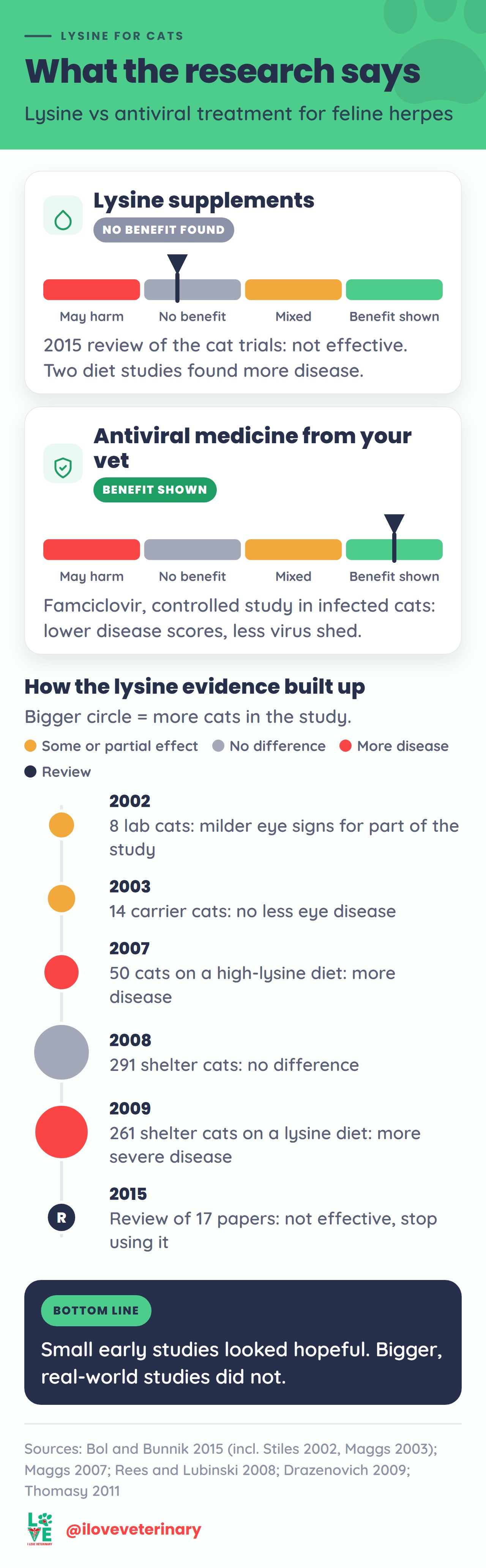
Early, small studies looked promising. Bigger and more realistic studies did not.
Year | Study | What they did | What they found |
|---|---|---|---|
2002 | Stiles and colleagues | 8 cats given lysine or not, then infected in the lab | Milder eye inflammation for part of the study; virus shedding unchanged |
2003 | Maggs and colleagues | 14 cats already carrying the virus | No less eye disease; less virus shed early on only |
2007 | Maggs and colleagues | 50 cats with respiratory disease, half on a high-lysine diet for 52 days | More disease and more virus in the lysine group; no firm conclusion possible |
2008 | 291 cats at an Indiana humane society, half given lysine daily | No difference: 37% of lysine cats and 34% of untreated cats got a respiratory infection | |
2009 | 261 shelter cats on a lysine or standard diet for 4 weeks | More moderate to severe disease in lysine-fed cats by week 4; herpesvirus found more often in them | |
2015 | Systematic review of 17 publications, including the five cat trials above | Not effective for preventing or treating FHV-1; they recommend an immediate stop |
The review also took apart the theory. In its authors' analysis, lysine does not reliably lower arginine in cats, and lab work found no clear sign that the virus slows down when lysine levels change. Safety matters here too: cats cannot make their own arginine, and a cat that runs short of it can get very sick, so lowering arginine on purpose is not a goal anyone should want.
Why do vets still disagree?
Because the references have not all caught up, and some vets see cats they believe it helps. The Merck Veterinary Manual (updated 2024) still says lysine "may reduce the severity" of feline viral rhinotracheitis and lists an amount. VCA Animal Hospitals says it may help and leaves the amount to your vet. Cornell Feline Health Center calls it "quite controversial" and notes studies suggesting it may worsen signs and increase virus shedding.
Our read: the larger, better-controlled studies deserve the most weight, and they point one way. Lysine is unlikely to help, and in group feeding it may have made things worse. If your vet wants to try it for one cat with recurring flare-ups, that is a reasonable conversation, as long as it does not replace treatment that works.
Why the shelter food studies went wrong
Mixing lysine into a shared diet sounds efficient for a shelter or a multi-cat home. It backfired. Sick cats eat less, so in the 2007 study the cats got the least lysine right when the disease peaked, and both diet studies found more severe disease in the lysine groups. A 2008 review in Clinician's Brief concluded that dietary lysine "cannot be recommended", and the 2008 shelter trial's authors pointed shelters toward stress reduction and infection control instead.
Lysine Dosage Chart for Cats
One caveat belongs right next to these numbers: a 2015 systematic review found no evidence that lysine prevents or treats feline herpesvirus. The amounts below show what references publish, not proof that they work.
For information only. These are typical published dose ranges, not a prescription and not medically verified for your pet. Your veterinarian sets the dose after examining your pet. Never start, stop or change a medicine without their OK.
Species | Use | Typical published amount | Per kg / per lb | How often | Route | Source |
|---|---|---|---|---|---|---|
Cat | Feline viral rhinotracheitis (FHV-1) signs, alongside supportive care | 250 mg per cat | Not dosed by weight: one amount per cat | 2 to 3 times a day | By mouth | |
Cat (adult) | Recurrent herpes flare-ups, during a flare-up or long term for frequent recurrences | 500 mg per cat | Not dosed by weight: one amount per cat | Every 12 hours | By mouth, given directly as a dose, not mixed into a whole meal | |
Kitten | Any use | Your vet sets the amount | No published kitten amount in the sources we checked | Your vet decides | By mouth | Ask your vet |
Dose calculator · Lysine (L-lysine)
Lysine amount calculator for cats
Not a prescription. For information only. These are typical published dose ranges, not a prescription and not medically verified for your pet. Your veterinarian sets the dose after examining your pet. Never start, stop or change a medicine without their OK.
Only give what your vet prescribed.
All doses in this calculator
| Pet | Use | Typical dose | How often | Route | Source |
|---|---|---|---|---|---|
| Cat | Feline viral rhinotracheitis (FHV-1) signs, alongside supportive care | 2 to 12 kg (4.41 to 26.5 lb): 250 mg per catThe same amount at any adult weight. Supplement, not an approved drug. A 2015 systematic review (Bol and Bunnik) found no evidence that lysine prevents or treats feline herpesvirus; use only if your vet recommends it. Never add lysine to shared food for a group of cats. Kittens and cats outside 2 to 12 kg: ask your vet. | 2 to 3 times a day | by mouth | Merck Veterinary Manual (2024) |
| Cat (adult) | Recurrent herpes flare-ups, during a flare-up or long term for frequent recurrences | 2 to 12 kg (4.41 to 26.5 lb): 500 mg per catThe same amount at any adult weight. Published in 2008, before the 2009 shelter diet study and the 2015 review that found no benefit. Use only if your vet recommends it. Kittens and cats outside 2 to 12 kg: ask your vet. | every 12 hours | by mouth, given directly as a dose, not mixed into a whole meal | Clinician's Brief (2008) |
Only give what your vet prescribed, at the dose they set.
Product labels list their own amounts, and your vet may choose a different one. Both published amounts are fixed per cat, the same for an 8 lb cat and a 14 lb cat, so the calculator shows one amount at any adult weight. Kittens, cats under 2 kg (about 4.4 lb) and cats over 12 kg (about 26 lb) are outside what it covers: ask your vet.
Given directly, not sprinkled on dinner
Clinician's Brief describes lysine products as made for "bolus" use: the whole dose given at once by mouth, as a gel, paste, chew or powder in a small bite of food, not mixed into a full meal or a shared bowl the way the failed diet studies gave it. That does not rescue the evidence, though. The 2008 shelter trial gave each cat its own daily dose in a little canned food and still found no benefit.
How to Give Lysine Without Stressing Your Cat
If your vet recommends lysine, VCA's guidance is simple:
- Give it with a small amount of food, ideally at the same time each day.
- Expect it to take a few weeks before you would see any effect.
- Missed a dose? Give it when you remember. Never give two doses at once to catch up.
Then watch how your cat takes it. Stress is the classic trigger for herpes flare-ups, and Cornell notes that the stress of giving medicine can itself make eye flare-ups worse. If your cat fights every dose, tell your vet. A supplement with weak evidence is not worth a daily wrestling match.
Lysine Side Effects in Cats
Side effects reported for lysine in cats are few, which is the one thing everyone agrees on.
- Diarrhea. The side effect VCA lists. Call your vet if it starts after you begin lysine; see our guide to diarrhea in cats.
- Sensitivity over time. VCA notes sensitivities can develop with repeated exposure.
- Possibly worse herpes disease in groups. Two diet studies found more severe disease and more virus detected in lysine-fed cats. Cornell mentions the same concern.
- The arginine question. Cats depend on arginine from food, and the 2015 review warns against anything meant to lower it.
Lysine is short acting: VCA says it stops working within about 24 hours. If you think your cat had a reaction or got into the bottle, call your vet.
Who Should Not Get Lysine, and Interactions
- Pregnant or nursing cats: VCA advises caution, so ask your vet first.
- Cats on arginine or oral calcium supplements: VCA flags both as interactions. Give your vet the full list of medicines and supplements your cat takes.
- Shelters, colonies and multi-cat food bowls: do not add lysine to shared food. Studies that mixed it into daily food found no benefit or worse disease.
- Cats with other illnesses, such as liver disease: your vet weighs any supplement against the whole picture.
Feline Herpesvirus in Plain Words
FHV-1 is extremely common. Cornell estimates it causes a lifelong infection in up to 80% of cats that are exposed, and up to 45% of those cats shed the virus from time to time, usually when stressed. Young cats are the most susceptible.

Signs of a flare-up include:
- Sneezing and nasal congestion
- Discharge from the eyes or nose
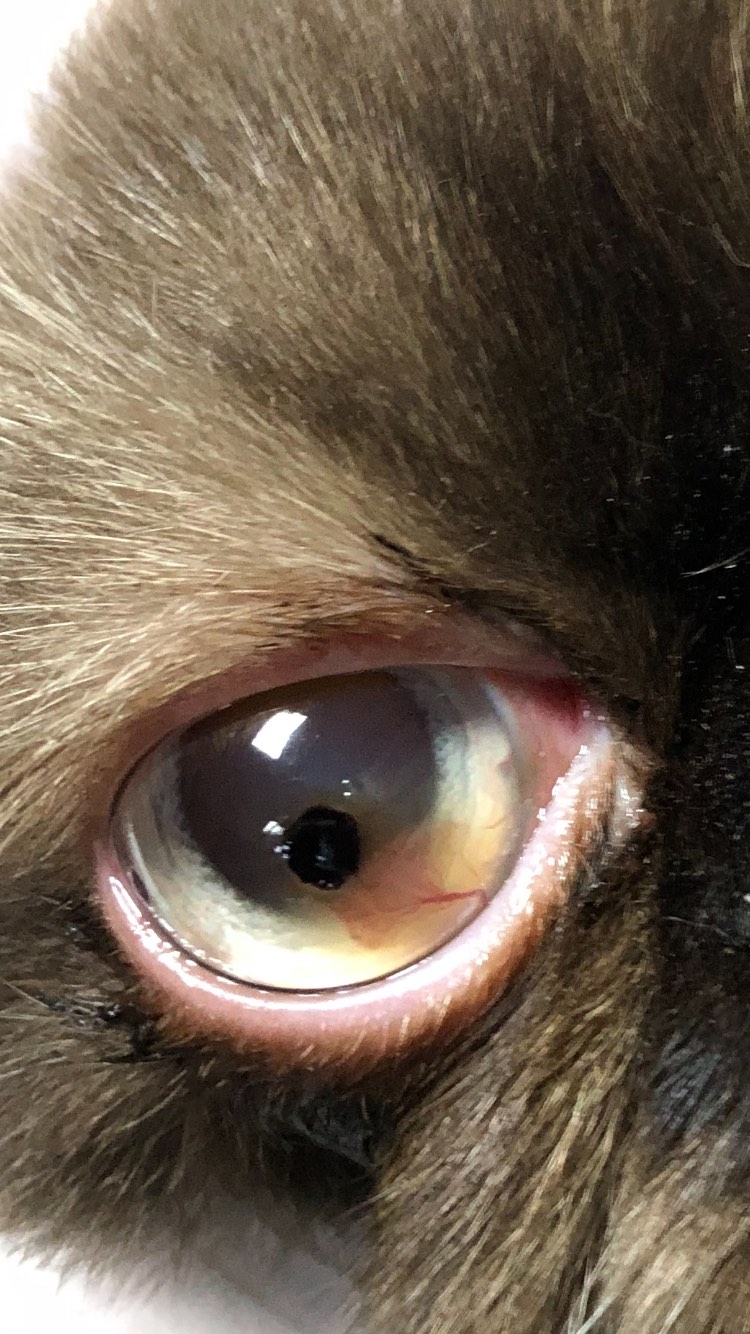
- Red, swollen eyes (conjunctivitis), squinting and extra blinking
- Fever
- Not eating, often because a blocked nose means the cat cannot smell food
- Ulcers on the cornea, the clear front of the eye

After the first infection, the virus goes quiet in the body (vets call this latent) and can wake up again with stress or illness. A cat in a flare-up spreads it in saliva and eye and nose discharge, including through shared bowls and bedding. Calicivirus is the other big cause of cat colds; see our calicivirus guide.
What Actually Helps a Cat With Herpes
There is no cure for FHV-1, but there is treatment with real evidence behind it. Your vet chooses the medicine and dose for each of these.
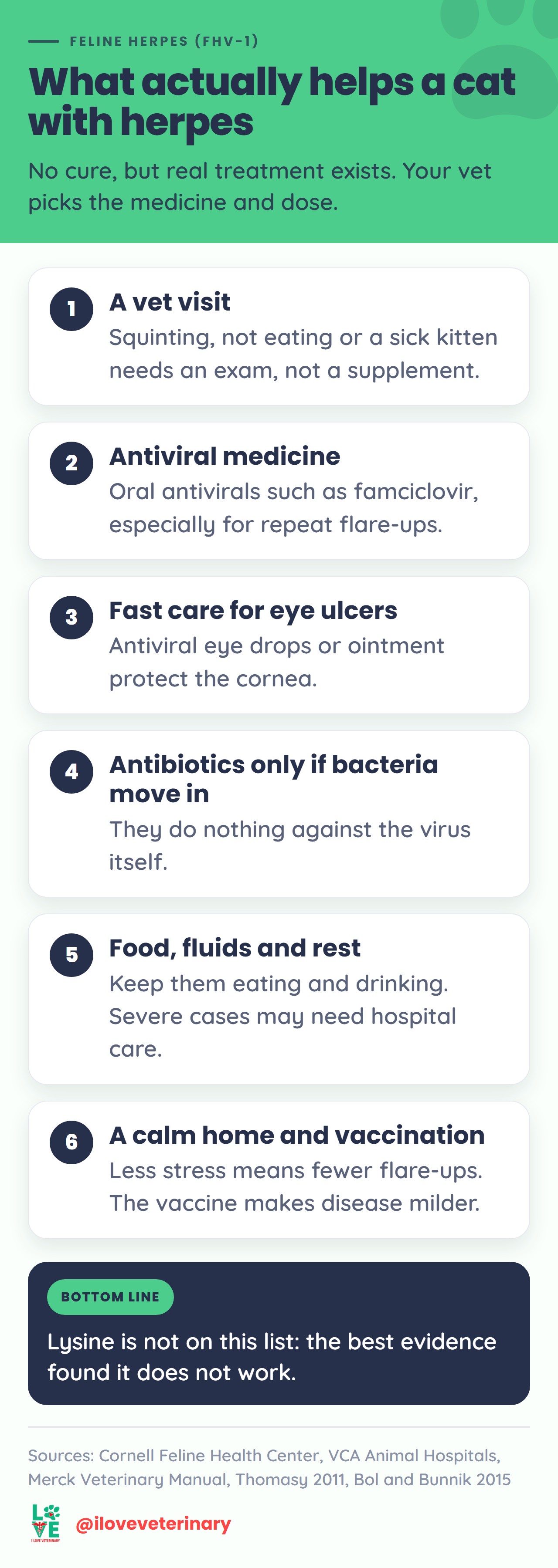
- Oral antiviral medicine. VCA names famciclovir as an oral antiviral vets use, especially for cats with recurring flare-ups. In a controlled study of experimentally infected cats, it lowered disease scores and virus shedding, and treated cats kept their weight.
- Eye medicines. Corneal ulcers need prompt, aggressive treatment to protect the eye, often with antiviral eye drops or ointments.
- Antibiotics, only for secondary infection. Antibiotics do nothing against the virus, but vets use them when bacteria move in, which is common in kittens. More in our post on antibiotics in veterinary medicine.
- Supportive care. Cornell calls nutrition and hydration "very important". Severely affected cats may need fluids, assisted feeding or, if breathing is hard, oxygen in the hospital.
- Less stress. Stable routines, fewer changes and calm handling, because stress is what wakes the virus up.
- Vaccination. Cornell recommends herpes vaccination for all cats. It does not stop every infection, but it makes the disease milder and cuts virus shedding.
When to Call the Vet
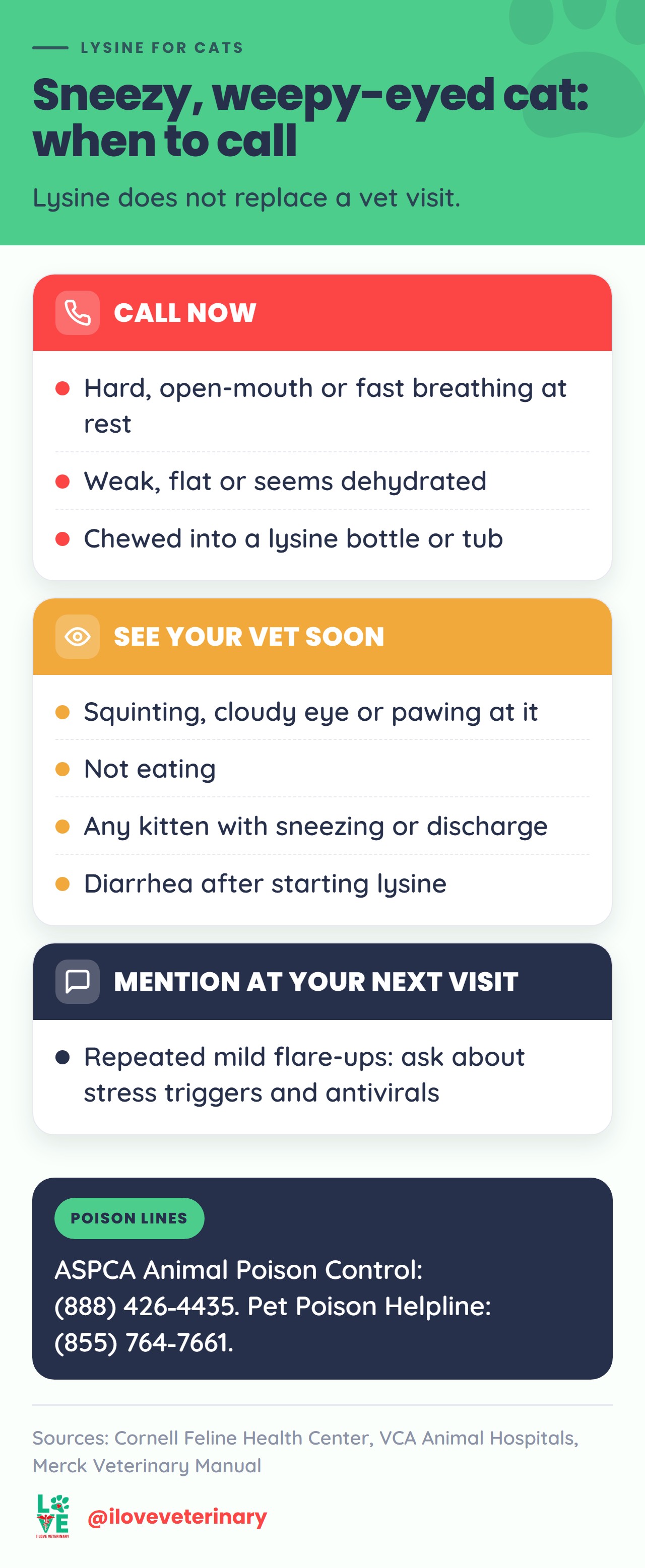
Call now (your vet or an emergency clinic):
- Breathing that is hard, open-mouthed or fast at rest. Cornell puts the upper limit at 35 breaths a minute at rest.
- A cat that is weak, flat or seems dehydrated.
- Your cat chewed into a lysine bottle or tub, or a pet ate a large amount. ASPCA Animal Poison Control: (888) 426-4435. Pet Poison Helpline: (855) 764-7661.
See your vet soon:
- Squinting, a cloudy eye, or a cat pawing at its eye. Corneal ulcers need treatment fast.
- Not eating. A congested cat that stops eating needs a vet, not a supplement.
- A kitten with any sneezing, eye discharge or nasal discharge.
- Diarrhea after starting lysine.
Mention at your next visit:
- Repeated mild flare-ups. Ask about stress triggers, antivirals and whether lysine is worth continuing.
Lysine for Cats: Quick Answers
Can lysine hurt my cat?
Side effects in individual cats seem uncommon; diarrhea is the main one listed. The bigger risks are indirect: weeks spent on something unlikely to work instead of treatment that does, the stress of daily dosing, and worse disease when lysine goes into group food. If your cat is not better after a few weeks, or is getting worse, see your vet rather than waiting.
Can I give my cat human lysine?
Ask your vet first and show them the label. Human tablets and capsules exist and some vets have used them, but they are not made or dosed for cats. If your vet says yes, choose plain lysine with no added ingredients. Many human supplements contain extras such as xylitol, a sweetener Merck lists as dangerous for dogs, so keep the bottle away from any dog in the house too.
How should I store it?
In a cool, dry place in a tightly sealed container, out of reach of pets and children.
The Bottom Line
Lysine is easy to buy and seems to cause few side effects in a single cat, which is why it hangs on. But the larger studies in real shelters found it did not help, and in shared food it may have made things worse. For herpes flare-ups, the useful steps are a vet visit, an antiviral or eye medicine when needed, vaccination and a calm home. If your vet still wants to try lysine, use only the product and amount they set, and stop if dosing becomes a fight.
Originally written by Jaclyn. Updated by the I Love Veterinary editorial team.
Sources
- BMC Veterinary Research: Lysine supplementation is not effective for the prevention or treatment of feline herpesvirus 1 infection in cats: a systematic review (Bol and Bunnik, 2015)
- Merck Veterinary Manual: Feline Respiratory Disease Complex (Tonozzi, updated 2024)
- Cornell Feline Health Center: Respiratory Infections
- Clinician's Brief: L-Lysine Administration for Feline Herpesvirus Infection (2008)
- Journal of Feline Medicine and Surgery: Oral supplementation with l-lysine did not prevent upper respiratory infection in a shelter population of cats (Rees and Lubinski, 2008)
- American Journal of Veterinary Research: Effects of dietary lysine supplementation on upper respiratory and ocular disease in cats within an animal shelter (Drazenovich and colleagues, 2009)
- Journal of Feline Medicine and Surgery: Effects of dietary lysine supplementation in cats with enzootic upper respiratory disease (Maggs and colleagues, 2007)
- American Journal of Veterinary Research: Evaluation of orally administered famciclovir in cats experimentally infected with feline herpesvirus type-1 (Thomasy and colleagues, 2011)
- VCA Animal Hospitals: Lysine
- VCA Animal Hospitals: Herpesvirus Infection in Cats (Feline Viral Rhinotracheitis)
- PetMD: Can Lysine for Cats Help With Illness? (Morrison, 2023)
- Merck Veterinary Manual: Xylitol Toxicosis in Dogs
- ASPCA Animal Poison Control Center
- Pet Poison Helpline
This article is for general information and is not a substitute for advice from your veterinarian.