Cefpodoxime (sold for dogs as Simplicef, and as generics like Cefpoderm) is a once-a-day prescription antibiotic. The FDA approved it for skin infections in dogs, specifically infected wounds and abscesses. The label range is 5 to 10 mg per kg of body weight by mouth, once a day, with or without food, and your vet picks the exact amount for your dog.
Most dogs handle it well. What's worth knowing is how long to give it, why your vet may want a lab test before choosing it, and the allergy warning: a dog that has reacted to penicillin or another cephalosporin should not get it. Below you'll find the label dose chart with its sources, a weight calculator, what side effects look like, and when to call.
What Is Cefpodoxime?
Cefpodoxime proxetil is a cephalosporin, an antibiotic family closely related to penicillin. Both families share the same core ring structure (the beta-lactam ring), which is why an allergy to one can carry over to the other.
It is a third-generation cephalosporin. The generation tells you when a drug was developed and what it can reach: each newer generation was designed to hit more Gram-negative bacteria and to resist more of the enzymes bacteria use to break these drugs down. Cefpodoxime is one of the few third-generation cephalosporins that can be given by mouth, and it was released for veterinary use in 2005.
- It is a prodrug. The tablet holds cefpodoxime proxetil, which the gut converts into active cefpodoxime.
- Brands for dogs. Simplicef (Zoetis) comes as 100 mg and 200 mg scored tablets. FDA-approved generics include Cefpoderm and DermaCeph.
- Human versions exist as tablets and liquids (brand name Vantin). Don't swap one in on your own.
- Prescription only. US federal law limits it to use by or on the order of a licensed veterinarian.
For the bigger picture on how vets choose between drug families, see our guide to antibiotics in veterinary medicine.
What Does Cefpodoxime Treat in Dogs?
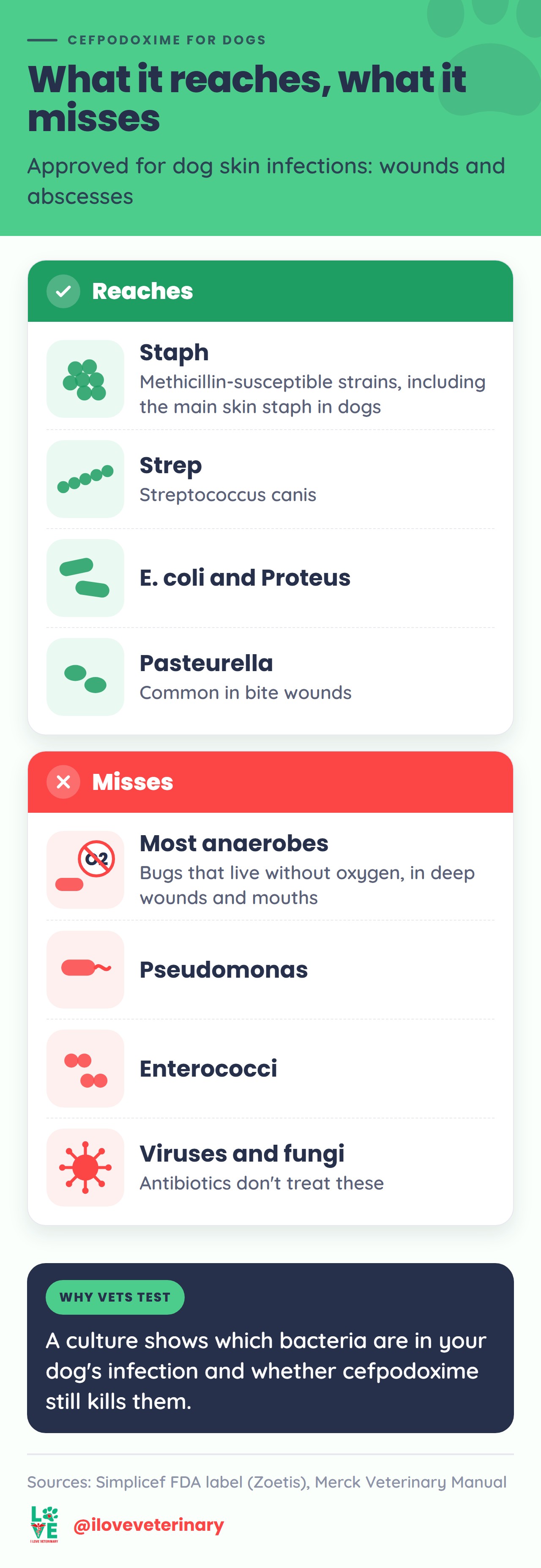
The FDA label covers one job: skin infections (wounds and abscesses) in dogs caused by bacteria that cefpodoxime can kill. The label lists:
- Staphylococcus pseudintermedius (the main skin staph in dogs, called S. intermedius on older labels)
- Staphylococcus aureus
- Streptococcus canis
- Escherichia coli
- Pasteurella multocida (common in bite wounds)
- Proteus mirabilis
In the field study behind the approval, 88.7% of dogs with infected wounds or abscesses were treated successfully on once-a-day cefpodoxime, about the same as the 88.4% on a comparison antibiotic given twice a day.
Vets also use it extra-label (for a use the label doesn't list, which US law allows a vet to do) for other skin infections such as pyoderma, and sometimes for urinary or respiratory infections.
What it does not cover
Cefpodoxime kills bacteria by blocking the proteins they need to build their cell wall. The label says it is not active against most anaerobes (bacteria that live without oxygen, common in deep wounds and dental infections), Pseudomonas or enterococci, and like any antibiotic it does nothing against viruses or fungi.
The Merck Veterinary Manual adds that the spectrum of veterinary third-generation cephalosporins "should not be considered extended". "Third generation" does not mean "covers everything".
Why Your Vet May Test Before Choosing It
The Simplicef label tells vets to take a sample for culture and sensitivity testing before starting treatment. A culture grows the bacteria from your dog's wound or skin, and the sensitivity part checks which antibiotics still kill them. When the results come back, your vet confirms the choice or switches drugs.
For skin infections, the International Society for Companion Animal Infectious Diseases (ISCAID) published updated canine pyoderma guidelines in 2025:
- Topical first. Antiseptic shampoos, sprays or wipes alone are the treatment of choice for surface and superficial skin infections.
- First-choice tablets. When a dog does need an oral antibiotic, the first-choice drugs are clindamycin, cephalexin, cefadroxil and amoxicillin-clavulanate.
- Cefpodoxime is second choice. It is meant for cases where culture results show the bacteria are susceptible and first-choice drugs are not suitable.
That isn't a knock on the drug. ISCAID notes it is consistently active against methicillin-susceptible staph. But second-choice drugs carry a higher risk of selecting for multidrug-resistant bacteria, and Look Ahead Vet classes cefpodoxime as a "critically important" antimicrobial. The point is to keep it working for the infections that need it.
If your dog's skin problem started as bumps around hair follicles, our post on folliculitis in dogs explains why topical care comes first there too.
Cefpodoxime Dosage Chart for Dogs
The chart shows the FDA label dose in milligrams (mg) of cefpodoxime per kilogram (kg) or per pound (lb) of body weight. Cats have no label dose, so their row stays with your vet.
Only give what your vet prescribed, at the dose they set.
For information only. These are typical published dose ranges, not a prescription and not medically verified for your pet. Your veterinarian sets the dose after examining your pet. Never start, stop or change a medicine without their OK.
Pet | Use | Dose per kg | Dose per lb | How often | How long | Source |
|---|---|---|---|---|---|---|
Dog | Skin infections (wounds and abscesses), FDA label | 5-10 mg/kg | 2.27-4.54 mg/lb | Once a day, by mouth, with or without food | 5-7 days, or 2-3 days past the last signs, up to 28 days. Recheck if an acute infection is no better after 3-4 days | |
Cat | Not FDA-approved for cats (extra-label) | Your vet decides | Your vet decides | Your vet decides | Your vet decides |
Dose calculator · Cefpodoxime (Simplicef, cefpodoxime proxetil)
Cefpodoxime dose calculator for dogs
Not a prescription. For information only. These are typical published dose ranges, not a prescription and not medically verified for your pet. Your veterinarian sets the dose after examining your pet. Never start, stop or change a medicine without their OK.
Only give what your vet prescribed.
All doses in this calculator
| Pet | Use | Typical dose | How often | Route | Source |
|---|---|---|---|---|---|
| Dog | Skin infections (wounds and abscesses), FDA label | 5 to 10 mg per kg (2.27 to 4.54 mg per lb)FDA label range only. Your vet picks the dose inside it, and your vet or pharmacist matches it to tablet sizes. Label course: 5 to 7 days, or 2 to 3 days past the last signs, up to 28 days; recheck if an acute infection is no better after 3 to 4 days. Never give it to a dog allergic to penicillins or cephalosporins. | once a day | by mouth, with or without food | Simplicef FDA label (Zoetis, DailyMed) |
What the numbers don't show:
- Why the amount varies. The label leaves the exact dose to your vet, based on how severe the infection is, which bacteria are involved and how well your dog's immune system is working. Your vet or pharmacist then matches it to tablet sizes.
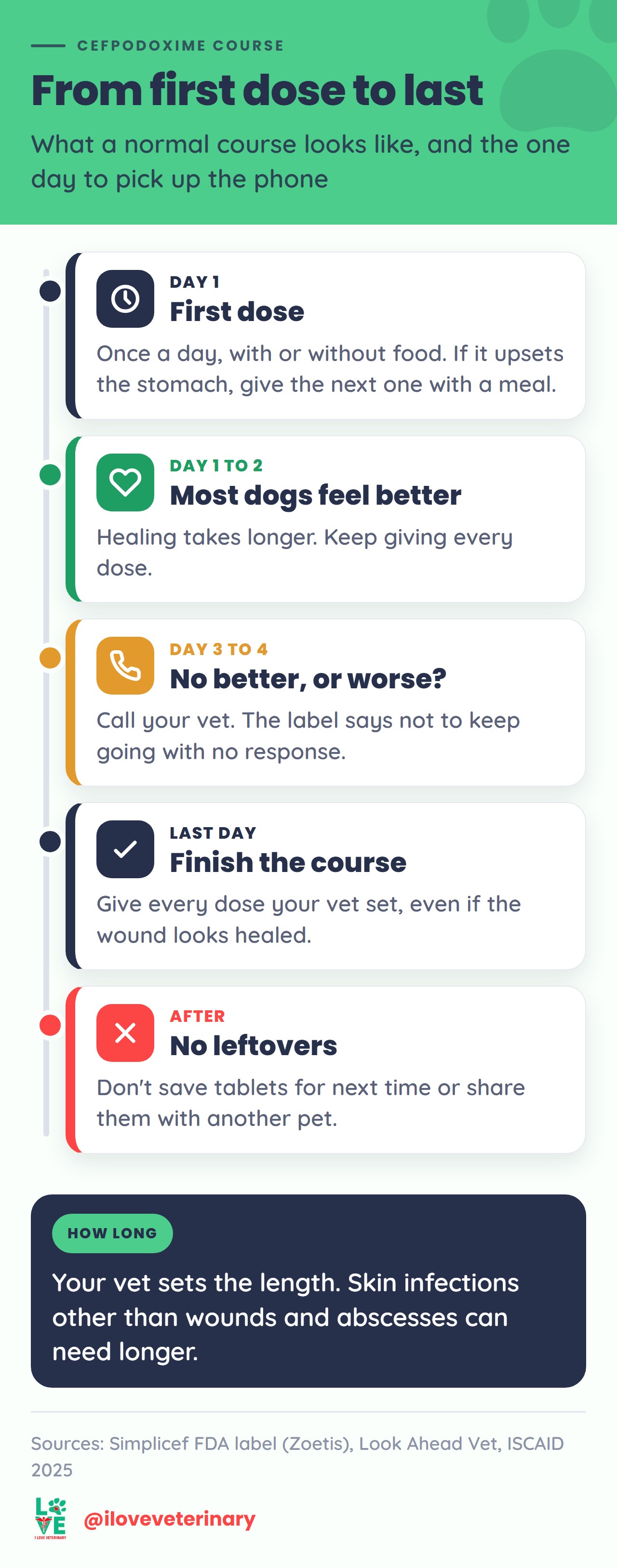
- The course length is part of the prescription. Give every dose for as long as your vet says, even once your dog looks better.
- Other skin infections can take longer. Guidelines for pyoderma may call for a longer course than the label's wound and abscess course, and your vet sets the length.
- Other uses are your vet's call. Urinary, respiratory or deeper skin infections are extra-label, so the dose and length come from your vet.
If your dog gets into the bottle or receives a double dose, call your vet or a poison line: ASPCA Animal Poison Control (888) 426-4435 or Pet Poison Helpline (855) 764-7661.
How to Give Cefpodoxime
- With or without food. The label allows both. If your dog vomits after a dose on an empty stomach, give the next one with a meal or a small treat. If the vomiting continues, call your vet.
- Once a day. Tying it to breakfast or another daily routine makes a missed dose less likely.
- Missed a dose? Give it when you remember. If the next dose is nearly due, skip the missed one and carry on. Never give two doses at once.
- Liquid version. If your vet prescribes a liquid, shake it well, measure with the syringe or spoon you were given, keep it in the fridge, and throw out what's left after 14 days.
- Finish the course. Stopping early because the wound looks better can let the infection come back. Don't save leftovers for the next infection or share them with another pet.
- That smell is normal. Cephalosporins can smell a bit like cat urine.
- If you're allergic to penicillin or cephalosporins, the label advises avoiding direct contact with the tablets.
Cefpodoxime Side Effects in Dogs
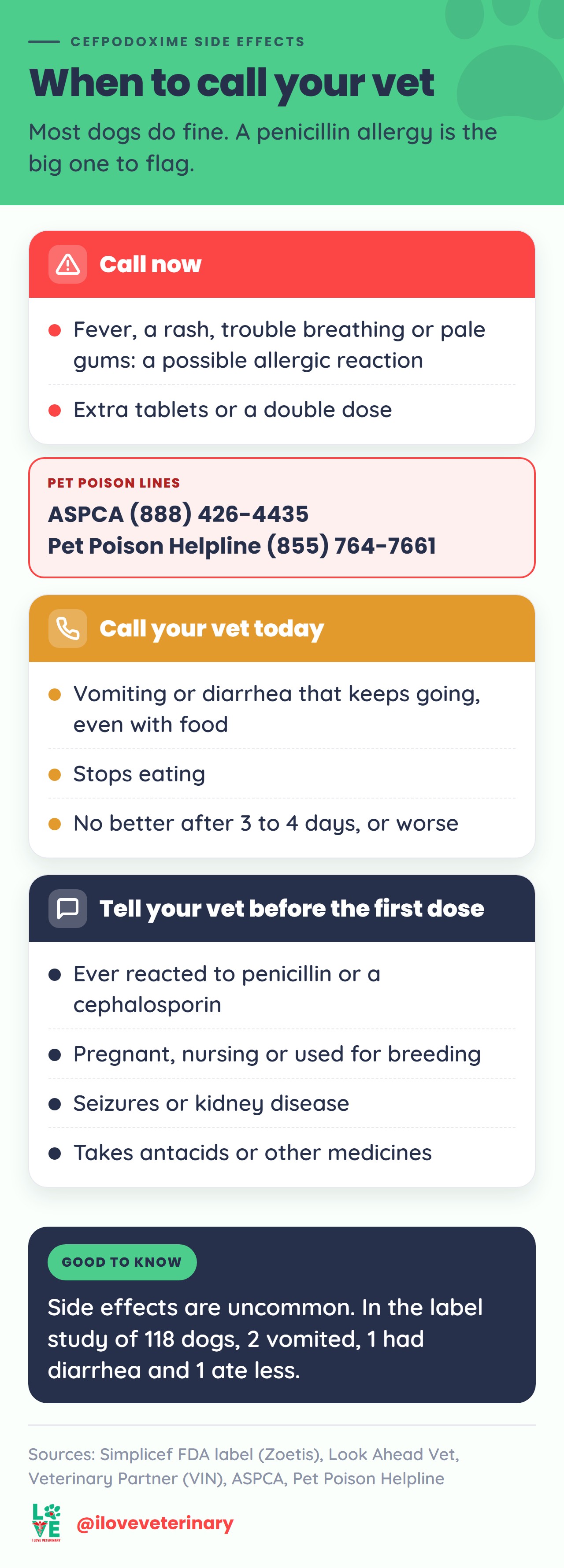
Side effects are uncommon and usually mild. In the US field study, 118 dogs got Simplicef: 2 vomited, 1 had diarrhea and 1 ate less.
Other effects reported for cephalosporins as a group:
- Allergic reactions. Rare, but they can be serious, and a dog with a penicillin allergy may react to cephalosporins too.
- Antibiotic-related diarrhea (colitis) from changes in the gut bacteria.
- Lab test changes. Cefpodoxime can make urine glucose dipsticks and some urine ketone tests read falsely positive, and it can occasionally cause a positive Coombs' test (a test for immune-mediated anemia). Mention the medicine if your dog has bloodwork or a urine test during the course.
- Low white blood cell counts (neutropenia) can follow high cephalosporin doses. The label says to stop the drug if that happens.
In the label's safety studies, adult dogs and young puppies tolerated 10 times the maximum label dose. That margin is no reason to give more than prescribed. Look Ahead Vet notes that vomiting is the most common sign of an overdose, and that a serious overdose can cause anemia and damage to the kidneys and nervous system.
When to call your vet
Call now:
- Fever, a rash, trouble breathing or pale gums (possible allergic reaction)
- Your dog ate extra tablets or got a double dose: call your vet, ASPCA Animal Poison Control (888) 426-4435 or Pet Poison Helpline (855) 764-7661
Call your vet today:
- Vomiting or diarrhea that continues after you've tried giving doses with food
- Your dog stops eating
- No improvement after 3-4 days, or the infection looks worse
Which Dogs Should Not Take Cefpodoxime?
- Dogs allergic to cefpodoxime, penicillins or other cephalosporins. This is the label's one firm "do not use".
- Breeding, pregnant or nursing dogs. The label says safety hasn't been established, so your vet weighs the risk.
- Dogs with seizure disorders. Veterinary Partner suggests choosing another antibiotic when one will do.
- Dogs with kidney disease. The label notes that cefpodoxime leaves the body mainly in the urine, so tell your vet about any kidney problem before the first dose.
Also tell your vet about every medicine and supplement your dog takes, especially antacids, which can reduce how much cefpodoxime is absorbed. Mention any past reaction to an antibiotic and any earlier antibiotic course for the same problem.
Cefpodoxime FAQ
How fast does cefpodoxime work in dogs?
It starts working within 1 to 2 hours of the first dose, and most dogs feel better within 1 to 2 days. A wound or abscess takes longer to heal, which is why the full course matters.
Can cats take cefpodoxime?
It isn't FDA-approved for cats, but vets sometimes prescribe it extra-label, and only your vet can set a cat's dose. If your cat stops eating completely while taking it, call your vet, because a cat that doesn't eat can develop serious liver problems.
Can I give my dog human cefpodoxime?
Not on your own. Human liquids come in more than one strength, and the right product and dose depend on the infection. Your vet decides whether a human product fits.
Is cefpodoxime a strong antibiotic?
It reaches more Gram-negative bacteria than older cephalosporins, but it still misses anaerobes, Pseudomonas and enterococci. Guidelines save it for cases where a culture supports it, which is why your vet may start with a first-choice antibiotic or a medicated shampoo.
Originally written by Dr. Catharina Hjorth. Updated by the I Love Veterinary editorial team.
Sources
- Zoetis: SIMPLICEF (cefpodoxime proxetil tablets) FDA label, DailyMed
- Dechra: Cefpoderm (cefpodoxime proxetil) Tablets package insert
- MWI/VetOne: DermaCeph (cefpodoxime proxetil) tablet label, DailyMed
- Merck Veterinary Manual: Cephalosporins and Cephamycins Use in Animals
- Veterinary Dermatology (ISCAID): Synopsis of the antimicrobial use guidelines for canine pyoderma, 2025
- Veterinary Partner (VIN): Cefpodoxime Proxetil (Simplicef, Vantin)
- Look Ahead Vet: Cefpodoxime medication sheet
- ASPCA: Animal Poison Control Center
- Pet Poison Helpline
This article is for general information and is not a substitute for advice from your veterinarian.