
Dogs and scorpions are a bad combination, especially in the desert Southwest, where both are common. A dog that noses into a woodpile or steps on a scorpion at night is the one that ends up limping.
Not all scorpions are equal, though. There are well over a thousand species worldwide, and only a small number are medically significant. In the United States, the one that matters is the Arizona bark scorpion. Most bark scorpion stings in dogs stay local and painful. A few turn into something more serious, and only your veterinarian can tell which one you are dealing with. Below: how to spot a sting, what to do on the way to the clinic, and what the vet team does when you get there.
Which Scorpions Are Dangerous to Dogs?

Scorpions are arachnids, related to spiders but not spiders. They grab prey with their pincers and sting with the tip of the tail, so a "scorpion bite" on a dog is really a sting.
The Arizona bark scorpion (Centruroides sculpturatus) is the only scorpion in the US considered of medical concern. According to the Merck Veterinary Manual, it lives in Arizona, western New Mexico, southern Utah and Nevada, and occasionally along the Colorado River in California and in northwestern Mexico. Its venom is a neurotoxin: it disrupts how nerves fire, which can affect heart rate and blood pressure.
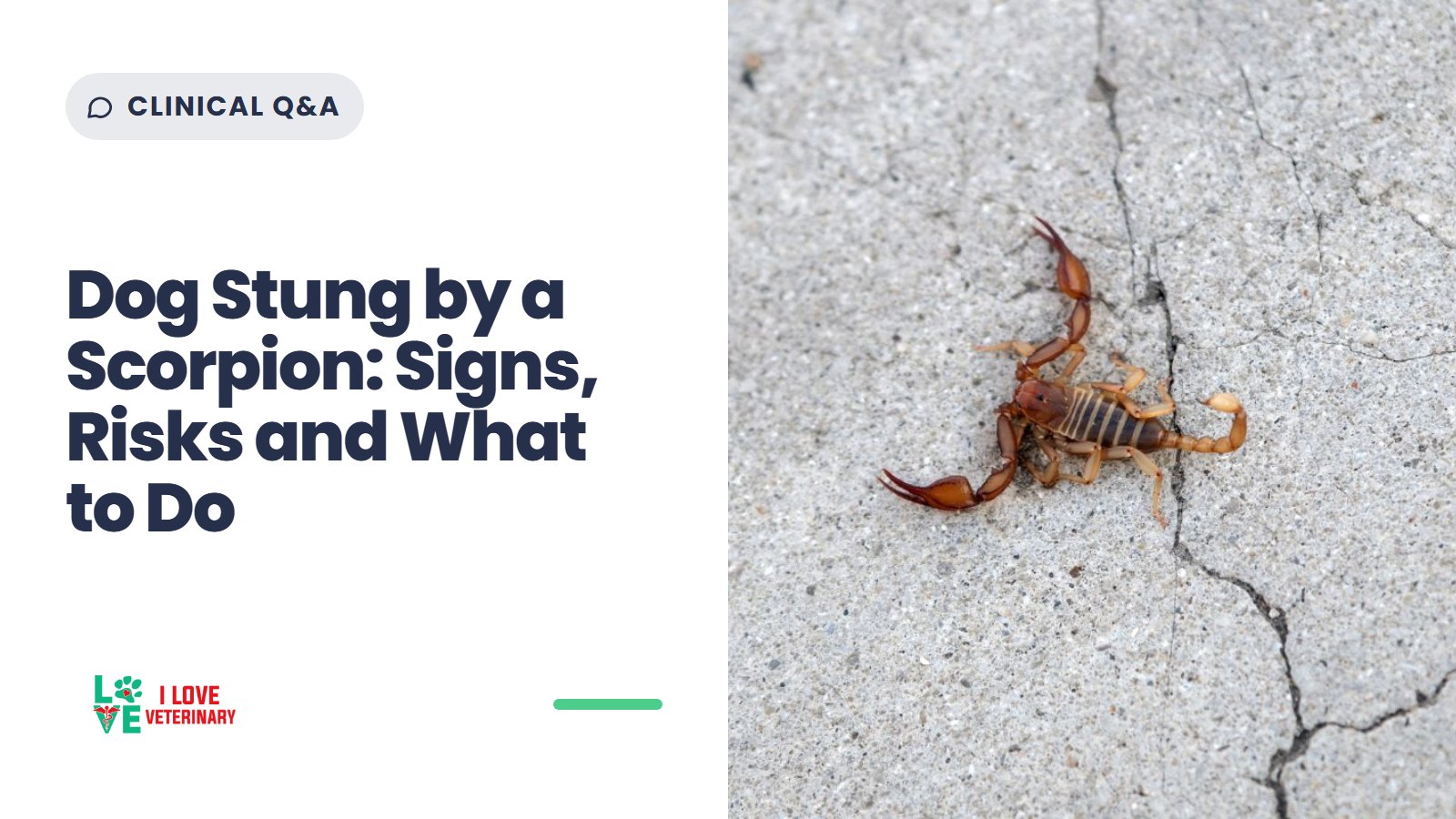
An adult bark scorpion is small, roughly 1.5 to 3 inches long (sources differ on the exact range), with a slender tail and thin, delicate pincers. Its color varies a lot, so color alone won't identify it. It is a strong climber that hides in cracks, can walk up walls, and is mostly active at night.
Size is not a rule for danger. Some small desert scorpions have mild venom, and so does the largest US species, the giant hairy scorpion. Shape and location tell you more than size does.
Signs Your Dog Was Stung by a Scorpion
The most common sign is sudden lameness. A dog that was fine a minute ago starts limping, holds a paw up, or moves slowly as if the leg feels wrong. Stings often land on the paws and legs because that is what touches the scorpion, but they can happen anywhere, including the face.
You may never see a mark. Many scorpion stings leave no visible puncture, and swelling, if there is any, may be mild. Watch how your dog moves rather than searching the skin for proof.

Common, local signs
These are the signs most dogs show, and they stay at the sting site:
- Limping, pawing at the area, or crying out
- Licking or chewing at a paw or at the face
- Pain when the area is touched
- Mild swelling and redness
- Itching
- Skin at the sting site that later peels or sloughs
Less common, urgent signs
When venom affects the whole body, vets call these systemic signs. The Merck Veterinary Manual says systemic signs from bark scorpion stings are not common in dogs, but they can happen. Any of these means your dog needs to be seen right away:
- Fast heart rate
- Breathing trouble
- Drooling more than usual
- Twitching, muscle tremors, or shaking
- Agitation or restlessness
- Collapse
Allergic reactions
An allergic reaction to scorpion venom is rare but possible. Signs include swelling of the eyelids, tongue, face or throat, vomiting, hives, and collapse. Treat any of these as an emergency.

What to Do Right Now
Your job is to get your dog to a veterinarian safely, not to treat the sting at home. If you suspect a scorpion sting:
- Stay calm. You need a clear head to handle your dog and drive.
- Keep your dog quiet. Carry a small dog. Walk a large dog slowly on a short leash.
- Note the time and the signs. Which leg, when the limping started, and anything new such as drooling or fast breathing.
- Leave the scorpion alone. Don't try to catch or kill it to bring along. People get stung that way. Just note where your dog was.
- Call ahead. Phone your veterinarian or nearest emergency clinic so they know you are coming. If you can't reach a clinic, call an animal poison line: the ASPCA Animal Poison Control Center at (888) 426-4435 or the Pet Poison Helpline at (855) 764-7661. Both may charge a consultation fee.
- Give no human medicines. No pain pills, antihistamines or creams from the medicine cabinet. Your veterinarian chooses the treatment after the exam.
- Go in. Even if your dog seems to settle, let the exam decide.

1-800-222-1222 is the human Poison Help line. For your dog, use your vet or one of the animal lines above.
What the Vet Does
Texas A&M's veterinary college gives owners simple advice: if you suspect a sting, bring the pet in. At the clinic, care usually looks like this:
- Exam. The vet checks the sting site, heart rate, blood pressure and breathing to see whether the sting has stayed local or turned systemic.
- Local wound care. The team may wash the sting area and use cold compresses to bring down swelling. This is done by the clinic, not at home.
- Pain control. Pain is the main problem for most dogs. Your veterinarian chooses the medication and dose, which may be an anti-inflammatory made for dogs or a medication for nerve pain.
- Monitoring. Dogs are watched for systemic signs such as a racing heart, high blood pressure, or fluid on the lungs.
- Supportive care. This means treating the signs while the body clears the venom. It can include IV fluids and hospital monitoring if a dog is more seriously affected.
What about antivenom?
An antivenom for bark scorpion stings exists in the US, but it is approved for people. Merck notes that it is rarely used in animals because it can be very expensive and has to be given shortly after the sting. For most dogs, pain control and supportive care are the treatment.
Can a Scorpion Sting Kill a Dog?
It can, but serious illness is uncommon. The Merck Veterinary Manual says severe toxicity from US scorpions is not likely and that most bark scorpion stings in dogs stay limited to local pain and swelling. Pet Poison Helpline notes that bark scorpion venom can cause death in companion animals, so the risk is real even if it is low. A Texas A&M emergency veterinarian reported never seeing a dangerous scorpion sting in a dog or cat in more than four years of emergency work. That is one clinician's experience, not a study, and no source we found counts dog deaths from bark scorpions.
Small dogs and puppies deserve extra caution. There is no dog data showing they fare worse, but a small body takes the same sting as a large one. A small dog that may have been stung should be seen, not watched at home.
Any dog with breathing trouble, tremors, collapse or facial swelling needs emergency care, whatever its size.
How to Prevent Scorpion Stings
You can't scorpion-proof the desert, but you can make your home and yard much less friendly to them.
Seal the house and target scorpions
Scorpions get inside under and around poorly fitted doors, through gaps in weather stripping, and through weep holes in walls. Caulk cracks, replace worn door sweeps, and close gaps around pipes and windows. To find gaps, have one person shine a flashlight along doors and windows from inside at night while another looks for light leaking through outside.
University of Arizona Extension specialists say scorpions are difficult to manage with pesticides alone, and that pest-proofing the house is by far the most effective step. If you hire a pest control company, choose one that specifically targets scorpions. A good technician can also point out openings that need sealing.
Sweep the yard with a UV light
Scorpions glow bright green under ultraviolet (black) light. A UV flashlight sweep of the patio, walls and yard after dark shows you where they are before your dog finds them. Don't shine the light into your own or your dog's eyes.
Be careful at night and on walks
Bark scorpions shelter during the day and come out after dark, especially in warm months. Keep evening potty breaks on a leash and steer your dog away from woodpiles, rock piles, leaf heaps and the base of walls. On walks and hikes, a leash keeps your dog's nose out of the cracks where scorpions hide. If you hike off leash, sharpen "leave it" and "come" first.

Other Venomous Scorpions Around the World
Outside the US, several scorpions are far more dangerous. The Merck Veterinary Manual lists the Brazilian yellow scorpion (Tityus serrulatus) in South America, the deathstalker (Leiurus quinquestriatus) in northeastern Africa and the Middle East, fat-tailed scorpions (Androctonus) in North Africa, the Middle East and southwestern Asia, and the Indian red scorpion (Hottentotta tamulus) on the Indian subcontinent. If you travel abroad with your dog, ask a local veterinarian which species live there.
Final Thoughts
Most scorpion stings in dogs stay local, and pain control at the clinic handles them. The catch is that you can't tell a mild sting from a serious one at home. A sudden limp in scorpion country means call the vet and drive. Save the clinic and animal poison line numbers in your phone now, then cut the odds of a repeat by sealing the house and sweeping the yard with a UV light.
Sources
- Merck Veterinary Manual: Spider and Scorpion Bites and Stings to Animals
- University of Arizona Cooperative Extension: Scorpions of the Desert Southwest United States (AZ1768)
- University of Arizona Cooperative Extension: Scorpions (Backyard Gardener)
- Arizona Poison and Drug Information Center: Scorpions
- Pet Poison Helpline: Scorpions
- ASPCA: Animal Poison Control Center
- Texas A&M College of Veterinary Medicine: Keeping Pets Safe From Scorpion Stings
- Poison Control (National Capital Poison Center): Scorpions
This article is for general information and is not a substitute for advice from your veterinarian.