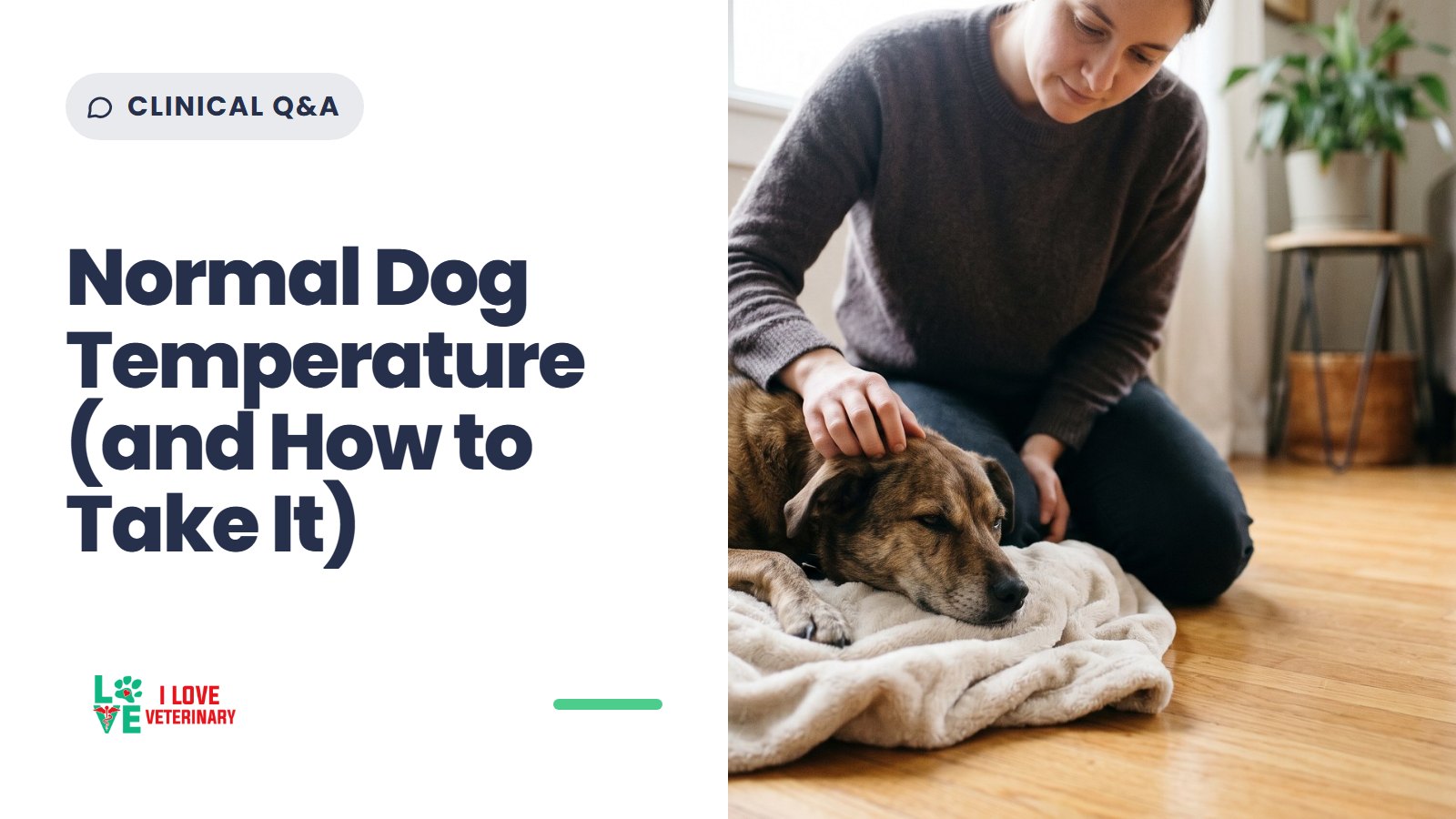
A normal dog temperature is 99.5 to 102.5°F (37.5 to 39.2°C), taken rectally, according to the Merck Veterinary Manual. Merck's pet-owner guide puts a typical healthy reading at about 101.5 to 102°F (38.6 to 38.9°C).
That's warmer than you are, which is why a perfectly healthy dog can feel hot under your hand. Only a thermometer settles it. Below you'll find the chart, how to take the reading, and the numbers that mean you should stop reading and drive to the vet. For heart rate, breathing and gums too, we keep all normal vital signs in one chart.
Go to the vet now if:
- The temperature is above 104°F (40.0°C) or below 99°F (37.2°C). VCA's veterinarians call both "emergency situations".
- Your dog shows heatstroke signs after heat or exercise: hot skin, rapid panting, drooling, vomiting, wobbly walking, collapse. Heatstroke is an emergency whatever the thermometer says.
- A newborn puppy feels cold. Merck lists chilling below 96°F (35.6°C) as a sepsis risk in newborns, so call your vet now.

Dog Temperature Chart (°F and °C)
All readings are rectal.
Reading | °F | °C | What it means |
|---|---|---|---|
Too low: go to the vet | below 99°F | below 37.2°C | Hypothermia risk; VCA's "take them to your veterinarian" line |
Normal adult range | 99.5-102.5°F | 37.5-39.2°C | Healthy, resting adult dog (Merck) |
Typical healthy dog | about 101.5-102°F | about 38.6-38.9°C | A typical reading (Merck owner guide) |
Fever | above 102.5°F | above 39.2°C | Above the top of the normal range; across species, Merck says most true fevers run 103-106°F (39.5-41.1°C) |
Too high: go to the vet | above 104°F | above 40.0°C | VCA's emergency line |
Heatstroke (definition) | above 105.8°F | above 41°C | Plus nervous system signs such as wobbling or collapse |
Why do other sites print 100°F or 101°F as the bottom of normal? Reference sources draw the line slightly differently. VCA and the Animal Medical Center use 100.0 to 102.5°F, and one Merck table starts at 101°F. We use Merck's main reference range.
What about a reading between 99 and 99.5°F? It's below normal but above VCA's emergency line. Recheck; if it stays low or your dog seems unwell, call your vet.
Small dogs and large dogs share one chart. Our veterinary sources don't give a separate normal range by size. What helps more is knowing your own dog's usual reading, taken when they're healthy and calm.
What Is Normal for Puppies?
Newborn puppies run cooler than adults. They can't regulate their own body temperature until about 4 weeks of age, so they depend on a warm environment.
Puppy age | Normal rectal temperature |
|---|---|
Week 1 | 95-99°F (35-37.2°C) |
Weeks 2-3 | 97-100°F (36.1-37.8°C) |
Week 4 | 99-101°F (37.2-38.3°C) |
By week 4 they reach the low end of the adult range. A chilled newborn is an emergency: Merck lists a body temperature below 96°F (35.6°C) as a risk factor for sepsis in newborn puppies and kittens. If a young puppy feels cold, call your vet now.

How to Take Your Dog's Temperature
A rectal reading with a digital thermometer is the reference method. It's quick once you've done it, and it's the number your vet will compare against.
What you need:
- A digital thermometer. Skip glass ones: they break, and mercury is hazardous. A regular human digital thermometer works rectally; label it as the dog's.
- Petroleum jelly or another lubricant.
- A helper and a few high-value treats.
A thermometer belongs in every pet first aid kit, so you have it before you need it.
- Let your dog settle first. If they've just run, played or been wrestled into position, wait about 10 minutes. Excitement alone can push the reading up.
- Get a second pair of hands. One person hugs the dog gently, holding the chest and head close. Treats help.
- Lubricate the tip. Petroleum jelly works.
- Lift the tail and slide the thermometer in gently, just past the tip, until the metal tip is fully inside. Never force it.
- Hold it steady until it beeps.
- Write it down with the time, then clean the thermometer.
Stop if your dog panics, struggles hard or tries to bite. A struggling dog can read falsely high, and nobody needs a bitten hand. Call your vet and describe what you're seeing instead.

Ear, Armpit or Touch: Do Other Methods Work?
Ear thermometers read from the ear canal and need to sit close to the eardrum. VCA describes them as "reasonably accurate, but not always precise". Don't use one in an ear that might be infected; the reading won't be accurate. Veterinarian Amy Attas, VMD, told the AKC she prefers a digital ear thermometer made for dogs when owners want an alternative to rectal. If your vet asks for a number, a rectal reading is still the one to give.
Armpit readings come last. Dr. Attas calls the armpit "a distant third choice", after rectal and ear. We found no sourced normal range for armpit readings, so you can't compare the number to the chart above.
Touching the nose, ears or belly won't give you a number. As VCA puts it, you can't tell whether a pet is too hot or too cold just by looking at them. If you're worried enough to feel your dog's ears, take a real reading or call your vet.
What Raises a Dog's Temperature (Without Illness)
Not every high number is a fever. Three things push a healthy dog's reading up:
- Excitement, stress or restraint. VCA notes that over-excited or agitated pets can have falsely elevated temperatures. Let your dog rest about 10 minutes, calm them, and recheck.
- Exercise on hot days. A dog's temperature can climb fast on a walk in the heat, especially in short-nosed (brachycephalic) breeds, the AKC notes. On hot days, check the ground too: see how hot is too hot for a dog's paws.
- A short nose. Merck warns that short-nosed dogs can overheat from stress or excitement even on cool days.
If the reading is still high after rest, or your dog seems unwell, call your vet.
Fever, Heatstroke or Hypothermia?
These three get mixed up, and they need different responses.
Fever | Heatstroke (hyperthermia) | Hypothermia | |
|---|---|---|---|
What's happening | A sign of an underlying problem, such as an infection, that your vet needs to find | The body overheats from hot weather, exercise or stress | Body temperature drops below normal |
Temperature | Above 102.5°F (39.2°C) | Above 41°C (105.8°F) with nervous system signs; above 40.8°C (105.5°F) can cause serious organ damage, especially if it lasts | Below 99°F (37.2°C) is a vet visit |
Higher risk | Any dog | Short-nosed breeds, hot days, exercise | Small, young and old dogs |
What to do | Call your vet; don't give human medicine | Emergency: first aid below, then go now | Dry and warm gently, then call or go |
While you get to the vet: heat
The Merck Veterinary Manual's first aid for heatstroke in pets:
- Move your dog out of the heat.
- Cool the head and body with cool water, wet towels or ice packs, especially the belly. A fan helps.
- Offer small amounts of water once the temperature starts to come down.
- Don't put your dog in cold water.
- Go to the vet right away.
While you get to the vet: cold
Merck's first aid for a cold pet: if your dog is wet, dry them first, then wrap warm (not hot) water bottles around the body. Then call your vet. Winter walks bring their own risks for feet: see dog paws in winter.
Never Give Human Fever Medicine
It's tempting to reach for the medicine cabinet. Don't. Human pain and fever relievers are dangerous for dogs:
- Aspirin, ibuprofen and naproxen can cause stomach and intestinal ulcers, reduce blood flow to the kidneys, and lead to kidney failure, liver failure and even death, according to the FDA.
- Acetaminophen tends to damage a dog's liver, and it's fatal to cats.
A fever is a sign, not the problem. Your vet finds the cause and chooses any medicine and dose for your dog.
Frequently Asked Questions
Is 103°F a fever in a dog?
It's above the normal range of 99.5 to 102.5°F, so yes, treat it as a fever. Merck notes that most animals with a true fever run 103 to 106°F (39.5 to 41.1°C). Excitement can push a reading up, so recheck after 10 minutes of calm rest, and call your vet if it stays high or your dog seems unwell. Above 104°F (40.0°C), go now.
Is 99°F too low for a dog?
It's below the normal adult range, and VCA's line for a vet visit is below 99°F (37.2°C). Between 99 and 99.5°F, recheck; if it stays low or your dog seems unwell, call your vet. Newborn puppies are different: 95 to 99°F (35 to 37.2°C) is normal in their first week.
Can I use a human thermometer on my dog?
Yes, a human digital thermometer works for a rectal reading. Keep it for the dog only and clean it after each use. Avoid glass thermometers.
Is a cat's normal temperature the same?
Close, but not identical. Cats run 100.5 to 102.5°F (38.1 to 39.2°C). See normal cat temperature for the cat chart and tips.
Sources
- Merck Veterinary Manual: Normal Rectal Temperature Ranges
- Merck Veterinary Manual: What to Do in a Dog or Cat Emergency
- Merck Veterinary Manual: Fever of Unknown Origin in Animals
- Merck Veterinary Manual: Monitoring the Critically Ill Small Animal Using the Rule of 20
- Merck Veterinary Manual: Management of the Neonate in Dogs and Cats
- Merck Veterinary Manual: Normal Rectal Temperature of Neonatal Dogs and Cats
- Bruchim Y, et al.: Pathophysiology of heatstroke in dogs, revisited (Temperature, 2017)
- VCA Animal Hospitals: Taking Your Pet's Temperature
- The Animal Medical Center: Vital Signs, Know What's Normal for Your Pet
- US FDA: Get the Facts about Pain Relievers for Pets
- American Kennel Club: How to Take Your Dog's Temperature
This article is for general information and is not a substitute for advice from your veterinarian.