
A healthy adult dog's normal respiratory rate is 18 to 34 breaths a minute when awake and resting, and under 30 breaths a minute while asleep. If your dog's sleeping rate stays above about 30, count again over the next couple of hours and call your vet if it is still high.
The sleeping number is the one veterinary cardiologists ask owners to track, because it is the easiest to measure the same way every day. For temperature, heart rate and breathing side by side, see all normal vital signs in one chart.
Normal dog breathing rate at a glance
Situation | Normal breathing rate | Source |
|---|---|---|
Awake, at rest | 18-34 breaths per minute | Merck Veterinary Manual |
Resting or sleeping at home | 15-30 breaths per minute; lower is fine if your dog is otherwise well | Texas A&M Cardiology |
Asleep: when to worry | Consistently above about 30 breaths per minute | Texas A&M Cardiology |
Healthy adult dogs, counted asleep at home | Average 13 breaths per minute; no dog averaged above 23 | Rishniw et al., 114 dogs |
Why two numbers? An awake dog is sniffing and reacting to the room, so it breathes a little faster, and the Texas A&M cardiology team notes that the sleeping rate is typically a little lower than the resting rate. So the 30 line applies to a sleeping count. A dog breathing 32 times a minute while lying awake on the sofa can be perfectly normal. The same dog breathing 32 times a minute in deep sleep, night after night, is worth a call.
Breathing is also much faster when a dog is hot, stressed or active, and that is expected. Count when none of those apply.

Go to a vet now if you see any of these
Counting can wait. Fast breathing with any one of these signs is an emergency:
- Blue, gray or very pale gums or tongue. Bluish gums with open-mouth breathing mean a severe lack of oxygen.
- Open-mouth breathing while resting in a cool room, when your dog has not been exercising.
- Visible effort. The ribs and belly heave with every breath, the neck is stretched out, the elbows point outward, or your dog cannot settle.
- Collapse, fainting or sudden weakness.
- A high sleeping count plus coughing, restlessness, weakness or a swollen belly after hours. Go to an emergency hospital.
Call ahead so the team can have oxygen ready, and keep your dog calm on the way. Stress makes a dog that is struggling to breathe work even harder.
How to count your dog's sleeping breathing rate
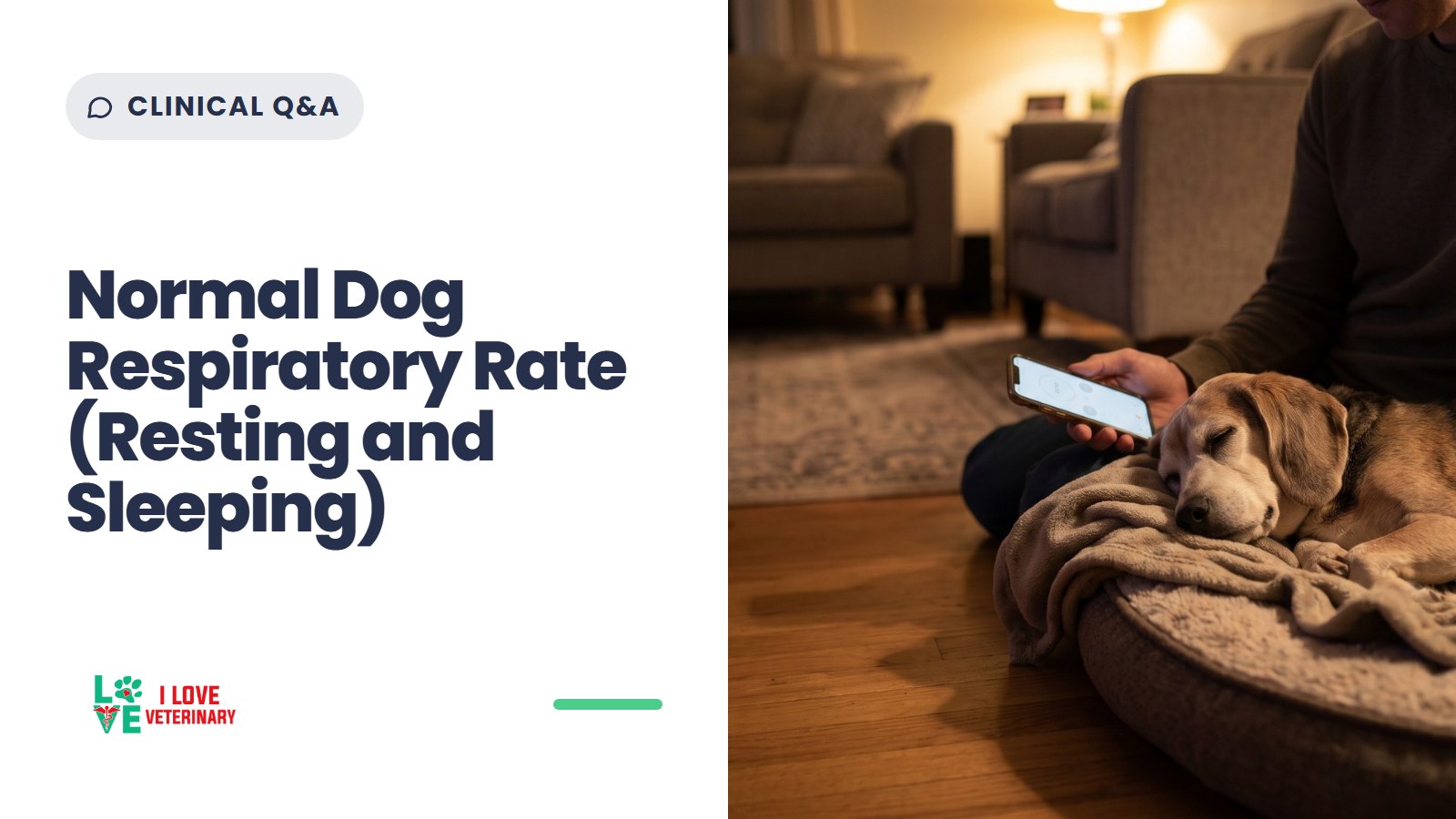
This is the method cardiology services give their clients. It takes one minute and a phone timer.
- Wait until your dog is sleeping quietly. Calm, quiet rest is the next best option. Skip counts right after exercise, in a hot room, or while your dog is dreaming (twitching paws, little yips).
- Watch the chest. One full rise and fall counts as one breath.
- Count for 30 seconds, then multiply by 2. That gives breaths per minute. Or count a full 60 seconds and skip the math.
- Write the number down with the date and time.

How often to count
To learn your dog's normal, count once a day for about a week. If your dog has heart disease without symptoms yet, your vet will tell you if and when to start, usually once or twice a week, sometimes daily. A dog with heart failure on treatment is counted once a day, every day.
Tips for an accurate count
- Count in the same situation each time, ideally the same nap or the first hour of night sleep.
- If counting live is hard, film your sleeping dog's chest for a minute and count from the video. Smartphone apps can also time the count and keep the log.
- One odd number means little. A pattern over several days is what your vet wants to see.
What your dog's number means
- Under 30 while asleep: normal for most dogs. Lower numbers are fine too if your dog is otherwise well. In a study of 114 healthy adult dogs counted at home, the average sleeping rate was 13 breaths a minute and no dog averaged more than 23, so 30 is a generous line.
- Above 30 while asleep: count again a few times over the next couple of hours. If it stays above about 30, call your vet. That is the rule in the Texas A&M cardiology handout.
- Your vet gave you a different number: use it. For some dogs a rate under 30 is already a rise.
- Creeping up from your dog's own normal: worth a call even below 30, especially in a dog with a heart murmur. This is where your log earns its keep.
- A high count plus effort, coughing, restless nights, weakness, fainting or a swollen belly: treat it as urgent. After hours, go to an emergency hospital.
Print the log below, keep it by your dog's bed, and bring it to every recheck.

Why vets ask dogs with heart disease to count
A rising sleeping rate is often the first sign that fluid is building up in or around the lungs from congestive heart failure, before the cough or the obvious struggle. The American College of Veterinary Internal Medicine guidelines for mitral valve disease, the most common heart disease in dogs, rank an increase in resting breathing rate above a dog's baseline as the best predictor that heart failure is about to get worse, and they encourage home monitoring. If your dog has a heart murmur, ask your vet whether to start counting now.
The Texas A&M cardiology service lists other signs that can go with heart disease: more effort to breathe, restless sleep, coughing or gagging, weakness, less stamina on walks, fainting, a poor appetite, weight loss and a swollen belly.
For vet teams: this page is written to send to clients with heart patients. The steps match the cardiology client handouts, and the log prints in black and white.
Panting, fast breathing or labored breathing?
These get mixed up all the time, and they call for very different responses.
What you see | What to do | |
|---|---|---|
Normal resting breathing | Quiet, easy breaths; the chest rises and falls gently | Nothing. Learn your dog's number |
Panting | Fast, shallow, open-mouth breathing with the tongue out, after exercise, heat or excitement. Dogs pant to cool down | Should ease within minutes of rest in a cool spot. Heavy panting that doesn't ease in the heat can be heatstroke: go now |
Fast breathing (tachypnea) | A breathing rate above normal at rest or asleep, without obvious effort | Count the sleeping rate. If it stays above 30, call your vet the same day |
Labored breathing (dyspnea) | Effort: heaving chest and belly, stretched neck, elbows out, open mouth at rest, blue or pale gums | Emergency. Go now and call ahead |
If you want to know why your dog is breathing fast, our guide to tachypnea in dogs covers the everyday reasons, the medical causes and what your vet will check.
Do small dogs and puppies breathe faster?
Our sources give one range for adult dogs of every size, and the Texas A&M handout applies the same 15 to 30 resting and sleeping range to all dogs. So the under-30 sleeping rule is the same for a Chihuahua and a Great Dane.
Puppies are different. The sleeping-rate research was done in adult dogs, so ask your vet what is normal for your puppy. Busy breathing during a dream is fine at any age; effort, pale or blue gums, or fast breathing that doesn't settle are not.
Flat-faced breeds such as Bulldogs and Pugs often breathe noisily and snore because of their short airways (brachycephalic obstructive airway syndrome). Noise can be normal for them. Effort, blue gums or collapse never is.
Quick answers
Is 60 breaths a minute normal for a dog?
Only while panting after play, in the heat or when excited. At rest or asleep, 60 is double the 30 line: count again once your dog is sleeping quietly in a cool room, and call your vet if it stays high. If 60 comes with effort, blue or pale gums or collapse, go now.
Can I count when my dog is awake?
Yes, if your dog is lying calmly and not sniffing, panting or watching something. Expect a slightly higher number (18 to 34 is normal awake at rest), and compare awake counts with awake counts, sleeping counts with sleeping counts.
Is the normal breathing rate the same for cats?
The sleeping rule is the same: under 30 breaths a minute, per the Texas A&M cardiology service. Cats have their own awake range. See normal cat respiratory rate.
Sources
- Merck Veterinary Manual: Table, Resting Respiratory Rates
- Texas A&M University Cardiology Service: Measuring Your Pet's Breathing Rate (client handout)
- Rishniw M, et al. Sleeping respiratory rates in apparently healthy adult dogs. Res Vet Sci. 2012;93(2):965-969
- Keene BW, et al. ACVIM consensus guidelines for the diagnosis and treatment of myxomatous mitral valve disease in dogs. J Vet Intern Med. 2019;33(3):1127-1140
- Merck Veterinary Manual: Evaluation and Initial Treatment of Dog and Cat Emergencies
- Merck Veterinary Manual: Initial Triage and Resuscitation of Small Animal Emergency Patients
- Royal Veterinary College: Respiratory distress in cats and dogs
- Merck Veterinary Manual (Dog Owners): Introduction to Lung and Airway Disorders of Dogs
- Cornell University Riney Canine Health Center: Heatstroke, a medical emergency
- American College of Veterinary Surgeons: Brachycephalic Syndrome
This article is for general information and is not a substitute for advice from your veterinarian.