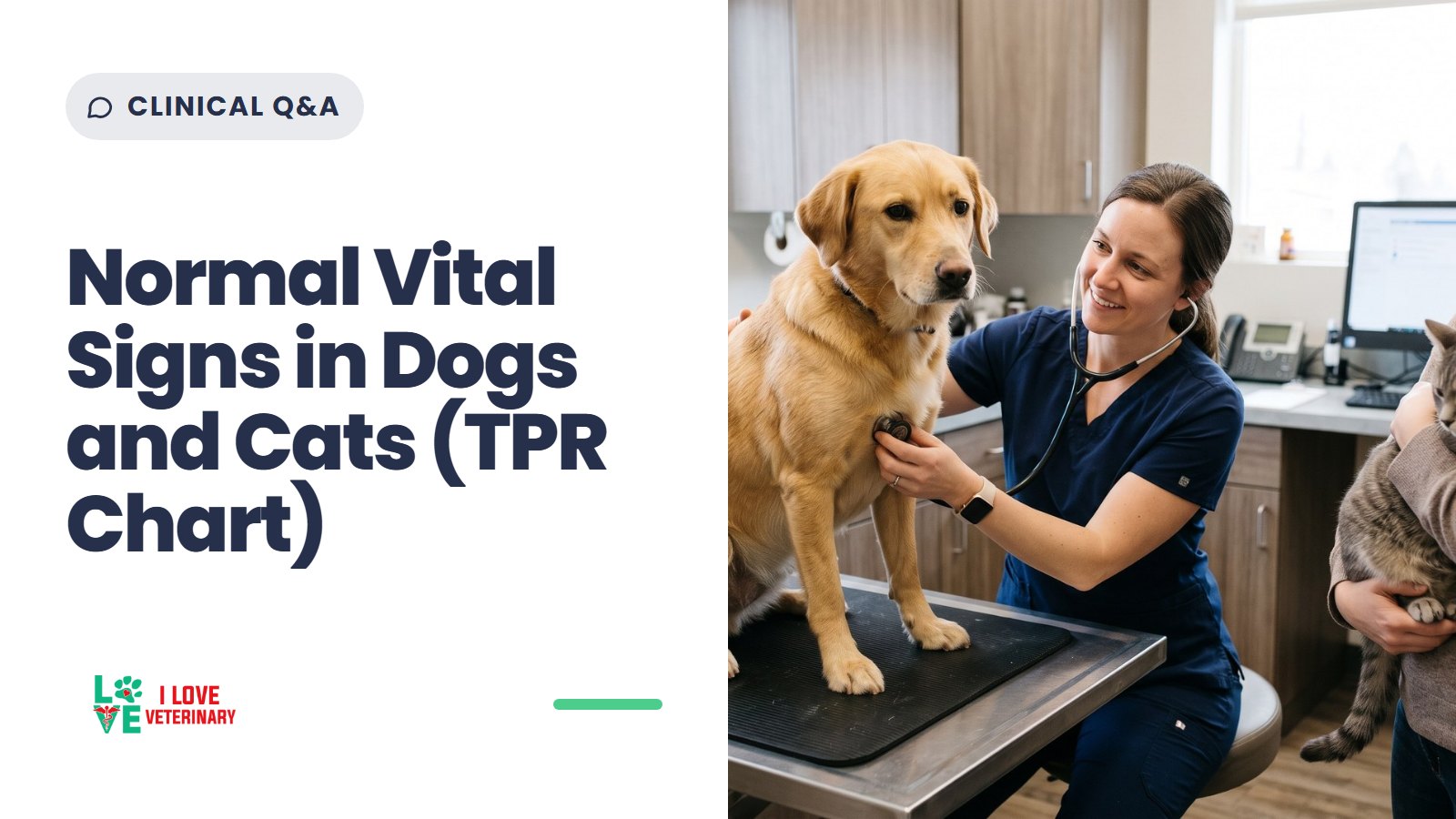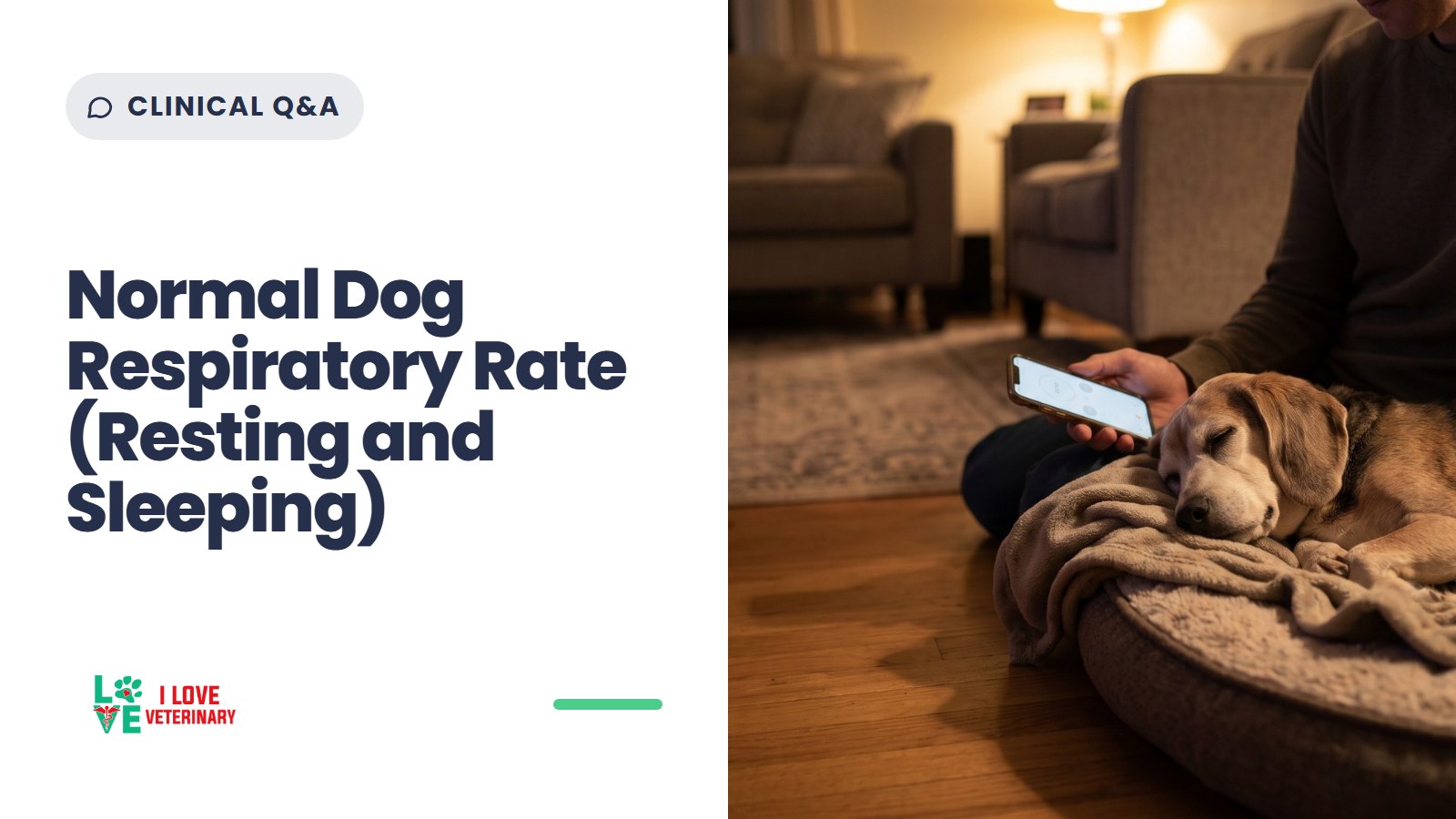


A normal resting heart rate for an adult dog is 70 to 120 beats per minute (bpm), according to the Merck Veterinary Manual. Where your dog lands in that range depends mostly on size: small dogs run faster, large dogs slower, and puppies faster than any adult.
Below you'll find the chart by size and age, how to count your dog's pulse in 30 seconds, and the signs that mean a vet visit can't wait. Want temperature and breathing too? We keep all normal vital signs in one chart.
Go to a vet or emergency clinic now if your dog:
- has a resting heart rate above 180 bpm (the emergency triage line for dogs in the Merck Veterinary Manual)
- has a fast heart rate with pale gums and a weak pulse (signs of shock)
- has bluish gums or is breathing with an open mouth while resting
- is having trouble breathing
- faints or loses consciousness
- has a heartbeat that feels irregular or chaotic and seems unwell
If you can't feel a heartbeat and your dog isn't breathing, start CPR for dogs while someone drives.
Normal dog heart rate chart by size and age
These are resting rates: your dog lying calm, not right after a walk, a zoomie session or the doorbell.
Dog | Normal resting heart rate | Source |
|---|---|---|
Adult dog, any size | 70-120 bpm | Merck Veterinary Manual |
Small dog | 90-120 bpm | Animal Medical Center, ASPCApro |
Medium dog | 70-110 bpm | Animal Medical Center, ASPCApro |
Large dog | 60-90 bpm | Animal Medical Center, ASPCApro |
Puppy | 120-160 bpm | UC Davis CVET |

Treat the size bands as a guide, not hard cut-offs. Vet sources draw the lines a little differently, and your dog's own resting rate on a healthy day is the better yardstick.
Why two sets of numbers? Merck gives one range for the whole species. The Animal Medical Center in New York splits it by size, and its bands match the ASPCApro vital signs poster. The size bands are the more useful guide for your own dog. Notice that a healthy large dog can sit at 60 bpm, below Merck's 70 floor.
Giant breeds and seniors don't have a separate sourced range that we could find. Use the large-dog band as a rough guide and ask your vet what's normal for your dog.
For puppies, the UC Davis veterinary emergency chart lists 120 to 160 bpm. It doesn't give an age where puppies switch to adult numbers, so ask your vet if your youngster's count falls between the two.
Cats run faster than dogs at rest: 120-140 bpm. Our normal cat heart rate guide explains why a cat's rate jumps at the clinic.
Why small dogs and puppies have faster hearts
Across animals, Merck notes a simple rule: the larger the species, the slower the heart rate. The same pattern shows up within dogs. A Chihuahua's heart beats faster than a Great Dane's, and both can be perfectly normal.
That's why one number can't cover every dog, and why the most useful number of all is your own dog's resting rate on a healthy day. For the bigger picture, see our animal heart rate chart, from blue whales to shrews.
How to check your dog's heart rate at home
You don't need a stethoscope. Pick a quiet moment when your dog is relaxed or dozing.

- Let your dog settle. Wait until they're lying down and calm.
- Find the heartbeat or the pulse. Place your hand flat over the heart, where the left elbow meets the chest. Or rest two fingers on the inside of a hind leg, high up near the body, to feel the femoral artery.
- Count for 30 seconds, then multiply by 2. That's the method the Animal Medical Center gives.
- Repeat once or twice. A second count confirms the first.
- Write it down. A few counts on calm, healthy days give you a baseline. The Animal Medical Center notes that any change from your pet's usual baseline is worth a call to your vet, especially when there's no clear cause.
Example: you count 44 beats in 30 seconds. 44 x 2 = 88 bpm, which is normal for a medium or large dog.
If your vet has asked you to watch a heart condition at home, they may also ask for the sleeping breathing rate. Here's how to count your dog's breaths.
Is an irregular heartbeat normal in dogs?
Often, yes. In quiet, healthy animals the heart rate speeds up a little as they breathe in and slows as they breathe out. Vets call this respiratory sinus arrhythmia. Merck describes heart rate changes in step with breathing as a good sign of heart health, and notes that dogs with heart failure tend to lose this variation.
So a beat that rises and falls with your dog's breaths is usually nothing to worry about. A rhythm that feels chaotic, has pauses that don't follow the breathing, or comes with weakness is different: have your vet listen to it. Abnormal heart rhythms are on Merck's list of problems that need prompt treatment.
When is a dog's heart rate too fast or too slow?
Use your dog's size band and baseline as the yardstick, not a single magic number.
- Call your vet today if the resting count stays above your dog's band after a couple of recounts, or has clearly changed from their usual baseline. Pain is one known reason a heart beats faster.
- Go now if a fast or slow rate comes with any sign in the emergency box above: pale or blue gums, a weak pulse, trouble breathing, fainting.
For context, the Merck Veterinary Manual's emergency triage guide treats a dog's heart rate above 180 bpm as too fast (tachycardia) and below 60-70 bpm as too slow (bradycardia). Those are the lines an emergency team works with. At home, don't wait for a reading that extreme if your dog seems unwell.
A slow rate in a big, relaxed dog can be normal: 60 bpm is inside the large-dog band. A slow rate in a small dog, or any slow rate with weakness, is worth a call.
Check the gums too
Your dog's gums show how well blood is reaching the body, and the check takes five seconds.
- Lift the lip and look at the color. Normal gums are pink. Pale or white gums can mean anemia or shock. Blue or muddy gums mean severe low oxygen, or late-stage shock.
- Press a fingertip on the gum until it turns pale, then let go. Normal color returns in 1-2 seconds (vets call this the capillary refill time). Longer than 2 seconds points to poor blood flow.
A fast heart rate plus pale gums and a weak pulse is a classic shock picture. Go straight in.
Quick answers
Is 140 bpm normal for a dog? For a resting adult, 140 is above every adult band in our chart. It's in the normal range for a puppy. In an adult that's just been playing, wait until they settle and count again. If it stays that high at rest, call your vet.
Is 60 bpm too low? Not for a calm large dog: the large-dog band is 60-90. For a small dog, or a dog that seems weak, it's worth a call.
What should I tell the vet? The count, how you took it (30 seconds x 2), what your dog was doing, gum color, and anything else that's off, like breathing, appetite or energy.
Sources
- Merck Veterinary Manual: Resting Heart Rates
- Merck Veterinary Manual: The Cardiovascular System in Animals
- Merck Veterinary Manual: Initial Triage and Resuscitation of Small Animal Emergency Patients
- Merck Veterinary Manual: Evaluation and Initial Treatment of Dog and Cat Emergencies
- Merck Veterinary Manual: What to Do in a Dog or Cat Emergency
- The Animal Medical Center: Vital Signs, Know What's Normal for Your Pet
- ASPCApro: Normal Temperature, Pulse and Respiratory Rate poster
- UC Davis CVET: Normal Vital Signs chart
This article is for general information and is not a substitute for advice from your veterinarian.