To become a vet assistant, you need a high school diploma or equivalent, a real comfort with animals, and either a clinic willing to train you or a short certificate program. Most vet assistants learn on the job, according to the US Bureau of Labor Statistics (BLS), and certification is optional.
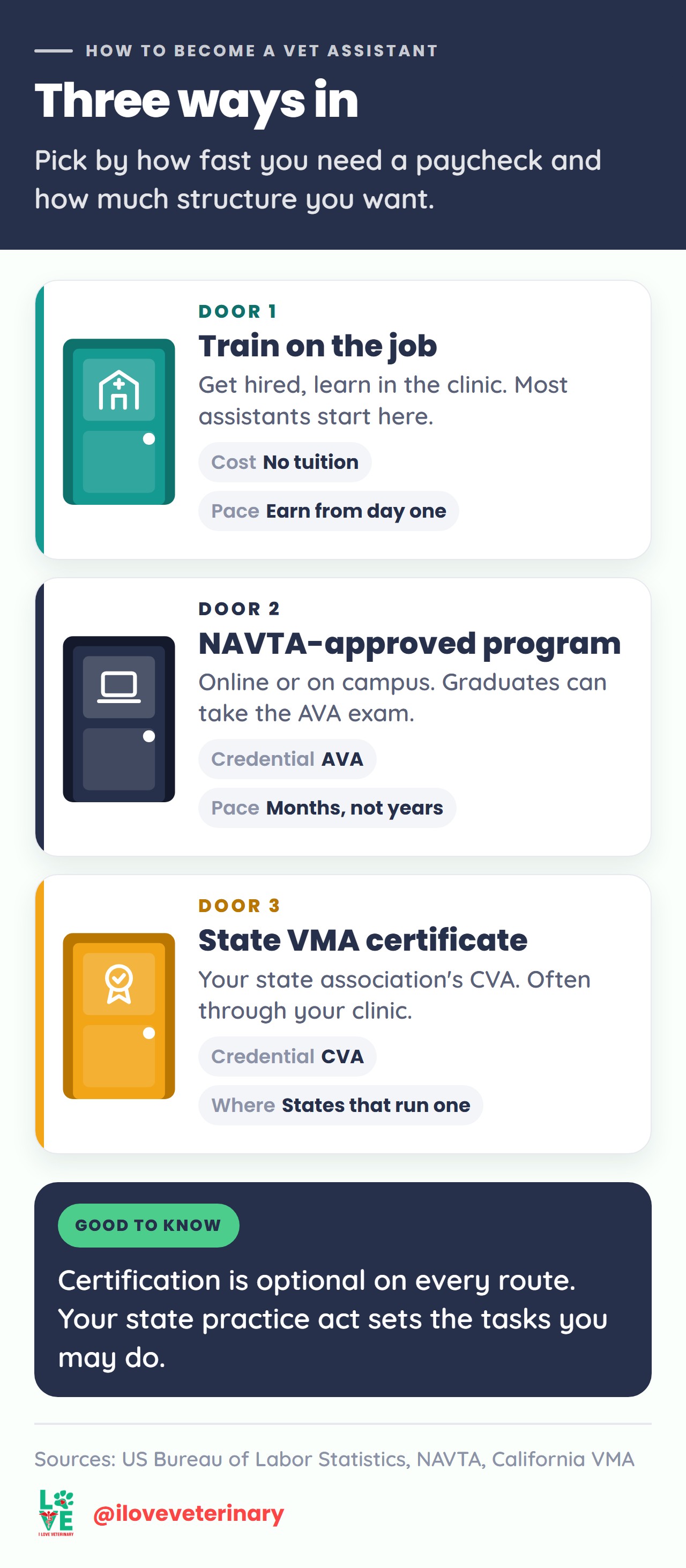
That leaves one choice: how you get in. You can get hired and trained in a clinic, finish a NAVTA-approved assistant program and earn the Approved Veterinary Assistant (AVA) designation, or complete a state veterinary medical association's Certified Veterinary Assistant (CVA) program. Certification is voluntary on every route, and all three can lead to the same job, and to vet tech school later if you want it.
Here's how each route works, what the job really involves, what it pays and where it can take you.
Vet assistant requirements
BLS lists no required exam or degree. What employers and programs typically look for:
- A high school diploma or equivalent. BLS lists this as the typical entry-level education. Individual programs set their own admission rules, and some have limited seats.
- Time around animals. BLS notes that experience working with animals may help job seekers. Kennel work, shelter volunteering, grooming or a pet sitting job all count.
- Physical strength and stamina. You'll lift and hold dogs, cats and sometimes bigger patients, and you'll be on your feet most of a shift.
- The people side. BLS lists communication, compassion, attention to detail and manual dexterity as core qualities. You follow instructions exactly, and you explain them clearly to worried owners.
A quick reality check: BLS describes the work as physically and emotionally demanding. You may handle sick or abused animals, help with euthanasia, and get bitten or scratched by a scared patient. People who last in this job love animals and can stay steady when a day goes badly.
Three ways to become a vet assistant
Route | How it works | Pace | Best for |
|---|---|---|---|
On-the-job training | A clinic hires you (often as a kennel attendant or assistant) and trains you on its own procedures | Start earning right away; short-term training | Career changers who need a paycheck now, and anyone looking for a route without college |
NAVTA-approved program (AVA) | Online, high school or adult campus program approved by NAVTA, then the AVA exam | Usually months, not years; set by the school | People who want structured training and a national designation before applying |
State VMA certificate (CVA) | A state veterinary medical association's Certified Veterinary Assistant program, through a school or your employer | Varies by program and level | People already working in a clinic, or students in states that run a CVA program |
On-the-job training
BLS says most veterinary assistants receive short-term on-the-job training. In practice that means a clinic hires you for kennel, reception or assistant work and teaches you restraint, cleaning protocols, how the hospital runs and how its doctors like things done.
This is the no-tuition route. The tradeoff: your training is only as good as the clinic, and you start without a credential to show the next employer. Many assistants add an AVA or CVA later, and some practices enroll their own staff in a CVA program.
NAVTA-approved programs and the AVA designation
The National Association of Veterinary Technicians in America (NAVTA) created its Approved Veterinary Assistant program in 2010. NAVTA doesn't teach the courses. It approves assistant programs run by schools, and graduates of those programs can sit the AVA exam.
NAVTA's list of approved programs is split into online programs, high school campus programs and adult campus programs. Check that list before you enroll anywhere; it changes, and a program that isn't on it won't make you eligible for the AVA.
Programs usually cover animal handling and restraint, medical terminology, basic anatomy and physiology, nursing care, lab and imaging support, and surgical prep such as cleaning and sterilizing instruments. Ask any school how you'll get hands-on practice with real animals. Restraint and handling are hard to learn from a screen, and they're the skills that keep you and the patient safe.
State VMA Certified Veterinary Assistant programs
Some state veterinary medical associations run their own Certified Veterinary Assistant programs. The California VMA's CVA program, for example, has Level I and Level II certification, combines online learning with experience in the practice, and is offered through clinics, high schools, regional occupational programs, technical colleges and RVT programs. Florida and Georgia have CVA programs through their state associations too, and one Florida college certificate builds the Florida VMA's CVA test into the program.
If your state has one, a CVA can be a good fit when you already work in a clinic: your practice can enroll you and a team member can mentor you through it.
How to become a vet assistant, step by step
- Get around animals. Volunteer at a shelter, work in a kennel or boarding facility, or shadow at a local clinic. You'll find out fast whether you like the work day to day.
- Pick your route. Need income now? Apply for clinic jobs and train on the job. Want structure first? Choose a NAVTA-approved program or your state's CVA program.
- Check the program before you pay. Confirm it's on NAVTA's approved list (for the AVA) or run by your state VMA (for a CVA), and ask how hands-on training works.
- Finish the training and get hired. Clinic jobs often start as kennel attendant or assistant roles. Job boards and the clinics in your area are where most openings show up.
- Earn the AVA or CVA if it helps you. It's optional, but it shows an employer you've covered a set curriculum.
- Keep learning. Both designations need continuing education to renew, and it's also how you work out whether vet tech school is your next step.
What vet assistants do
A vet assistant keeps patients safe and calm and keeps the hospital running so the vets and vet techs can do their parts. The BLS job description lists these duties:
- Animal care: feed, bathe and exercise patients.
- Cleaning and setup: clean and disinfect cages, kennels, and exam and operating rooms; maintain and sterilize surgical instruments and equipment.
- Hands-on support: restrain animals during exams and lab procedures; help collect blood, urine and tissue samples.
- Nursing support: monitor and care for animals after surgery; help provide emergency first aid; give medication or vaccines that the veterinarian prescribed, where state rules allow.
Depending on the clinic, assistants also greet clients, room patients, schedule appointments, make follow-up calls, update records and keep inventory stocked. In a small practice you might do all of it in one shift.
If you're new, learning the shorthand on charts and whiteboards saves a lot of confusion. Our guide to veterinary abbreviations is a good place to start.
What vet assistants don't do
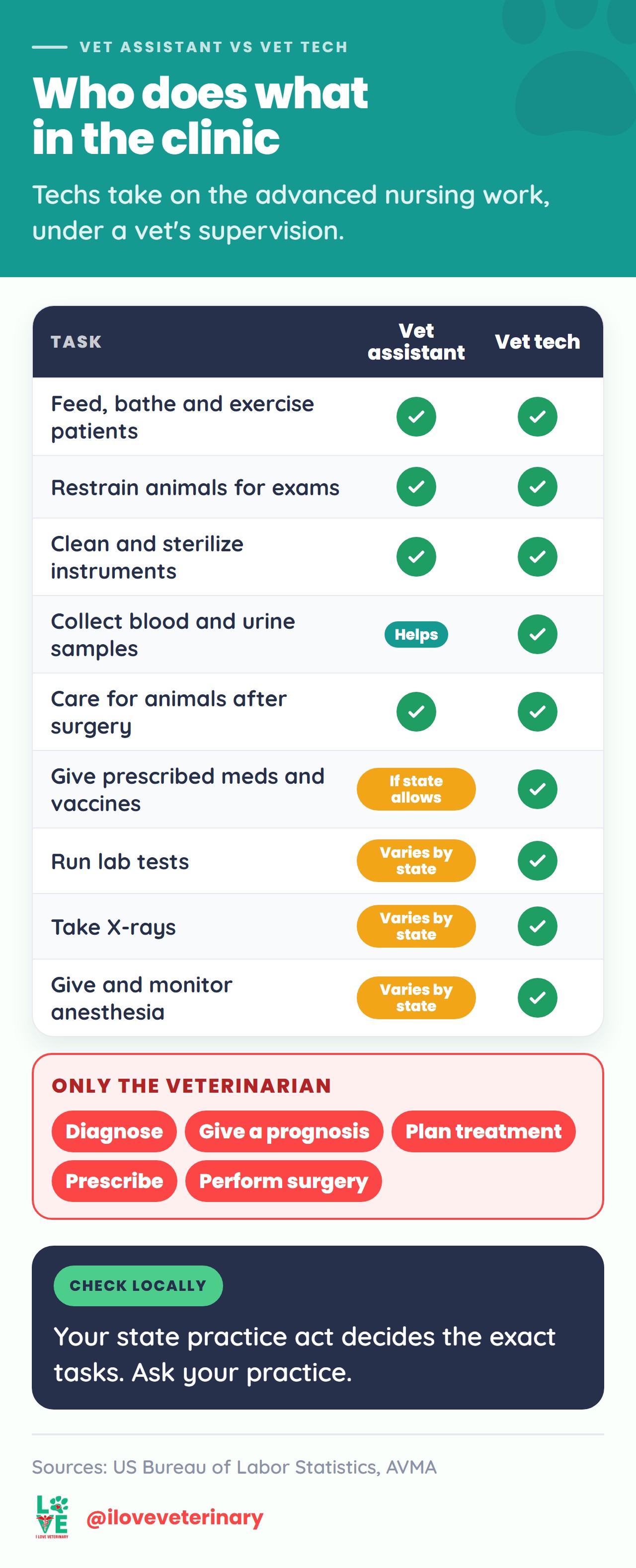
Assistants work under the direction of a veterinarian, and the law sets the edges. AVMA policy limits diagnosis, prognosis, treatment planning, prescribing and surgery to the veterinarian. So an assistant doesn't diagnose a patient, tell an owner what's wrong, decide on treatment, prescribe medication or perform surgery.
Beyond that, each state's veterinary practice act and board rules decide which tasks an assistant may do and how closely they're supervised. A task that's routine for assistants in one state can be limited to credentialed vet techs in another. Ask your practice what your state allows, and don't use a title such as "technician" that your state may reserve for credentialed vet techs.
Vet assistant certification: AVA and CVA
Certification isn't required to work as a vet assistant. In BLS's words, certification is not mandatory, but it lets you show competency. That's the honest pitch for the AVA or a CVA: it's a voluntary credential and a hiring signal. What you're allowed to do on the job still comes from your state's practice act, not from the certificate.
How the NAVTA AVA works, per NAVTA:
- Graduate from a NAVTA-approved veterinary assistant program. That's the only way to become eligible.
- Take the AVA exam, which runs through VetMedTeam on behalf of NAVTA. An exam mentor proctors it by watching you take it.
- Pass, and you receive a certificate and can use the AVA designation.
- Renew by completing at least 10 hours of veterinary continuing education.
On prep, NAVTA says it has neither approved nor endorsed outside courses, practice tests or review questions that claim to prepare you for the AVA exam. VetMedTeam offers practice exams. Your program's own coursework is the main preparation.
CVA programs follow their state VMA's rules for levels, testing and renewal. The California CVA, for example, is renewed with continuing education too. Check your own state association's page.
How long it takes to become a vet assistant
On-the-job training is the fastest way to start working, since you're hired first and trained as you go. Certificate programs take months, not years, and the length depends on the school and whether you study full or part time. One Florida college certificate runs three part-time semesters, while some career schools advertise programs of about 10 months. Self-paced online programs vary the most, so ask for a realistic completion time before you enroll.
Vet assistant pay and job outlook
The BLS figures cover veterinary assistants and laboratory animal caretakers together:
The median pay was $38,150 a year, or $18.34 an hour (BLS, May 2025 data). In veterinary services, where 86% of these jobs are, the median was $37,930.
There were about 132,100 of these jobs in 2025. Employment is projected to grow 9% from 2025 to 2035, much faster than average, with about 23,200 openings a year (BLS Employment Projections 2025-35).
Some assistants work part time, and nights, weekends and holidays are common in hospitals that board or treat patients around the clock.
One more BLS figure worth knowing before you apply: this group has one of the highest rates of injuries and illnesses of all occupations. Bites, scratches and kicks from scared animals, and strains from lifting and restraining, are part of the risk. Good restraint training protects you as much as the patient.
Vet assistant vs vet tech
Vet assistant | Vet tech | |
|---|---|---|
Education | High school diploma or equivalent; on-the-job training or a certificate program | Usually a 2-year associate's degree in veterinary technology |
Credential | Optional (AVA, state CVA) | Credentialing exam; each state regulates vet techs and sets the title |
Typical work | Animal care, restraint, cleaning and sterilizing, sample collection help, client and clinic support | Nursing care, anesthesia, X-rays, lab tests, surgical prep, under a vet's supervision |
Median pay (BLS, May 2025) | $38,150 | $47,380 |
The short version: assistants support, techs carry out more advanced nursing and medical tasks under the veterinarian. For a full picture of the tech side, see what vet techs do.
Stepping up to vet tech
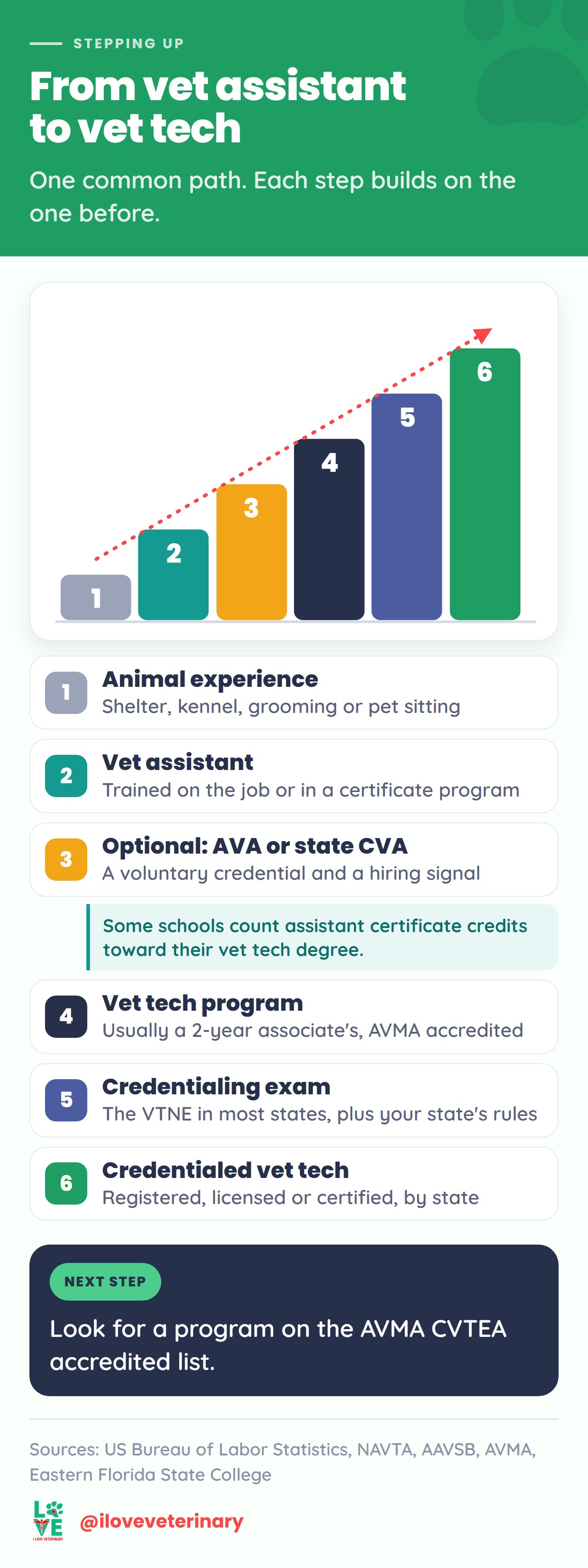
A lot of assistants use the job as a test drive for vet tech school. BLS says vet techs usually need a 2-year associate's degree and typically must pass a credentialing exam, with requirements set by each state. The AAVSB notes that most jurisdictions require VTNE candidates to graduate from a veterinary technology program accredited by the AVMA or the Canadian VMA, so look for a program on the AVMA CVTEA accredited list.
Your assistant time isn't wasted. Some schools let assistant certificate credits count toward their vet tech degree, so ask about transfer credit before you enroll in either program. Start with our complete guide to becoming a vet tech, and when the exam gets close, our VTNE prep tips.
Just finished your program or landed your first clinic job? A vet assistant hoodie is a fun way to mark it.
Quick answers
Can you become a vet assistant without college? Yes. BLS lists a high school diploma or equivalent as the typical education, and most assistants are trained on the job.
Can you get vet assistant certification online? Yes. NAVTA's approved list includes online programs, and graduates of any approved program can take the AVA exam. Some state CVA programs also use online learning.
Are there free vet assistant programs? Training on the job costs you nothing, and some practices enroll their assistants in a CVA program. Be wary of any "free certification" that isn't from a NAVTA-approved program or your state VMA.
Is there a vet assistant certification test? The AVA has an exam for graduates of NAVTA-approved programs, and state CVA programs have their own testing. Neither is required to work as an assistant.
Is a vet assistant the same as a vet tech? No. Vet techs usually complete a 2-year degree program and a credentialing exam, and they can do more advanced tasks under a vet's supervision.
Sources
- US Bureau of Labor Statistics: Veterinary Assistants and Laboratory Animal Caretakers, Occupational Outlook Handbook
- US Bureau of Labor Statistics: Veterinary Technologists and Technicians, Occupational Outlook Handbook
- NAVTA: Veterinary Assistants Program
- NAVTA: Approved Veterinary Assistant programs
- NAVTA: AVA program guidelines
- California Veterinary Medical Association: Certified Veterinary Assistant program
- Georgia Veterinary Medical Association: Certified Veterinary Assistant Program
- AVMA News: AVMA pledges to vigorously defend against expanding scope of practice
- AAVSB: VTNE eligibility
- AVMA: Programs accredited by the CVTEA
- Eastern Florida State College: Veterinary Assisting certificate
- Caris College: Top Reasons to Become a Vet Assistant