

To become a vet tech in the US, you finish an AVMA-accredited veterinary technology program (usually a 2-year associate degree), pass the Veterinary Technician National Examination (VTNE), and get credentialed by the state where you'll work. Most techs train through the associate degree, so plan on about two years of school.
The route is simpler than the forums make it look. The confusing part is the alphabet soup at the end: RVT, LVT and CVT are the same job with different state names. Below is every step, how long each one takes, what the work is really like, and what it pays right now.
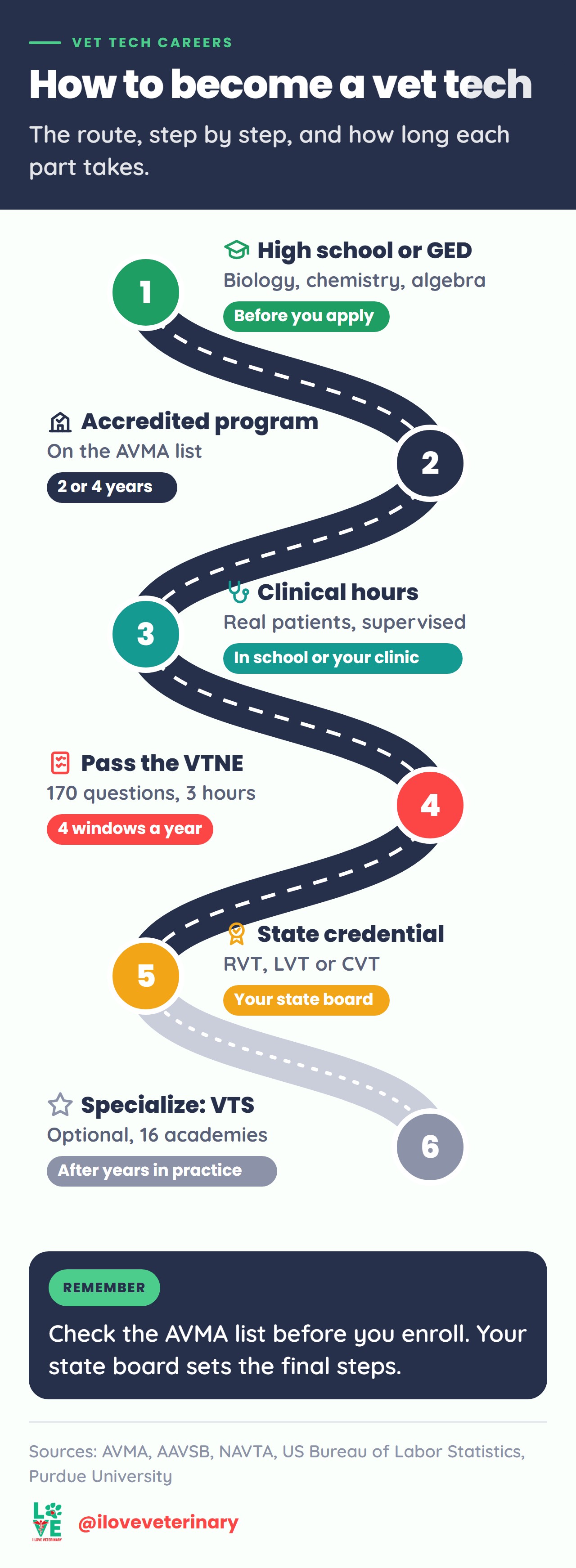
The path at a glance
Step | What you do | How long |
|---|---|---|
1. Prepare | High school diploma or GED, with biology, chemistry and algebra | Before you apply |
2. Study | An AVMA-accredited vet tech program: associate (technician) or bachelor (technologist), on campus or by distance learning | Usually 2 years (associate) or 4 years (bachelor) |
3. Practice | Clinical hours with real patients, built into the program | During the program |
4. Test | Pass the VTNE, run by the AAVSB | A 3-hour exam, offered in four testing windows a year |
5. Credential | Register, license or certify with your state board (RVT, LVT or CVT) | Varies by state |
6. Grow (optional) | Continuing education, then a Veterinary Technician Specialist (VTS) credential | After years of experience |
Step 1: Finish high school with science and math
Every program asks for a high school diploma or GED. Take biology and chemistry if you can, and don't skip algebra: vet techs run medication and fluid calculations every shift, and Purdue's veterinary nursing faculty call a strong grasp of algebra integral to the job.
Beyond that, each school sets its own entry requirements. Some ask for placement tests, SAT or ACT scores, prerequisite courses or time spent in a clinic. Ask the programs on your shortlist exactly what they need before you apply. Experience as a veterinary assistant is not required, but it shows you what clinic life is like and gives your application real hours to point to.
Step 2: Choose an AVMA-accredited program
This is the step that matters most. Graduating from a program accredited by the AVMA Committee on Veterinary Technician Education and Activities (CVTEA) is the standard route to the VTNE, and the AVMA notes its graduates are eligible to take the exam in nearly all states. Check any school against the AVMA's list of accredited veterinary technology programs before you pay a deposit. A course that isn't on that list may teach you plenty and still leave you unable to sit the exam.
The AVMA lists 220 accredited programs, 28 of them with a four-year degree and 13 with distance learning, so you can usually find one that fits your life.
Option | Credential path | Typical length | Good fit if |
|---|---|---|---|
Associate degree (on campus) | Veterinary technician | 2 years | You want the most common, fastest route into clinic work |
Bachelor's degree | Veterinary technologist | 4 years | You're drawn to research, lab or teaching roles |
Distance learning | Veterinary technician | Often longer, part-time | You already work or volunteer in a clinic and need to keep your job |
The difference between a technician and a technologist is mostly the degree. The US Bureau of Labor Statistics (BLS) says technicians usually need a 2-year associate degree and technologists a 4-year bachelor's, and that technologists more often work in advanced, research-related jobs, where pay tends to be higher.
When you compare programs, look at three things: accreditation status, how and where the clinical training happens, and the program's own published VTNE results if it shares them. Our guides to accredited vet tech programs and online vet tech programs go deeper on choosing a school.
Step 3: Get your clinical hours
Accredited programs mix classroom work with hands-on training. Expect courses like anatomy and physiology, pharmacology, anesthesia, radiology, clinical pathology and hematology, parasitology, surgical nursing, animal behavior and nursing care, then lab sessions and clinical rotations where you practice on real patients under supervision.

Distance programs handle this part differently. At Purdue's AVMA-accredited distance program, for example, students complete clinical mentorships at a veterinary practice where they work or volunteer, coached by a licensed veterinarian or a credentialed technician. Purdue notes the program can be finished in as little as eight consecutive semesters. If you're looking at online study, line up a clinic that will mentor you before you enroll, not after.
Step 4: Pass the VTNE
The Veterinary Technician National Examination is the national credentialing exam for vet techs. It's owned and run by the American Association of Veterinary State Boards (AAVSB), and most states and provinces require a passing score before they credential you.
The exam takes three hours and has 170 multiple-choice questions, 150 of them scored (the other 20 are unscored pilot questions). You sit it at a test center or with a live remote proctor, during one of four testing windows a year. The AAVSB sends your score to the state where you plan to work, and your score report appears in your MyAAVSB portal within three business days.
Two things trip people up. First, the AAVSB asks every candidate to check their eligibility pathway before applying, so confirm yours early. Second, the windows are fixed, so plan your study around a real date. Our VTNE guide covers the application, the windows and how to prepare, and these vet tech books and study materials help with the review.

Step 5: Get your state credential (RVT, LVT or CVT)
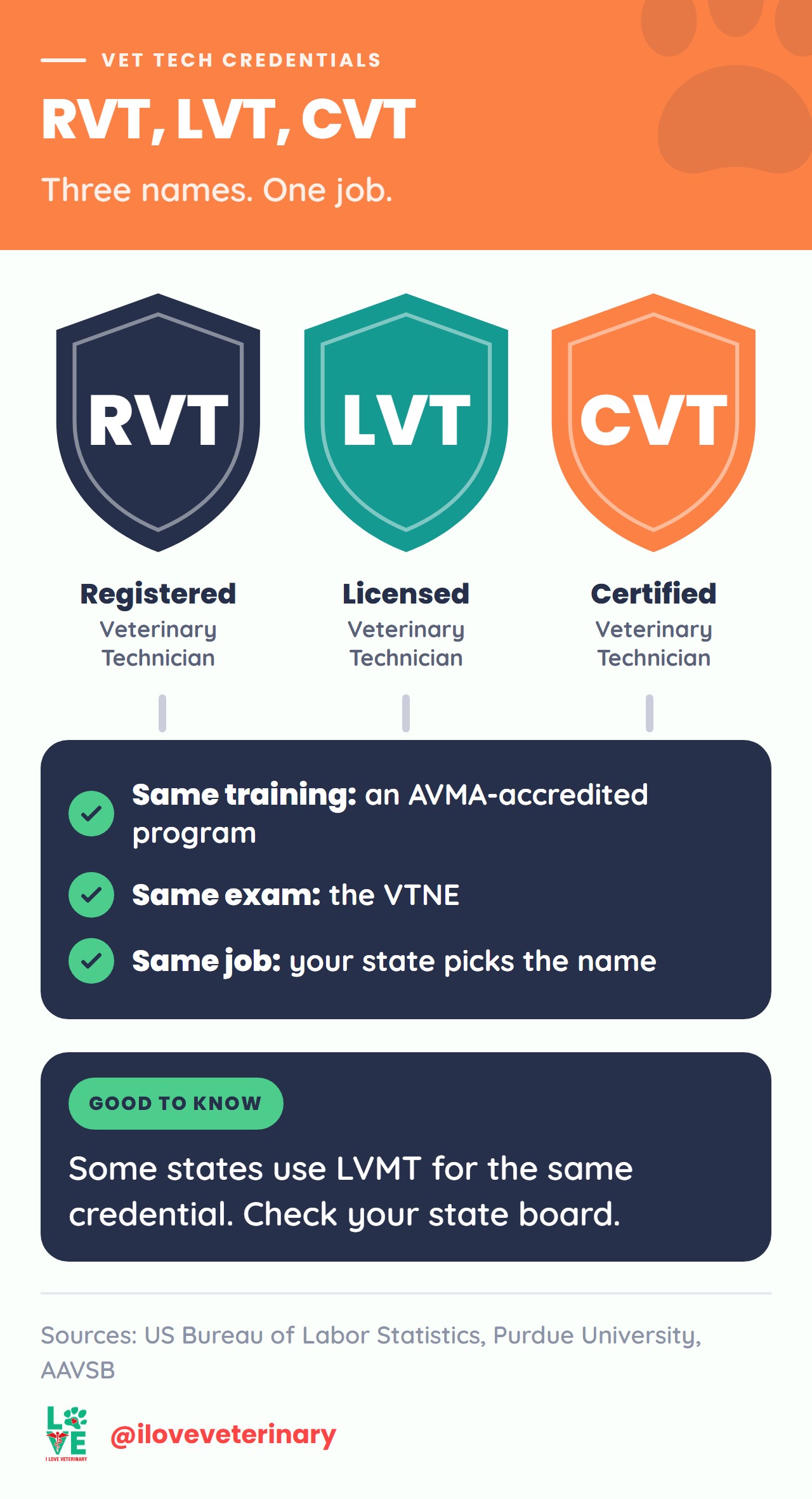
Passing the VTNE doesn't make you a vet tech on its own. Your credential comes from your state, not the AAVSB. Depending on the state, you become a:
- RVT, Registered Veterinary Technician
- LVT, Licensed Veterinary Technician
- CVT, Certified Veterinary Technician
Same training, same exam, same job. The letters change because each state writes its own law, and you may also see LVMT (Licensed Veterinary Medical Technician) used the same way. Your state board may add its own steps on top of the VTNE, so read your board's requirements before you graduate.
You'll also hear "veterinary nurse". NAVTA supports that title only for credentialed techs, and whether you can use it depends on your state's rules.
Can you become a vet tech without college? Accredited-program graduates are eligible in nearly all states, and that's the route we'd plan on. A few states have offered other pathways that combine work experience with required coursework, and credentials earned that way may not transfer if you move. If you're hoping to skip school, check your state board first.
Once credentialed, keep it current. Most states require continuing education (CE) to renew.
Step 6 (optional): Specialize as a VTS
After a few years in practice, many techs go after the Veterinary Technician Specialist (VTS) credential. You earn it through a specialty academy approved by NAVTA (the National Association of Veterinary Technicians in America); each academy runs its own credentialing process and exam. Only techs certified by an approved academy may use the VTS letters.
NAVTA's list currently shows 16 approved academies, including emergency and critical care, anesthesia and analgesia, dentistry, internal medicine, surgery, behavior, nutrition, clinical pathology, zoological medicine, equine nursing, diagnostic imaging and physical rehabilitation. See all of them, and what each asks for, in our guide to vet tech specialties.

How long does it take to become a vet tech?
About two years for the associate degree, which is how most techs train, plus the time to sit the VTNE and get your state credential. A bachelor's in veterinary technology takes four years. Part-time distance programs can take longer than two years because you study around a job.
How much does vet tech school cost?
It depends on the school, whether you pay in-state or out-of-state tuition, and the format. Community college associate programs, four-year universities and distance programs all price differently, so compare each program's published tuition and fees. Ask what's not in the headline number: uniforms, equipment, travel to clinical sites, and the VTNE and state application fees.
Vet tech salary and job outlook
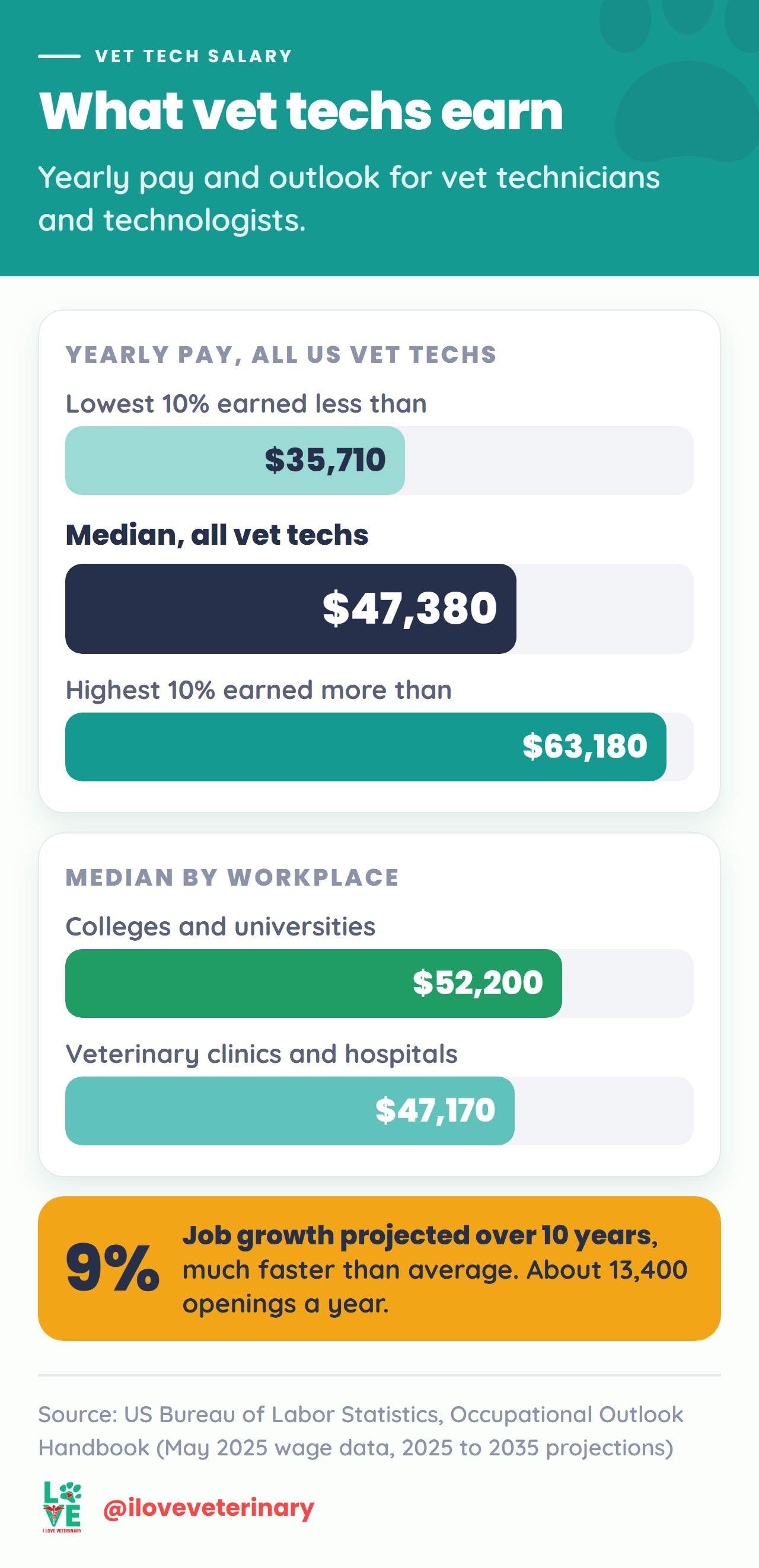
Vet techs earned a median of $47,380 a year ($22.78 an hour), according to the BLS (May 2025 data). That's well above the old figures you'll still see quoted online.
Measure (BLS, May 2025 data) | Pay |
|---|---|
Median annual wage, vet technologists and technicians | $47,380 |
Median hourly wage | $22.78 |
Lowest 10% earned less than | $35,710 |
Highest 10% earned more than | $63,180 |
Median in colleges and universities (educational services) | $52,200 |
Median in veterinary services (clinics and hospitals) | $47,170 |
Pay varies by state, setting, experience and credential. Technologists in research roles often earn more than those in other settings, and Purdue's faculty note that specialists generally have higher earning potential and a wider range of jobs.
The outlook is strong. The BLS projects vet tech employment to grow 9% from 2025 to 2035, much faster than the 3% average for all jobs, with about 13,400 openings a year.
What the job is really like
This is a job for animal lovers who also love science. On a normal day a vet tech might take histories, collect blood and urine and run the lab work, take radiographs, place catheters, prepare patients and instruments for surgery, induce and monitor anesthesia, clean teeth (see our post on dog dental care), give the medications and vaccines a veterinarian prescribes, nurse patients through recovery, and explain home care to owners. Our breakdown of what vet techs do goes through it area by area.

There are hard limits, too. Under state veterinary practice acts, vet techs can't diagnose, prescribe or perform surgery. Those stay with the veterinarian.
The hard parts are real:
- It's physical. BLS ranks injury and illness rates for vet techs among the highest of any occupation, mostly bites, scratches and kicks. You lift and restrain animals and stand for most of a shift.
- It's emotional. You'll help with euthanasia, see neglect cases and sit with grieving owners. Compassion fatigue is a real risk, so have a plan for it. Read our guide to burnout and compassion fatigue.
- The hours aren't always nine to five. Emergency and specialty hospitals run evenings, weekends, overnights and holidays.
And the good parts: you're the person the patient spends the most time with, you get to be good at a lot of different skills, and the work goes well beyond the clinic. About 9 in 10 vet techs work in veterinary services, but techs also work in research labs, universities, shelters and humane societies, zoos and wildlife centers, and industry roles like pharmaceutical and pet food companies.
Vet tech, vet assistant or veterinarian?
Role | Training | Credential | Can they... |
|---|---|---|---|
Vet assistant | On-the-job training or a certificate course | No VTNE or state tech credential | Support techs and vets with restraint, cleaning, feeding and basic care |
Vet tech | AVMA-accredited 2-year or 4-year program | VTNE plus state credential (RVT, LVT, CVT) | Run nursing, anesthesia monitoring, lab, imaging and dental work under a vet's supervision |
Veterinarian | Doctor of Veterinary Medicine (DVM or VMD) | State veterinary license | Diagnose, prescribe and perform surgery |
Starting as an assistant is a common way in. Weighing vet school instead? Compare the two careers in veterinarian vs vet tech.
FAQ
Can you become a vet tech online?
Yes, through an AVMA-accredited distance program; the AVMA lists 13 of them. You still need supervised clinical hours, usually at a clinic where you work or volunteer, and you still sit the VTNE.
What's the difference between a vet tech and a vet technologist?
Mostly the degree: technicians usually hold a 2-year associate, technologists a 4-year bachelor's. Both take the VTNE and get the same state credential; technologists more often work in research and lab roles.
Is the VTNE hard?
It's a broad exam: 150 scored questions in three hours, covering everything an accredited program teaches, from pharmacology and anesthesia to lab work, imaging and nursing care. It rewards steady review over last-minute cramming.
Are RVT, LVT and CVT different jobs?
No. They're state names for the same credential. The training and the national exam are the same.
Can a vet tech become a veterinarian?
Yes, but it means applying to veterinary school and earning a DVM. Tech experience gives you clinical hours and a clear view of the job, but there's no shortcut credential.
Ready to start?
Find an accredited program, line up your clinical hours, book the VTNE, and send your score to your state. Then celebrate, because you've earned the letters after your name. When the time comes, something from our vet tech collection is a fun way to mark it. And the profession gets its own week every year: here's how clinics celebrate Vet Tech Appreciation Week.
Sources
- US Bureau of Labor Statistics: Occupational Outlook Handbook, Veterinary Technologists and Technicians (pay from May 2025 data, projections 2025-2035)
- American Veterinary Medical Association: Veterinary technology programs accredited by the AVMA CVTEA
- American Veterinary Medical Association: Programs accredited by the CVTEA (program totals)
- American Association of Veterinary State Boards: VTNE overview
- American Association of Veterinary State Boards: Schedule and take the VTNE
- American Association of Veterinary State Boards: VTNE Candidate Information Handbook
- NAVTA: VTS credentials
- NAVTA: List of approved academies
- NAVTA: Veterinary nurse/technician job title use resources
- Purdue University College of Veterinary Medicine: Comprehensive Guide to Vet Tech
- Purdue University College of Veterinary Medicine: What is the difference between LVT and RVT?
- Purdue University: Veterinary Technology Distance Learning FAQ
- NC State University CALS VetPAC: Veterinary Technician