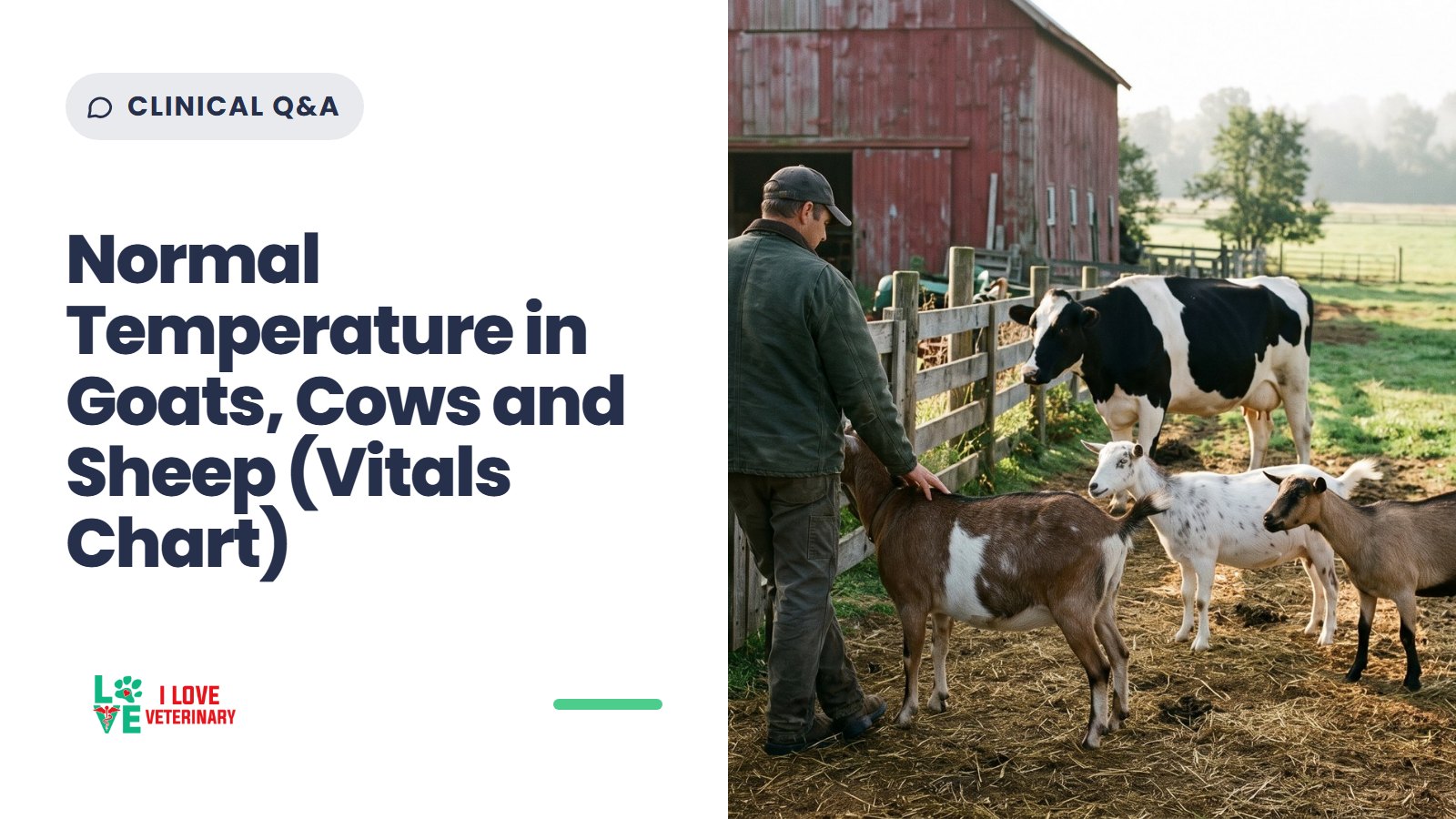
A healthy adult goat's normal rectal temperature is 101.3-103.5°F (38.5-39.7°C), according to the Merck Veterinary Manual. Sheep run 100.9-103.8°F (38.3-39.9°C), dairy cows 100.4-102.8°F (38.0-39.3°C) and beef cows 98.0-102.4°F (36.7-39.1°C).
Those numbers only help if the reading is taken properly and compared with the right animal on the right day. So this page puts temperature, heart rate and breathing rate for goats, sheep and cattle in one chart, then covers how to take a temperature without getting kicked, what pushes the number up or down, and when to call your vet. Keeping dogs and cats too? We have all their normal vital signs in one chart.
Call your vet now if:
- A cow is down and can't get up, usually within 48 hours of calving, with a low temperature and cold ears and legs. Merck describes this as milk fever (a sudden drop in blood calcium), and it needs prompt treatment.
- Any animal reads above or below its normal range on a recheck and also can't stand, is struggling to breathe or shows nervous signs.
Normal Vital Signs Chart for Goats, Sheep and Cattle
All values are for healthy adults at rest. Temperatures are rectal.
Animal | Temperature (°F) | Temperature (°C) | Heart rate (beats/min) | Breathing rate (breaths/min) |
|---|---|---|---|---|
Goat | 101.3-103.5 | 38.5-39.7 | 70-80 | 15-40 (UC Davis) |
Sheep | 100.9-103.8 | 38.3-39.9 | 70-80 | 16-34 |
Dairy cow | 100.4-102.8 | 38.0-39.3 | 48-84 | 26-50 |
Beef cow | 98.0-102.4 | 36.7-39.1 | not listed | not listed |
Ox | not listed | not listed | 36-60 | not listed |
Pig | 101.6-103.6 | 38.7-39.8 | 70-120 | 32-58 |
Horse (mare) | 99.1-100.8 | 37.3-38.2 | 28-40 | 10-14 |
Horse (stallion) | 99.0-100.6 | 37.2-38.1 | 28-40 | 10-14 |
Sources: Merck Veterinary Manual reference tables for rectal temperature, resting heart rate and resting breathing rate. "Not listed" means Merck's table has no figure for that animal. Merck lists no breathing rate for goats; the goat figure is from the UC Davis veterinary emergency team's field chart.
Two things in that table trip people up. Merck splits cattle into dairy cows, beef cows and oxen, and the ranges differ: a beef cow's normal floor (98.0°F) sits well below a dairy cow's (100.4°F). And goats, sheep and pigs run warmer than many people expect, so a goat reading 103°F is inside the normal range, not feverish. If you're comparing across more species, our list of animal heart rates goes well beyond the farm.
Calves, Kids and Lambs
Young animals have faster hearts and breathing than adults, and calves, kids and lambs also run a little warmer.
Young animal | Temperature (°F) | Temperature (°C) | Heart rate (beats/min) | Breathing rate (breaths/min) |
|---|---|---|---|---|
Calf | 101.5-103 | 38.6-39.4 | 100-140 | 30-60 |
Goat kid | 102-104 | 38.9-40.0 | 120-160 | 40-65 |
Lamb | 102.5-104 | 39.2-40.0 | 120-160 | 30-70 |
Foal | 99-102 | 37.2-38.9 | 50-70 | 20-40 |
Source: UC Davis California Veterinary Emergency Team, Normal Vital Signs chart. Celsius converted from Fahrenheit. The calf heart and breathing rates match the University of Georgia's calf health bulletin.

Why Charts Disagree (and Which Number to Trust)
Search for a goat's normal temperature and you'll find several ranges, some starting higher than Merck's. The differences come from different reference books, different groups of animals and different conditions. We use Merck because it is a standard veterinary reference and states where its numbers come from (Dukes' Physiology of Domestic Animals).
The more useful number is your own animal's. A veterinarian writing for the National Pygmy Goat Association puts it plainly: lists of normal values are only guidelines, and you should get to know your individual animals. Take a few readings when an animal is healthy, at the same time of day, and write them down. When something seems off, you'll be comparing her with herself, not with a textbook.
How to Take a Goat, Sheep or Cow's Temperature
Take livestock temperatures rectally. A goat will not hold a thermometer under its tongue, as NPGA notes. You need a digital thermometer, a little lubricant, a string with a clip, and ideally a helper.
- Restrain the animal. A goat is easiest on a milking or trimming stand, or held against a wall by a helper. Hold a horned goat by the base of the horn, never the tips, and never catch or drag a goat by its horns or hair. Cattle should be in a stanchion, headgate or chute (a narrow pen that holds the animal still), which protects both you and the cow.
- Stand to the side. Work from beside the hindquarters, not directly behind, in case the animal kicks.
- Use a digital thermometer. The University of Georgia recommends an electronic thermometer: faster and safer than old mercury ones. Livestock thermometers have a ring on top; tie a string to it with a clip on the other end.
- Clip it to the tail. Fasten the clip to the tail hair. If the animal jumps or the thermometer slips, it stays attached instead of getting lost or stepped on.
- Lubricate and insert. Put a little petroleum jelly on the tip, lift the tail and gently slide the thermometer partway into the rectum.
- Hold it steady until it beeps, then read it and write down the number, the time and what the animal was doing beforehand.

The step most likely to fool you comes after the beep. A thermometer sitting in an air pocket in the rectum reads falsely low, for example right after rectal palpation. If a reading looks too low for an animal that otherwise looks fine, take it again.
How to Check Heart Rate and Breathing Rate
Breathing rate. Step back and watch the flank and ribs rise and fall, then count the breaths in one minute. Don't hold your hand in front of the nose to feel breaths; the University of Georgia notes the smell and curiosity change how the animal breathes. Comparing with penmates helps you spot a fast breather.
Heart rate. In goats, Cornell describes feeling the heartbeat with your fingers on each side of the lower ribcage, or the pulse on the inside of the upper hind leg. In calves, the pulse can be felt at the base of the tail or under the jaw, or you can listen with a stethoscope placed behind the left elbow against the chest wall. Count for a full minute.
An excited or freshly chased animal will breathe faster and have a faster heart than "normal", so let it settle first.
What Changes a Livestock Temperature
A reading above the chart doesn't automatically mean infection. Several everyday things push it up.
- Heat and humidity. Hot days, high humidity and no shade raise body temperature, and heart and breathing rates climb with it (UGA). Heat-stressed cows can stay high well into the afternoon.
- Exercise and handling. Chasing a goat to catch her, or moving calves to a new pen just before checking, raises the reading. Cornell's advice: let her calm down and take it again.
- A long hair coat. Cornell lists it alongside exercise and hot weather as something that heats a goat up.
- Eating. Temperature can rise after a meal.
- Time of day. Because heat and feeding both push it up, the UGA dairy team recommends taking temperatures in the early morning and keeping the time consistent.
- Calving. Dairy cows show a small drop in temperature over the two days before calving. Researchers found it is a useful extra hint alongside the usual signs, but it can't predict the exact time.

The practical rule: if a reading is high, check the conditions, let the animal rest in the shade, and recheck. Then compare with healthy herdmates taken the same way.
When to Call the Vet
Merck's chart gives normal ranges, not a fever cut-off for livestock. Use the chart, a recheck and the animal's behavior together.
Call now:
- A cow down or wobbly around calving with a low temperature and cold ears (the milk fever picture in the box at the top).
- Any animal outside its range on a recheck that is also struggling to breathe, can't stand, or shows nervous signs.
Call today:
- A temperature above or below the range on a recheck after rest, with the animal off feed or dull.
- Signs NADIS lists as ill health in goats: diarrhea, a persistent cough, sudden weight loss or going off feed, with or without a raised temperature.
- Vital signs that keep changing or don't add up, as University of Missouri Extension advises for young stock.
In fresh dairy cows, a fever usually points vets toward an infection such as mastitis, a uterine infection (metritis) or pneumonia. A normal temperature doesn't rule out illness, though: simple metabolic problems can come without a fever. Choosing treatment, including whether an antibiotic is needed at all, is your veterinarian's call. Before you phone, take the animal's temperature, heart rate and breathing rate and have your notes ready. Cornell's 4-H guide suggests exactly that: check the vital signs, make the animal comfortable, then call with what you observed.
Quick Answers
What is a cow's normal temperature in Celsius? Merck gives 38.0-39.3°C (100.4-102.8°F) for dairy cows and 36.7-39.1°C (98.0-102.4°F) for beef cows.
Is 104°F normal for a goat? For a kid, it can be: the UC Davis chart runs to 104°F. For an adult goat it is above Merck's range, so let her rest, recheck, and call your vet if it stays high or she seems off.
What is a sheep's normal temperature? 100.9-103.8°F (38.3-39.9°C) for an adult, per Merck. Lambs run 102.5-104°F on the UC Davis chart.
Sources
- Merck Veterinary Manual: Normal Rectal Temperature Ranges
- Merck Veterinary Manual: Resting Heart Rates
- Merck Veterinary Manual: Resting Respiratory Rates
- Merck Veterinary Manual: Parturient Paresis in Cows (Milk Fever)
- UC Davis California Veterinary Emergency Team: Normal Vital Signs
- University of Georgia Extension: Calf Health Basics (Bulletin 1500)
- University of Georgia Dairy Team: Transition Cow Examinations
- Cornell CALS / NYS 4-H: Routine Health Care for Goats
- Extension Horses: How to Take a Horse's Temperature
- Maryland Small Ruminant Page: Handling Goats
- Penn State Extension: Restraint and Treatment Facilities for Dairy Animals
- National Pygmy Goat Association: Normal Values
- NADIS: Goat Health 1, The Healthy Goat
- Ozarks Farm & Neighbor: Vital signs in young animals (University of Missouri Extension)
- Burfeind O, et al. Validity of prepartum changes in vaginal and rectal temperature to predict calving in dairy cows. J Dairy Sci 2011
This article is for general information and is not a substitute for advice from your veterinarian.