

A ThunderShirt is a pressure wrap: a stretchy vest that fastens snugly around a dog's chest and belly to apply steady, gentle pressure. A veterinarian quoted by Business Insider compares the idea to swaddling a baby. Owners usually reach for one when their dog shakes through thunderstorms, hides on the Fourth of July or comes apart in the car.
Below are three wraps worth a look and a breakdown of the ThunderShirt styles. First, though, a quick look at what the research says, because it sets how much you should expect from any of them.
Some links in this post are affiliate links. If you buy through them, we may earn a small commission at no extra cost to you. As an Amazon Associate, we earn from qualifying purchases.
We chose these wraps from manufacturer specifications and published reviews. We did not test them ourselves.
Do ThunderShirts work? What the research says
A little, for some dogs, and the evidence is thin. In 2024, researchers at NC State's College of Veterinary Medicine published a systematic review of compression wraps for anxious dogs. They screened 229 studies and found only 4 that met their criteria. Their conclusion: the evidence that pressure wraps reduce physical or behavioral signs of anxiety is weak and limited, and confidence in it is low because of bias risks and inconsistent results.
Three of those studies looked at commercial wraps. As the review summarizes them:
- King and colleagues, 2014 (ThunderShirt). Dogs diagnosed with anxiety disorders were left alone in a kennel for 15 minutes. With a tightly fitted ThunderShirt, their average heart rate rose less than with a loose wrap or no wrap. The people scoring the dogs knew which wrap each dog wore.
- Cottam and colleagues, 2013 (Anxiety Wrap). Owners scored their dogs' behavior over five thunderstorms. Scores dropped by the fifth storm, and 89% of owners called the wrap at least partly effective. There was no comparison group, owners knew the dog was wrapped, and the wrap's maker funded the study.
- Pekkin and colleagues, 2016. Twenty-eight noise-phobic dogs (dogs with an intense, lasting fear of loud sounds) heard about two minutes of recorded fireworks while wearing a lighter or a deeper pressure vest. The researchers found no clear therapeutic effect. This study was also manufacturer-funded.
The review flags a bigger gap too: the test noises lasted minutes, while a real storm or fireworks night lasts hours. Two studies hinted that a tighter fit may matter.
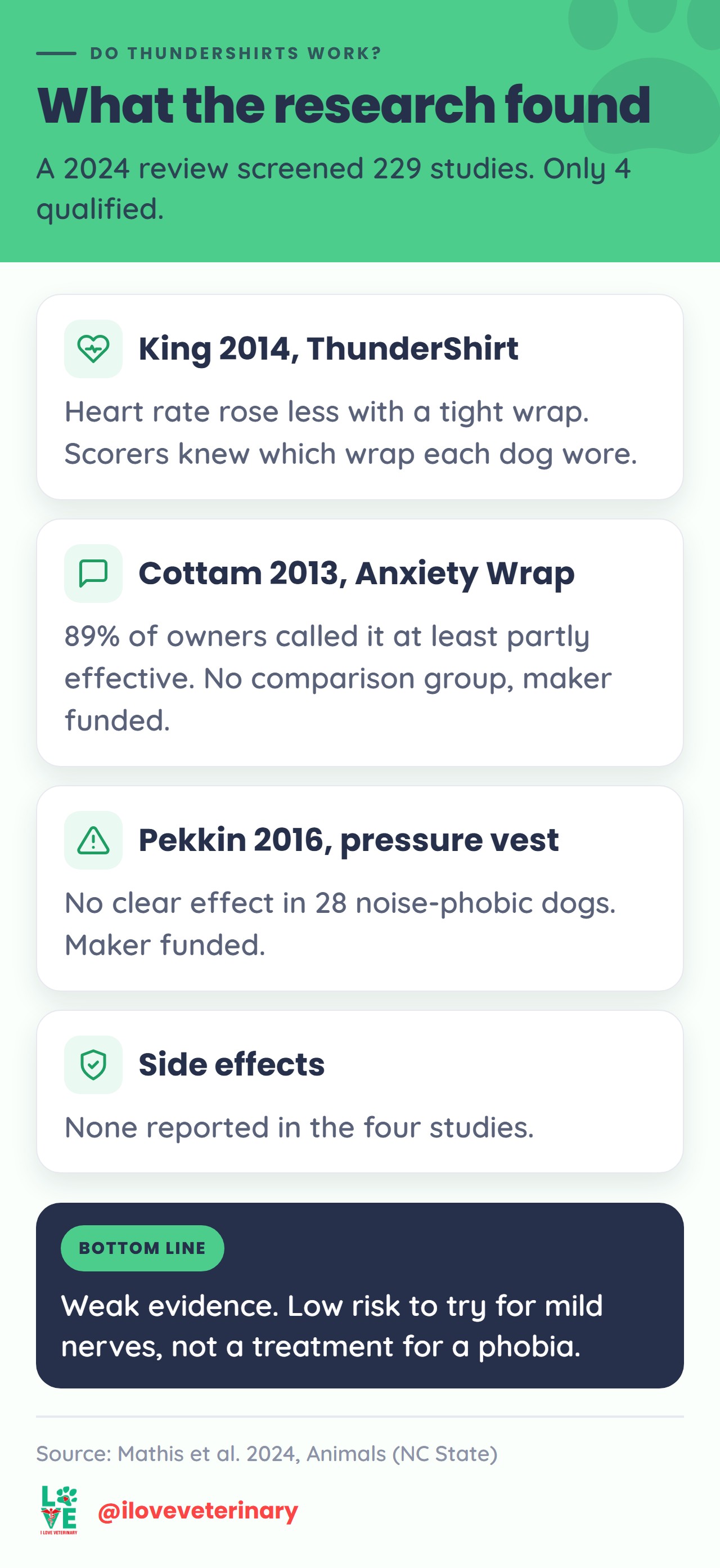
The useful finding for owners is on the other side of the ledger: none of the four studies reported adverse effects. That does not make a wrap risk-free. Behavior specialists at Penn Vet point out that clothing holds in heat and makes it harder for a dog to cool down, and that some dogs find wraps distressing and should not be made to wear them.
Our take: a wrap is a low-risk thing to try for a dog with mild noise or travel nerves. It is not a treatment for a real phobia, and it should never replace a plan from your veterinarian.
Our picks
ThunderShirt Classic: the default choice for most dogs
Best for: owners who want the brand used in the research, in a size range that covers almost any dog.
- Seven sizes, from XXS (under 8 lb) to XXL (over 110 lb), according to the maker.
- It wraps around the chest and closes with hook-and-loop fasteners, so nothing goes over the dog's head.
- A lightweight polyester, spandex and rayon blend that is machine-washable.
- It is the wrap used in the King 2014 study above.
Limitation: it is a plain wrap with no extras. There is a patch on the chest strap for a calming spray, but the spray is sold separately. If your dog falls between two sizes, ThunderShirt advises going with the smaller one.
See the ThunderShirt Classic on Amazon
Which ThunderShirt style?
ThunderShirt makes the same wrap in three styles, and the maker says all of them are equally effective. That is the company's claim, not a study finding, so pick the style on fit and use:
Style | What is different | Good fit for |
|---|---|---|
Classic | Heather gray, polyester, spandex and rayon blend | Most dogs, at home or traveling |
Sport | 100% polyester, built for movement, can be worn with a harness | Dogs that need the wrap on walks or at the park |
Polo | Shirt-style fabric designed for comfort, goes on differently, runs small | Dogs whose triggers happen at home; size up |
The Polo is also on Amazon: see the ThunderShirt Polo. Remember that it runs smaller than the Classic.
AKC Calming Coat: a lighter wrap for warm weather
Best for: dogs who need help in summer, when fireworks season and heat overlap.
- A light, breathable cotton, polyester and spandex blend.
- Five sizes covering dogs from about 10 to 100 lb, per Business Insider's review.
- Adjustable straps around the chest and waist; the coat is machine-washable.
Limitation: it does not fit dogs under about 10 lb, and Business Insider's reviewer found the straps confusing to fasten the first time.
See the AKC Calming Coat on Amazon
Mellow Shirt calming wrap: an easy on, easy off option
Best for: dogs who hate having anything pulled over their head.
- Hook-and-loop closures around the body, with no over-the-head step.
- Published reviews list sizes from XS (starting around 10 lb) up to XL (about 110 lb).
- Soft, lightweight and machine-washable.
Limitation: there is no size for very small dogs, and these specs come from review sites rather than the maker, whose website did not load when we checked. Treat it as a reasonable alternative, not a better one.
See the Mellow Shirt on Amazon
No study has compared these wraps head to head, so none of them can be called more effective than the others. The real differences are fit, fabric and how easily your dog tolerates being dressed.
How to choose a calming wrap
- Measure the chest. Sizing runs on chest girth, so measure before you order and pick the size by chest girth on the listing. The wrap should be snug but not tight.
- Wrap-around or over the head. Some dogs resist anything pulled over their head. All three picks above wrap around the body.
- Heat and fabric. For hot months or homes without air conditioning, choose the lightest fabric that fits.
- Add-ons. Some vests add hoods, sound features or scent pockets. Penn Vet's behavior team notes there is no good evidence that aromatherapy helps storm fear, so a scent pocket is not a reason to buy.
- Weighted vests. These are a different product. A Cornell veterinarian quoted by Business Insider advises having your vet check dogs with neck, front-leg, mobility or musculoskeletal problems first, and skipping weighted vests in warm weather, on long walks and near water.
- Return terms. Since no wrap is guaranteed to work, a veterinary behaviorist quoted by Business Insider recommends picking one with a money-back guarantee. ThunderShirt currently lists a satisfaction guarantee on its site; check the current terms before you buy.
How to use a wrap safely
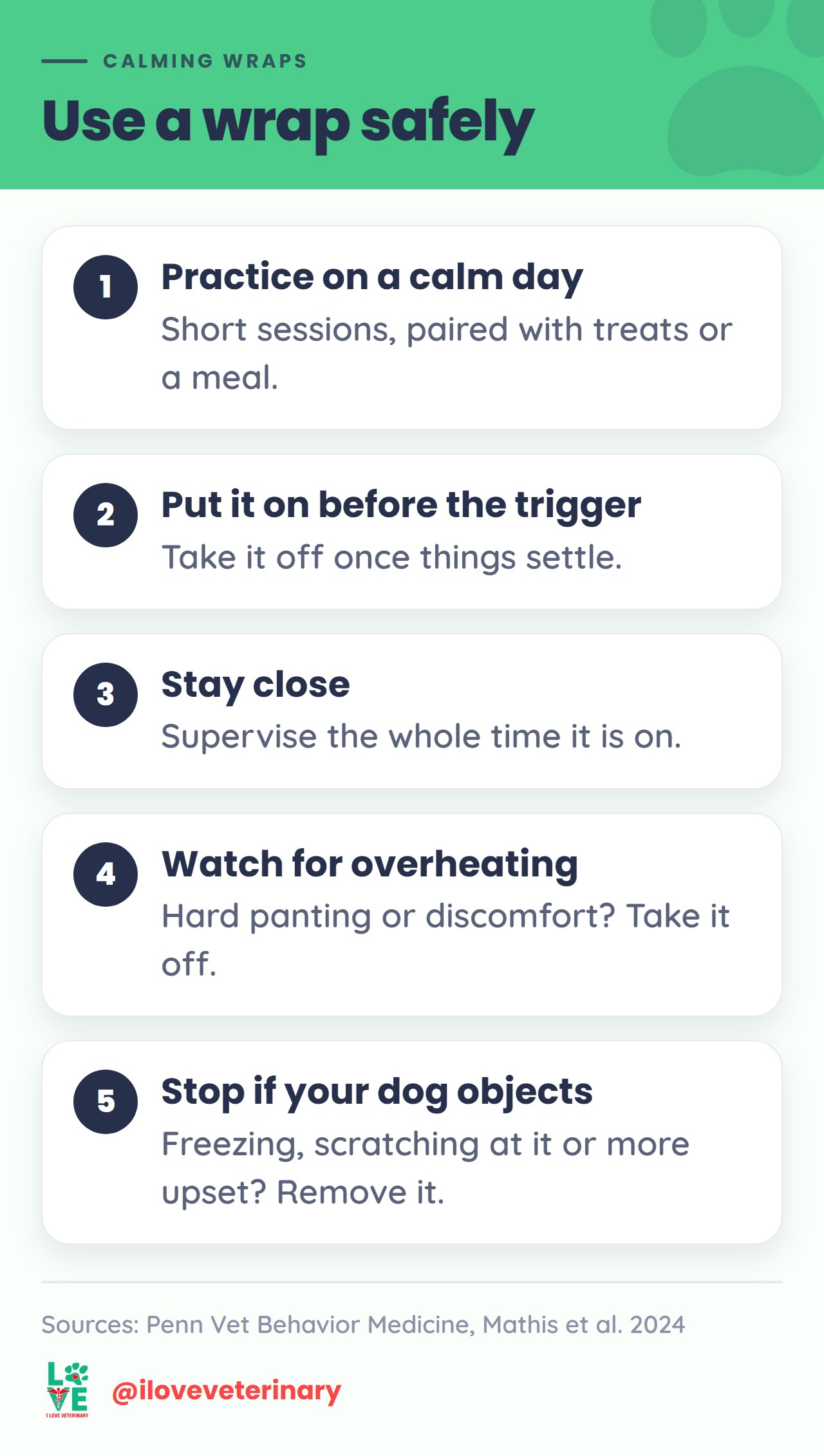
- Introduce it on a calm day. Put the wrap on for short periods when nothing scary is happening, and pair it with treats or a meal so the dog links it with good things.
- Put it on before the trigger. Dress your dog before the storm rolls in or the fireworks start, and take the wrap off once things settle.
- Stay close. Supervise your dog the whole time the wrap is on.
- Watch for overheating. A wrap holds in body heat. If your dog starts panting hard or seems uncomfortable, take it off.
- Stop if your dog objects. If your dog freezes, scratches at the wrap, tries to wriggle out or seems more upset, remove it. Some dogs simply do not tolerate wraps, and forcing one on them helps no one.
Other ways to help a frightened dog
A wrap works best as one small part of a bigger plan. Penn Vet's behavior medicine handout on storm and fireworks fear covers the rest:
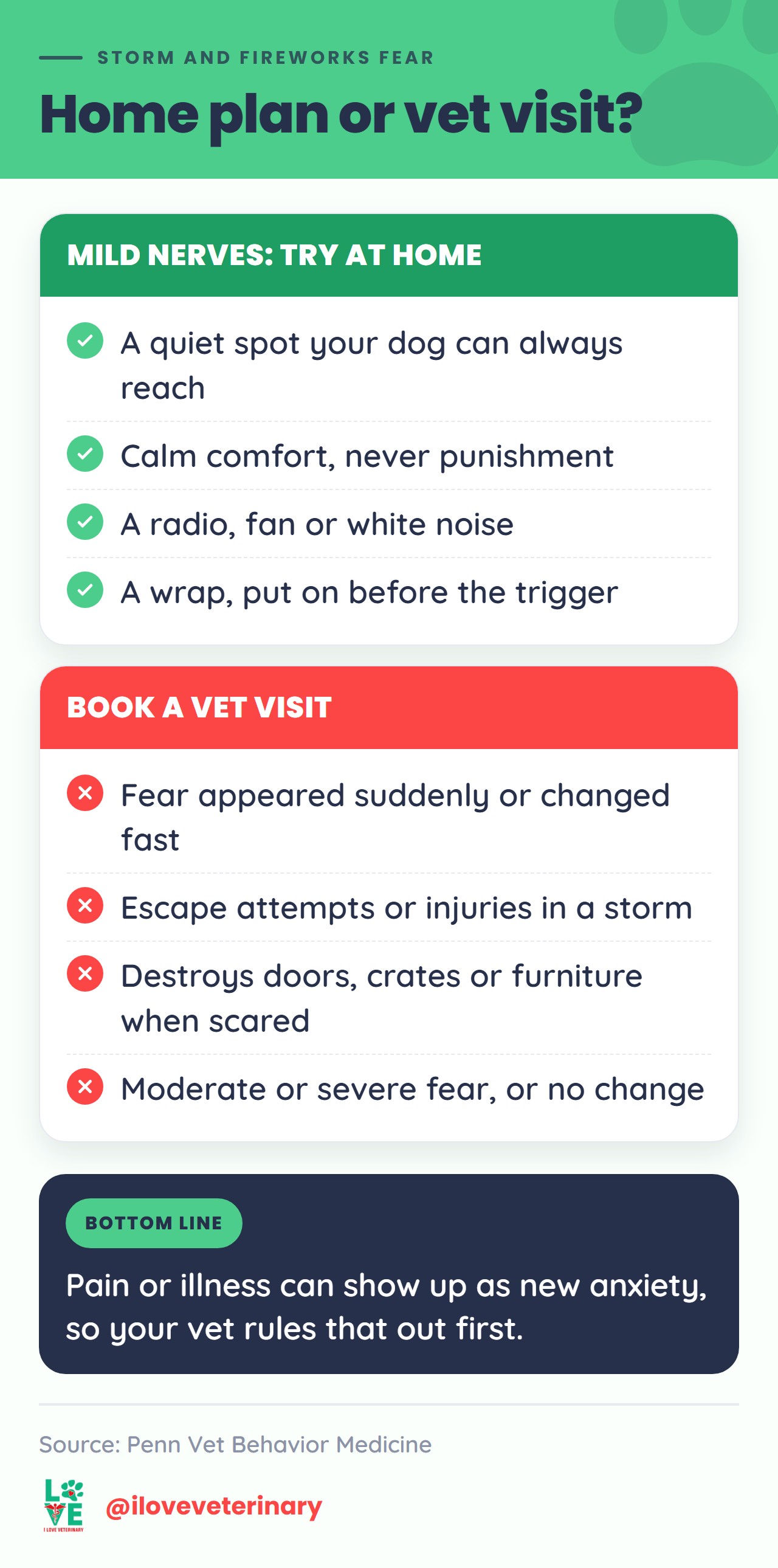
- Set up a quiet spot your dog can choose to go to, and keep it available at all times. Never shut a panicking dog behind a closed door, gate or crate, because frightened dogs can hurt themselves trying to escape.
- Comfort your dog. Calm attention during a storm does not reward fear. Punishing a fearful dog makes things worse.
- A radio, fan or white noise machine may help a little, though it cannot cover loud thunder.
- On days with a good chance of storms, arrange for someone to be home or for day care so your dog is not alone.
Learn your dog's fear signals so you can act early. The Penn Vet handout lists trembling, panting, pacing, whining, drooling, hiding, clinging to people, chewing or digging, house soiling and trying to escape. Storm-fearful dogs may start reacting before the first thunderclap, as the wind picks up, the sky darkens and barometric pressure drops. If your dog barks through storms, our guide on why dogs bark covers the common reasons. And if the trouble starts when you leave rather than when the weather turns, read our guide to separation anxiety in dogs, because that needs a different plan.
When to see your vet or a veterinary behaviorist
Book a visit with your veterinarian if:
- the fear appeared suddenly or changed quickly, since pain or illness can show up as new anxiety and should be ruled out first;
- your dog has tried to escape, gone through a window or screen, or injured itself during a storm;
- your dog destroys doors, crates or furniture when frightened;
- the fear is moderate or severe, or a wrap and the steps above make no visible difference.
Your veterinarian may refer you to a veterinary behaviorist, a veterinarian with specialist training in animal behavior. For moderate to severe storm fear, Penn Vet notes that medication is often an essential part of the plan, alongside behavior modification. Your veterinarian decides whether medication fits your dog and which product to use.
Can you make your own ThunderShirt?
If you sew, you can make a simple wrap at home from a stretchy knit fabric, using measurements of your dog's neck, chest and waist and a long flap that wraps around and fastens over the back. The video below walks through one pattern.
A homemade wrap follows the same rules as a store-bought one. Fit it snug, never tight, and make sure nothing around the neck can tighten if your dog pulls or twists. Supervise every minute it is on. If your dog's fear is more than mild, spend the effort on a vet visit rather than a sewing project.
FAQ
Do ThunderShirts really work?
For some dogs with mild fears, they may take the edge off. A 2024 systematic review found only four qualifying studies, with weak and inconsistent results and no reported side effects. They are not a cure for noise phobia.
How long can a dog wear a ThunderShirt?
No study sets a safe wearing time. Put the wrap on shortly before the trigger, take it off when things calm down, and stay with your dog while it is on. All-day wear adds overheating risk with no evidence of extra benefit.
Sources
- Animals (Basel): A Systematic Review of the Efficacy of Compression Wraps as an Anxiolytic in Domesticated Dogs (Mathis et al., 2024)
- Penn Vet, Ryan Veterinary Hospital Behavior Medicine: Fear of Thunderstorms and Fireworks
- Journal of Veterinary Behavior: The effect of a pressure wrap (ThunderShirt) on heart rate and behavior in canines diagnosed with anxiety disorder (King et al., 2014), as summarized in Mathis et al.
- Journal of Veterinary Behavior: The effectiveness of the Anxiety Wrap in the treatment of canine thunderstorm phobia (Cottam et al., 2013), as summarized in Mathis et al.
- Applied Animal Behaviour Science: The effect of a pressure vest on the behaviour, salivary cortisol and urine oxytocin of noise phobic dogs (Pekkin et al., 2016), as summarized in Mathis et al.
- ThunderShirt: ThunderShirt for Dogs (styles, sizes and guarantee)
- Business Insider: The best dog anxiety vests to help calm noise-sensitive dogs
- TrustedHousesitters: Dog anxiety vests to calm a nervous pooch
- Top Dog Tips: Best dog anxiety vests (Mellow Shirt sizes)
- Canine Bible: Best dog anxiety vests (Mellow Shirt design)
This article is for general information and is not a substitute for advice from your veterinarian.