

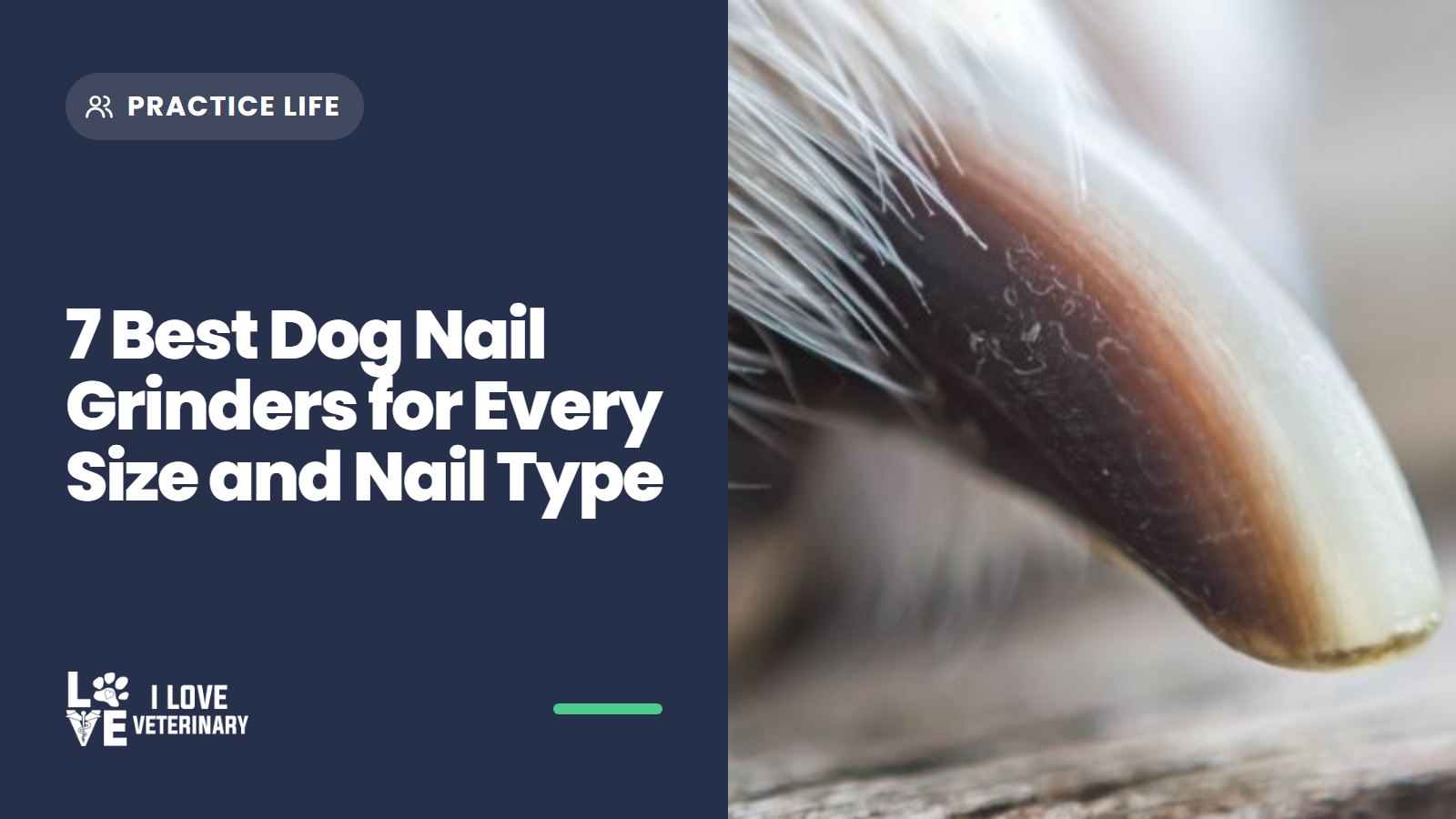
We all know the sound of dog nails clicking on the floor as they run towards us. It's a welcome sound, but it also means the nails are too long, and clipping a dog's nails is often nowhere near as easy as it sounds.
A nail grinder is the other option. Instead of cutting, it files the nail down a little at a time with a spinning sanding drum or diamond bit. Some dogs that fight the clippers will sit for a grinder, and some won't, so the right tool depends on your dog's size, nail thickness and nerves. Below are seven grinders matched to those needs, plus the safety basics to know before the first session.
Some links in this post are affiliate links. If you buy through them, we may earn a small commission at no extra cost to you. As an Amazon Associate, we earn from qualifying purchases.
The Advantages of a Dog Nail Grinder
Grinding isn't better for every dog, but it solves some common problems:
- No squeeze on the nail: Some dogs react to the pressure of a clipper more than to the trim itself. VCA veterinarians note that some dogs who dislike clipping tolerate grinding better.
- No sharp edges: Grinding leaves the nail end smooth.
- Gentler on the quick: Because you take off a little at a time, VCA notes there is less risk of damaging the quick, the sensitive living part of the nail.
- Easier on thick nails: Nails too thick to clip comfortably can be shortened gradually.
There are trade-offs. Grinding is slower, the noise and vibration bother some dogs, the bit can catch long hair, and the nail gets warm if you hold the tool on it too long. The safety section covers all four.
Our Picks at a Glance
These picks are based on manufacturer specifications, product listings and published reviews, not on our own testing. Noise figures are the makers' own claims.
Grinder | Best for | Power | Key features |
|---|---|---|---|
Dremel PawControl 7760-PET | Most owners, first-timers who want a guide | 4V lithium-ion, USB charging | 4 speeds, 45-degree paw guide with dust collection |
Casfuy 6-Speed (N60) | Mixed-size households | USB rechargeable | 6 speeds, dual LED lights |
LuckyTail | Noise-sensitive dogs | USB-C rechargeable | Two LED lights, 30 dB maker rating |
Dremel 7350-PET | Free-hand shaping with a light tool | 4V lithium-ion, micro-USB | 60-grit sanding bands, no guard in the kit |
IREDOON (MC-05) | Thicker nails | Rechargeable lithium-ion | 3 speeds, 3 ports, 4 LED lights, battery display |
Casfuy Upgraded 2-Speed (N10) | A simple first grinder | Rechargeable | 2 speeds, 3 ports |
Wahl Classic 5971 | No charging, occasional touch-ups | 2 C batteries (not included) | Safety cap |
Reviewing the Best Dog Nail Grinders
1. Dremel PawControl 7760-PET: Best Overall
Best for: owners who want the tool to help with angle and depth, including first-timers and multi-dog homes.
- The 45-degree paw guide sets the trimming angle and collects dust. Dremel says it reduces the risk of taking the nail too short, and its guide recommends using the clear guard so you can set the depth for each nail.
- Four speed settings, so you can start low with a nervous dog and step up for harder nails.
- Nine sanding bits and a twist-off nose cap.
Limitation: there's no built-in light, and with a guard plus nine bits there are more parts to learn than on a basic grinder.
Check the Dremel PawControl 7760-PET on Amazon
2. Casfuy 6-Speed Dog Nail Grinder: Best for Mixed Sizes
Best for: households with dogs of different sizes.
- Six speeds from 7,000 to 12,000 RPM, per the listing, so you can stay low for a small dog and go higher on a big one.
- Diamond drum bit and dual LED lights.
- Casfuy calls it whisper-quiet with very low vibration, but gives no decibel figure.
Limitation: the maker quotes about 2 hours of use after a 3-hour charge, so charge it the day before. The LEDs won't help you find the quick on black nails.
Check the Casfuy 6-Speed Dog Nail Grinder on Amazon
3. LuckyTail Dog Nail Grinder: For Noise-Sensitive Dogs
Best for: nervous or sound-sensitive dogs.
- Rated at about 30 dB by the maker, the lowest figure claimed among these picks.
- USB-C charging: LuckyTail says it charges in about an hour and runs for over 4 hours.
- Diamond bit head and two LED lights.
Limitation: a gentle motor may take longer on large, thick nails, so expect longer sessions with a big dog.
Check the LuckyTail Dog Nail Grinder on Amazon
4. Dremel 7350-PET: A Simple, Light Dremel
Best for: owners who want an uncomplicated Dremel for free-hand shaping. It takes the place of the Dremel 7300-PT from earlier versions of this list.
- Dremel says it runs 7% quieter and gives 30% more runtime than the 7300-PT.
- 4V lithium-ion battery with micro-USB charging.
- Comes with 60-grit sanding bands and a drum mandrel.
Limitation: Dremel describes the 7350 as a one-button, single-speed tool, so you can't slow it down for a nervous dog. No nail guard is listed in the kit, so you control angle and depth yourself, and the sanding bands need replacing as they wear.
Check the Dremel 7350-PET on Amazon
5. IREDOON Dog Nail Grinder: For Thicker Nails
Best for: medium to large dogs with thicker nails.
- Three speeds and three grinding ports, so you can match the opening to the nail.
- An LED display shows battery level and speed setting, plus four LED lights around the head.
- The maker quotes a noise level of 40 dB.
Limitation: that's a higher claimed figure than LuckyTail's, so a timid dog may need a longer introduction.
Check the IREDOON Dog Nail Grinder on Amazon
6. Casfuy Upgraded 2-Speed: A Simple First Grinder
Best for: a first grinder for small to medium dogs. This is the Casfuy from the original version of this list.
- Low and high speeds on a 7,000 to 8,000 RPM motor.
- Three grinding ports for small, medium and large nails.
- Diamond drum bit; Casfuy calls it ultra-quiet with low vibration.
Limitation: the two speeds sit close together, so there's less room to adjust for very thick nails. No light, and about 2 hours of use after a 3-hour charge.
Check the Casfuy Upgraded 2-Speed on Amazon
7. Wahl Classic Nail Grinder 5971: No Charging Needed
Best for: occasional touch-ups by owners who'd rather swap batteries than charge.
- Runs on two C batteries, so there's no charge time.
- Wahl lists a safety cap and a safety stop meant to reduce dust and prevent over-trimming.
- Wahl describes it as quiet and lightweight, with a 1-year limited warranty.
Limitation: it's an older design (on Amazon since 2015), and the C batteries aren't included.
Check the Wahl Classic Nail Grinder 5971 on Amazon
How to Choose a Dog Nail Grinder
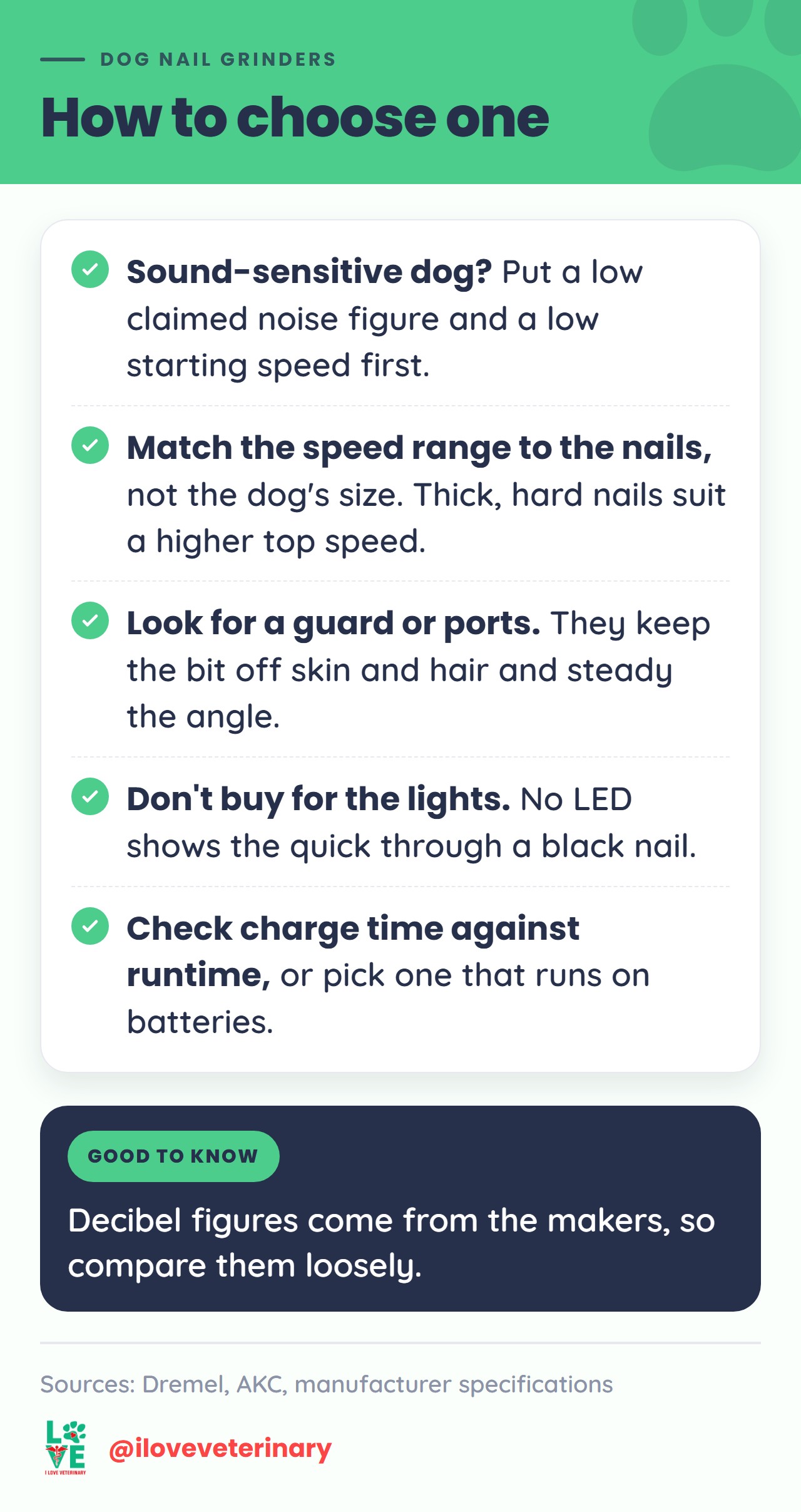
Start with noise if your dog is sound-sensitive. Put a low claimed noise figure and a low starting speed ahead of extra power. Decibel numbers come from the makers, so compare them loosely.
Match the speed range to the nails, not the dog's size. Thin nails need only a low speed. On thick, hard nails, a higher top speed may finish in fewer passes, with less time on each nail.
Look for a guard or ports. They keep the bit off skin and paw hair and steady the angle. Without one, as on the Dremel 7350-PET, you need a steadier hand.
Don't buy for the lights. LEDs help on pale nails, where the pink quick shows anyway. No light shines through a black nail, so treat LEDs as a convenience, not a safety feature.
Check charge time against runtime. Or skip charging: the Wahl 5971 runs on C batteries.
How to Use a Dog Nail Grinder Safely
If you've never used a grinder before, ask your vet team to show you. The American Kennel Club's chief veterinarian suggests a lesson from your veterinarian or vet tech, and they can show you where the quick sits on your own dog's nails. For nail anatomy and technique, see our step-by-step guide to cutting dog nails.
Get your dog used to the grinder first
Dogs introduced to the tool as puppies are easiest. If yours wasn't, don't panic: take it slow, use lots of praise and treats, and spread it over several short sessions:
- Let your dog sniff the grinder while it's off, and give a treat.
- Turn it on at a distance so your dog hears the sound, with more treats.
- Touch the running grinder to a paw without grinding, so your dog feels the vibration.
- Only then grind one nail, briefly, and stop on a good note.
VCA's behavior team notes that a dog with no existing fear may need only a session or two, while a dog that's already afraid may need weeks or months. If your dog is truly fearful of nail care, get personalized help from your veterinary team or a behavior professional rather than pushing through.
Grinding the nails
- Put your dog on a raised, stable surface such as a grooming table, or on the floor if you mind your back.
- Sit beside your dog. Don't do this with a dog you don't know well: your face is very close to their teeth.
- Hold the paw and support each toe firmly but gently.
- Push back the hair on the paw. On long-haired dogs, keep it well away from the bit so it can't get caught.
- Grind a small amount at a time, across the bottom of the nail and then carefully in from the tip.
- Use brief touches and lift the tool often. Grinding makes the nail hot, and Wahl's grinding guide advises against holding the tool on a nail for more than a second or so at a time.
- Round off the tip when you're done.
Know where to stop. The quick is the pink part of the nail that contains blood vessels; nicking it hurts and bleeds. On pale nails you can see it. On dark nails, AKC advises watching for a chalky white ring. With regular trims, the quick recedes from the end over time.

Keep the bit off the skin. If it slips onto the skin, it can cause a severe skin burn, so use the guard or port where your tool has one.
Grind outside if you can. VCA notes nail dust can irritate people (and presumably dogs), so a porch or yard beats the living room.
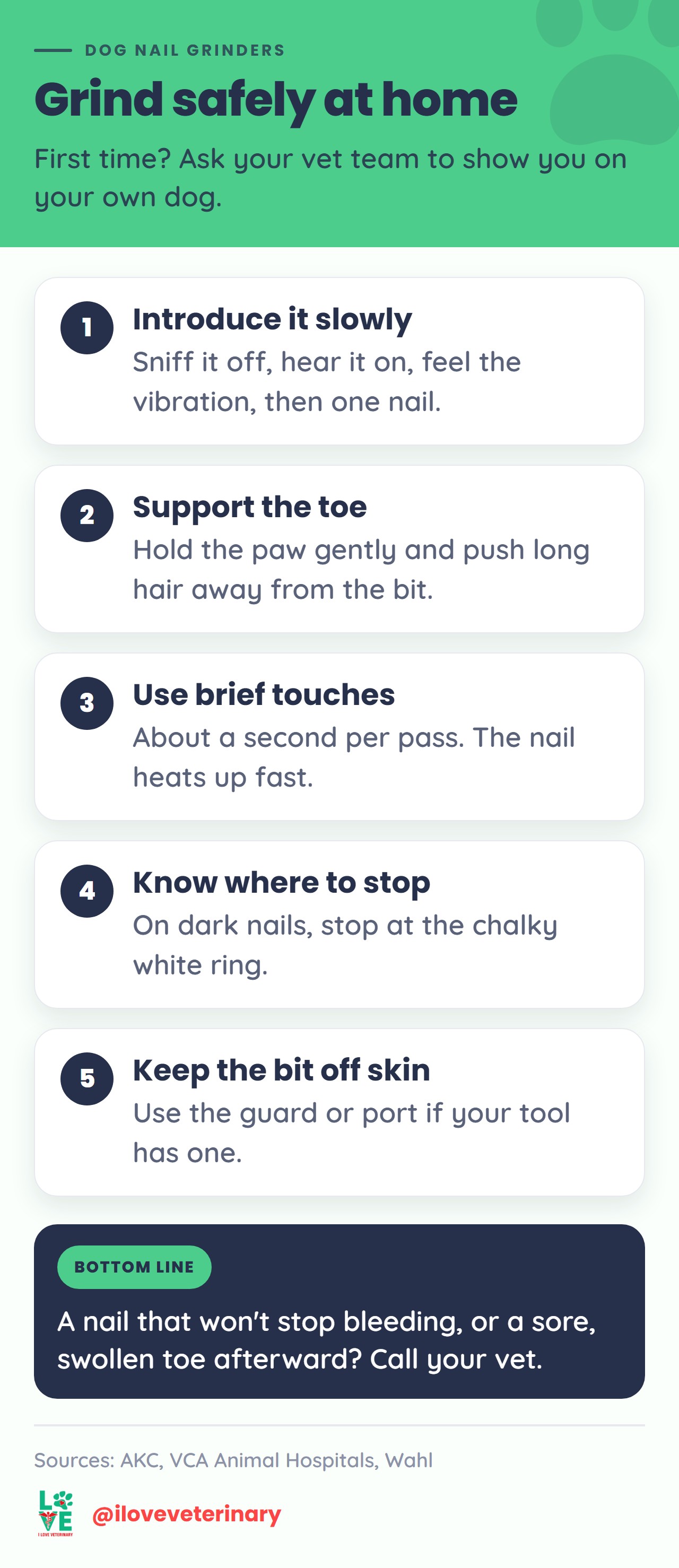
If a nail bleeds and won't stop, or a toe looks sore, swollen or red afterward, call your veterinarian. Problems around the nail can point to a nail bed infection, which needs a vet's diagnosis.
So, What Is the Best Dog Nail Grinder?
For most owners we'd pick the Dremel PawControl 7760-PET. The 45-degree guide sets the angle and helps you control depth, which matters most when you're new to grinding, and four speeds cover both a nervous small dog and a big dog with hard nails.
For a sound-sensitive dog, try the LuckyTail first, based on the maker's low noise rating. For dogs of different sizes, look at the Casfuy 6-Speed.
Whichever you choose, introduce it slowly and ask your vet team to show you the technique on your own dog. Most dogs will never love having their nails done, but the right grinder can make it a lot less scary. For the rest of the routine, see our dog grooming tips.
FAQ
Is it better to grind or clip a dog's nails?
Neither is better for every dog. The AKC says both are safe when used correctly, and that some dogs tolerate grinders better while others prefer clippers. Grinding leaves a smoother edge; clipping is faster.
Do LED lights on a grinder show the quick?
Not on dark nails. Watch for the chalky white ring instead, and stop there.
How often should I grind my dog's nails?
It depends on growth and how much the nails wear down on walks. Clicking on hard floors means they're due. Your vet team can suggest a routine, especially for overgrown nails.
Sources
- American Kennel Club: How to Trim Your Dog's Nails Safely
- VCA Animal Hospitals: How to Trim a Dog's Nails at Home
- VCA Animal Hospitals: Taking the Stress out of Nail Trimming for Dogs
- Wahl: Nail Grinding Guide
- Whole Dog Journal: Grinders vs. Clippers
- Dremel: How to Choose the Right Nail Trimmer
- Product specifications: each manufacturer's Amazon listing, linked in the picks above.