
Indoor cats are less exposed to fleas and ticks than cats that go outside, but less exposed is not the same as protected. Fleas ride into the house on people and other pets, and even a short trip outdoors can be enough for a cat to pick them up. Cats living both outdoor and indoor lives face a higher risk again.
This guide covers the external parasites (ectoparasites, the ones living on the skin, coat and ears) that matter for cats, why guidelines recommend prevention all year, what the product types do, and the one safety rule every owner needs: never put a dog flea or tick product on a cat. The product and the dose are your veterinarian's call.
Which external parasites affect cats
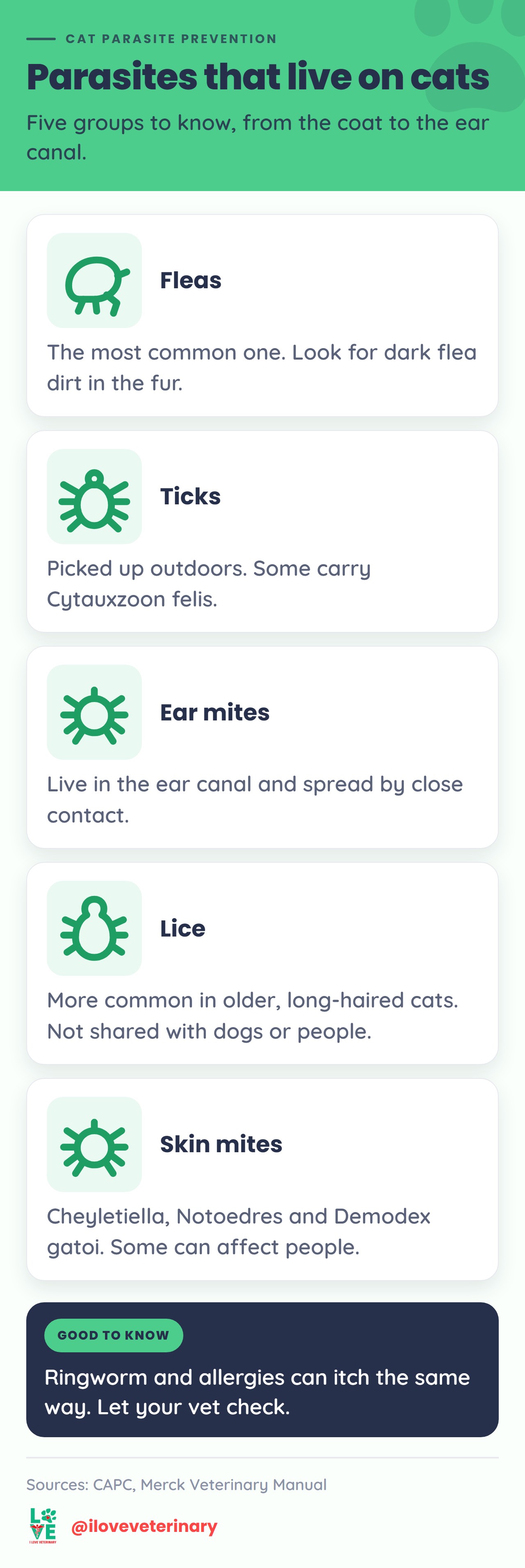
- Fleas. The cat flea, Ctenocephalides felis, is the most common ectoparasite of cats in North America, according to the Companion Animal Parasite Council (CAPC). Signs include frequent scratching and dark specks in the fur. Those specks are flea dirt (digested blood), and they turn reddish on a damp paper towel.
- Ticks. Cats pick up ticks outdoors, and ticks can carry feline diseases. The lone star tick is the main carrier of Cytauxzoon felis, a blood parasite behind cytauxzoonosis, a disease where mortality is often high even with treatment.
- Ear mites. Otodectes cynotis lives in the ear canal and spreads by close contact, so one itchy cat often means several affected pets. Our guide to ear mites covers signs and diagnosis.
- Lice. Cats have their own chewing louse, Felicola subrostratus. It is more common on older, long-haired cats that can no longer groom themselves, and rare in cats kept on flea and tick prevention. Cat lice are not shared with dogs or people.
- Skin mites. Cheyletiella ("walking dandruff") is very contagious and frequently bites people too. Notoedres cati causes feline scabies (notoedric mange), which is highly contagious among cats and can opportunistically infest people. Demodex gatoi causes a contagious, superficial form of demodicosis.

Itching is not always parasites. Ringworm, food allergy and atopic dermatitis can look similar, which is why a scratchy cat needs a veterinary exam rather than a guess.
Why prevention matters
External parasites do more than make a cat itch. CAPC lists the diseases the cat flea can transmit: Bartonella henselae (the cause of cat scratch disease in people), flea-borne Rickettsia species, and the tapeworm Dipylidium caninum. Fleas are also linked to hemotropic mycoplasmas, blood parasites of cats. Heavy infestations can cause iron deficiency anemia and even death, particularly in young animals such as kittens. Some cats also react to flea saliva with flea allergy dermatitis (FAD), an intensely itchy skin disease.
Ticks matter for the whole household. The AAHA/AAFP Feline Life Stage Guidelines call tick prevention for cats increasingly important: ticks can carry feline rickettsial infections and hemotropic mycoplasmosis, and cats can carry infected ticks to the people they live with.
Why vets recommend prevention all year
CAPC recommends flea and tick control for all cats, year-round and throughout their lives, tailored to the individual cat: its health, lifestyle, household and the parasites found where you live.
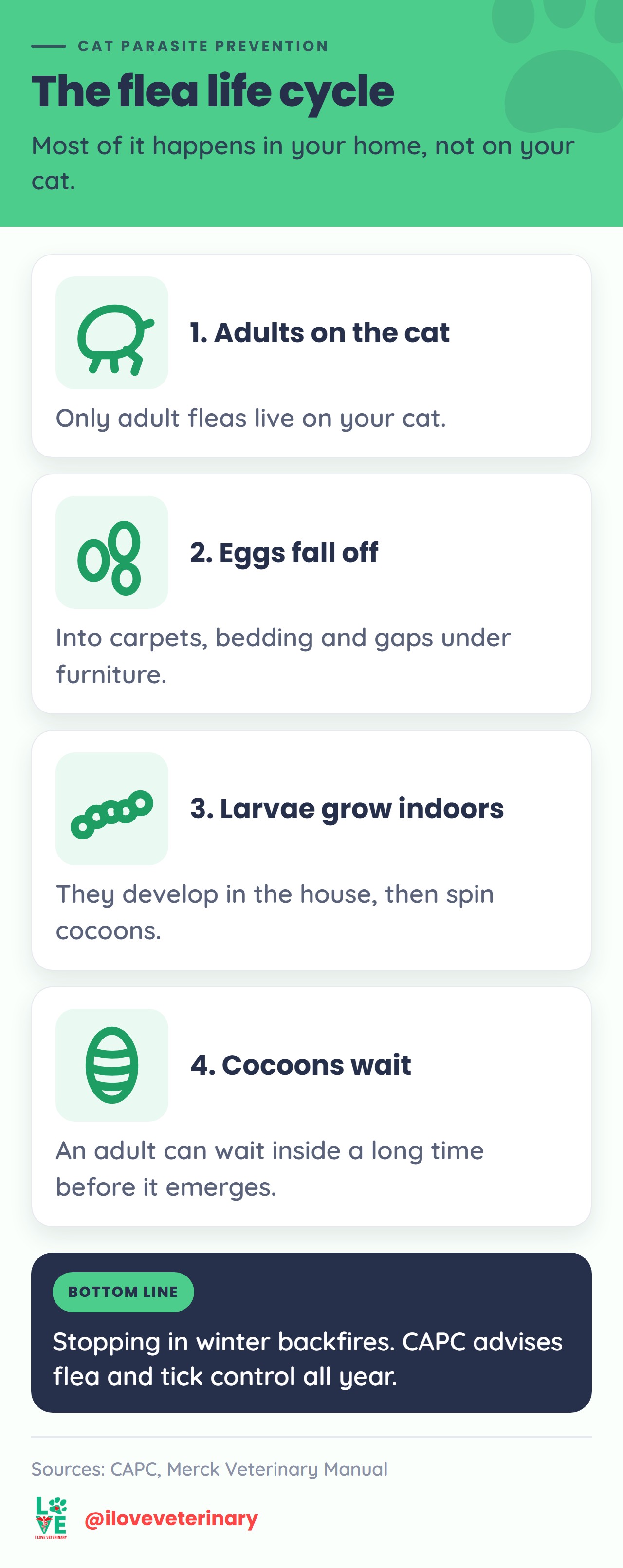
The flea life cycle explains why stopping in winter backfires. Only adult fleas live on the cat. Eggs fall off into carpets, bedding and the gaps under furniture, where larvae develop and spin cocoons. Under typical household conditions the cycle moves quickly, and an adult flea can wait inside its cocoon for a long time before it emerges. Merck also notes that flea allergy in indoor cats can occur at any time of year.
What about indoor cats?
Lower risk, not zero. Keeping a cat indoors limits tick exposure, and CAPC lists it as one way to reduce the risk of cytauxzoonosis. Fleas are another story: people bring them home without noticing, dogs carry them in from the yard, and even pets that only go out briefly can become infested.
That is why the AAHA/AAFP guidelines say routine, regular use of broad-spectrum parasite products is likely to benefit most pet cats, regardless of lifestyle. The same guidelines advise treating canine and feline housemates in sync, for example when a new kitten or cat joins the home. Protecting one animal while another carries parasites leaves a gap.
Prevention products: forms and classes
Flea and tick control for cats mainly comes in three forms:
- Spot-on (topical) products, liquids applied to the skin that spread over the body or are absorbed into it.
- Oral products, tablets or chews that work systemically, meaning the active ingredient circulates in the body and reaches the parasite when it feeds. For ticks, that means the tick has to bite to be exposed. Some oral products act briefly to clear an existing flea burden; others are longer-acting preventives.
- Collars, which release active ingredients slowly over time.
Behind those forms sit several ingredient classes. The ones your veterinarian may choose for cats include isoxazolines, macrocyclic lactones such as selamectin, fipronil, neonicotinoids such as imidacloprid, spinosyns, and insect growth regulators, which stop flea eggs and larvae from developing. Some products combine flea and tick control with heartworm and intestinal-parasite protection.
Coverage is easy to get wrong. According to the Merck Veterinary Manual, you cannot assume that the same compound controls both fleas and ticks, so a product that handles fleas well may do little against ticks, mites or lice. That is why the choice belongs with your veterinarian, who weighs:
- your cat's age and general health, including any past reactions to a product;
- lifestyle: indoor only, indoor and outdoor, or time in a catio or yard;
- the other pets in the home and what they are treated with;
- which parasites are a real risk in your area;
- the form you can give reliably, since a product that never gets used protects no one.
Shampoos are not prevention. Water-soluble insecticides wash off during bathing, so a flea shampoo is a short-term clean-up at best.
Cat safety: why dog products are dangerous
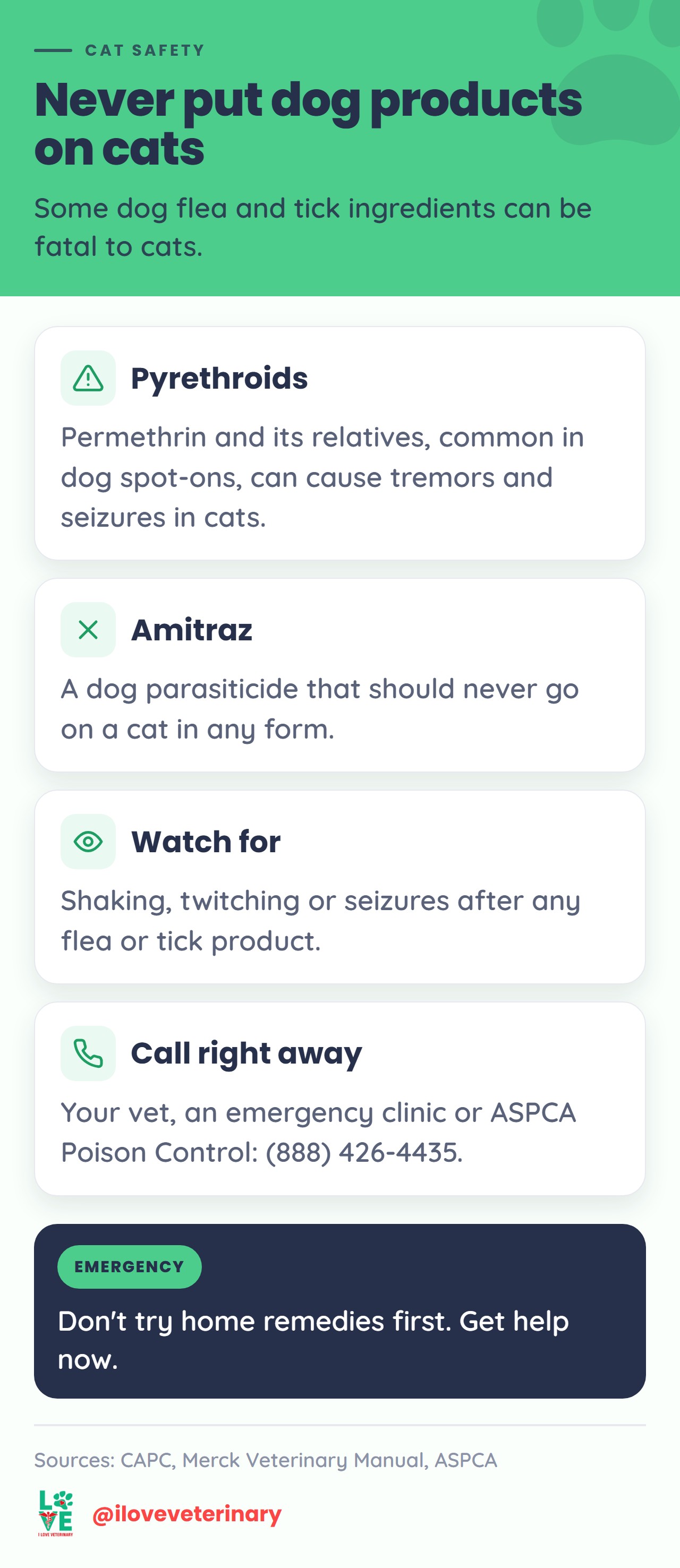
*Never use products made for dogs on cats.* CAPC states it plainly: products labeled for dogs should not be given to cats.
The main danger is permethrin and other synthetic pyrethroids, ingredients common in dog spot-ons. Merck describes permethrin as potentially highly toxic to cats, causing muscle tremors and seizures, and the ASPCA warns that these products can cause severe tremors and seizures in cats. Some of these reactions can be fatal. Amitraz, another dog parasiticide, should not be applied to cats in any form. If you also have a dog, ask your veterinarian whether the dog's product is safe in a home with cats; our guide to external parasite prevention for dogs covers the dog side.
Cat products can cause reactions too. After a spot-on, some cats groom excessively, become agitated, act oddly sensitive to touch or seem subdued for a while. For the isoxazoline class, the FDA considers these products safe and effective for dogs and cats, while noting they have been associated with neurologic reactions such as muscle tremors, wobbliness (ataxia) and seizures in some animals, including some with no history of seizures. Most dogs and cats never have them. Tell your veterinarian about any past reaction or seizure, and report a suspected one.
If your cat has been exposed to a dog product, or starts shaking, twitching or having seizures after any flea or tick product, call your veterinarian or an emergency clinic right away. You can also call the ASPCA Animal Poison Control Center at (888) 426-4435 (a consultation fee may apply). Do not try home remedies first.
Around the house
Flea eggs and larvae develop in the house, not on the cat, so the home needs attention too:
- Wash pet blankets, throw rugs and carriers.
- Thoroughly vacuum every spot where your pets sleep or rest.
Use insecticide sprays or foggers in the home only on your veterinarian's advice, so that whatever you use is safe around cats.
Questions to ask your vet
- Which external parasites are a real risk for my cat, here and with our lifestyle?
- Which parasites does this product cover, and which does it not?
- Is it safe with my other pets and what they are using?
- My cat reacted to a product before. What should we use instead?
- I found a tick on my treated cat. Has the product failed? (Not automatically, says CAPC, but it is worth a call.)
- Does this product also cover heartworm and intestinal worms, or do we need something else?
Set the plan with your veterinarian for every pet in the home, so no one becomes the gap the fleas come back through.
Sources
- CAPC: Fleas
- CAPC: Ticks
- CAPC: Cytauxzoonosis
- CAPC: Lice
- CAPC: Otodectic Mite
- AAHA/AAFP: 2021 Feline Life Stage Guidelines, Parasite Control
- Merck Veterinary Manual: Fleas in Dogs and Cats
- Merck Veterinary Manual: Fleas of Cats
- Merck Veterinary Manual: Ectoparasiticides Used in Small Animals
- Merck Veterinary Manual: Lice in Dogs and Cats
- Merck Veterinary Manual: Mange in Dogs and Cats
- ASPCA: Not All Pets Are the Same: Why Species Matters for Pet Toxins
- ASPCA: Using Flea Medications Safely: Top 5 Tips for Pet Parents
- ASPCA: Animal Poison Control Center
- FDA: Fact Sheet for Pet Owners and Veterinarians about Potential Adverse Events Associated with Isoxazoline Flea and Tick Products
This article is for general information and is not a substitute for advice from your veterinarian.