


The Golden Retriever is a Scottish gundog built to retrieve waterfowl for hours, and it is the third most registered breed with the American Kennel Club (3rd of 210). Goldens are friendly, easy to train and great with families. They also need daily exercise, shed a lot, and have a high cancer risk, which is why a study of more than 3,000 Goldens follows them for life.
Golden Retriever Breed Facts
Trait | Golden Retriever |
|---|---|
AKC group | Sporting Group |
Origin | Scottish Highlands, 1800s |
AKC recognition | 1925 |
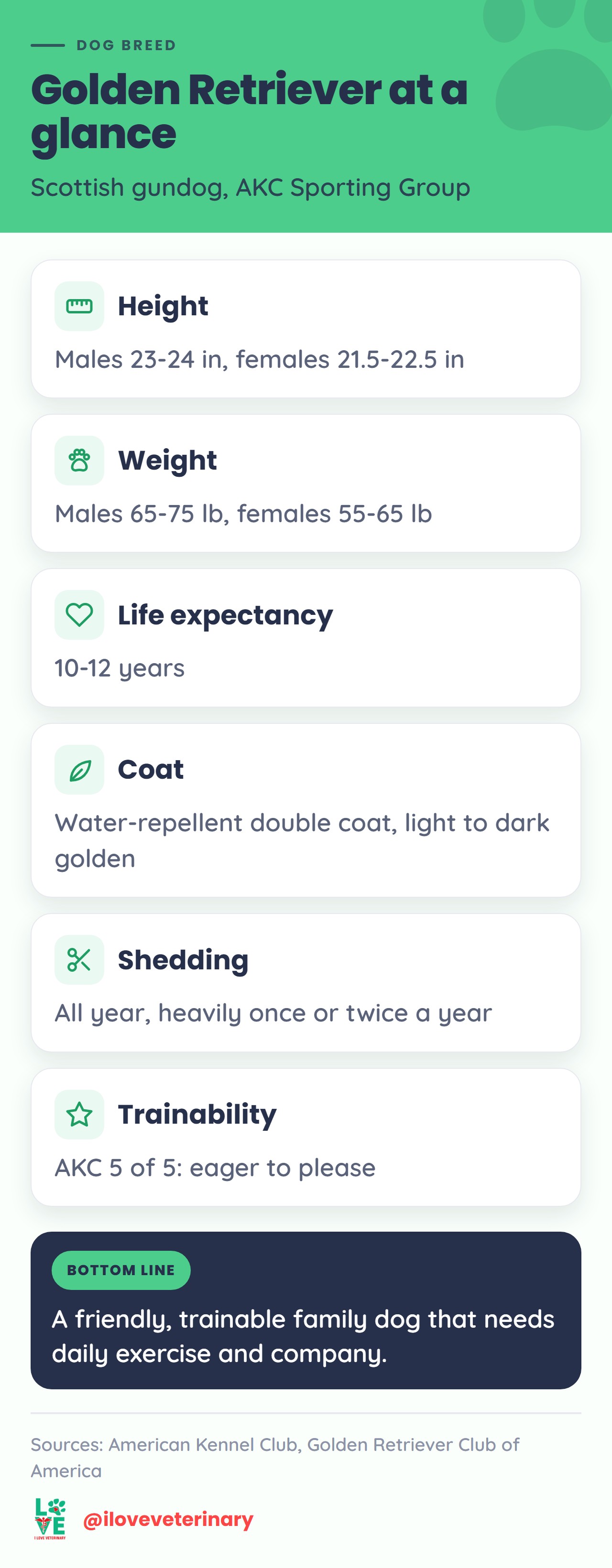
Height | Males 23-24 in, females 21.5-22.5 in |
Weight | Males 65-75 lb, females 55-65 lb |
Life expectancy | 10-12 years |
Coat | Double coat, medium length, water-repellent |
Colors | Light golden, golden, dark golden |
Shedding | High (AKC 4 of 5), with heavy seasonal sheds |
Energy | Moderate (AKC 3 of 5), but needs daily exercise |
Trainability | Very high (AKC 5 of 5) |
Good with young children | Yes (AKC 5 of 5), with supervision |
Source: AKC breed page and breed standard.
The breed standard asks for a "rich, lustrous golden of various shades", so a pale Golden and a deep red-gold one are the same breed.
Where the Golden Retriever Comes From
The breed was developed in the Scottish Highlands by Dudley Marjoribanks, the first Lord Tweedmouth, on his Guisachan estate in Inverness-shire. According to the AKC, he wanted a retriever that could handle the rain and rough terrain, so he crossed his "Yellow Retriever" with the now-extinct Tweed Water Spaniel, with Irish Setter and Bloodhound added later.
Goldens were first shown in Britain in 1908, reached America by way of Canada around the same time, and the AKC registered its first Golden in November 1925. They still work as hunting dogs, guide dogs and search-and-rescue dogs. One for trivia night: the first three dogs of any breed to earn the AKC Obedience Champion title, first offered in July 1977, were all Golden Retrievers.
Temperament: What Golden Retrievers Are Like
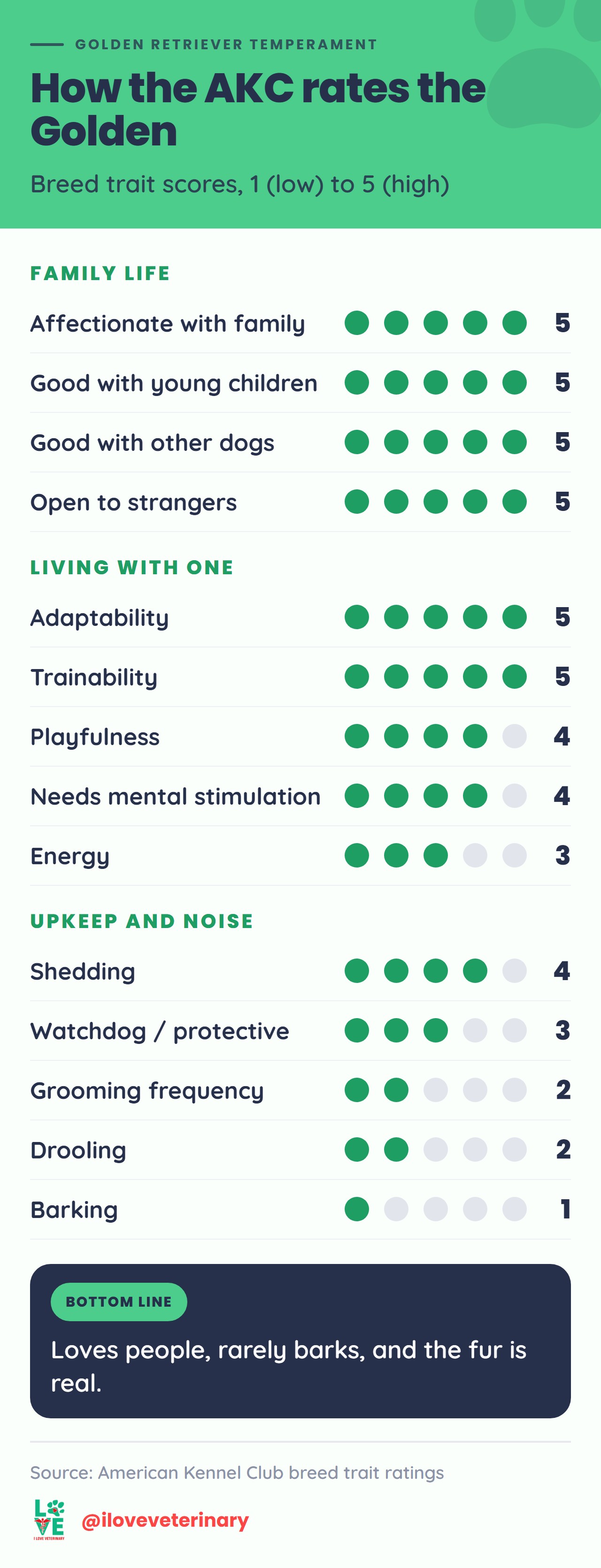
Goldens are people dogs. The AKC gives them its top score (5 of 5) for being affectionate with family, good with young children, good with other dogs, open to strangers, trainable and adaptable. They are playful (4 of 5) and keep a puppyish streak well into adulthood.
They rarely bark (1 of 5), and that friendliness has a downside if you want protection. The Golden Retriever Club of America (GRCA) puts it well: a typical Golden is more likely to carry an intruder's flashlight than to guard the house.
What they need in return is company and something to do. AKC scores their need for mental stimulation at 4 of 5, and GRCA warns that Goldens kept away from people, in a yard, a garage or tied outside, get bored and stressed and start barking, chewing and digging.
Is a Golden Retriever Right for You?
The breed club publishes a frank list of the issues that land Goldens in rescue. Read it before you commit.
A Golden tends to suit you if:
- Someone is home for much of the day, or you can arrange a dog walker or daycare while the dog is young.
- You enjoy walks, swimming, fetch or dog sports, and want a dog that joins in.
- You are ready for puppy classes and plenty of early socialization.
- Dog hair on the floor and the sofa won't ruin your week.
Think twice if:
- You have toddlers and little spare time. GRCA compares a new Golden puppy to adding another toddler. Most Goldens are good with children, but only when the adults have the time to exercise, train and supervise.
- The dog would be alone all day. A young puppy can't be crated for 8 hours while everyone is out.
- You're counting on a yard for exercise. Goldens are not self-exercisers; a fenced yard is a bathroom break, not a workout.
- Someone in the home has dog allergies. No breed is truly hypoallergenic, so GRCA suggests visiting the breeder's dogs first.
- You want a guard dog. See above.
Apartments can work. AKC gives the breed 5 of 5 for adaptability, and GRCA's real condition is that the dog lives with its family and gets enough exercise.
Caring for a Golden Retriever
Exercise
Goldens are a Sporting breed and need plenty of daily exercise. A Golden that doesn't get it is likely to find its own entertainment, usually something you own. GRCA suggests brisk walks on lead, swimming, chasing a ball in a safe enclosed area, and training sessions.
Go easy on young joints. GRCA advises against jogging or biking with a Golden until at least 12 months of age, and even then to check with your veterinarian first, perhaps with a hip X-ray. AKC also recommends a vet check before strenuous or high-impact activity.
Grooming and shedding
The double coat sheds moderately all year and heavily once or twice a year. Per the AKC:
- Brush with a slicker brush once or twice a week, and daily during a heavy shed.
- Bathe occasionally. A bath helps loosen dead coat, but let the dog dry completely before brushing.
- Trim nails regularly.
- Check the ears weekly for signs of infection and brush the teeth often.
Training and socialization
Goldens are eager to please, which makes them easy to train. The AKC recommends gently introducing puppies to many people, places and situations between about 7 weeks and 4 months of age, plus puppy training classes. That window is when a bouncy puppy learns that the world is safe and not worth losing its head over.
Weight and diet
Feed a quality food made for your dog's age (puppy, adult or senior), keep treats moderate, and give table scraps sparingly if at all, as the AKC advises. Some Goldens put on weight easily, and extra pounds matter for this breed: the Orthopedic Foundation for Animals (OFA) notes that calorie intake and exercise affect how bad hip dysplasia becomes. Ask your veterinarian to check body condition at each visit and to set the right amount to feed.
Golden Retriever Health
The AKC calls Goldens generally healthy, and most are. The breed does have known inherited problems, which responsible breeders screen for, and a high cancer rate, which the Golden Retriever Lifetime Study is trying to explain.
Health tests to ask a breeder for
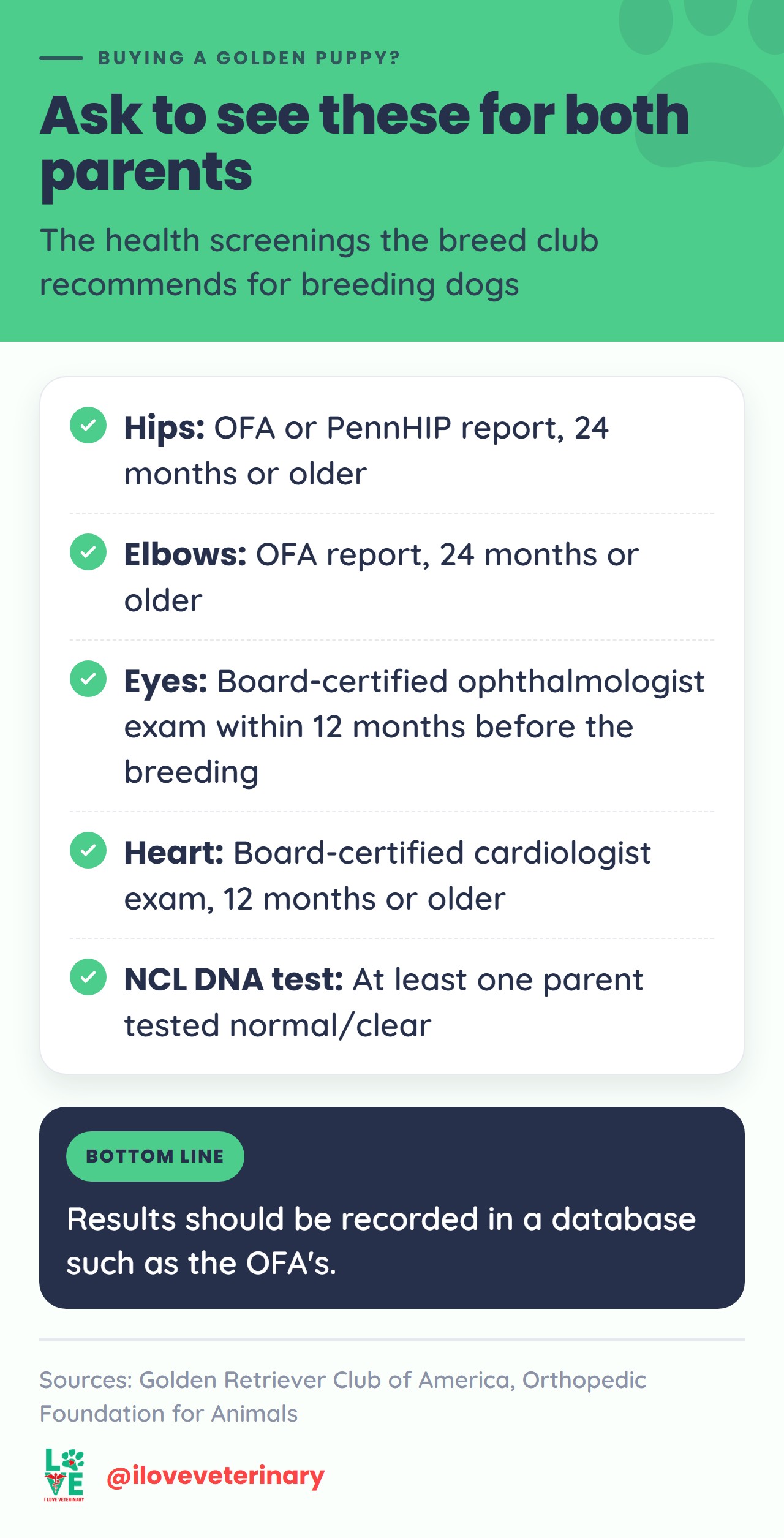
The Golden Retriever Club of America's health statement recommends these screenings for every US breeding dog, with results recorded in a database such as the OFA's. Ask to see them for both parents:
- Hips: an OFA or PennHIP report at 24 months of age or older.
- Elbows: an OFA report at 24 months of age or older.
- Eyes: an exam by a board-certified veterinary ophthalmologist (ACVO Diplomate) within 12 months before the breeding.
- Heart: an exam by a board-certified veterinary cardiologist (ACVIM Cardiology Diplomate) at 12 months of age or older.
- NCL: a DNA test for neuronal ceroid lipofuscinosis, a fatal inherited nerve disease; at minimum, one parent should test normal/clear.
OFA grades hip X-rays from excellent to severely dysplastic and only issues the breeding clearance at 2 years, though puppies can have preliminary films from 4 to 23 months.
Common conditions in Golden Retrievers
- Hip and elbow dysplasia: joints that form abnormally and wear into arthritis. See our guides to hip dysplasia in dogs and elbow dysplasia.
- Eye disease: juvenile cataracts, pigmentary uveitis and progressive retinal atrophy are on the AKC's screening list. More on uveitis in dogs.
- Heart disease, including subvalvular aortic stenosis, a narrowing below the aortic valve, which is why the heart exam is on the list.
- Ears and skin: AKC advises weekly ear checks, and the Lifetime Study tracks allergic skin disease (atopy) and outer ear infections (otitis externa) among its outcomes. Our photo guide to common dog skin problems shows what to look for.
The same study also tracks hypothyroidism, epilepsy, heart failure and kidney failure in Goldens.
Cancer and the Golden Retriever Lifetime Study
Morris Animal Foundation launched the Golden Retriever Lifetime Study in 2012. Between June 2012 and April 2015 it enrolled 3,044 US Goldens aged 6 months to 2 years and follows them for life, with annual vet exams, owner questionnaires and samples. Its main targets are four cancers: hemangiosarcoma, lymphoma, osteosarcoma and high-grade mast cell tumors.
What it has published so far:
- Hemangiosarcoma is common. By September 2022, 233 of the 3,044 dogs (7.65%) had been diagnosed with hemangiosarcoma, a cancer of the blood vessel lining, mostly in internal organs such as the spleen and heart (Hillman et al., 2023). Morris described its prevalence as higher than expected.
- The cancer count keeps climbing. The study passed 500 diagnoses of the four main cancers in 2023, and by April 2026 Morris reported more than 1,700 confirmed cancer diagnoses across the cohort.
- Lymphoma is the second most common cancer in Golden Retrievers.
- Genes play a part. A study funded by the foundation found a chromosome region associated with hemangiosarcoma, and the work continues.
Call your vet or an emergency clinic now if a Golden suddenly becomes weak, collapses or has pale gums. Internal hemangiosarcoma may show little early on and can first appear as an emergency, and Cornell's Riney Canine Health Center lists collapse, weakness and pale gums among the signs.
Older Goldens benefit from regular checkups, and any new lump or change is worth a call. Your veterinarian decides which tests make sense.
Spaying, neutering and timing
In one Lifetime Study analysis, Goldens spayed or neutered at any age were more likely than intact dogs to become overweight, and those altered at 6 months or younger had about four times the hazard of cruciate ligament injury or osteoarthritis (Simpson et al., 2019); it is one observational cohort in one breed, so it shows a link rather than a cause, and timing is a decision to make with your veterinarian (our post on the spay and neuter debate covers the wider picture).
Golden Retriever FAQs
How long do Golden Retrievers live?
The AKC gives a life expectancy of 10 to 12 years.
How big do Golden Retrievers get?
Males stand 23 to 24 inches at the shoulder and weigh 65 to 75 pounds; females stand 21.5 to 22.5 inches and weigh 55 to 65 pounds. GRCA says size well outside that range may mean the breeder isn't following its code of ethics.
Are Golden Retrievers good with kids?
Yes, AKC rates them 5 of 5 with young children, but GRCA says success with a puppy and small children depends on the parents supervising and training.
Do Golden Retrievers shed a lot?
Yes, all year and heavily once or twice a year. They are not hypoallergenic, and GRCA cites research finding no breed that truly is.
Can a Golden Retriever live in an apartment?
It can, if it gets daily exercise and spends its time with the family.
Are Golden Retrievers good guard dogs?
No. Some bark at activity outside, but the typical Golden is friendly to everyone, strangers included.
Is a Golden Retriever the same as a Labrador?
No. They are separate breeds, both retrievers in the AKC Sporting Group, and the AKC lists the Labrador Retriever first among the Golden's related breeds.
Sources
- American Kennel Club: Golden Retriever (breed page and standard)
- Golden Retriever Club of America: Health Statement
- Golden Retriever Club of America: Is a Golden Retriever Right for You?
- Orthopedic Foundation for Animals: Hip Dysplasia
- Labadie et al., 2022: Cohort profile, the Golden Retriever Lifetime Study (PLoS One)
- Hillman et al., 2023: Haemangiosarcoma in dogs enrolled in the Golden Retriever Lifetime Study (Vet Comp Oncol)
- Simpson et al., 2019: Age at gonadectomy and risk of overweight/obesity and orthopedic injury in Golden Retrievers (PLoS One)
- Luethcke et al., 2022: Environmental exposures and lymphoma risk in the Golden Retriever Lifetime Study (Canine Med Genet)
- Morris Animal Foundation: Golden Retriever Lifetime Study reaches 500 diagnoses of 4 major cancers
- Morris Animal Foundation: What the Golden Retriever Lifetime Study tells us about dog health
- Cornell Riney Canine Health Center: Hemangiosarcoma in dogs
This article is for general information and is not a substitute for advice from your veterinarian.