There is no federal law in the US that says you must spay or neuter your pet. What exists is a patchwork. According to the Animal Legal & Historical Center, shelters and animal control agencies in about 32 states must provide for the sterilization of the dogs and cats they adopt out, and some cities and counties go further and require it for owned pets too.
When we asked our Facebook community whether spay and neuter should be mandatory, the answer was a split: 44% yes, 36% no, 20% mixed. The professionals are less divided than the public. Nearly every veterinary and shelter group supports spay and neuter, and most oppose blanket mandates for privately owned pets. Their reason is access, not doubt about the surgery.

What mandatory spay and neuter laws actually do
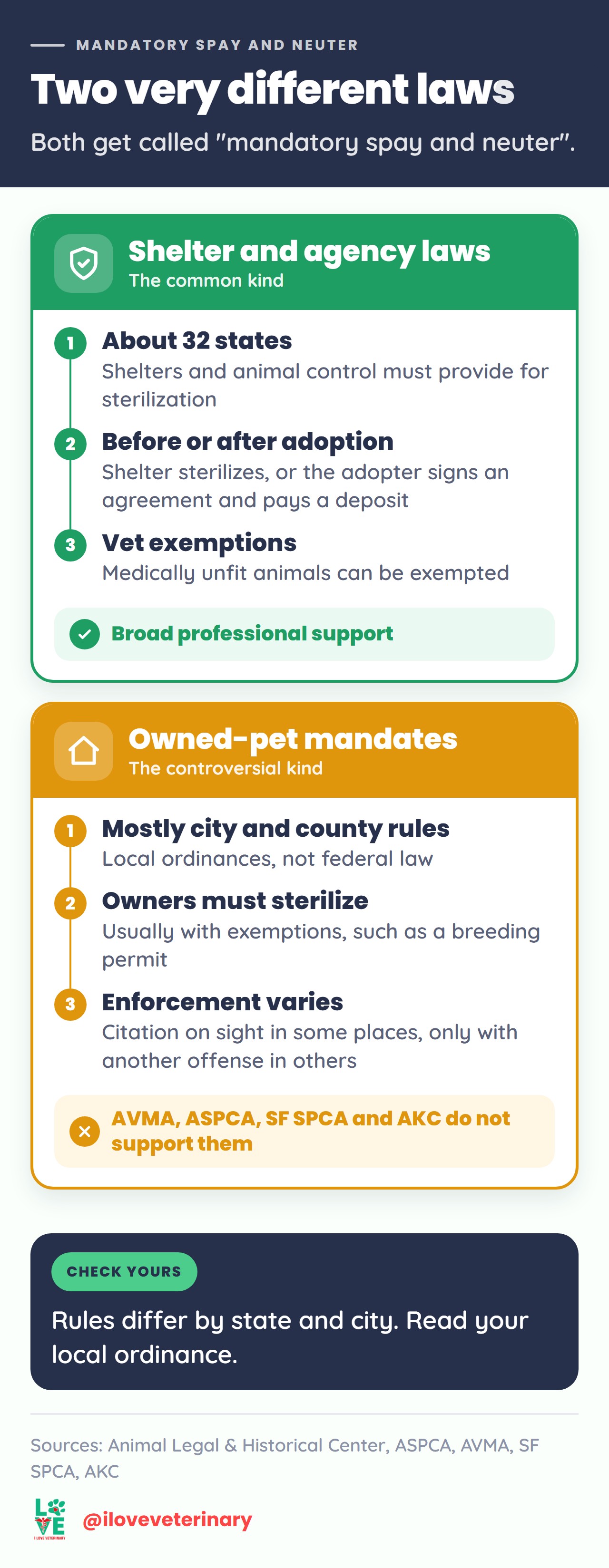
"Mandatory spay and neuter" covers two very different kinds of law.
Shelter and agency laws (the common kind). In about 32 states, per the Animal Legal & Historical Center, releasing agencies such as shelters and animal control must provide for sterilization of the dogs and cats they adopt out. If an animal goes home before surgery, the adopter usually signs an agreement to have it done by a licensed veterinarian by a deadline and pays a refundable deposit. Animals that are medically unfit for surgery can be exempted.
Owned-pet mandates (the controversial kind). These are mostly local ordinances that require owners to sterilize pets unless they qualify for an exemption, such as a breeding permit. The ASPCA points out that "mandatory" means different things in different places: in some communities a citation can follow for any unaltered animal over four months, while in others it only comes up when the owner is cited for something else.
Fines are the most common penalty, per the Animal Legal & Historical Center. Rules differ by state and city, so check your local ordinance.
The case for mandatory spay and neuter
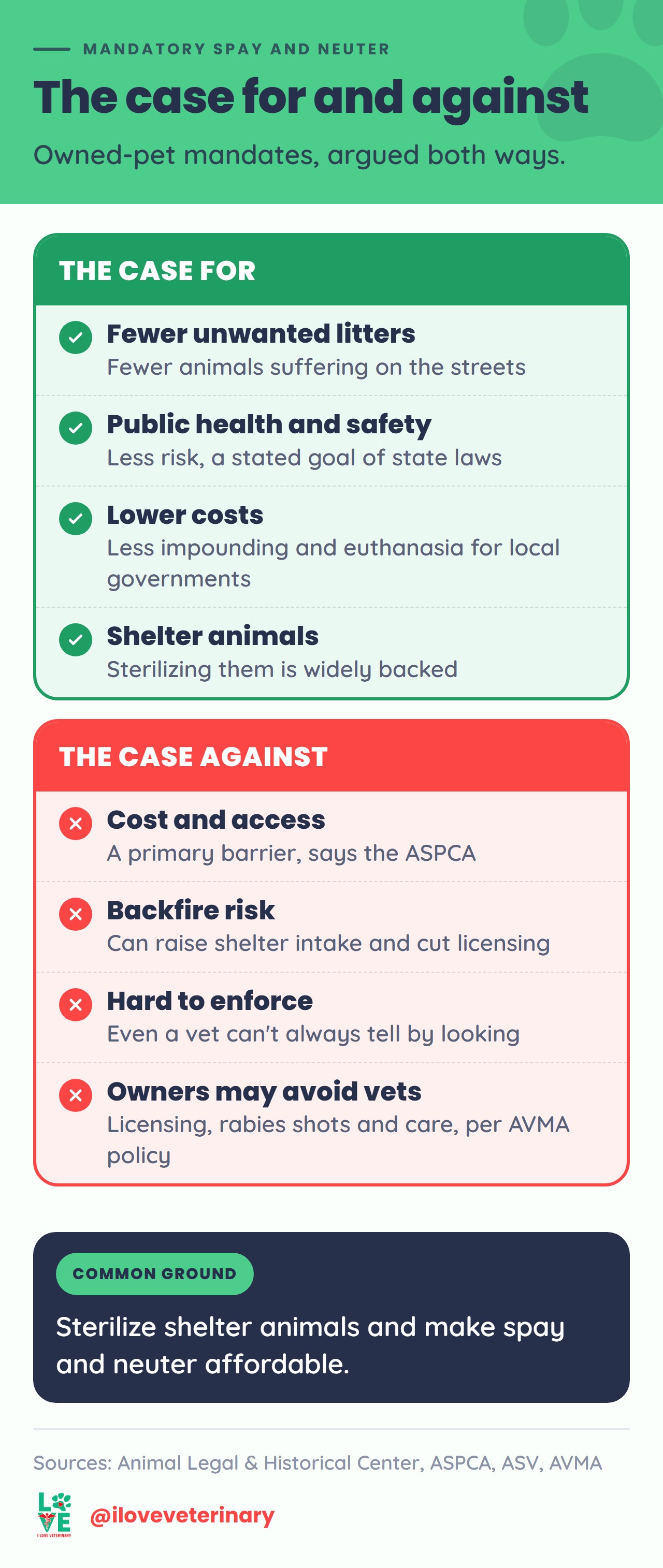
Supporters start from the shelter. The stated goals of state sterilization laws, as the Animal Legal & Historical Center summarizes them, are fewer unwanted animals suffering on the streets, less risk to public health and safety, and lower costs for local governments that impound and euthanize animals.
One kind of mandate has strong professional support. The Association of Shelter Veterinarians says shelters should sterilize all animals before adoption or make sure it happens after, and the ASPCA supports mandatory sterilization of shelter animals and of dogs and cats sold by pet stores.
Followers who said yes pointed to overcrowded shelters:
"...look at your local shelter and volunteer!!"
"I can only imagine how many resources would open up to help animals in need if everything wasn't overcrowded."
Some supporters wanted carve-outs:
"Proven reputable breeders should be exempt as well as some others that meet certain criteria. But overall YES."
The case against
Cost and access. The ASPCA calls cost one of the primary barriers to spay and neuter and notes that low household income is linked with having an intact cat. The SF SPCA, which performs thousands of spay and neuter surgeries a year, opposes mandates for exactly this reason: access is the real bottleneck.
Unintended consequences. The ASPCA warns that mandates can increase shelter intake and keep stray pets from going home when owners can't pay to have them altered. In at least one community with such a law, fewer pets were licensed afterward. AVMA policy raises a similar worry: owners may avoid licensing, rabies vaccination and veterinary care altogether.
Enforcement. Even a veterinarian can find it hard to tell by looking whether a female has been spayed, the ASPCA notes, so enforcement ends up uneven.
Choice and health. The American Kennel Club opposes laws that mandate spaying or neutering of dogs, saying the decision belongs to the owner and their veterinarian, partly because of research on timing.
Followers who said no:
"No. We need reputable breeders literally to continue to have dogs."
"Not healthy for the dogs, punishes good breeders and can wipe out endangered breeds."
"Don't like mandates. Making free spay/neuter would be better along with transportation for those who don't have any."
Do mandatory laws actually work?
The ASPCA says it is not aware of any credible evidence that a mandatory law covering all owned animals produces a statistically significant extra drop in shelter intake or euthanasia.
Measuring it is hard. Per capita shelter intake and euthanasia have been falling for years, and the ASPCA links that decline in part to more pets being sterilized voluntarily. To see what a law adds, you would need several years of data before and after it passed, compared with similar communities that have no such law. Dogs and cats also have to be counted separately, so falling dog numbers don't hide rising cat numbers. And owned-pet mandates do nothing about feral and unowned stray cats, who remain a substantial share of shelter cats.
What does have evidence behind it, according to the ASPCA: voluntary sterilization of owned pets, plus sterilizing at-risk groups such as shelter animals and feral cats.
What the research says about spay and neuter timing
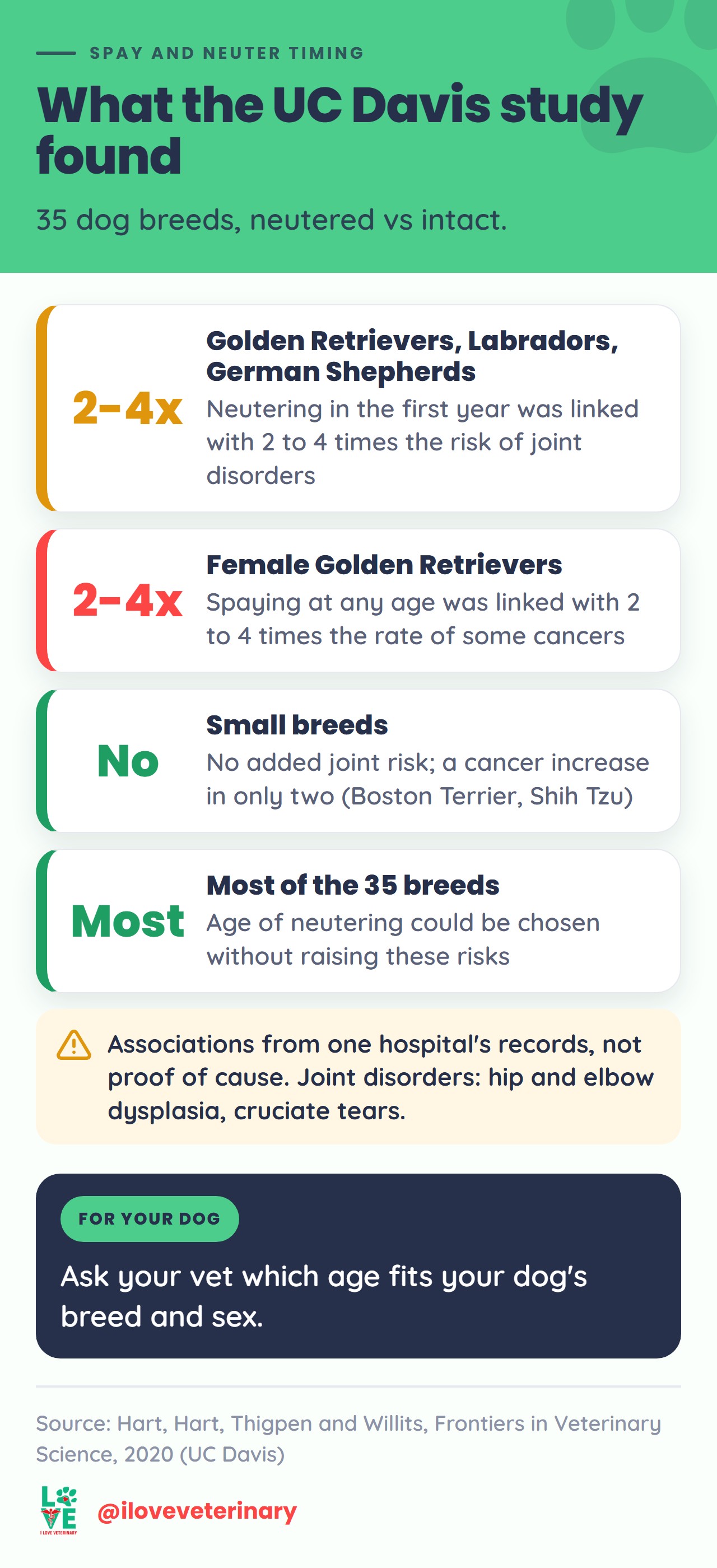
Some of the pushback against mandates is about age. The best-known work here comes from UC Davis: in a 2020 study of 35 dog breeds using the university's veterinary hospital records, Hart and colleagues found big differences between breeds:
- In Golden Retrievers, Labrador Retrievers and German Shepherds, neutering in the first year was linked with 2 to 4 times the risk of one or more joint disorders (hip dysplasia, cruciate ligament tears, elbow dysplasia) compared with intact dogs.
- In female Golden Retrievers, spaying at any age was linked with 2 to 4 times the rate of one or more of the cancers studied.
- Small breeds showed no added joint risk, and only two (Boston Terrier and Shih Tzu) showed a significant cancer increase.
- For most breeds, the authors concluded, the age of neutering can be chosen without raising the risk of these joint disorders or cancers.
These are associations, not proof of cause, and the authors name the limits: one hospital's records, 35 breeds, and no data on why owners chose to neuter or not.
Professional groups still back early sterilization. AVMA policy supports the concept of pediatric (early-age) spay and neuter in dogs and cats to reduce unwanted animals. AAHA supports neutering cats and dogs as young as eight weeks, while noting that early versus delayed sterilization has both positive and negative outcomes in some breeds. For cats not meant for breeding, the AAFP recommends spay or neuter by 5 months, because cats can start reproducing at 4 to 5 months.
The practical takeaway: for a shelter kitten or a small-breed puppy, timing is rarely a reason to wait. For a large-breed dog, ask your veterinarian which age makes sense for that breed and sex. Our guide to spay and neuter and why it matters covers the basics.
Where veterinary and shelter groups stand
Organization | Spay and neuter | Blanket mandate for owned pets | Shelter animals |
|---|---|---|---|
AVMA (veterinarians) | Supports, including pediatric spay/neuter | Does not support | Not addressed |
AAHA (animal hospitals) | Supports, as young as eight weeks | Not addressed | Not addressed |
AAFP (feline practitioners) | Cats not for breeding by 5 months | Not addressed | Not addressed |
Association of Shelter Veterinarians | Supports | Not addressed | Sterilize before adoption or ensure it after |
ASPCA | Strongly supports | Does not support | Supports mandatory sterilization |
SF SPCA | Strongly supports | Does not support | Not addressed |
American Kennel Club | Owner and vet decide | Opposes | Not addressed |
Each row comes from the organization's published position, listed under Sources. "Not addressed" means the statement we read takes no position on that point. The SF SPCA also names the AVMA, the ASPCA and Best Friends Animal Society among the groups that oppose mandates in favor of better access.
What our followers said

We asked the question on our Facebook page and counted the 174 comments that took a clear or mixed stance. It isn't a scientific survey, since the people who comment pick themselves. Still, the shape is telling. The yes side (44.3%) talked about overcrowded shelters. The no side (36.2%) worried about breeders, dog health and mandates themselves. The mixed group (19.5%) liked the goal but not the mechanics, and asked the questions any city council would have to answer:
"For whom? Who will enforce? Who will perform the procedures? Who pays?"
Cost came up again and again: one follower said more people would spay and neuter if it were within their financial reach. Another, who opposed mandates, wanted stricter breeding laws instead but agreed on this much:
"...every shelter pet/rescue everywhere needs to be altered."
That sums up the overlap: most "no" voices weren't against spay and neuter, only against forcing it on owners.
What works instead of a blanket mandate
The ASPCA and the SF SPCA point to the same toolkit:
- Make it affordable and easy to reach. Low-cost and subsidized clinics, convenient locations and help with transport. If cost is the problem, see our guide on what to do if you can't afford a vet.
- Sterilize shelter animals before adoption, as the Association of Shelter Veterinarians recommends.
- Trap-Neuter-Return (TNR) for community cats, the free-roaming and feral cats that owned-pet laws never reach.
- Use incentives instead of penalties. The ASPCA suggests, for example, waiving redemption fees when owners agree to free or low-cost spay or neuter for a stray pet they reclaim.
Our take
Spay and neuter works, and shelter animals should go home sterilized. That part has broad professional support and very little real disagreement. Blanket mandates for owned pets are a different matter: the evidence that they add anything is thin, the risk that they push poorer owners away from vets is real, and the money spent enforcing them would probably do more good funding low-cost clinics. For your own pet, the useful question isn't "is it the law?" but "when is the right time for this animal?", and that's a conversation for your veterinarian.
FAQ
Is spaying or neutering mandatory in the US?
Not nationally. In about 32 states the law covers shelters and agencies; a smaller number of cities and counties require owners to sterilize pets, usually with exemptions.
Do shelters have to spay or neuter before adoption?
In those states, yes, or the adopter signs an agreement and pays a deposit to have it done later. The Association of Shelter Veterinarians recommends it for all shelter animals.
Does early spay or neuter cause health problems?
In a few large breeds, UC Davis research links neutering in the first year with more joint disorders, and spaying female Golden Retrievers with more of certain cancers. For most breeds in the study, age made no difference, so ask your veterinarian about timing.
Why does the AVMA oppose mandates if vets support spaying?
AVMA policy says it does not support laws mandating spay and neuter of privately owned, non-shelter dogs and cats, out of concern that owners may then avoid licensing, rabies vaccination and veterinary care.
Sources
- ASPCA: Position Statement on Mandatory Spay/Neuter Laws
- AVMA: Dog and cat population management (policy)
- AVMA: Pediatric spay/neuter of dogs and cats (policy)
- JAVMA News: AVMA: Mandatory spay/neuter a bad idea
- AAHA: Pediatric neutering position statement
- AAFP: Pediatric sterilization in cats position statement
- Association of Shelter Veterinarians: Guidelines for Standards of Care in Animal Shelters, Shelter Surgery highlights
- American Kennel Club: Spaying and Neutering position statement
- Hart BL, Hart LA, Thigpen AP, Willits NH. Assisting Decision-Making on Age of Neutering for 35 Breeds of Dogs. Frontiers in Veterinary Science, 2020
- Animal Legal & Historical Center: Overview of State Spay and Neuter Laws
- SF SPCA: Position on Mandatory Spay/Neuter Laws
- I Love Veterinary on Facebook: follower comments on mandatory spay/neuter
This article is for general information and is not a substitute for advice from your veterinarian.