US studies show that veterinarians and veterinary technicians die by suicide more often than the general population. That finding is real and well documented. It is not a prediction about any one person, though. Risk builds when many things stack up, and support, connection and treatment lower it. Help is free, confidential and available today.
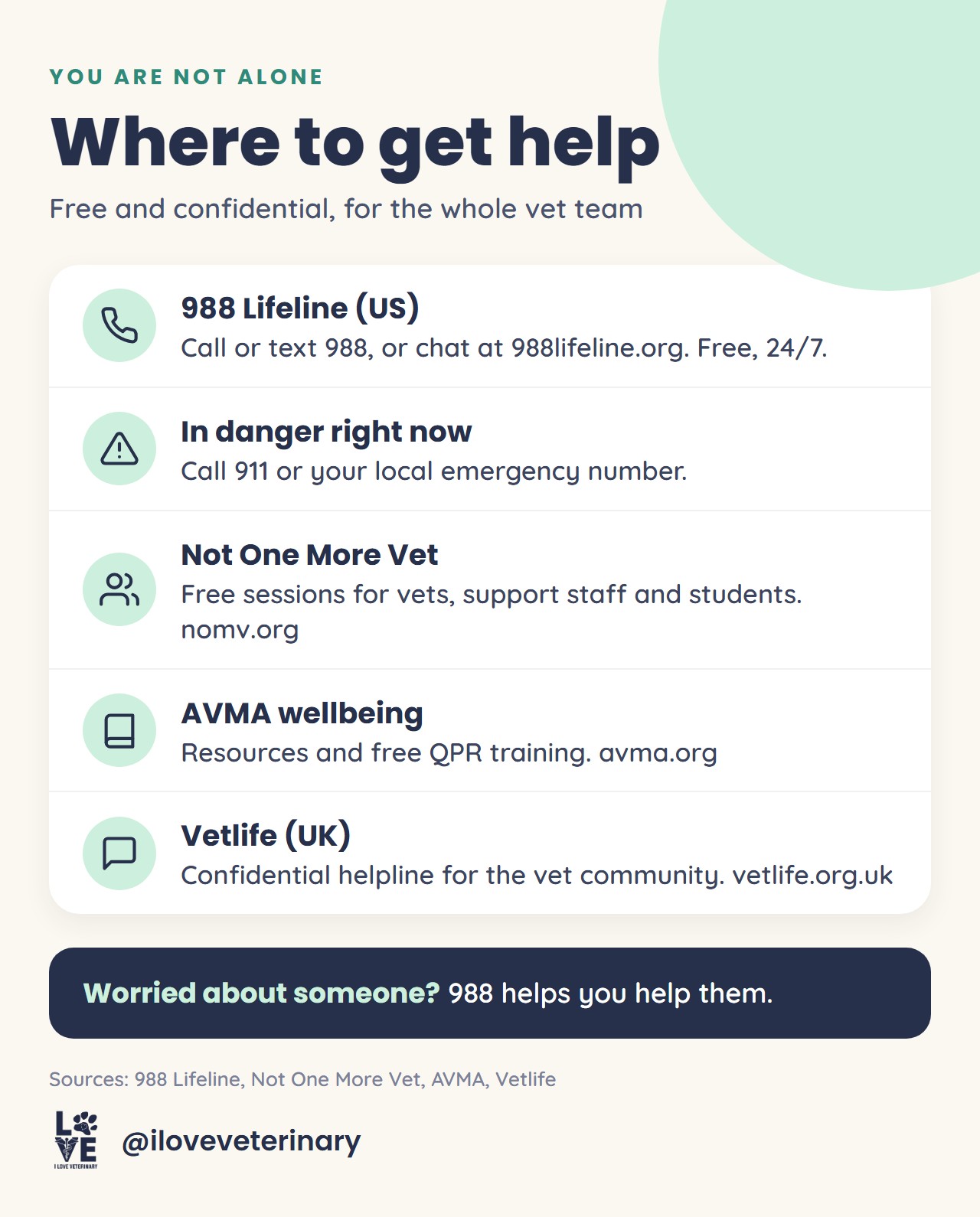
Need help now?
- 988 Suicide & Crisis Lifeline (US): call or text 988, or chat at 988lifeline.org. Free, confidential, 24/7. You can also reach out if you're worried about someone else.
- In immediate danger: call 911 (or your local emergency number).
- Not One More Vet: free, confidential Veterinary Mental Health Support sessions for veterinarians, support staff and students. Not a crisis service.
- AVMA: wellbeing and suicide prevention resources for the whole veterinary team.
- UK: Vetlife runs a confidential helpline for anyone in the veterinary community.
What the data says about veterinary suicide rates
Most of what we know about US veterinary professionals comes from two CDC-led studies published in JAVMA in 2019, plus surveys of how vets are doing day to day. Each one measured something slightly different, which matters when you compare them.
Study | Who and when | What it measured | Main finding |
|---|---|---|---|
Tomasi et al., JAVMA 2019 (CDC) | Death records of 11,620 US veterinarians who died from 1979 through 2015 | Share of deaths that were suicides, compared with the general population (PMR) | 398 deaths were suicides. The share was 2.1 times expected for men and 3.5 times for women |
Witte et al., JAVMA 2019 (CDC) | 197 veterinary professionals and 5 students in the National Violent Death Reporting System, 2003 through 2014 | Suicide deaths compared with the general population (SMR), by role | Veterinarians: 1.6 (men) and 2.4 (women). Vet techs and technologists: 5.0 (men) and 2.3 (women). Veterinary assistants and lab animal caretakers: not significantly higher |
Nett et al., JAVMA 2015 (CDC survey) | 11,627 US veterinarians, surveyed in 2014 | Psychological distress and suicidal thoughts | About 1 in 11 had serious psychological distress; about 1 in 6 had experienced suicidal thoughts since leaving vet school |
Perret et al., JAVMA 2020 | 1,403 Canadian veterinarians | Suicidal thoughts in the past 12 months | 26.2%, compared with an estimated 2.1% to 10% in the general population |
Platt et al., Occupational Medicine 2010 (systematic review) | 19 studies; UK veterinary surgeons in the better-quality studies | Suicide rate compared with the general population | At least three times the general population rate |
Two details from Tomasi et al. (2019) are worth knowing. The higher share held for veterinarians in clinical jobs (2.2 for men, 3.4 for women) and in nonclinical jobs (1.8 and 5.0). And 75% of the veterinarians who died by suicide were 65 or younger.
If you're a vet tech, Witte et al. (2019) is the study to read. It's the only US study here that looked at the whole team, and technicians and technologists had some of the highest figures in it.
How to read these numbers
- PMR vs SMR. A proportionate mortality ratio (Tomasi) compares what share of deaths were suicides. A standardized mortality ratio (Witte) compares suicide deaths with what you'd expect in a general population of the same age and sex. Both say "higher than expected", but they use different yardsticks, so don't line the numbers up side by side.
- The periods are older than they look. The newest US death data here ends in 2014 and 2015, even though the studies came out in 2019.
- Surveys aren't random samples. The Nett and Perret surveys relied on vets who chose to answer, so they describe the people who responded, not every vet.
- Higher risk is not destiny. These are group-level ratios. The American Foundation for Suicide Prevention (AFSP) notes that most people who actively manage their mental health conditions go on to engage in life.
Why is the risk higher? There's no single cause
The AFSP is clear that suicide has no single cause. It most often happens when stressors and health problems pile up together and leave a person feeling hopeless. Depression is the condition most often involved, and it frequently goes undiagnosed or untreated.
Research on vet teams points to several pressures that are common in the work:
- The demands of practice. In the 2014 CDC survey of more than 11,000 US vets (Nett et al., 2015), "demands of practice" was the most commonly reported stressor.
- Exhaustion and long hours. Merck Animal Health's fourth Veterinary Wellbeing Study (released 2024) names exhaustion as a major contributor to burnout on vet teams, and links long hours, a negative work environment and student debt with lower wellbeing. Our guide to burnout and compassion fatigue covers the signs of both.
- Stigma about getting help. Only 32% of vets in the same survey (Nett et al., 2015) agreed that people are sympathetic toward someone with a mental illness. That makes it harder to ask.
- The emotional weight of the work. Hard conversations with clients, difficult decisions and end-of-life care are part of the job, and clients don't always see how demanding it is.
General life events count too: relationship problems, money trouble, a loss, or someone else's suicide. None of these on its own explains why a person dies by suicide.
Warning signs in a colleague (or in yourself)
The AFSP lists warning signs that matter most when they're new or have changed, especially after a painful event, a loss or a hard case. Look for someone who:
- Talks about feeling hopeless, trapped, in unbearable pain, or like a burden to others
- Says they have no reason to live, or talks about wanting to die
- Pulls away from friends, family or the team
- Is drinking or using drugs more
- Sleeps far more or far less than usual
- Seems unusually irritable, anxious, ashamed or flat, or loses interest in things they used to enjoy
- Gives away things that matter to them, or reaches out to say goodbye
- Seems suddenly calm or relieved after a very hard stretch
What to do if you're worried about someone
Anyone on the team can help, counselor or not. It comes down to asking, listening and connecting them with support.
- Ask directly. "Are you thinking about suicide?" Plain words are clearer than hints.
- Listen without fixing. Let them talk. Don't argue with how they feel or rush to solutions.
- Stay with them if you think they're in danger, and call 988 or 911 together. 988 also supports people who are worried about someone else.
- Connect them to help. 988, their doctor or therapist, an employee assistance program if your practice has one, or NOMV's support sessions.
- Check in again. Keep the door open in the days that follow.
The AVMA offers free QPR suicide prevention training (Question, Persuade, Refer) to anyone in the veterinary community. It takes about an hour online, and it's worth doing as a team.

What helps: protective factors
The AFSP also names protective factors, the things that lower risk. Most of them can be built by a person or a team:
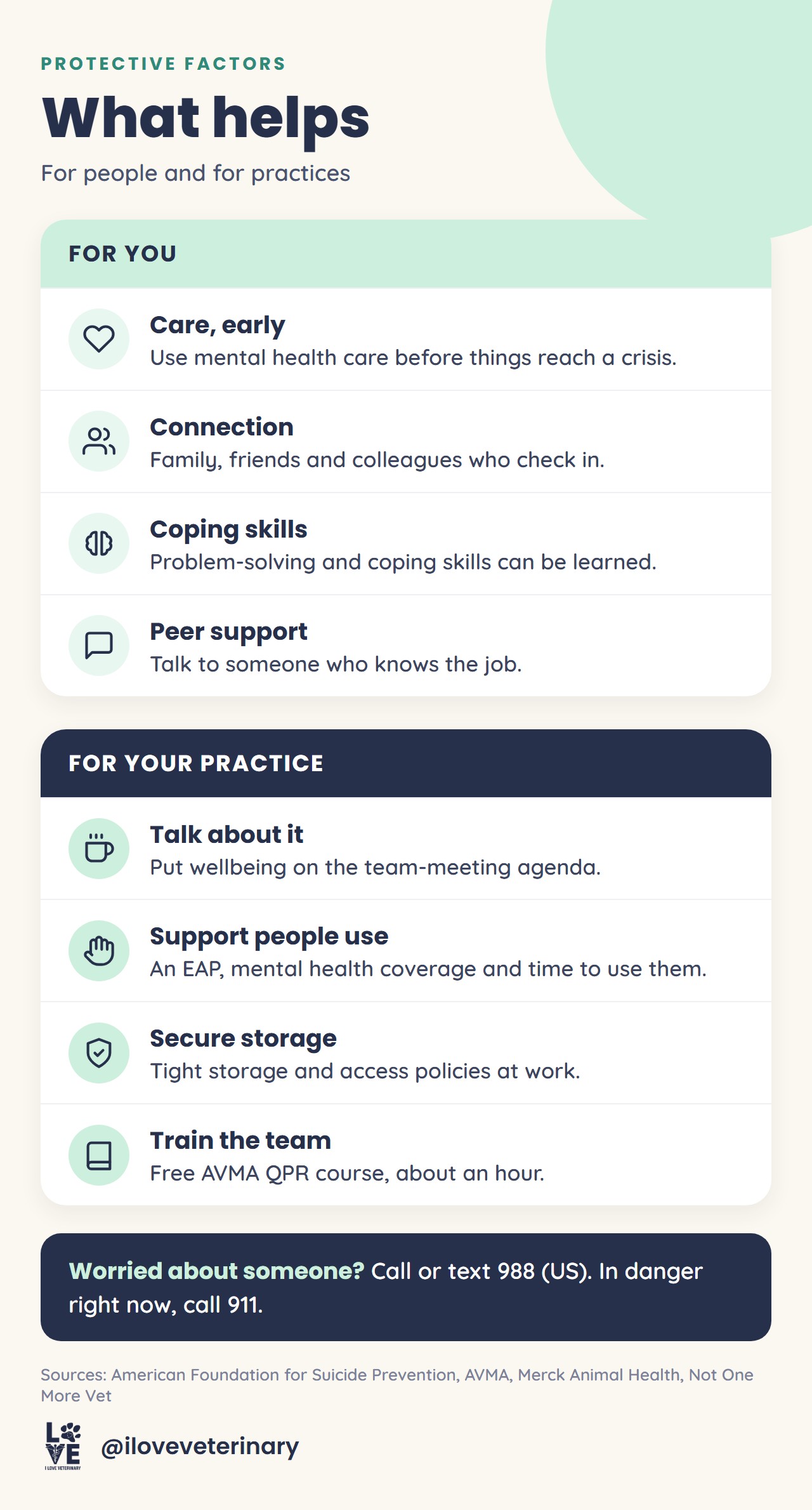
- Mental health care used early, before things reach a crisis
- Connection: family, friends and community, and at work, colleagues who check in
- Problem-solving and coping skills, which can be learned alone or with a counselor or support group
- Limited access to lethal means, at home and at work
- Beliefs and communities that encourage help-seeking, and a sense of purpose
In vet medicine, peer support adds something specific: talking to someone who knows what a bad shift feels like. That's the idea NOMV was built on.
What veterinary practices can do
Individual coping only goes so far if the workplace stays the same. In Merck Animal Health's fourth Veterinary Wellbeing Study (released 2024), only 36% of vet team members said wellbeing and mental health are discussed openly in team meetings (somewhat or to a great extent), and 38% of clinics offered an employee assistance program (EAP). There is plenty of room to do better on both.
Practical steps, drawn from AFSP, AVMA, Merck and NOMV guidance:
- Talk about it. Put wellbeing on team-meeting agendas, share where to get help, and post 988 where staff can see it.
- Offer support people can use. An EAP, mental health coverage, and time off to use them.
- Fix the workload where you can. Enough time per appointment, realistic schedules, real breaks.
- Build a respectful culture. Trust, candid communication, staff input that's acted on, and clear limits on how clients may treat the team.
- Keep secure-storage and access policies tight. Limited access to lethal means is a protective factor. Witte et al. (2019) concluded that veterinarians' higher risk might be attributable to access to lethal means at work, and called better administrative controls a promising prevention strategy.
- Train the team. AVMA's free QPR course, so more people know how to ask and refer.
- Use a framework. NOMV's CLEAR Blueprint is a certification program that helps practices build a mentally healthy workplace.
For the leadership side of this, see our guide to veterinary practice management.
Not One More Vet: who they are and what they offer
Not One More Vet (NOMV) began on October 1, 2014, when Dr. Nicole McArthur started a Facebook group where veterinary friends could talk honestly about the job, after the death of Dr. Sophia Yin. It became a 501(c)(3) nonprofit in 2017, and NOMV says its forum now has around 40,000 veterinary professionals.
NOMV's stated mission is to transform the status of mental wellness in the profession so veterinary professionals can survive and thrive, through education, resources and support. Its programs, as listed on nomv.org:
- Veterinary Mental Health Support (VMHS). Free, confidential, virtual one-hour sessions with trained clinicians who know veterinary work, up to eight per calendar year, plus process and psychoeducational groups. Open to veterinarians, support staff and students. VMHS is not therapy and not a crisis service; in a crisis, call 988 or 911.
- Peer forums. Online communities where vet professionals support each other.
- Education and outreach. Talks and workshops on veterinary wellbeing, and an international outreach project.
- Grants. Support grants for people who work, or worked in the past six months, in veterinary medicine and face financial hardship (housing, groceries, mental health care or transportation), and emergency grants for practices hit by a disaster. Details are on the NOMV grants page.
- CLEAR Blueprint. The workplace certification program mentioned above.
- A peer-vetted resource list of mental health services that understand veterinary work.
Frequently asked questions
Do veterinarians have the highest suicide rate of any profession?
The studies above compare veterinary professionals with the general population, not with every other job, so they can't rank professions. What they do show, across several countries, is a higher risk than the general population.
Are vet techs at risk too?
Yes. In Witte et al. (2019), male vet techs and technologists had a suicide SMR of 5.0 and female techs 2.3, both significantly higher than the general population. The authors noted that techs probably need different prevention strategies than veterinarians.
Is NOMV only for veterinarians?
No. NOMV's VMHS sessions and groups are open to veterinarians, veterinary support staff and veterinary students.
What should I say to a colleague I'm worried about?
Ask directly whether they're thinking about suicide, listen, and help them reach 988, their doctor, an EAP or NOMV. If they may be in danger now, stay with them and call 988 or 911.
You don't have to carry this alone

If you're struggling, reach out today.
- Call or text 988 (US), or chat at 988lifeline.org. Free, confidential, 24/7.
- In immediate danger: 911.
- Book a free NOMV support session.
- Explore the AVMA wellbeing resources.
- UK: contact Vetlife for confidential support.
People in this profession spend their days caring for animals and the people who love them. You deserve the same care.
Sources
- Tomasi SE et al. Suicide among veterinarians in the United States from 1979 through 2015. JAVMA, 2019
- Witte TK et al. Suicides and deaths of undetermined intent among veterinary professionals from 2003 through 2014. JAVMA, 2019
- Nett RJ et al. Risk factors for suicide, attitudes toward mental illness, and practice-related stressors among US veterinarians. JAVMA, 2015
- Perret JL et al. Prevalence of mental health outcomes among Canadian veterinarians. JAVMA, 2020
- Platt B et al. Systematic review of the prevalence of suicide in veterinary surgeons. Occupational Medicine, 2010
- American Foundation for Suicide Prevention: Risk factors, protective factors, and warning signs
- Merck Animal Health: Fourth Veterinary Wellbeing Study (2024 release)
- AAHA NEWStat: Documentary highlights prevalence of suicide in veterinary professionals
- 988 Suicide & Crisis Lifeline
- Not One More Vet: Our story and mission
- Not One More Vet: Peer support and VMHS
- Not One More Vet: Grants
- Not One More Vet: CLEAR Blueprint
- AVMA: Wellbeing resources
- AVMA: QPR suicide prevention training
- Vetlife
- Reporting on Suicide: Recommendations
This article is for general information and is not a substitute for advice from a doctor or mental health professional.