
Veterinary practice management is the business side of running a clinic: people, schedules, clients, inventory and money, handled so the doctors and techs can stay focused on patients. The person who does it may be called an office manager, a practice manager or a hospital administrator, and the top credential for the job is the CVPM from the Veterinary Hospital Managers Association (VHMA).
Our author, Amanda Kuster, came to it sideways. She spent time in large animal sports therapy, working on dogs, cats, horses and even elephants, and realized the part she enjoyed most was the business side. Practice management let her keep animals in her life and build a career around running the place well. Plenty of managers arrive the same way: from the front desk, the treatment room or another industry entirely.
What does a veterinary practice manager do?
A practice manager works beside the owner and the veterinarians to keep the hospital running well. The job is leadership first: healthy ways of working, growing revenue, happy clients and enough cash in the bank.
It also means wearing a lot of hats. One day you are shut in the office closing out month-end before the deadline. The next you are covering reception, checking in patients, or helping hold a dog in the back because the team is short. In a small clinic the manager pitches in everywhere; a large hospital keeps the manager closer to planning, hiring and finance.
The work falls into five areas:
- Staffing and retention. Hiring, onboarding, schedules, payroll, reviews and conflict. Keeping good people takes clear schedules, fair workloads, real training and an open door: your team should know they can raise a concern and that their opinion counts.
- Scheduling and patient flow. Appointment templates, surgery days, walk-ins and emergencies all compete for the same doctors and rooms. A schedule that protects lunch breaks and closing time is a retention tool as much as an efficiency one.
- Client experience. Service standards, complaints, communication, support for grieving clients and marketing your practice.
- Inventory. Drugs, vaccines, food and supplies tie up cash. Track what you buy, sell and throw out, and set reorder points so the shelf is never empty and never overloaded.
- Finance. Budgets, pricing, payables and monthly reporting. You don't need to be an accountant, but you need to read a profit and loss statement and explain it to the owner. If you're helping build something new, our guide to starting a veterinary practice covers the setup side.
Practice manager vs office manager vs hospital administrator
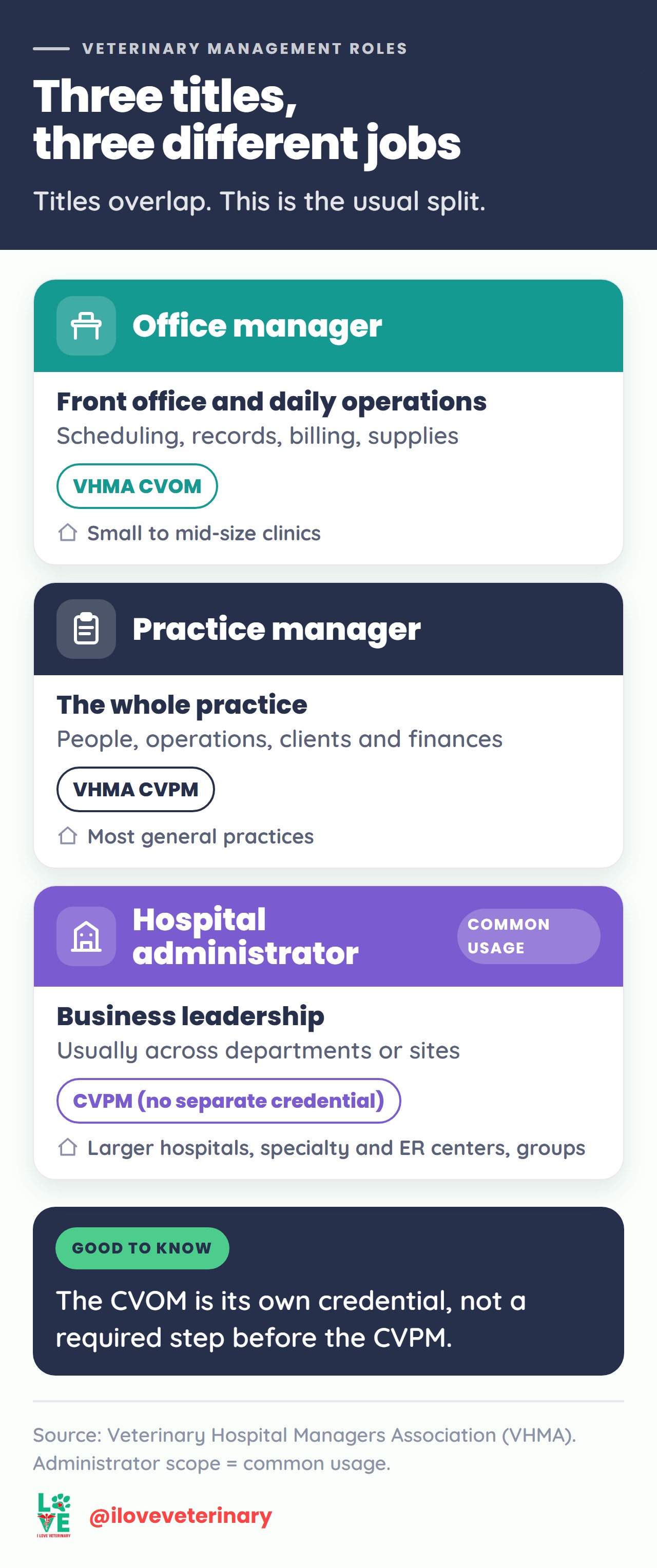
The titles overlap, and every practice uses them a little differently. VHMA draws the clearest line between the first two: an office manager's knowledge "focuses more on clerical and operational functions within the office," while a practice manager "typically requires a deeper and broader educational background," according to VHMA's guide to its credentials. Hospital administrator is a separate title in VHMA's pay survey, but VHMA doesn't define it. It is commonly used to mean the business lead of a larger hospital.
Office manager | Practice manager | Hospital administrator | |
|---|---|---|---|
Focus | Front office and daily operations: scheduling, records, billing, supplies | The whole practice: people, operations, client experience and finances | Business leadership, usually across departments or sites (common usage) |
Typical setting | Small to mid-size clinics, or under a practice manager | Most general practices | Larger hospitals, specialty and emergency centers, groups |
Matching VHMA credential | CVOM (Certified Veterinary Office Manager) | CVPM (Certified Veterinary Practice Manager) | No separate credential; the CVPM is the top VHMA credential |
If you're a tech or receptionist thinking about the move, the office manager role is often the first rung. Our guides to the vet tech career and the veterinary receptionist role show where those jobs overlap with management.
How to become a veterinary practice manager
There's no license for this job and no single required path. What you need is veterinary experience plus business skill, and the CVPM spells out the standard well.
The common routes in:
- Promotion from inside. Techs, receptionists and client service leads move into office manager or assistant manager roles, then take on more of the business side.
- Business background first. People with management, HR or accounting experience come in and learn the veterinary side on the job.
- Education alongside work. Many managers take management-related college courses while employed, because the CVPM asks for 18 semester hours of them.
Courses, degrees and CE. You'll find veterinary practice management certificate programs online and at community colleges, general business degrees, and CE from associations and conferences. None of these alone makes you a certified manager. When you compare programs, check whether the credits are college semester hours in subjects VHMA counts toward the CVPM, and whether the CE is management-focused. VHMA also runs a Rising Manager Training Program for people new to management or preparing for a promotion.
The CVPM: requirements, exam and recertification
VHMA calls the Certified Veterinary Practice Manager (CVPM) "the highest level of credential for professional veterinary managers," and the program is accredited by the NCCA, the accreditation arm of the Institute for Credentialing Excellence (VHMA: About Certification).
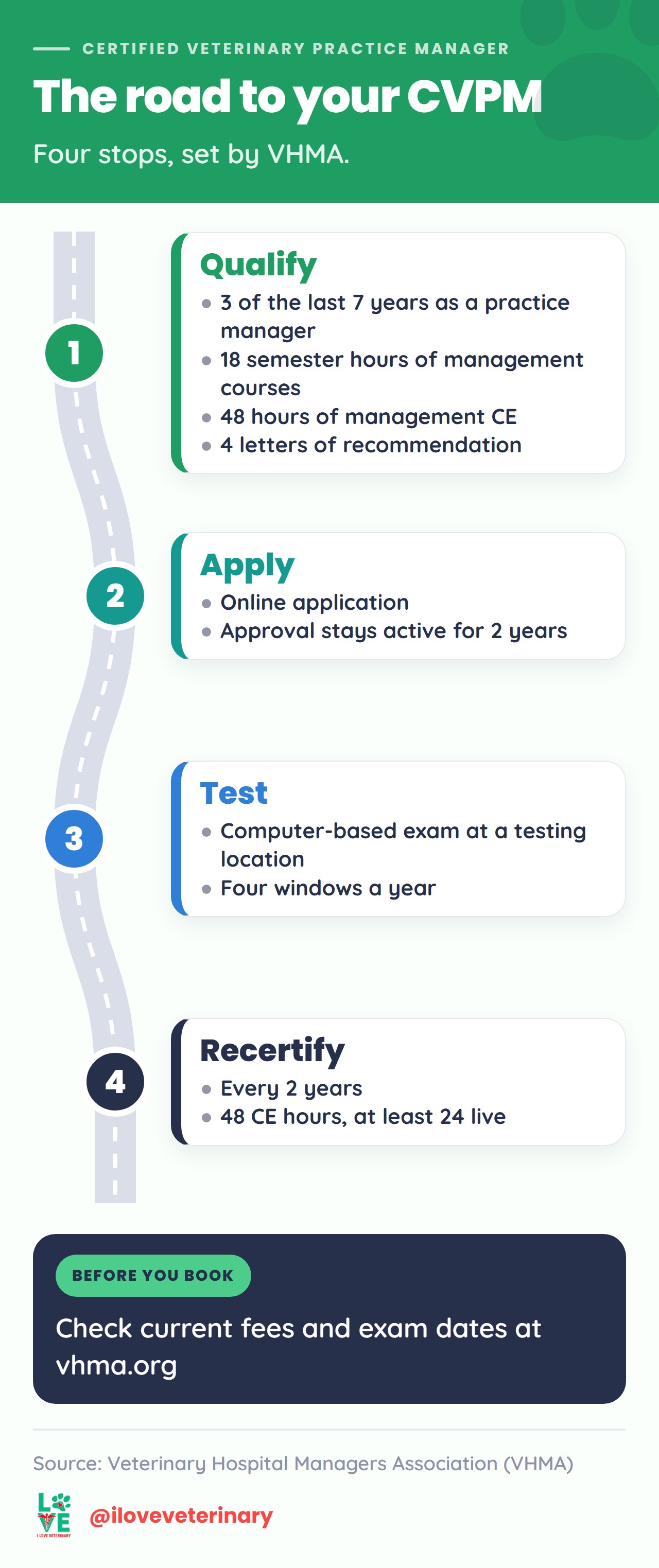
Step 1: Qualify. Per VHMA's eligibility page, you need all of these:
- At least 3 years of active employment as a practice manager within the last 7 years, responsible for 26 of the 30 duties VHMA lists.
- 18 semester hours of management-related college courses, in subjects such as accounting, economics or finance, computer science, marketing, management, labor relations or human resources, and law or taxation.
- 48 hours of continuing education specifically devoted to management.
- 4 letters of recommendation.
Step 2: Apply. Submit the online application with your documents. VHMA doesn't process it until the exam fee is paid, and an approved application stays active for two years. Fees differ for members and non-members; check the current amounts on the exam dates and fees page.
Step 3: Take the exam. The exam is computer-based and given at secure testing locations across North America, in four windows a year. VHMA says the whole process typically takes one to two months, sometimes longer. Its free study guide and reading list includes the test blueprint, and VHMA also sells a prep workbook and a facilitated test-prep program (preparing for the exam).
Step 4: Recertify. The CVPM renews every two years. You need 48 CE hours per cycle, at least 24 of them from live, in-person events (VHMA recertification).
The experience requirement is the part people underestimate. Three years as the person actually responsible for most of those 30 duties is the real gate, so ask your owner for ownership of budgets, hiring and policies early, not just the title.
Not there yet? VHMA's CVOM asks for 1 year of practice management experience in select duties and 2 letters of recommendation. It's an independent program, not a step you must complete first, but it's a sensible milestone for office managers.
Veterinary practice manager salary
The most useful pay data comes from VHMA's own managers compensation survey, which runs every two years. In the VHMA compensation survey, 2021 data (388 manager responses), the median salary was $60,000 for practice managers and $75,000 for hospital administrators, and practice managers with a CVPM were the top earners among practice managers.
Those figures are several years old, and pay varies by region, practice size and responsibility. VHMA publishes newer editions for members, so if you're negotiating, the current report for your region is worth more than any national median.
KPIs veterinary practice managers track
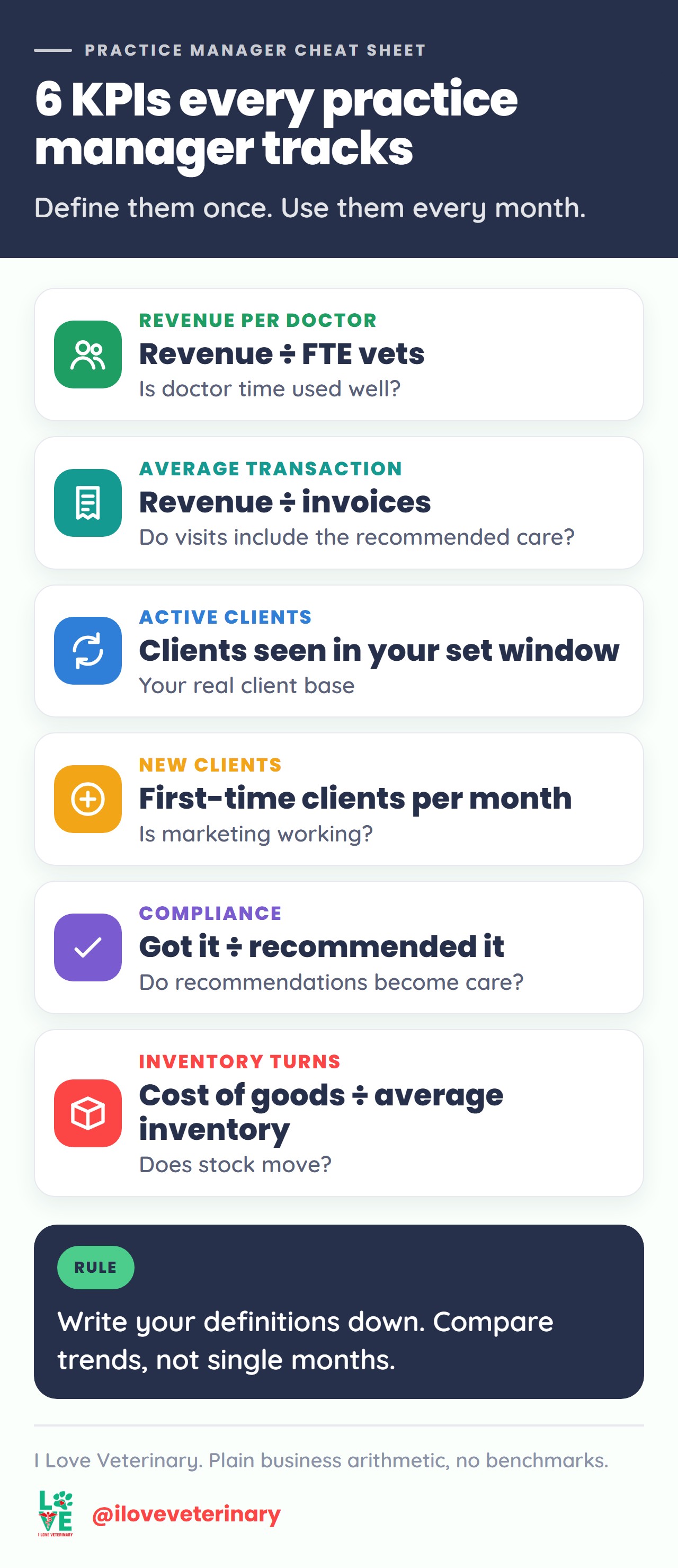
KPIs (key performance indicators) turn a busy month into numbers you can act on. These six make a solid core set, and none needs more than simple division.
KPI | How to calculate it | What it tells you |
|---|---|---|
Revenue per doctor | Gross revenue ÷ full-time-equivalent (FTE) veterinarians, for the same period | Whether doctor time is booked and used well |
Average transaction (ACT) | Total revenue ÷ number of invoices | Whether visits include the care that was recommended |
Active clients | Clients with a visit or purchase within your chosen window | The real size of your client base |
New clients | First-time clients per month | Whether marketing and referrals are working |
Compliance | Patients who received a recommended service ÷ patients it was recommended for | Whether recommendations turn into care |
Inventory turns | Cost of goods sold ÷ average inventory value, for the same period | Whether stock moves or sits on the shelf |
Define it before you compare it. "Active client" has no single standard: practices pick different time windows, and some count any purchase, even food. The same goes for whether revenue per doctor includes product sales. Define your window, write it down and keep it consistent every month. A number compared against a benchmark built on a different definition is worse than no number at all.
Watch trends, not single months. A dip in average transaction after a new doctor starts, or rising inventory with flat sales, is worth a conversation. One slow month usually isn't.
Team culture and wellbeing
Your staff are your teammates, working toward the same goals. Everyone should understand and value the practice's mission statement, and the manager keeps it alive in schedules, policies and daily decisions.

Practical places to start:
- Recognition. Small, regular thanks beat one big party. Matching team shirts or hoodies for Vet Tech Week or a practice anniversary are a simple way to show people they belong; we take team and bulk orders for exactly that.
- Lower-stress handling. Training like Fear Free certification helps patients, clients and the people doing the restraint.
- Workload and burnout. Long days and hard cases wear people down. Our guide to burnout and compassion fatigue in veterinary medicine covers the signs and what helps.
A CDC-led study of US veterinarians found higher suicide rates than in the general population (Tomasi et al., JAVMA), and a manager can make help easy to reach. Our article on suicide risk and support for veterinary teams lists support resources. If someone on your team is struggling in the US, the 988 Suicide & Crisis Lifeline is available by call or text at 988.
Practice management software and tools
Practice management software (PIMS) is the system the whole clinic runs on: appointments, patient records, invoicing, reminders and reporting. Many practices connect it to telemedicine, imaging and in-house lab equipment. Judge options against your own workflow, not a feature list:
- Can it report the KPIs above, with your definitions?
- Does it connect with your lab, imaging and payment systems?
- What do data migration, training and support look like?
- Can you export your own data if you leave?
Ask for a demo using a real day from your schedule, and talk to a practice of similar size that uses it.
Is veterinary practice management the right job for you?
You'll probably enjoy it if you like solving problems for people, can have a hard conversation calmly, and get as much satisfaction from a well-run day as from a saved patient. Days are rarely the same, you still see animals every day, and you help the doctors focus on what they're good at: medicine.
The hard parts are real too. Compassion fatigue reaches managers, and you'll carry the tough conversations with staff and clients. The best managers balance time on the floor with time in the office to regroup, and make sure they are around when the team is under the most pressure.
FAQ
What does CVPM stand for?
Certified Veterinary Practice Manager, a credential awarded by the Veterinary Hospital Managers Association (VHMA).
Can I earn the CVPM online?
You can complete much of the coursework and management CE online, but the CVPM exam itself is taken at a secure testing location, and the credential still requires three years of practice management experience.
Do I need a degree to be a veterinary practice manager?
No degree is legally required, but the CVPM asks for 18 semester hours of management-related college courses, so college coursework matters if you want the credential.
How many CE hours does a practice manager need?
For the CVPM: 48 hours of management CE to apply, then 48 CE hours every two years to recertify, with at least 24 from live, in-person events.
About the author

Amanda Kuster is a veterinary practice management professional sharing her passion and knowledge in veterinary medicine, management and animal welfare.
Originally written by Amanda Kuster. Updated by the I Love Veterinary editorial team.
Sources
- VHMA: About Certification (CVPM)
- VHMA: Earning Your CVPM
- VHMA: CVPM Examination Dates and Fees
- VHMA: Preparing for the CVPM Examination
- VHMA: CVPM Recertification
- VHMA: CVOM Certification
- VHMA: Start Your Journey
- VHMA: 2021 Managers Compensation and Benefits Survey Report
- Tomasi SE et al. Suicide among veterinarians in the United States from 1979 through 2015. JAVMA
- 988 Suicide & Crisis Lifeline