
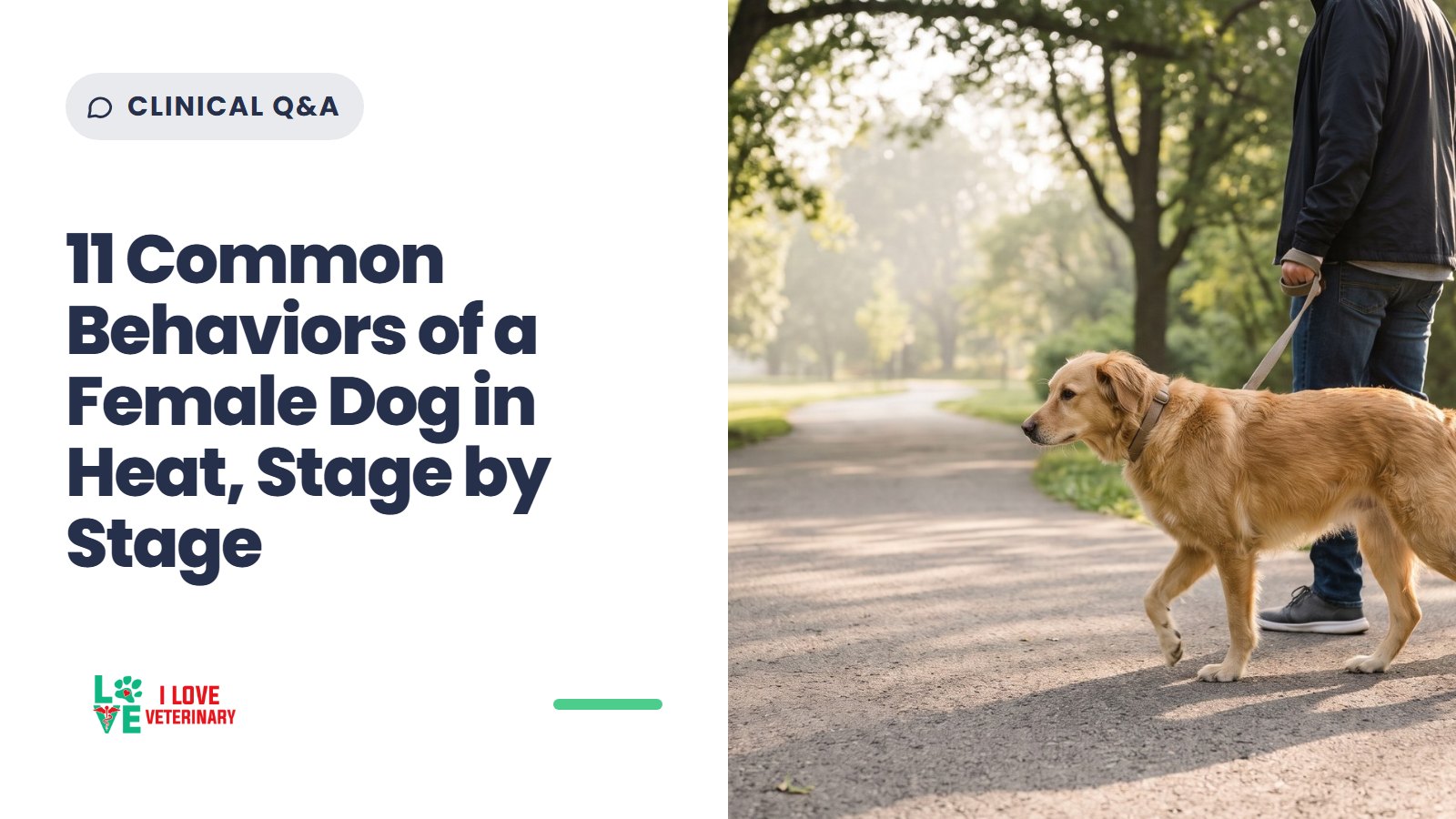
Your dog is suddenly licking herself more, leaving little puddles on every walk, and either glued to your side or pacing by the door. If she isn't spayed, heat is the first thing to suspect.
Heat is the fertile part of her reproductive cycle. Most owners first notice two things: a swollen vulva and a bloody discharge. Heat usually lasts about two to three weeks and comes back roughly every six to seven months, though both numbers vary a lot from dog to dog.
This guide matches each of the 11 behaviors to the stage of the cycle that causes it, then covers how to keep her safe and the signs, during or after a heat, that mean it's time to call your veterinarian.
What Does a Dog in Heat Mean?
A dog "in heat" is in the fertile phase of her estrous cycle, the hormonal cycle that prepares her body to mate and carry puppies. Vets also call it being "in season."
Two hormones drive almost everything you will see. Estrogen rises first: it swells the vulva, causes the bloody discharge and makes her attractive to male dogs. Then progesterone takes over around ovulation and stays high for about two months afterward, whether she is pregnant or not (Cornell University College of Veterinary Medicine). Those shifts change her body and her behavior.
When Do Dogs Have Their First Heat?
Most dogs have their first heat somewhere between 6 and 24 months of age. Size makes a big difference:
- Small breeds: often around 6 to 7 months, and occasionally as early as 4 months.
- Medium breeds: about 7 to 9 months.
- Large breeds: about 12 to 16 months.
- Giant breeds: sometimes not until 18 months to 2 years.
These figures come from the American Kennel Club, Cornell and VCA. They are averages, and individual dogs vary around them.
The first heat can be irregular, and it can take up to two years for a young dog's cycles to settle into a pattern (VCA). Some dogs also have a "silent heat": they ovulate, but the swelling and discharge are so slight that nobody notices. If your puppy is past the usual age and you have never seen a heat, mention it at her next checkup.
How Often Do Female Dogs Go Into Heat?
The average gap between heats is about seven months, with a normal range of 4 to 13 months (Merck). That works out to roughly two heats a year for most dogs.
- Small breeds may cycle up to three times a year.
- Giant breeds may cycle only once a year.
- Some breeds, such as the Basenji and the Tibetan Mastiff, typically cycle once a year (Cornell).
Dogs don't go through menopause the way women do (AKC). An unspayed female keeps coming into heat as she ages, so a senior dog can still get pregnant, and she stays at risk of the uterine infection covered further down.
How Long Does a Dog Stay in Heat?
Heat itself (proestrus plus estrus, the two stages when males are interested) averages about 18 days: roughly 9 days of each. Each of those stages can last anywhere from 3 days to 3 weeks, though, so a heat can be as short as about a week or as long as about six weeks (Merck Veterinary Manual).
The bloody discharge usually lasts 14 to 21 days (Cornell). It tends to lighten to pink or straw-colored as she becomes fertile. That is the stage where owners get caught out: lighter discharge does not mean the heat is over. It often means she is at her most fertile.
The Dog Heat Cycle Explained
The behaviors in the next section make far more sense once you know which stage she is in.
What Is the Dog's Heat Cycle?
The canine estrous cycle has four stages:
- Proestrus
- Estrus
- Diestrus
- Anestrus
The first three are the hormonally active part of the cycle. Anestrus is the quiet, resting part.

The wheel shows a typical cycle. Real dogs vary, so here are the ranges vets work with:
Stage | Typical length | What you see | Will she accept a male? |
|---|---|---|---|
Proestrus | About 9 days (3 days to 3 weeks) | Swollen vulva, bloody discharge, males interested | No |
Estrus | About 9 days (3 days to 3 weeks) | Discharge lighter, pink or straw-colored; tail held to the side | Yes, this is the fertile window |
Diestrus | About 2 to 3 months if not pregnant | Discharge stops, vulva shrinks back; false pregnancy possible | No |
Anestrus | 1 to 6 months | No outward signs | No |
Ranges from the Merck Veterinary Manual and Cornell University.
Proestrus
Proestrus is the start of heat. Rising estrogen swells the vulva and brings on a bloody discharge. Males find her very interesting, and she may play and flirt with them, but she won't let them mate yet (Cornell, Merck). On average it lasts about 9 days.
Estrus
Estrus is the fertile stage, when she becomes receptive and will stand for a male. Ovulation happens during this stage. The discharge often fades to pink or straw-colored but may not stop completely. Merck puts the average at about 9 days; Cornell describes 5 to 9 days as usual, with a possible range of 1 to 20 days.
She can get pregnant at any point in estrus, because sperm can survive in her reproductive tract for about a week (VCA). She can also mate with more than one male, and a single litter can have more than one father: in one study of planned two-sire breedings, about 3 in 10 litters did (Hollinshead and colleagues, 2020).
If she does get pregnant, pregnancy lasts about 60 to 63 days (Merck Veterinary Manual).
Diestrus
Diestrus starts when she stops accepting males. Progesterone stays high for about two months whether or not she is pregnant, and males gradually lose interest. Without a pregnancy, diestrus usually lasts 2 to 3 months (Merck).
Because her hormones look like pregnancy hormones, this is when false pregnancy (pseudopregnancy) shows up. It is common in female dogs and appears at the end of the heat cycle. A dog with a false pregnancy may gain weight, develop swollen mammary glands, make milk, build a nest, "mother" toys or shoes, guard them and go off her food (Merck Veterinary Manual). It usually settles on its own within 1 to 3 weeks. Your veterinarian can rule out a real pregnancy, and Merck advises against milking her glands. More on this in our guide to pseudopregnancy in dogs.
Anestrus
Anestrus is the resting stage. The ovaries go quiet and the uterus repairs itself, which takes about four months (Cornell). She neither attracts males nor accepts them. Anestrus normally lasts 1 to 6 months, and then the cycle starts again with proestrus (Merck).

11 Common Behaviors of a Female Dog in Heat
Hormones change how she acts as well as how she looks, and each behavior below belongs to a particular part of the cycle. Not every dog shows all 11. Temperament, age and breed all change the picture.

1. Bloody Discharge and Inflammation of the Vulva
When: proestrus, often continuing more lightly into estrus.
These are the two signs most owners spot first. Estrogen swells the vulva and causes a red, bloody discharge from the uterus. The swelling isn't always obvious, and in some dogs the discharge is light enough to miss (VCA).
As she moves into estrus, the discharge usually turns pink or straw-colored and the vulva softens. Don't treat that change as the all-clear: it is the fertile window. Once diestrus begins, the swelling goes down and the discharge stops (AKC).
2. Excessive Licking
When: throughout heat.
More licking of her genital area is a normal part of heat (AKC). Most of it is her keeping herself clean.
Keep an eye on the calendar, though. Heavy licking with a smelly or pus-like discharge weeks after a heat has ended is a different story: it is one of the warning signs of pyometra (see "When to Call Your Vet" below).
3. Change in Urination Habits
When: mostly proestrus and estrus.
A female in heat often urinates more often than usual, or leaves small amounts on objects to mark them. Her urine carries pheromones and hormones that tell other dogs where she is in her cycle and draw in males (VCA). AKC notes the extra urination is especially noticeable around male dogs.
If the frequent urination carries on after her heat has ended, have your vet check her.
4. Getting Friendlier With Other Dogs
When: flirting in proestrus, accepting males in estrus.
In proestrus she is attractive to males and may play with them, but she won't let them mate (Cornell). In estrus that changes: she becomes receptive and will let a male approach, sniff and mount her (Merck).
Once diestrus begins she turns males down again and they lose interest (Merck).
5. Change in Posture and Tail Position
When: estrus.
A receptive female signals it with her body. She may stand still when a male approaches, and she often moves her tail to one side. This is known as "flagging" (AKC). Standing to be mounted is one of the clearest signs that she is in estrus; when it stops, she has moved on to diestrus (Cornell).
If you see flagging, assume she can get pregnant that day, even if the discharge has nearly gone.
6. Mounting and Humping
When: most often around estrus.
Mounting isn't only a male behavior. Hormonal changes in heat can bring on mounting (AKC), so she may mount other dogs, toys, cushions or your leg. Since hormones are behind it, redirect her calmly with a toy or a short training game rather than scolding her.
7. Anxiety, Agitation, and Nesting
When: restlessness during heat; nesting toward the end of the cycle.
Many dogs get restless during heat. Increased anxiety is one of the hormone-driven changes AKC lists: pacing, panting, trouble settling, sticking to you one minute and hiding the next.
Nesting usually comes later. After the heat ends, high progesterone can trigger a false pregnancy, and she may gather blankets or toys into a quiet spot such as a closet or under the bed and guard them (Merck). If she makes milk, builds a nest and won't eat, or she seems unwell, ask your veterinarian to check her.
8. Seeking Out Male Dogs
When: estrus especially, and late proestrus.
The drive to find a mate is strong in estrus. She may pull toward other dogs on walks, hang around doors and gates, and try to slip out. Males are working on the problem from the other side: they can detect a female in heat from a long way off (VCA) and may turn up at your fence.
Good training is not enough to override this. Treat every door, gate and loose leash as a possible escape route until her heat is fully over.
9. Reluctant Eating
When: during heat, and with false pregnancy afterward.
A dip in appetite is common during heat (AKC), and dogs with a false pregnancy may also refuse food (Merck). Keep offering her normal meals on her usual schedule.
Appetite is also the sign to watch weeks later. A dog who goes off her food in the month or two after a heat, especially if she is also tired, thirsty or vomiting, needs a vet the same day.
10. Mood Swings
When: throughout heat, and in false pregnancy.
Her personality may wobble. One day she is extra affectionate, the next she is short-tempered with the other pets or just wants to be left alone. That fits the anxiety and behavior changes AKC links to heat hormones. In a false pregnancy some dogs also guard toys as if they were puppies (Merck), so take care reaching for them.
Give her space, keep the routine steady and supervise her with children and other dogs.
11. Being More Vocal
When: during heat.
More whining, howling or barking is another hormone-driven change (AKC). Some dogs vocalize at windows or doors when they sense males outside. Extra leashed walks in quiet places and something to chew can help her settle.
How Do You Take Care of a Dog in Heat?
Preventing an accidental litter is harder than it sounds. She is motivated, the males nearby are motivated, and a few minutes of freedom is enough.
Spaying
Spaying removes the ovaries and, in many cases, the uterus. It ends heat cycles for good, prevents unplanned litters and prevents pyometra (Cornell). Leaving a female intact also carries risks of ovarian, uterine and mammary tumors and ovarian cysts (Merck).
When to spay is a conversation with your veterinarian, not a fixed age. Merck states there is no consensus on the best age for spaying. Your vet will weigh her breed, expected adult size and health, because spaying also has documented downsides in some dogs, such as estrogen-responsive urinary incontinence (Merck). AKC's experts likewise say the decision should be made individually with your vet.
If she is in heat right now, Cornell advises waiting about two months after the cycle ends before spaying her.
Outdoors
- Keep her on a leash every time she goes out. Even a dog with great recall can bolt when hormones take over (AKC).
- Never leave her alone in the yard, even for a minute. Males can get in and she can get out.
- Skip dog parks and busy dog areas until her heat has fully finished, and walk at quieter times and places.
- Make sure her ID tag and microchip details are current in case she does get loose.
Indoors
- Keep her apart from intact males, including male dogs in your own home, behind closed doors.
- Keep her in rooms that are easy to clean, and put washable covers or old towels on her bed and the furniture she uses.
- Dog diapers or heat pants help with the discharge, but they are not birth control. A diaper will not stop a determined male from mating with her (AKC). Choose a snug, absorbent size and change it often.
Keeping Her Calm
- Keep daily routines (meals, walks, bedtime) the same.
- Use extra play, chew toys and food puzzles to tire her mind, since off-leash runs are off the table.
- Keep the house quiet and give her a cozy spot she can retreat to.
- Be patient. Hormones are pushing her mood around.
If She Mated by Accident
Call your veterinarian the same day. Options to prevent or end an unwanted pregnancy are time-sensitive and only work within a short window after mating, and your vet decides which one is safe for her (AKC). Don't wait to "see if she's pregnant."
When to Call Your Vet
Heat itself is normal. These signs are not.
Call now (same day, or an emergency clinic after hours):
- In the month or two after a heat, she is lethargic, off her food, drinking and urinating more, vomiting, has a swollen belly, or has a pus-like or bloody discharge. These are the signs of pyometra, an infection of the uterus that can progress quickly to shock and death (Merck Veterinary Manual). Cornell calls it a medical emergency. It is most common in middle-aged and older unspayed females, but don't let her age stop you calling. Read more in What Is Pyometra?
- She mated with a male and you don't want puppies.
See your vet soon:
- Heat signs that last more than 40 days. That can point to an ovarian cyst that keeps estrogen high (Merck).
- Swollen tissue showing through the vulva during heat. This is usually vaginal overgrowth, which estrogen causes in some young dogs (Merck), but your vet should check it.
- A false pregnancy with milk, a nest and a dog who won't eat, or one that hasn't settled after a few weeks.
- Cycles that are suddenly very different from her usual pattern.
Mention at your next visit:
- A young dog well past the usual age with no heat you have noticed.
- Your plans for spaying or breeding, so you and your vet can choose timing that suits her.

FAQ
Do Female Dogs Have Periods?
Not in the human sense. The bloody discharge does come from the uterus, as a period does (Merck). The timing is what differs: a dog bleeds at the start of heat, before she ovulates, so the bleeding means she is about to become fertile.
Do Dogs Get Period Cramps?
Pain is not among the normal heat signs that Merck and the AKC describe. Restlessness, whining and a smaller appetite are common. A dog who seems to be in pain should see your vet, and a swollen belly after a heat can be a sign of pyometra, which needs a call the same day.
Do Male Dogs Go Into Heat?
No. Only females have a heat cycle. Intact males respond to a female's cycle rather than having one of their own.
How Do Male Dogs Know a Female Is in Heat?
By smell. Her urine carries pheromones and hormones that tell other dogs where she is in her cycle, and males can detect a female in heat from a long way off (VCA Animal Hospitals).
At What Age Should I Spay My Female Dog?
There is no single right age: Merck states there is no consensus, so your veterinarian will weigh her breed, adult size and health. If she is in heat now, Cornell advises waiting about two months after the cycle ends.
Originally written by Alianna Munakata. Updated by the I Love Veterinary editorial team.
Sources
- Merck Veterinary Manual: Breeding Management of Bitches
- Merck Veterinary Manual: Reproductive Management of the Female Small Animal
- Merck Veterinary Manual (Dog Owners): Reproductive Disorders of Female Dogs
- Merck Veterinary Manual: Cystic Endometrial Hyperplasia-Pyometra Complex in Small Animals
- Merck Veterinary Manual: Social Behavior of Dogs
- Cornell University College of Veterinary Medicine: Dog Estrous Cycles
- Cornell University College of Veterinary Medicine: Pyometra
- American Kennel Club: Everything You Need to Know About Dogs in Heat
- VCA Animal Hospitals: Estrous Cycles in Dogs
- VCA Animal Hospitals: Infertility in Female Dogs
- Hollinshead FK et al. Factors influencing parentage ratio in canine dual-sired litters. Theriogenology, 2020
This article is for general information and is not a substitute for advice from your veterinarian.