Yes, you can become a vet tech through an online program. AVMA's accreditation committee lists 13 distance education programs in veterinary technology, and their graduates can sit the same national exam as campus graduates. The catch: only the coursework is online. The hands-on skills happen in a real veterinary practice, under a mentor, and that part takes as much planning as picking the school.
Below you'll find every program on AVMA's distance list, how the clinical side works, what to ask before you enroll, and what comes after graduation. If you're still deciding whether the job is for you, start with our guide to becoming a vet tech and our rundown of what vet techs do on a normal shift.
AVMA-Accredited Online Vet Tech Programs
The AVMA Committee on Veterinary Technician Education and Activities (CVTEA) accredits vet tech programs in the US. Its list of distance education programs is the only list that matters for this decision. The table below copies it as AVMA listed it in November 2026, in AVMA's order. It is not a ranking, and we have no relationship with any of these schools.
School | Program (as AVMA lists it) | Location | Degree | AVMA status |
|---|---|---|---|---|
Appalachian State University | Veterinary Technology Program | Boone, NC | Bachelor of Science (Online Modality) | Initial accreditation |
Colby Community College | Veterinary Technology Distance Learning Program | Colby, KS | Associate of Applied Science | Full accreditation |
Dallas College | Veterinary Technology Distance Education Program | Lancaster, TX | Associate in Applied Science | Full accreditation |
Great Falls College/Montana State University | Veterinary Technician Program | Great Falls, MT | Associate of/in Applied Science | Initial accreditation |
Jefferson State Community College | Veterinary Technology Distance Education Program | Birmingham, AL | Associate in Applied Science | Full accreditation |
Murray State College | Veterinary Nursing Distance Education Program | Tishomingo, OK | Associate in Applied Science | Full accreditation |
Nebraska College of Technical Agriculture | Veterinary Technology Program | Curtis, NE | Associate of Applied Science | Full accreditation |
Northern Virginia Community College | (no program name listed) | Sterling, VA | Associate in Applied Science | Full accreditation |
Penn Foster College | Veterinary Technician Distance Education Program | Chandler, AZ | Associate in Science; Bachelor of Applied Science | Probationary accreditation (Standard 8a) |
Purdue University | School of Veterinary Medicine, Veterinary Technology Program | West Lafayette, IN | Associate of Applied Science | Full accreditation |
St. Petersburg College | Veterinary Nursing Distance Education Program | Largo, FL | Associate in Science; Bachelor of Applied Science | Full accreditation |
San Juan College | Veterinary Technology Distance Education Program | Farmington, NM | Associate of Applied Science | Full accreditation |
YTI Career Institute | Veterinary Technology Program | York, PA | Associate in Specialized Technology | Full accreditation |
Accreditation status changes; check AVMA's list before you apply. AVMA's overall count on its accredited programs page was 220 programs, 13 of them offering distance learning. If you'd rather study on campus, see our roundup of accredited vet tech programs and schools.
What the status column means
AVMA's accreditation policies define each status. One program on the distance list, Penn Foster College, is listed by AVMA with probationary accreditation.
- Full accreditation: the program substantially meets all the standards.
- Initial accreditation: a new program. It can stay in this status for up to five years.
- Probationary accreditation: the program has specific deficiencies it must correct within a set time, no more than two years. AVMA states that probationary accreditation is not an adverse decision.
The part that protects you: graduates of programs with full, initial or probationary accreditation are all graduates of an AVMA CVTEA-accredited program. Graduates of a program whose accreditation was withdrawn are not. Whatever status a school holds, ask it what that means for your class and your exam eligibility, then confirm it on AVMA's page.
If a school isn't on the list
Plenty of schools advertise online vet tech study. Some describe a curriculum that "parallels" accredited programs, and some run online tracks of accredited campus programs. If a program you're considering isn't on AVMA's distance page, ask the school directly how its online track is accredited, then confirm it on AVMA's site. Your eligibility for the national exam depends on it.
How Online Vet Tech Programs Work
Every program splits into two halves.
Coursework online. Lectures, reading, quizzes and exams happen through the school's learning platform. Pace varies: some programs are semester based, others let you take as many or as few courses as you can handle.
Clinical skills in person. You still have to learn and prove the hands-on skills AVMA requires of every accredited program, online or not. Online programs handle this in different ways. Three examples from the schools' own pages:
- Dallas College (Veterinary Technology Distance Education Program): students work at a veterinary hospital or clinic, and each clinic that employs a student must name a preceptor, a mentor who commits at least one to two hours a week to that student. Preceptors must be veterinarians, graduates of an AVMA-accredited program, or credentialed technicians (RVT, LVT or CVT).
- Purdue University: students complete clinical mentorships at their place of employment or as a volunteer at a qualified practice, under a licensed veterinarian or credentialed vet tech. Skills are documented, including through narrated videos, and Purdue also offers labs as another way to complete tasks.
- YTI Career Institute: instruction and simulated labs are online, plus two externships at an approved site near the student.

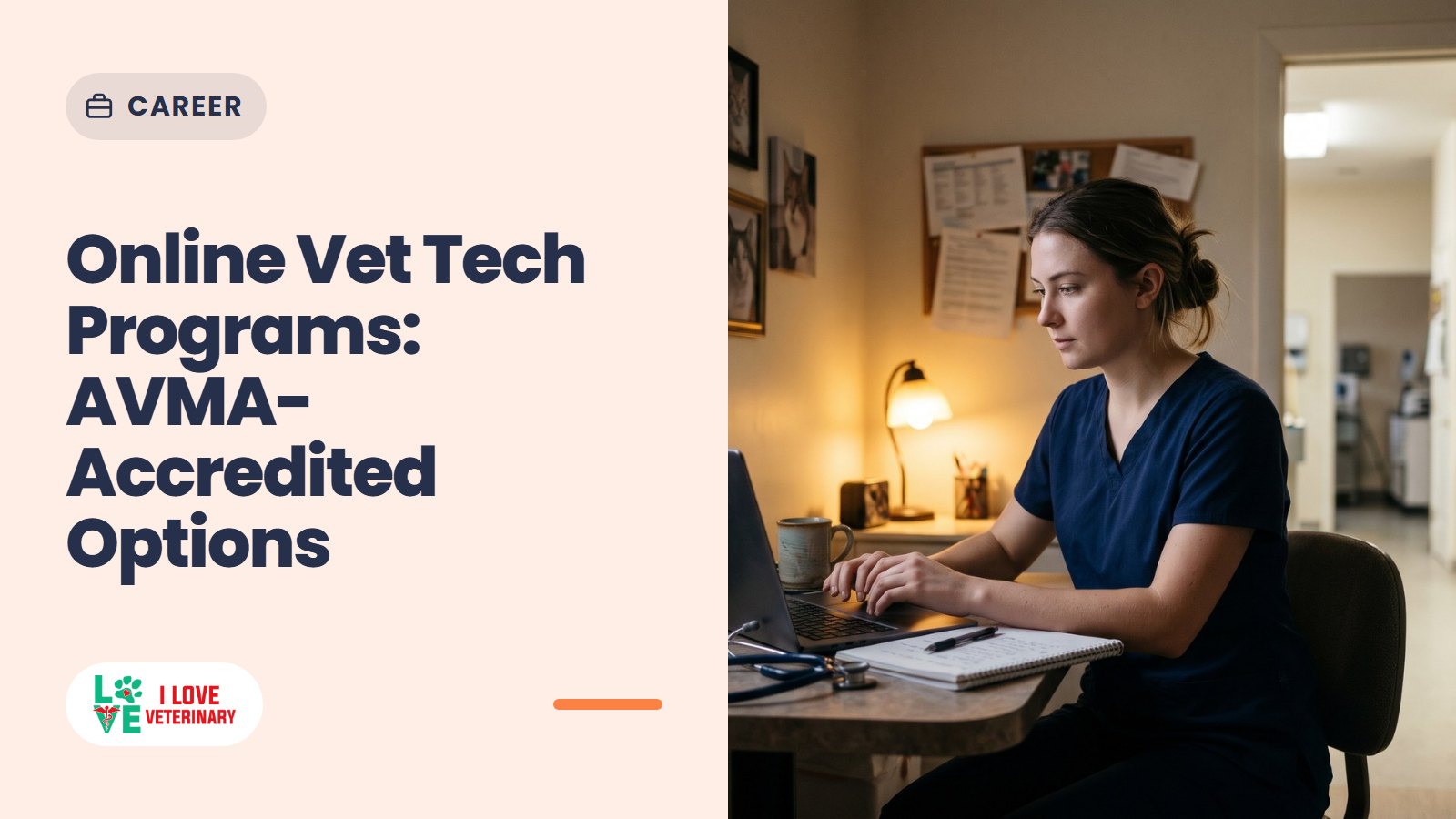
Watching the anesthesia monitor during a procedure: this is the kind of work your mentorship hours put you next to.
So with most online programs, you find the clinic and the mentor. A Purdue article by two credentialed techs puts it plainly: online students must identify the practices and mentors that will help them learn the AVMA-required hands-on skills. If you already work in a practice that will back you, you're halfway there. If you don't, line up a clinic before you enroll.

Are Online Vet Tech Programs Respected by Clinics?
On paper, yes: an online grad ends up with the same credential. A graduate of an AVMA-accredited online program is a graduate of an accredited program, takes the same Veterinary Technician National Exam (VTNE), and gets credentialed by the same state board as a campus graduate. AAVSB, which runs the VTNE, says graduates of accredited programs are eligible in every jurisdiction.
Some practices actively choose this route. Purdue's techs describe clinics that grow their own: they send a current employee through an online program while keeping them on staff, sometimes paying part of the tuition in exchange for a work commitment after graduation. That's worth asking your own clinic about.
Where online grads can fall short is experience, not paperwork. Your mentorship hours are your proof that you can handle real patients and keep up on a busy day. Treat them as the main event of the program.

If your clinic only sees small animals, ask each program early how you'd complete any large animal skills it requires.
How to Choose an Online Vet Tech Program
Ask every school on your shortlist the same five questions.

- What is your current AVMA accreditation status? Check the answer against AVMA's list.
- What is your three-year VTNE pass rate for first-time takers? Programs such as YTI post it on their program page as the share of first-time candidates who passed over a three-year period. Check the date range and, if the school also runs a campus program, whether the figure covers the online track. If it isn't posted, ask.
- Who finds my clinic and mentor, and what are the requirements? Do I need to be employed at a practice, or can I volunteer? Who can be my mentor? How are skills checked: video, in-person labs, site visits?
- How flexible is the schedule? Semester based or self-paced, minimum course load, any on-campus or lab sessions you'd have to travel to.
- What does it cost in total, and what aid is available? Tuition, fees, books, travel for labs. Ask the financial aid office what you qualify for, and ask your employer about tuition help.
A program that answers all five quickly and in writing is telling you something about how it will support you when you're stuck on a skill at 9 p.m.
How Long Does an Online Vet Tech Program Take?
It depends on the program and how many courses you take at once. Two examples from the schools: YTI says its program takes as few as 20 months, and Purdue says its associate degree can take as little as three years. Taking fewer courses per term stretches the timeline, so ask each school for a realistic plan at the course load you can manage. Three programs on AVMA's list offer a bachelor's degree: Appalachian State (its only degree on the list), Penn Foster and St. Petersburg College.
After Graduation: The VTNE and Your Credential
The VTNE is the national exam most states and provinces require before they credential a vet tech. The AAVSB candidate handbook sets out the essentials:
- Format: 150 scored multiple-choice questions plus 20 unscored pilot questions, in 3 hours.
- When: four testing windows a year: February 15 to April 15, May 15 to July 15, August 15 to October 15, and November 15 to January 15. Completed applications are due by March 15, June 15, September 15 and December 15 for those windows.
- Eligibility: graduates of AVMA- or CVMA-accredited programs qualify in every jurisdiction. For recent graduates, the program director uploads a roster to AAVSB. Some programs let students test in their last semester, so ask your school whether it takes part.
- Other routes: an on-the-job trained pathway is accepted only in Montana, Wisconsin, Alaska and Utah, and it limits where you can transfer your license later.
AAVSB runs the exam, but it doesn't issue the credential. Your state board does, under titles like RVT, LVT or CVT. For study strategies, see our tips for preparing for the VTNE.

Is an Online Program Right for You?
Online works well if you:
- already work in a veterinary practice, or have one willing to mentor you;
- need to keep a job or care for family while you study;
- live far from a campus program;
- can keep yourself on schedule without set class times.
It's harder if you:
- have no clinic lined up for the hands-on skills;
- learn best with an instructor in the room and instant feedback;
- want the classmate network a campus program builds.
Neither route is the "real" one. Pick the one where you'll actually get the hands-on hours, and pick it from AVMA's list.
FAQ
Can you become a vet tech completely online?
The coursework, yes. The clinical skills, no. Every AVMA-accredited online program requires hands-on work in a veterinary setting, through mentorships, externships or labs.
Are there free online vet tech courses?
Free courses and webinars can help you learn, but they don't lead to the credential. To sit the VTNE in most states, you need to graduate from an accredited program. Working as a veterinary assistant while you study is a common way to get experience and a mentor at the same time.
Is there an online vet tech certification?
Not on its own. Vet tech credentials (RVT, LVT or CVT, depending on the state) come from the state after you pass the VTNE, usually as a graduate of an accredited program. A "certificate" from an unaccredited online course is not the same thing.
Is an online vet tech degree the same as an on-campus one?
For eligibility, yes: AVMA accredits online and campus programs, and graduates of either are graduates of an accredited program. The day-to-day experience differs, mostly in how you get your hands-on training.
Sources
- AVMA: Distance education programs in veterinary technology accredited by the AVMA CVTEA
- AVMA: Programs accredited by the AVMA CVTEA
- AVMA: CVTEA accreditation policies and procedures, classification of accreditation
- AAVSB: VTNE Candidate Information Handbook
- AAVSB: VTNE overview
- Purdue University: Veterinary Technology Distance Learning
- Purdue University: Clinical mentorship for distance learners
- Purdue University: What are the pros and cons of online vet tech school?
- Dallas College: Veterinary Technology Distance Education Program
- YTI Career Institute: Veterinary Technician Program