


There is no official ranking of vet tech schools. What exists is more useful: the AVMA's list of accredited veterinary technology programs, the list that decides whether your diploma lets you sit the Veterinary Technician National Exam (VTNE) in nearly every state. Start there, then judge the programs on it by pass rates, clinical training, degree type and real cost.
This guide shows you how to read that list, what each accreditation status means, and how to compare programs without leaning on someone else's "top 10."
What AVMA accreditation means for a vet tech program
Vet tech programs in the US are accredited by the American Veterinary Medical Association's Committee on Veterinary Technician Education and Activities (CVTEA). The committee checks each program against 11 standards, from the college's own institutional accreditation, finances and facilities to clinical resources, faculty, curriculum and outcomes.
This matters because most states and provinces require graduation from an AVMA CVTEA (or Canadian CVMA) accredited program before you can take the VTNE, and most require a passing VTNE score before they credential a vet tech. A few jurisdictions accept on-the-job training or an alternate pathway, but the AAVSB warns that not every state recognizes those routes, so a credential earned that way may not move with you.
If a program isn't on the AVMA list, treat it as a dead end for credentialing until your state board tells you otherwise.

New to the field? Our vet tech career guide covers the whole path from school to credential, and what vet techs do walks through the daily work, from anesthesia and dentistry to lab and imaging. Weighing the job against vet school? See vet tech vs. veterinarian.
How many accredited vet tech programs are there?
The AVMA's CVTEA summary page lists 220 accredited programs, with 28 offering a four-year degree and 13 offering distance learning (as of AVMA's directory; check it for changes). The list moves during the year as new programs gain initial accreditation and others close, so trust the live page over any number in an article, this one included.
For scale: AVMA reports that CVTEA-accredited programs graduated 5,162 vet techs in 2023 (4,664 associate degrees and 498 bachelor's degrees) and enrolled 33,590 students in the 2023-24 academic year.
Accreditation status, decoded
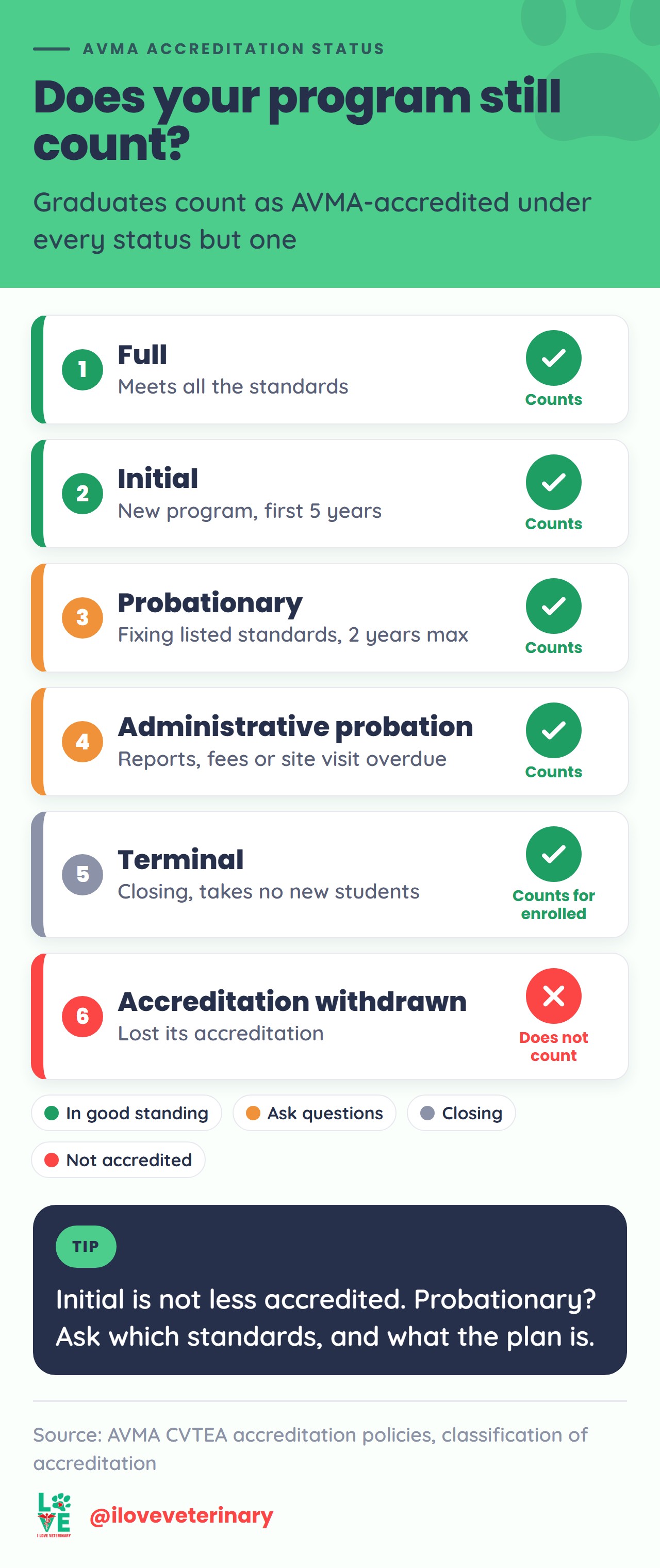
Every program in the directory carries a status. Several sound alarming and aren't. Here is how the CVTEA defines them:
Status | What it means | Graduates count as AVMA-accredited? |
|---|---|---|
Full | The program substantially meets all accreditation standards. | Yes |
Initial | A newly accredited program, for up to its first five years. AVMA says this is not "less" accredited. | Yes |
Probationary | The program has specific deficiencies in one or more standards (listed after the status) that it must fix within a set time of no more than two years. AVMA says this is not an adverse decision. | Yes |
Administrative probation | Reports, fees or a site-visit date are overdue. | Yes |
Terminal (voluntary) | The program is closing and takes no new students. | Yes, for students already enrolled |
Accreditation withdrawn | The program lost accreditation. | No |
In practice, Initial is fine, Probationary deserves a direct question to the program director ("Which standards, and what is the plan?"), and Terminal means you can't enroll.
How to use the AVMA directory
- Open the AVMA list of CVTEA-accredited programs.
- Use the row of state abbreviations at the top to jump to your state. The last link, Canada, Distance Education, takes you to the online programs.
- Read each entry: school, program name, address, the degree(s) it grants, the date of first accreditation, and the status in capitals at the end.
- Check the separate lists on the CVTEA summary page: programs offering a four-year degree, programs that have applied for accreditation (not yet accredited), and the accreditation-withdrawn history.
- Cross-check on the school's own site that the exact campus and delivery format you want is the one listed. A school can have an accredited campus program and a separate distance program, each with its own entry.
A quick search of the page with Ctrl+F (Cmd+F on a Mac) finds a school faster than scrolling. Alaska and the District of Columbia show "None" in the directory, so students there look at distance programs or neighboring states.
How to judge a vet tech program
Accreditation is the floor, not the finish line. Once you have a shortlist, these are the questions that separate programs:
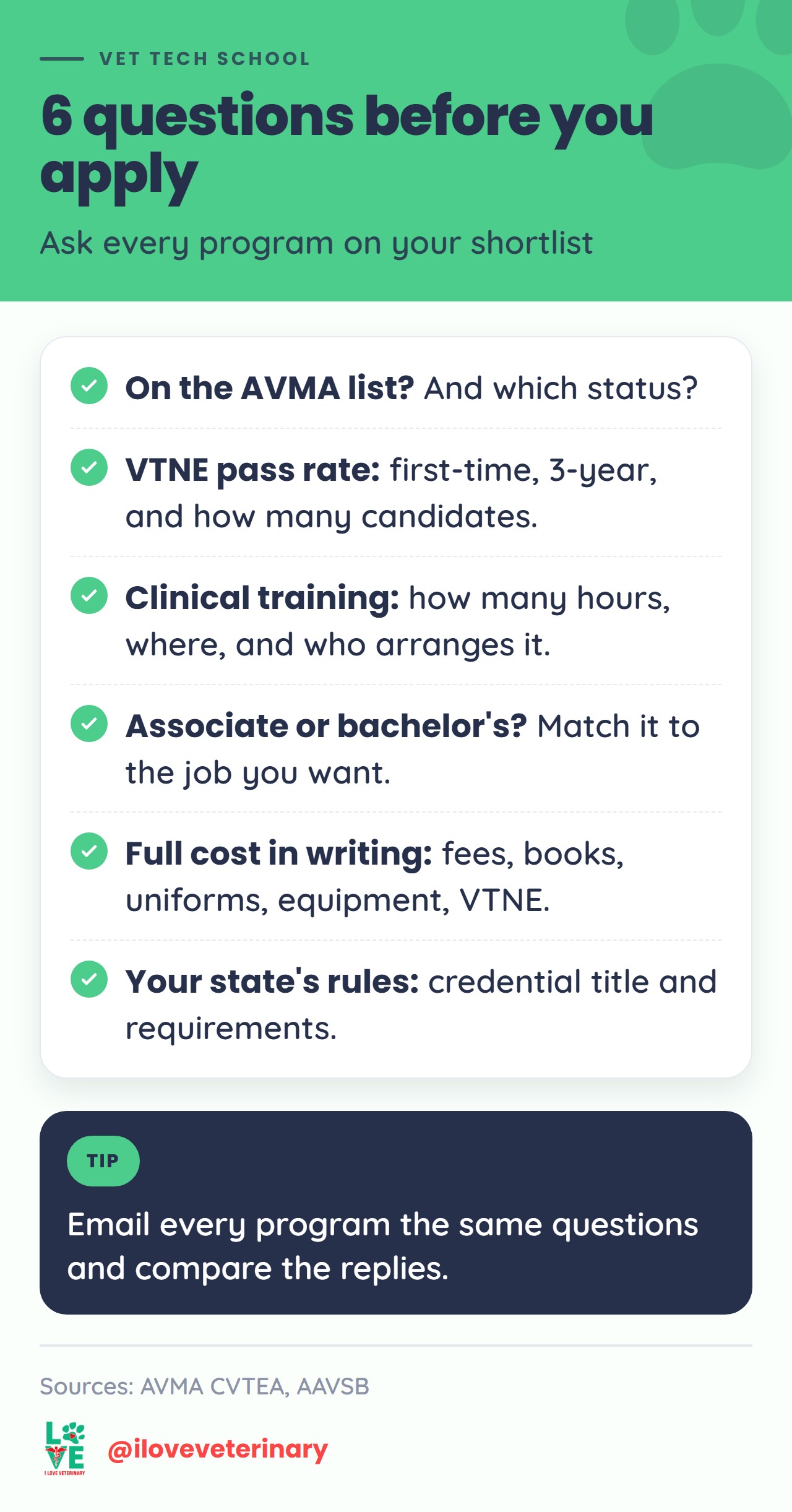
- VTNE pass rate. Look for the first-time, three-year VTNE pass rate and the number of first-time candidates behind it. In January 2025 the CVTEA told programs to post both figures on their website, so check there first. A high rate from a handful of candidates tells you less than a steady rate from a large class. If you can't find it, ask.
- Clinical training. How many hours, where, and who arranges placements? For distance programs this is the big one: you still have to complete hands-on clinical skills, usually at a practice near you. Ask who finds and approves that site, and who checks your skills, before you enroll.
- Associate or bachelor's. Most vet techs start with a two-year associate degree. A four-year bachelor's is the usual route to a veterinary technologist role (more below).
- Admissions requirements. Entry requirements and prerequisite courses differ from program to program, so read each one's list early and plan any missing courses before the deadline.
- Cost, in writing. Ask for the full cost of the program, including fees, uniforms, books, equipment and VTNE costs, not only per-credit tuition. A program that makes this hard to get is telling you something.
- Your state's rules. Credential titles (RVT, LVT, CVT, LVMT) and requirements are set by each state. Check your state board or the AAVSB before you enroll, especially if you plan to move after graduating.
Associate, bachelor's or certificate?
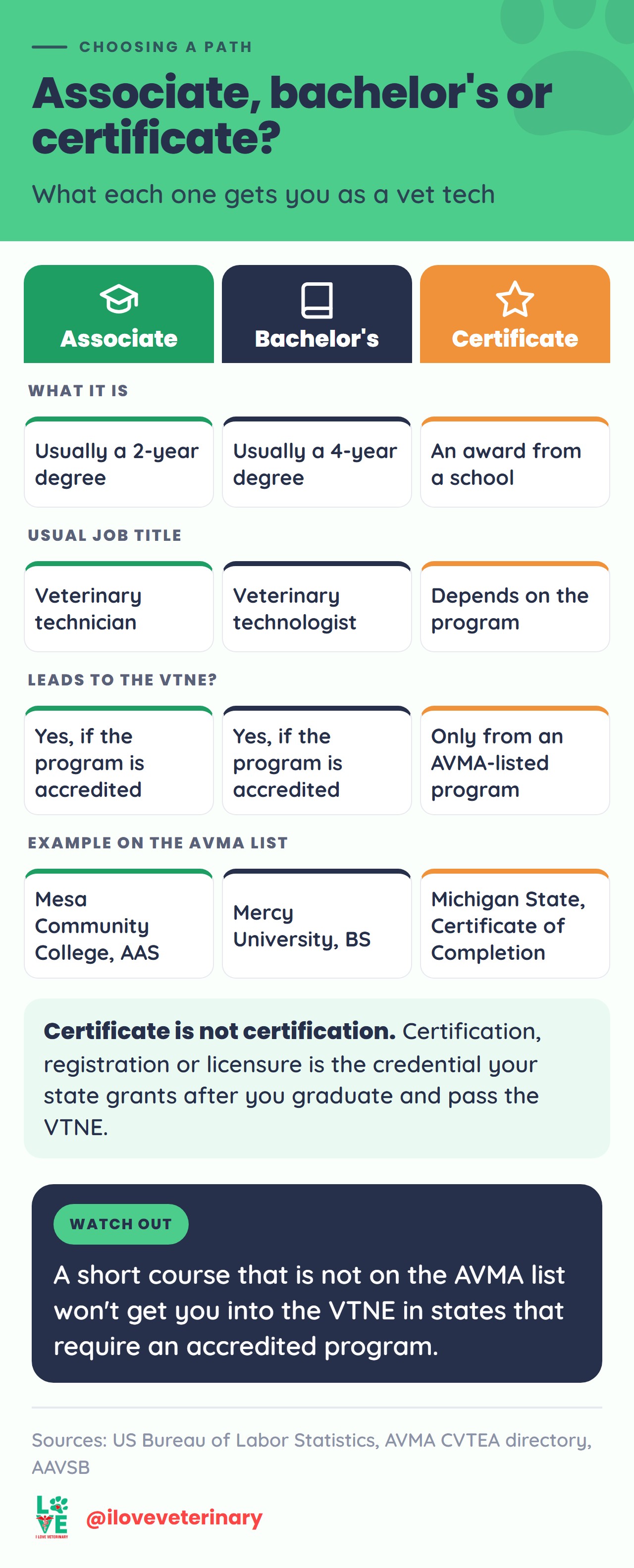
The BLS notes that veterinary technicians usually hold a two-year associate degree from a veterinary technology program, while veterinary technologists usually hold a four-year bachelor's degree. Either one from an accredited program can lead to the VTNE.
"Vet tech certificate programs" and "vet tech certification programs" are easy to mix up:
- A certificate is an award from a school. A few accredited programs grant one; Michigan State University, for example, lists a Certificate of Completion in Veterinary Nursing alongside its bachelor's. A short "vet tech certificate" course that isn't on the AVMA list won't qualify you for the VTNE in states that require an accredited program.
- Certification, registration or licensure is the credential your state grants after you graduate and pass the VTNE.
If a course promises vet tech status in a few months and isn't on the AVMA list, read the fine print. Veterinary assistant work is a real job and a good way in; our guide on how to become a veterinary assistant explains the difference.
Examples of accredited programs by type
These are examples, not a ranking. Each is listed by AVMA with the degree and status shown at the time of writing. Status can change, so confirm it in the directory before you apply.
Type | Program | Degree listed by AVMA | Status |
|---|---|---|---|
University, bachelor's | Michigan State University, East Lansing, MI | Certificate of Completion; BS in Veterinary Nursing | Full |
University, bachelor's | Mercy University (formerly Mercy College), Dobbs Ferry, NY | BS | Full |
University, campus and distance | Purdue University, West Lafayette, IN | Campus: AAS and BS in Veterinary Nursing; distance: AAS | Full |
Community college, campus and distance | Dallas College (formerly Cedar Valley College), Lancaster, TX | AAS (campus since 1978, distance since 2001) | Full |
Distance learning | Jefferson State Community College, Birmingham, AL | AAS | Full |
Distance learning | Nebraska College of Technical Agriculture, Curtis, NE | AAS | Full |
Community college | Los Angeles Pierce College, Woodland Hills, CA | AS | Full |
Community college | Mesa Community College, Mesa, AZ | AAS | Full |
Community college | Yuba College, Marysville, CA | AS | Probationary (Standards 4, 5, 9, 10) |
Private career college | Pima Medical Institute, Tucson, AZ (one of several Pima campuses on the list) | AAS | Full |
Private career college | The Vet Tech Institute of Houston, Houston, TX | AAS | Full |
Looking for the University of Nebraska? Its accredited vet tech program is at the Nebraska College of Technical Agriculture in Curtis, not the Lincoln campus. Yuba College is in the table on purpose: Probationary programs are still accredited, and that is exactly the kind of status worth asking about.

Comparing online options? Our guide to online vet tech programs goes deeper on how distance programs handle clinical hours.
What you'll study
Programs differ, but most start with general education (English, math, communication) and build toward veterinary courses such as:
- Animal anatomy and physiology across species.
- Animal husbandry, handling and restraint, so you can work safely with frightened or painful patients.
- Pharmacology and dosage calculations, which is why math shows up early.
- Clinical laboratory procedures: blood work, urinalysis, parasitology.
- Anesthesia and surgical nursing, including monitoring patients under anesthesia.
- Diagnostic imaging, mainly radiography.
- Clinical rotations or externships, where you practice these skills on real patients.

After graduation, some techs go on to earn a veterinary technician specialty in areas such as anesthesia, dentistry or emergency and critical care.
Pay and job outlook
According to the US Bureau of Labor Statistics, the median annual wage for veterinary technologists and technicians was $47,380 (BLS, May 2025 data). Employment is projected to grow 9% from 2025 to 2035, much faster than the average for all occupations, with about 13,400 openings a year on average.

Frequently asked questions
Does initial accreditation mean a program is worse?
No. Initial is simply the label for a newly accredited program in its first five years. AVMA says graduates of initially accredited programs are graduates of an AVMA CVTEA-accredited program and are eligible in nearly all states to take the VTNE.
Are online vet tech programs accredited?
Some are. AVMA lists 13 programs offering distance learning, under "Distance Education" in the directory. Expect required hands-on clinical work, even in an online program.
Can I take the VTNE without going to an accredited program?
In a few states, through on-the-job training or an alternate pathway. Most states require graduation from an AVMA CVTEA or CVMA accredited program, and AAVSB notes that a credential earned through an alternate route may not transfer to another state.

How do I prepare for the VTNE once I'm in a program?
Start early and practice with timed questions. Our VTNE preparation tips cover study plans and the topics the exam leans on.
Your next step
Open the AVMA directory, jump to your state and the distance list, and write down every program within reach. Then email each one the questions from the checklist above: pass rate and candidate count, clinical placements, full cost. The answers, and how quickly they arrive, will tell you more than any ranking.
And when acceptance letters land, the ILV vet student collection has gifts and apparel made for vet students.
Sources
- AVMA: Veterinary technology programs accredited by the AVMA CVTEA
- AVMA: Programs accredited by the CVTEA (general statistics)
- AVMA: CVTEA accreditation policies and procedures, classification of accreditation
- AVMA News: CVTEA announces policy changes, decisions (January 2025)
- AAVSB: Verifying your VTNE eligibility
- AAVSB: VTNE overview
- US Bureau of Labor Statistics: Veterinary technologists and technicians, Occupational Outlook Handbook
- Purdue University: What is an accredited vet tech program?