

The veterinary receptionist is the first person clients see when they walk into a clinic and the last one they see on the way out. How a worried owner is greeted, how a phone call is handled and how a bill is explained all shape what clients remember about the visit.
In short, a veterinary receptionist greets clients and their pets, answers the phones, books and checks in appointments, keeps records up to date, takes payments, and makes sure the veterinary team knows who has arrived and who needs help fast. Most clinics do not ask for a degree: in the US, receptionists typically need a high school diploma and learn the job through short on-the-job training. Receptionists working in veterinary services earned a median of $37,910 a year in May 2025, according to the US Bureau of Labor Statistics (BLS).

What does a veterinary receptionist do?
The job mixes customer service, scheduling and office work, with animals and emotional owners in the middle of it. The exact list varies by practice, but most postings cover the same ground.
Clients and phones
- Greet clients and their pets warmly and help nervous owners settle in.
- Answer phone calls, take messages and route calls to the right person.
- Schedule, confirm and reschedule appointments, and send appointment reminders.
- Answer general questions about the clinic, its services and the visit, and handle emails and other correspondence.
Check-in and the team
- Check in patients and update their charts with the owner's information.
- Let the veterinarian or technician know a patient has arrived.
- Watch for pets that may need urgent care and alert the team right away.
- Pass prescription refill requests to the veterinarian and hand over medications the veterinarian has approved.
Records and money
- Keep client and patient records accurate and filed.
- Prepare invoices and process payments by card, cash or other methods.
- Help clients buy pet food, supplies and other items sold at the counter.
The clinic itself
- Keep the reception area clean and welcoming.
- Order office supplies and pick up other admin tasks the practice assigns.
Triage needs a clear boundary. Triage means sorting patients by how urgently they need care, and the receptionist is often the first person to hear about a problem, by phone or at the counter. Their part is to recognize that a situation sounds urgent and get the veterinary team involved straight away, as Clinician's Brief explains in its guide to triage. Examining the patient is the technician's and the veterinarian's job. A receptionist does not diagnose or give medical advice, and when in doubt, hands the call or the pet to a clinical team member.

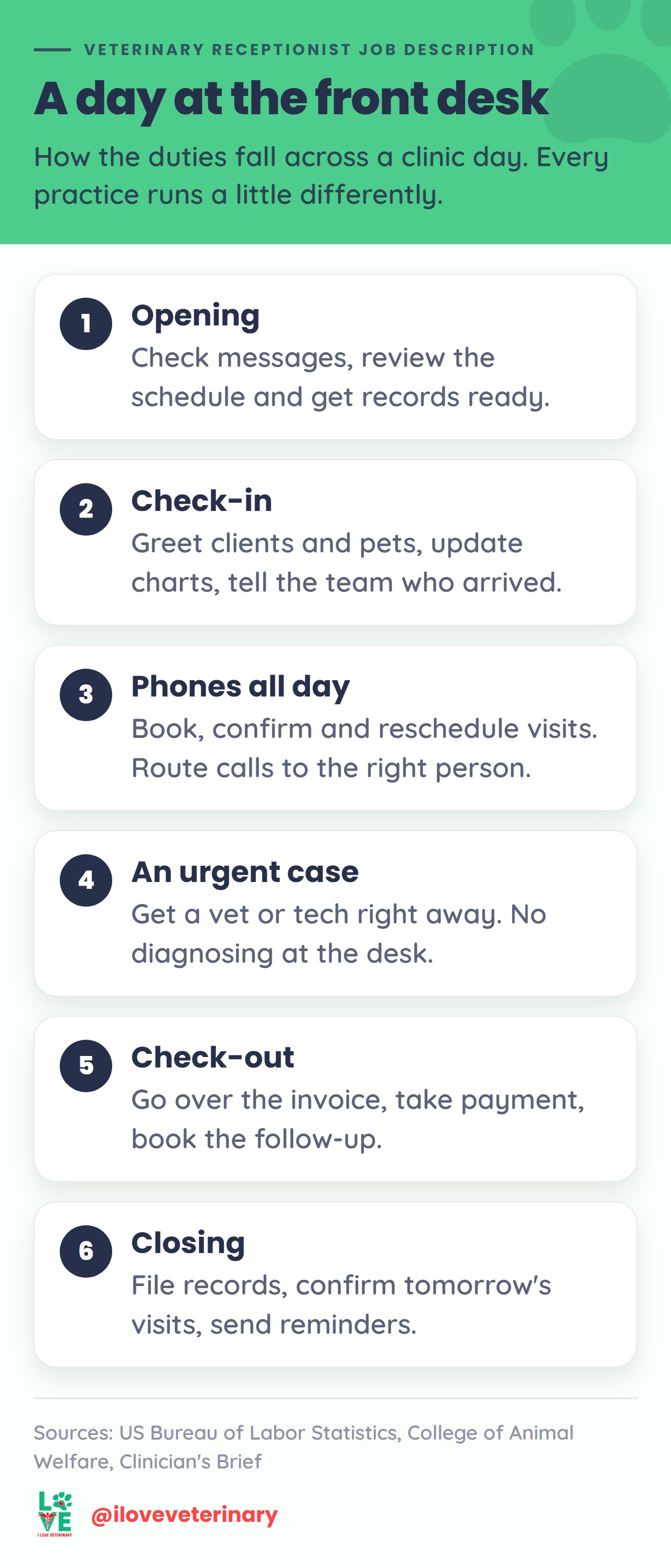
A typical day at the front desk
Clinics run their days differently, so treat this as an example of how the work tends to flow rather than a fixed schedule.
- Opening: check voicemail and messages, look over the day's schedule, and get records ready for the first appointments.
- Appointment hours: greet arrivals, check patients in, keep the waiting room moving, answer a steady stream of calls, and fit in sick pets when the team says there is room. This is where multitasking matters most.
- Check-out: go over the invoice with the client, take payment, book follow-up visits and hand over any approved medications or food.
- Closing: file and update records, confirm tomorrow's appointments, send reminders and tidy the desk.
Some shifts are harder than others. The front desk is often where a grieving or upset owner speaks to someone first, including families coming in to say goodbye to a pet. Our guide on dealing with euthanasia as a veterinary professional covers that side of clinic life. Hours depend on the practice, and you may be asked to cover evening and weekend shifts.
Skills clinics look for
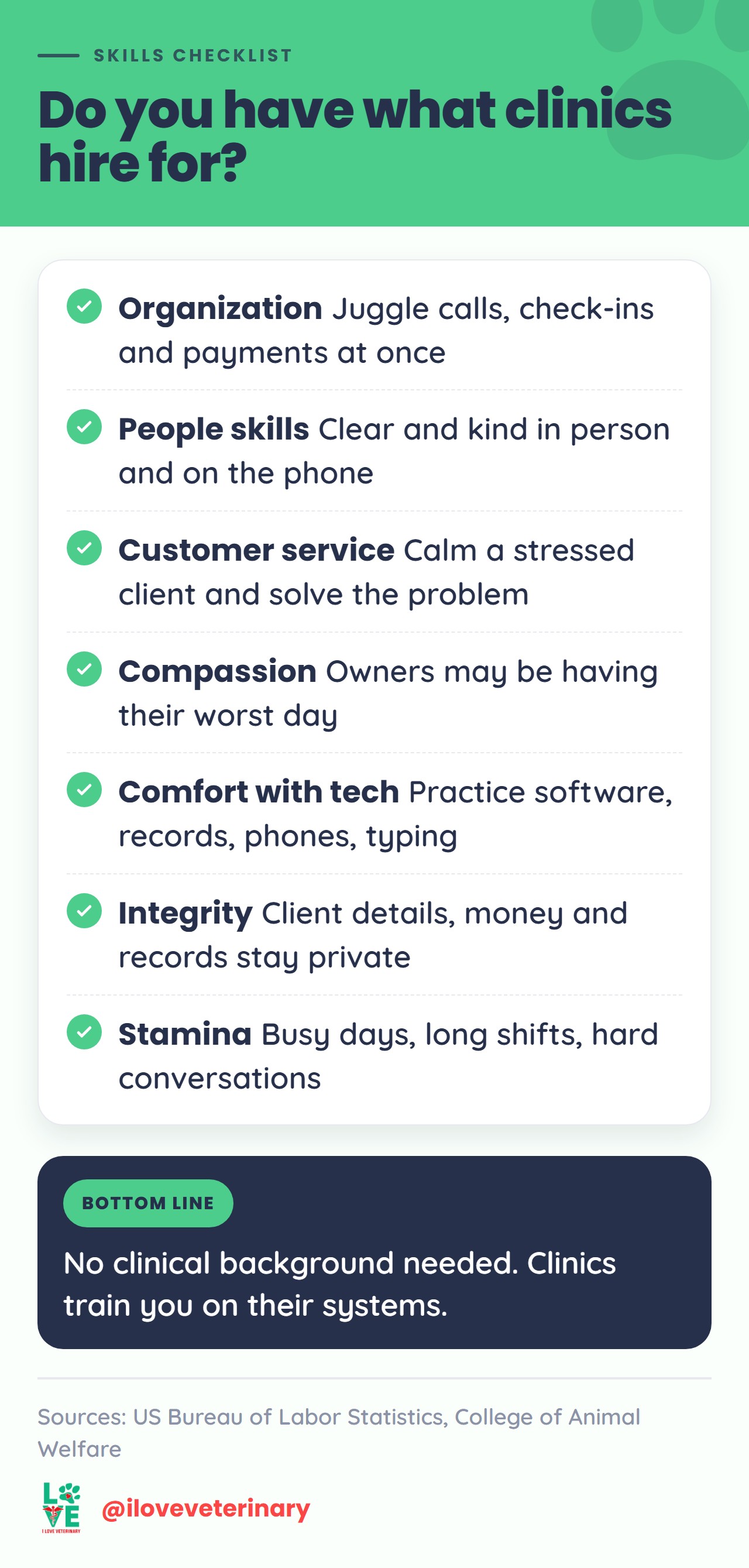
Clinics hire front desk staff for people skills and organization, not clinical knowledge. The BLS lists most of the skills below as important qualities for receptionists, and veterinary work adds a couple of its own.
- Organizational skills: you will juggle calls, check-ins, payments and walk-ins at the same time. Staying organized keeps the schedule and the waiting room running smoothly.
- Interpersonal skills: you will work closely with clients in person and over the phone, and with every member of the veterinary team.
- Customer service skills: calming a stressed client and solving their problem is a daily part of the job.
- Compassion: pets are family. You will meet owners on some of their worst days, and empathy matters as much as efficiency.
- Comfort with technology: practice management software, electronic medical records, multi-line phones and card terminals are the tools of the job. Fast, accurate typing helps.
- Integrity: you handle client details, payments and medical records, so discretion and honesty are part of the role.
- Stamina: busy days, long shifts and difficult conversations take physical and mental energy.
How to become a veterinary receptionist
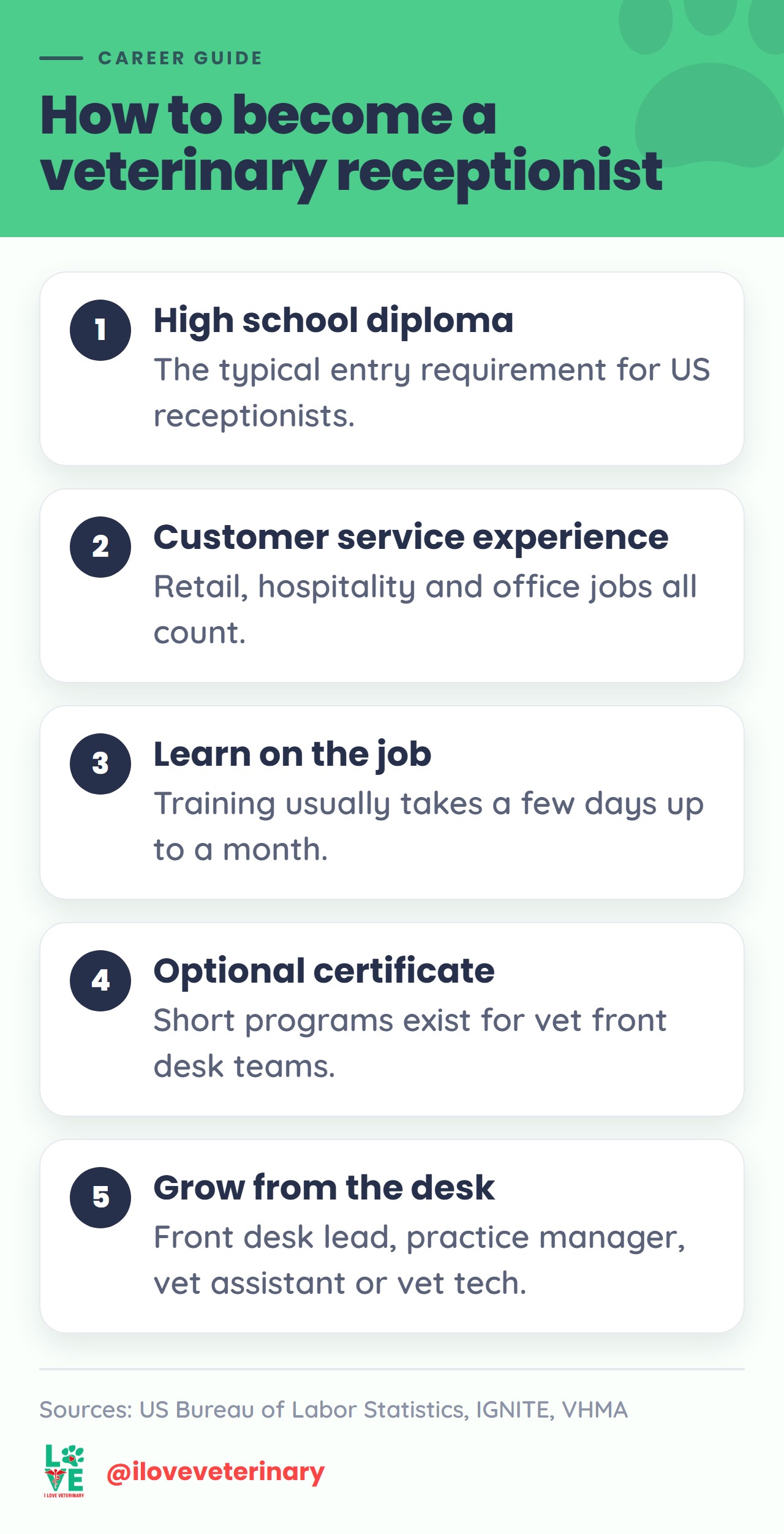
Requirements vary by clinic, but the route in is usually short.
- Finish high school or an equivalent. In the US, a high school diploma is the typical entry requirement for receptionists, according to the BLS Occupational Outlook Handbook. A college degree is not usually required.
- Build customer service experience. Retail, hospitality or office jobs all count. Clinics value people who stay calm with upset clients and can handle money and a busy phone. Prior veterinary or pet care experience helps, but it is not always required.
- Learn on the job. Most receptionists get short-term on-the-job training, usually lasting a few days up to a month, per the BLS. Expect to learn the clinic's software, its booking rules and a lot of new terms. Our list of veterinary abbreviations is a good head start.
- Consider a short training program (optional). None is required, but a few exist for veterinary front desk teams. IGNITE's Veterinary Receptionist Certificate of Excellence is a 13-week certificate program for client service representatives. In the UK, the College of Animal Welfare offers the VetSkill Level 2 Certificate for Veterinary Receptionists.
- Join the community. The North American Association of Veterinary Receptionists (NAAVR), a nonprofit founded in 2024, offers members webinars, training resources and a peer community.
Veterinary receptionist salary
BLS does not track "veterinary receptionist" as its own job. It tracks receptionists and information clerks (occupation code 43-4171) and reports their pay by industry. These figures are for receptionists employed in veterinary services, from the May 2025 Occupational Employment and Wage Statistics survey:
Pay point (veterinary services, May 2025) | Annual wage |
|---|---|
10th percentile | $30,340 |
25th percentile | $35,600 |
Median | $37,910 ($18.23 an hour) |
75th percentile | $44,010 |
90th percentile | $46,990 |
Mean | $39,360 ($18.92 an hour) |
So the middle half of receptionists in veterinary services earned between $35,600 and $44,010 a year. About 55,330 receptionists worked in veterinary services in May 2025, roughly 12% of all jobs in the industry. The median for receptionists across all industries was $38,010, almost the same as in veterinary practices.
The percentiles show how pay is spread across all receptionists in veterinary services. They are not experience levels. Where you land depends on things like your location, the type of practice and your responsibilities.
Job outlook and where the job can lead
BLS projects employment of receptionists in all industries to decline 2% from 2025 to 2035. Even so, it expects about 105,100 openings a year, all from replacing people who leave the job. In practice, the number of jobs stays roughly flat while turnover keeps openings coming. These projections cover receptionists in every industry; the Handbook gives no separate projection for veterinary practices.
The front desk is also a common starting point in veterinary medicine. Typical next steps include:
- Some receptionists move up to lead the front desk or run the office side of the practice.
- Others become practice managers, a job where knowing the front desk well pays off. The Veterinary Hospital Managers Association's Certified Veterinary Practice Manager (CVPM) credential requires at least three years as a practice manager within the last seven, 18 college semester hours in management-related courses, 48 hours of management continuing education and four letters of recommendation.
- If you want hands-on work with patients, veterinary assistants work alongside the clinical team. See how to become a veterinary assistant.
- Veterinary technicians hold a credentialed clinical role that needs formal schooling. Learn more in everything you need to know about being a vet tech.
Veterinary receptionists have their own appreciation week too: see our guide to Veterinary Receptionist Week for ways to celebrate yours.
If you like people, stay calm when the phones and the waiting room are both full, and care about animals and their owners, the front desk is a practical way into veterinary medicine, with room to move toward management or clinical work later.
Originally written by Amber LaRock. Updated by the I Love Veterinary editorial team.
Sources
- US Bureau of Labor Statistics: Occupational Employment and Wages, Receptionists and Information Clerks (43-4171), May 2025
- US Bureau of Labor Statistics: Occupational Outlook Handbook, Receptionists
- College of Animal Welfare: Veterinary Receptionist career profile
- Clinician's Brief: The Art of Triage
- Blue Springs Animal Hospital: Employment (veterinary receptionist posting)
- North American Association of Veterinary Receptionists (NAAVR)
- IGNITE: Veterinary Receptionist Certificate of Excellence
- Veterinary Hospital Managers Association: Earning Your CVPM