This list is a guide for future vet students who want to know which US veterinary schools rank highest right now, and what the numbers behind each one look like. We use the U.S. News Best Veterinary Schools ranking, the edition U.S. News marks "Ranked in 2026", and every cost and pass-rate figure below comes from the school's own website with its academic year attached. Comparing options abroad? See our Top 5 Vet Schools in Europe and our guide to veterinary colleges in Australia.
How this list was ranked
The top five in the 2026 edition are UC Davis, Cornell, Colorado State, and then NC State and Texas A&M, which tie for fourth. That tie is why the list stops at exactly five schools.
School | U.S. News rank (peer score) | Location | Latest NAVLE pass rate |
|---|---|---|---|
UC Davis | #1 (4.3) | Davis, California | 94% (2025-2026) |
Cornell | #2 (4.2) | Ithaca, New York | 97% (2024-2025) |
Colorado State | #3 (3.9) | Fort Collins, Colorado | 93% (2025) |
NC State | #4, tie (3.7) | Raleigh, North Carolina | 93% (2025) |
Texas A&M | #4, tie (3.7) | College Station, Texas | 96% (2025) |
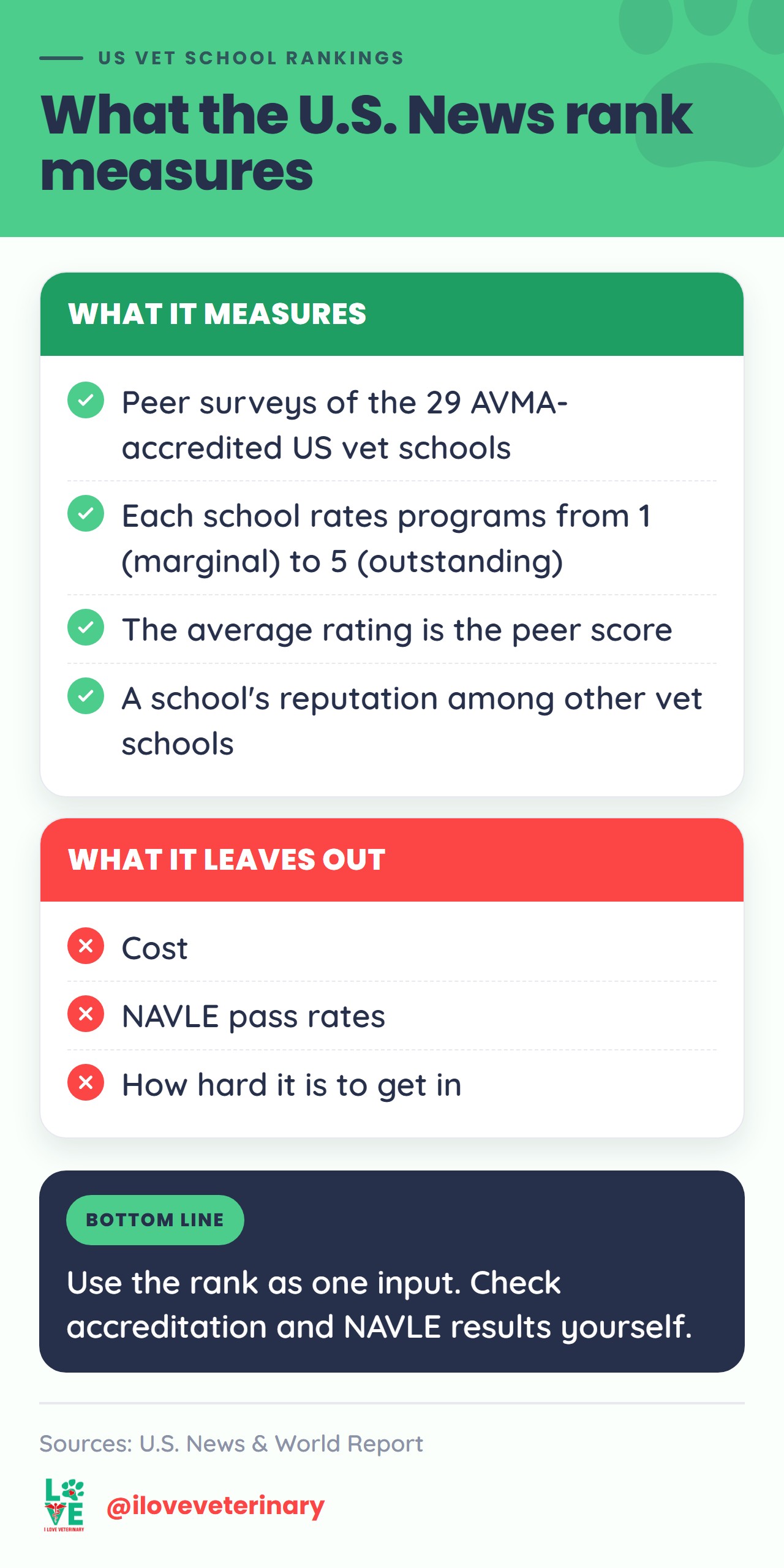
U.S. News computes the veterinary ranking solely from peer assessment surveys: it surveyed the 29 AVMA-accredited US vet schools and asked them to rate each program from 1 (marginal) to 5 (outstanding). The peer score is the average of those ratings. It reflects a school's reputation among other vet schools, not its cost, licensing results, or how hard it is to get in. U.S. News itself says a school's rank should be only one consideration, so each profile below also gives cost and licensing-exam results.
1. UC Davis Weill School of Veterinary Medicine

UC Davis holds the #1 spot with a peer score of 4.3. The name is new. In January 2026 the school became the UC Davis Weill School of Veterinary Medicine after a $120 million gift, which UC Davis describes as the largest gift ever made to veterinary medicine worldwide.
- Location: Davis, California
- Accreditation: Accredited by the AVMA Council on Education, last evaluated in 2025
- Cost (2026-27): tuition and fees of $38,061 a year in years 1-3, plus $12,245 in nonresident supplemental tuition for students from outside California
- NAVLE pass rate: 94% in 2025-2026 (135 of 144 students), 92% the year before, per the school's accreditation page
If you live outside California, watch the nonresident supplement. It is charged every year on top of tuition and fees, so your residency moves the bill more than the school's rank does.
2. Cornell University College of Veterinary Medicine

Cornell sits at #2 with a peer score of 4.2, close behind UC Davis. It reports the highest licensing-exam pass rate of the five, though each school reports its own year.
- Location: Ithaca, New York
- Accreditation: Full accreditation, last site visit December 2024
- Cost (2026-2027): tuition of $46,230 for New York residents and $68,935 for non-residents
- NAVLE pass rate: 97% in 2024-2025, per Cornell's accreditation page
Non-residents pay more than $22,000 a year above the New York rate. That makes Cornell's non-resident tuition the highest of the schools here that publish a figure.
3. Colorado State University College of Veterinary Medicine and Biomedical Sciences
Colorado State ranks #3 with a peer score of 3.9.
- Location: Fort Collins, Colorado
- Accreditation: Fully accredited, last site visit 2022, per the school's accreditation page
- Cost: depends on your Colorado residency and sponsorship classification, so we do not quote a single figure; see the DVM program's financial resources page for current tuition and costs
- NAVLE pass rate: 93% in 2025 (135 of 145 students), per the school's NAVLE data
4. (tie) NC State College of Veterinary Medicine
NC State shares fourth place with a peer score of 3.7. It also has the lowest resident tuition of the schools here that publish a figure.
- Location: Raleigh, North Carolina
- Accreditation: Full accreditation granted in 2021, next site visit expected in 2028, per the college's accreditation page
- Cost (2026-2027, proposed): tuition and fees of $26,067 a year for residents and $59,041 for non-residents, based on proposed rates
- NAVLE pass rate: 93% in 2025 (90 of 97 students), with a five-year average of 96%
4. (tie) Texas A&M College of Veterinary Medicine & Biomedical Sciences
Texas A&M also scores 3.7, tying NC State for fourth.
- Location: College Station, Texas
- Accreditation: Full accreditation, next site visit in fall 2029
- Cost: depends on Texas residency, so we do not quote a figure; see the college's DVM financial aid page, which links to the university's cost of attendance estimate
- NAVLE pass rate: 96% in 2025 (154 of 161 students), per the college's accreditation page
Why accreditation and the NAVLE matter
Two checks matter more than any ranking. The first is accreditation by the AVMA Council on Education (COE), the body that accredits US veterinary colleges. Graduating from a COE-accredited school is a prerequisite for a license in the majority of US states, and the AVMA's list of accredited colleges is the only official online list. All five schools above are accredited.
The second is the North American Veterinary Licensing Examination (NAVLE), the exam you must pass to practice in every US and Canadian jurisdiction. The COE expects at least 80% of a school's graduating students who sit the NAVLE to pass. All five schools here reported 93% or higher in their latest year.
Other strong programs
Outside the top five, these three AVMA-accredited programs rank as follows in the 2026 U.S. News edition.
The Ohio State University College of Veterinary Medicine ranks #9 (tie).

University of Minnesota College of Veterinary Medicine ranks #16 (tie).

Michigan State University College of Veterinary Medicine ranks #18 (tie).

A lower peer score does not make any of them a weak choice, especially if you are a resident of that state.
How to choose a vet school
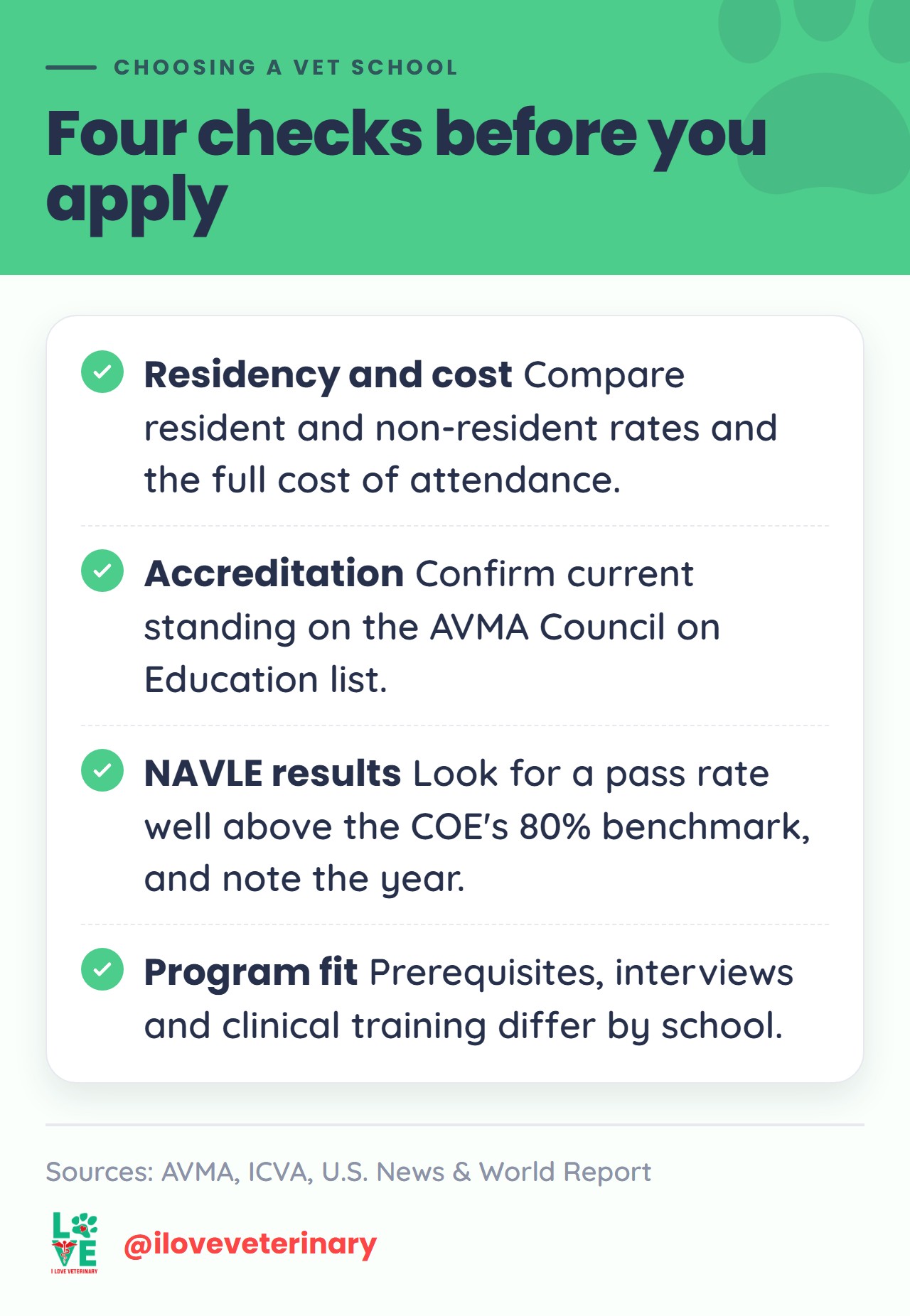
A rank tells you what other schools think. These questions tell you what fits you:
- Residency and cost. Your state of residence can matter more than the ranking. Compare resident and non-resident tuition, and look at the full cost of attendance, not tuition alone. Our guide to veterinary school scholarships covers ways to fund the gap.
- Accreditation status. Confirm the school's current standing on the AVMA list before you apply.
- Licensing outcomes. Look for a NAVLE pass rate comfortably above the COE's 80% benchmark, and note which year it covers.
- Program fit. Prerequisites, interviews, and clinical training differ by school, so read each school's admissions pages directly.
If you are still weighing the career itself, read 10 things to consider before becoming a veterinarian.
Sources
- U.S. News & World Report: Best Veterinary Schools (Ranked in 2026)
- U.S. News & World Report: Methodology, 2026 Best Health Schools Rankings
- AVMA: Accredited veterinary colleges
- UC Davis: UC Davis receives $120M gift, largest ever to veterinary medicine
- UC Davis School of Veterinary Medicine: DVM accreditation and NAVLE scores
- UC Davis Financial Aid: DVM 2026-27 cost of attendance
- Cornell College of Veterinary Medicine: Accreditation and NAVLE pass rates
- Cornell College of Veterinary Medicine: Cost of attendance
- Colorado State University: DVM accreditation
- Colorado State University: NAVLE data
- Colorado State University: DVM financial resources
- NC State College of Veterinary Medicine: Accreditation
- NC State College of Veterinary Medicine: DVM costs
- Texas A&M College of Veterinary Medicine & Biomedical Sciences: Accreditation
- Texas A&M College of Veterinary Medicine & Biomedical Sciences: DVM financial aid
Figures come from each school's own website and the 2026 U.S. News ranking, checked October 2026. Tuition and pass rates change every year, so confirm them with the school before you apply.