
A compilation of responses from I Love Veterinary followers.
These are the things people in our community wish someone had told them before they started. They appear below in the same order as the infographic, and we have added current numbers on school, licensing, debt, pay and wellbeing so you can weigh each point against real data. If you are a student thinking about vet school, a career changer, or a vet tech wondering about the DVM route, this is the honest version.
10 Things to Consider Before Becoming a Veterinarian
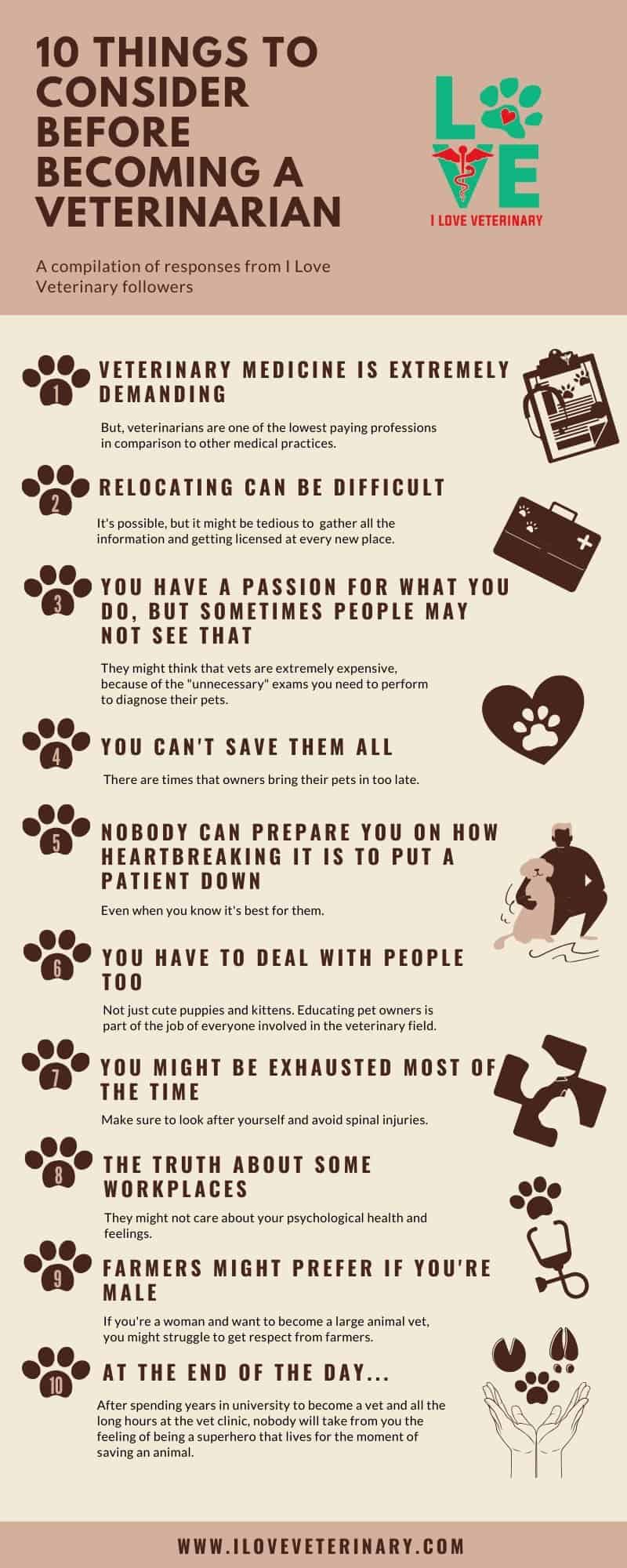
- Veterinary medicine is extremely demanding
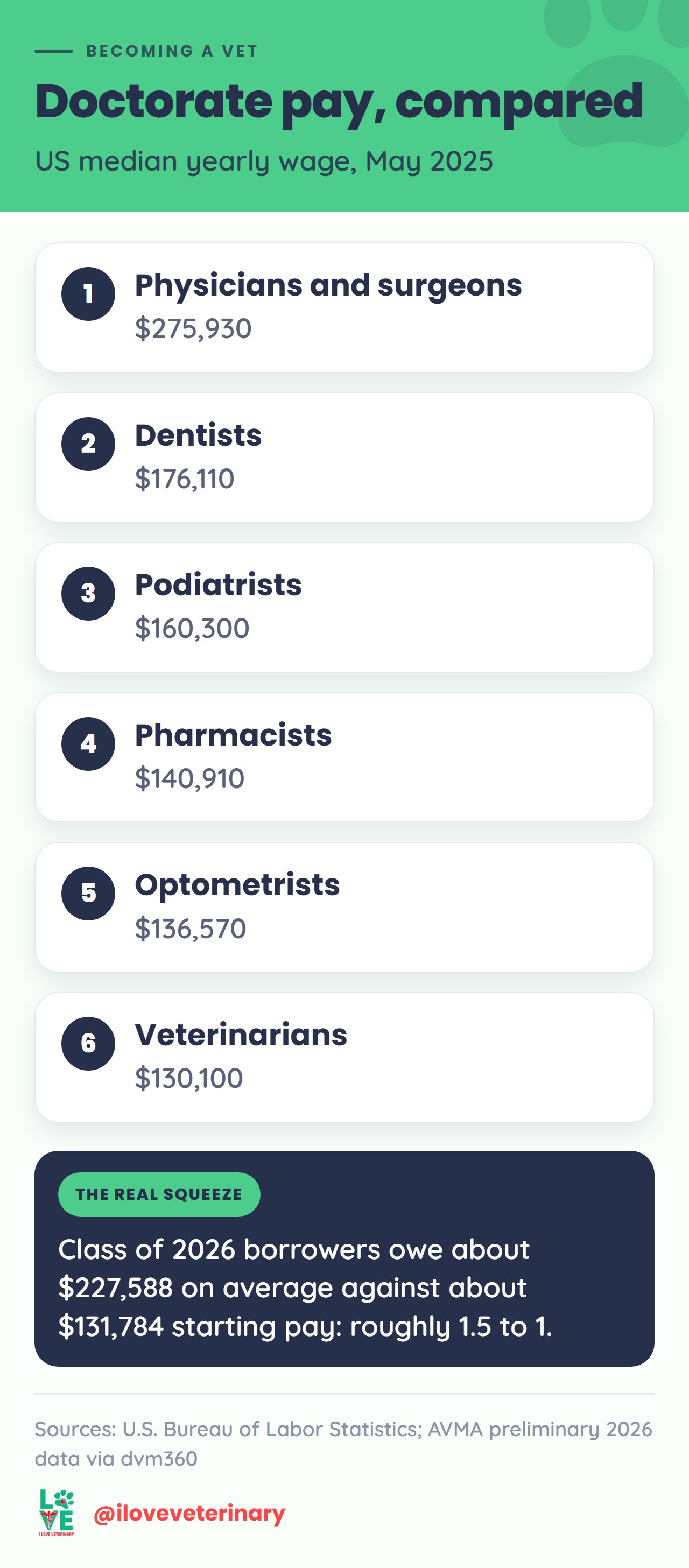
But the pay does not always match the training. One of our colleagues summed it up: they wish someone had told them all this before they got into veterinary medicine. Vets are not the lowest paid health professionals, but they earn less than most other doctorate-level ones. The median veterinarian wage was $130,100 in May 2025, compared with $275,930 for physicians and surgeons, $176,110 for dentists, $160,300 for podiatrists and $140,910 for pharmacists. Optometrists, at $136,570, are the closest match.
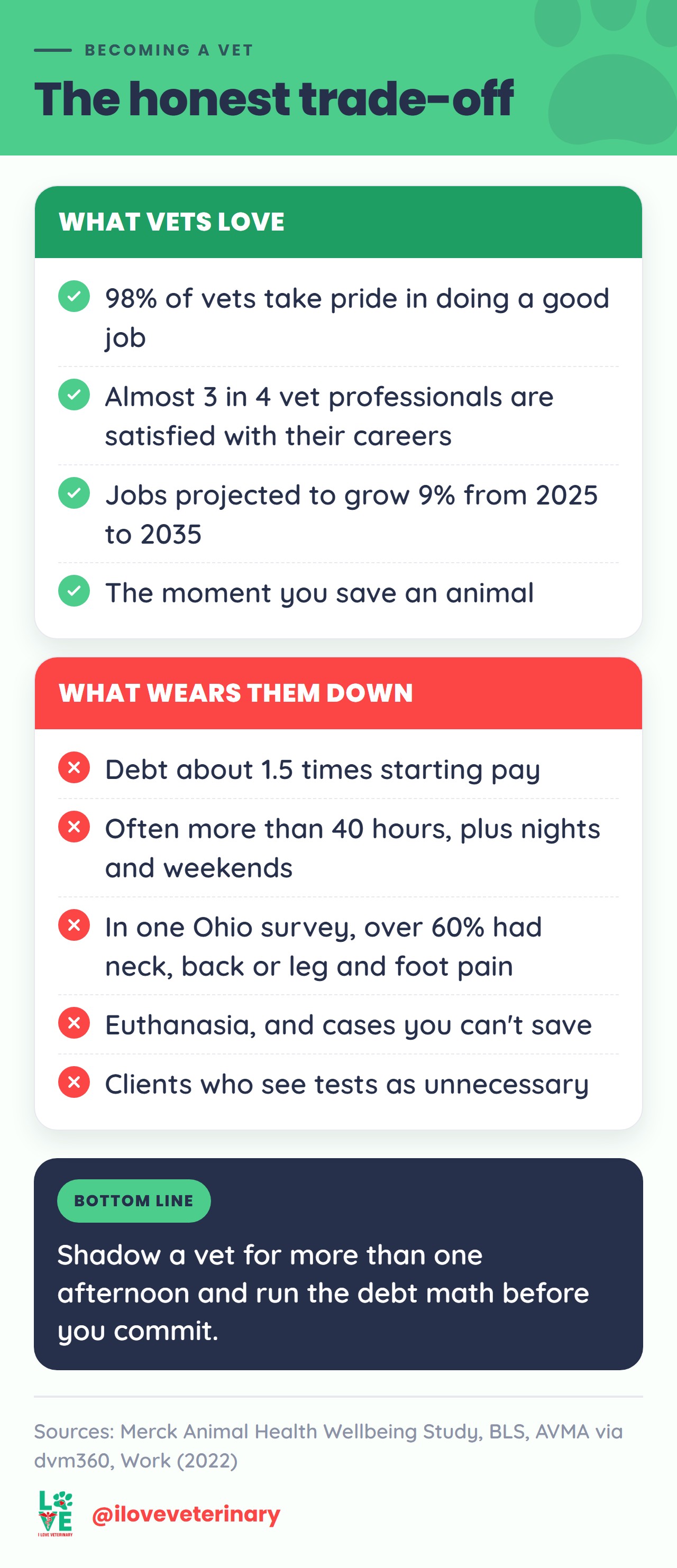
The bigger squeeze is debt. AVMA's preliminary figures for the class of 2026 put average debt at $227,588 among new graduates who borrowed, against full-time starting pay of about $131,784. AVMA puts the class's debt-to-income ratio at about 1.5 to 1. Before you commit, run that math for the schools you are considering, and look at veterinary school scholarships early.
- Relocating can be difficult
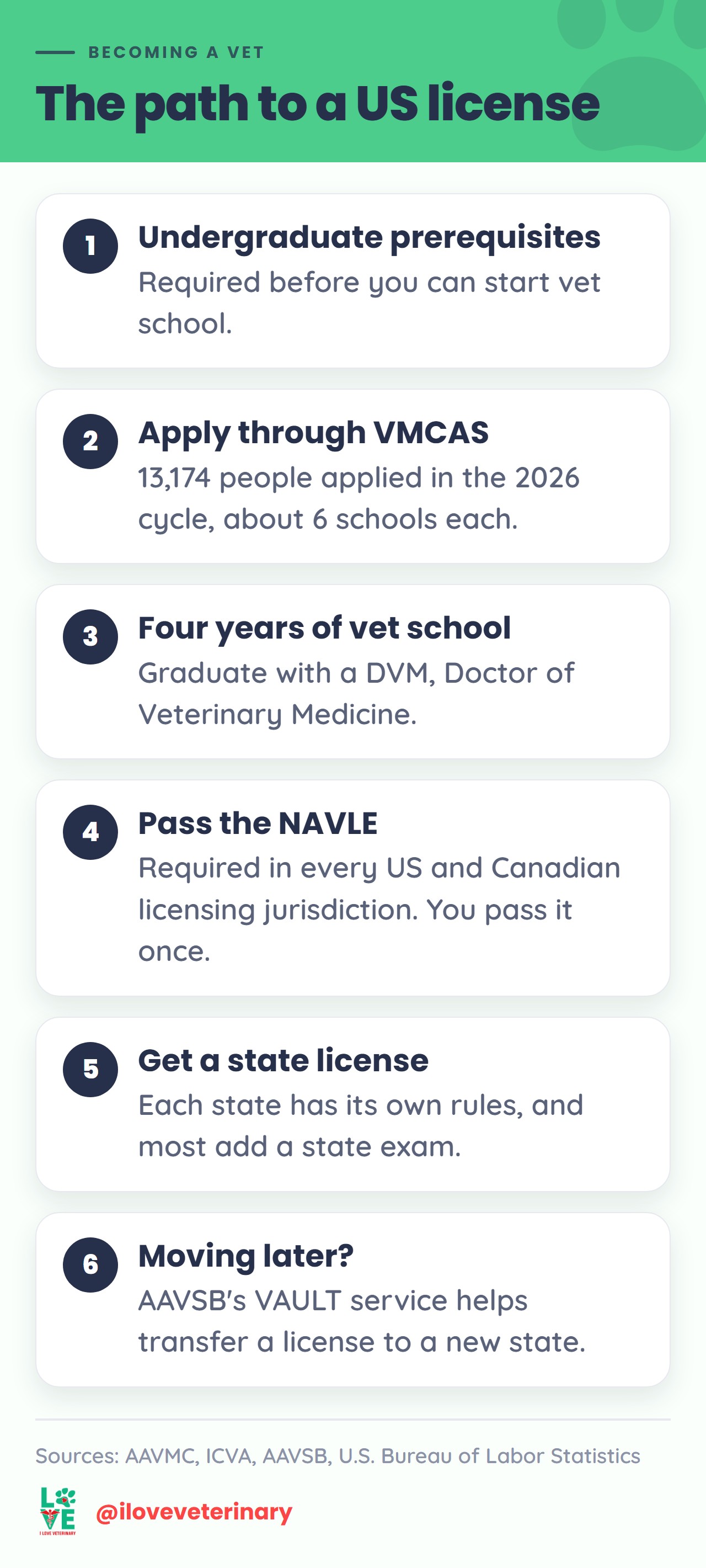
It's possible, but it can be tedious to gather all the paperwork and get licensed in every new place. In the US, you need a license in each state where you practice. The national exam, the NAVLE (North American Veterinary Licensing Examination), is required in every US and Canadian licensing jurisdiction, so you pass it once. Most states also require their own state exam. The AAVSB (American Association of Veterinary State Boards) runs a license transfer service called VAULT, and you can hold licenses in several states at once if you meet each one's requirements. If you might move, check that state board's rules before you accept a job there.
- You have a passion for what you do, but sometimes people may not see that
Some clients think vets are extremely expensive because of the "unnecessary" exams and tests needed to diagnose their pets. Explaining why a test matters, and what it will and will not tell you, is a skill you will use constantly.
- You can't save them all
There are times that owners bring their pets in too late. The illness may be too advanced, the money may run out, or you may do everything right and it still is not enough. Learning to carry those cases without blaming yourself is part of the job.
- Nobody can prepare you on how heartbreaking it is to put a patient down
Even when you know it's best for them. There will be times when you will have to euthanize a beloved pet. Dealing with euthanasia and the loss is something you will have to learn to do.
- You have to deal with people too
Not just cute puppies and kittens. Every patient comes with an owner, and a large part of your day is spent talking: taking a history, explaining a diagnosis, presenting options and costs, and persuading someone to follow a treatment plan. Educating pet owners is part of the job of everyone involved in the veterinary field. If you would rather avoid people, this career will be hard on you.
- You might be exhausted most of the time
According to the Bureau of Labor Statistics, most vets work full time and often more than 40 hours a week, with some nights, weekends and emergency calls outside regular hours. The work is physical too. In one survey of 56 veterinarians and 38 vet techs in Ohio, more than 60% reported neck, low back or leg and foot discomfort in the previous 12 months, and the BLS lists bites, kicks and scratches as job hazards. Look after yourself: use proper lifting technique, ask for help with large or difficult patients, and treat rest as part of the job. Our guide to burnout and compassion fatigue covers the warning signs.
- The truth about some workplaces
Some workplaces might not care about your psychological health and feelings. Things are improving, slowly. In the Merck Animal Health Veterinary Wellbeing Study, run with the AVMA in 2023, only 38% of clinics offered an employee assistance program (up from 27% in 2019), and only 36% of teams discussed wellbeing in team meetings even somewhat. A paper from the same survey found that vets' burnout and overall wellbeing were broadly similar to other employed US adults, but serious psychological distress was more common, and that work-life balance and a positive clinic culture were linked to better wellbeing. So when you interview, ask about support, scheduling and how the team handles hard days. The answers tell you a lot.
- Farmers might prefer if you're male
Women are now most of the profession. Nearly 70% of US vets in 2023 were women, according to BLS figures, and 83% of the veterinary class of 2027 are women, according to the AAVMC, both as reported by Harvest Public Media. Even so, women vets in rural practice have described farmers and ranchers calling in and asking for a man to be sent instead. If you are a woman who wants to be a large-animal vet, you may have to earn some clients' trust twice.
- At the end of the day...
After four years of vet school on top of your undergraduate prerequisites, and all the long hours at the vet clinic, nobody will take from you the feeling of being a superhero who lives for the moment of saving an animal. You would not be alone in feeling that way: in the 2023 Merck wellbeing survey, almost three-quarters of veterinary professionals said they were satisfied with their careers, and 98% of vets said they take pride in doing a good job. Each veterinarian has some characteristics that make them successful.
The path to becoming a vet, in numbers
What to consider | The current numbers |
|---|---|
Training | Undergraduate prerequisites, then a DVM (Doctor of Veterinary Medicine) program that generally takes 4 years |
Applications | 13,174 applicants in the 2026 VMCAS cycle, sending about 6 applications each |
Licensing | Pass the NAVLE, then meet each state's own requirements |
Debt | About $227,588 on average for class of 2026 graduates who borrowed (preliminary) |
Starting pay | About $131,784 for full-time new graduates (preliminary, class of 2026) |
Median pay | $130,100 for all veterinarians (May 2025) |
Job outlook | Employment projected to grow 9% from 2025 to 2035, about 3,100 openings a year |
The row to stare at is debt against starting pay. The gap can shape your early career for years, so treat it as seriously as your grades.
So, is becoming a vet worth it?
For many people, yes, but only if two things hold. First, your motivation survives contact with the real job: the clients, the euthanasia, the long days. Shadow a vet for more than a single afternoon and ask what they wish they had known. Second, the debt math works for you, with a realistic plan for scholarships, school choice and repayment.
If you are a career changer and the debt is the dealbreaker, look at the vet tech path too. Vet techs earn far less (a median of $47,380 in 2025), but it is a different route into hands-on patient care with a different cost of entry.
If you liked this infographic, you can Pin the image below to your Pinterest!

Infographic created by Arais Conde, find out more about her by visiting her Instagram or Portfolio.
Sources
- U.S. Bureau of Labor Statistics: Occupational Outlook Handbook, Veterinarians
- U.S. Bureau of Labor Statistics: Occupational Outlook Handbook, Healthcare Occupations
- International Council for Veterinary Assessment: NAVLE
- AAVSB: License transfer (VAULT)
- AAVMC: 2025 Annual Report
- dvm360: New veterinary graduates face widening real income gap, record debt (AVMA preliminary 2026 Senior Survey data)
- Merck Animal Health: Veterinary Wellbeing Study IV results (press release via BioSpace)
- Volk et al., JAVMA 2024: Veterinarian wellbeing and psychological distress
- Work (2022): Musculoskeletal discomfort in veterinary healthcare professions
- KCUR / Harvest Public Media: Women veterinarians and rural shortages