
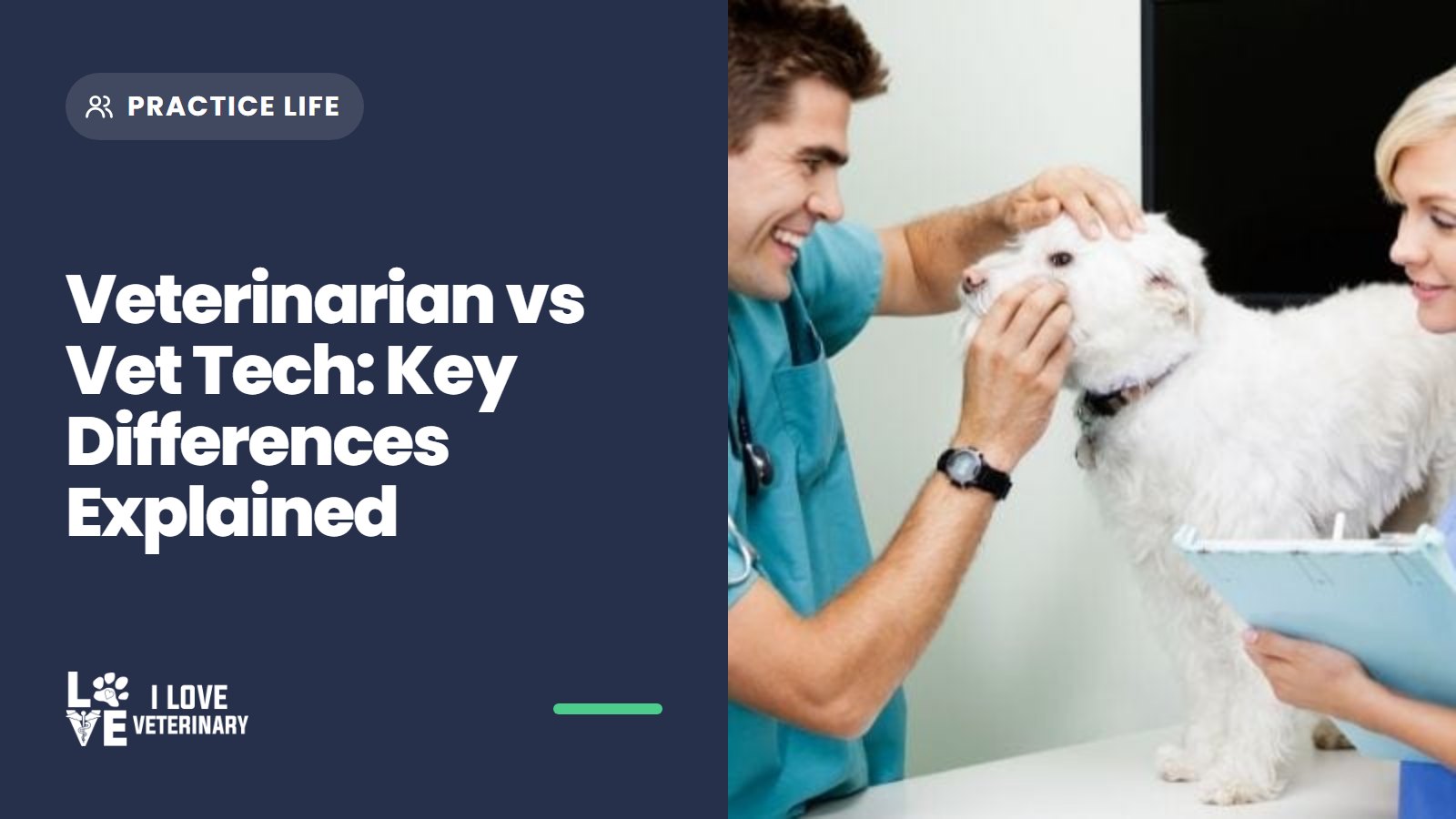
The short version: the veterinarian diagnoses, prescribes and performs surgery. The vet tech is the clinic's credentialed nurse and does most of the hands-on medicine around those decisions, from anesthesia to lab work, under the vet's supervision. Getting there takes about eight years of college for a vet and about two for a vet tech.
Both care for the same patients. The difference is who carries the diagnosis and who runs the treatment floor. Here's the side-by-side, then what a shared morning looks like.
Veterinarian vs vet tech at a glance
Veterinarian | Vet tech | |
|---|---|---|
Role | Leads the case: examines, diagnoses, decides treatment | Credentialed nurse: carries out and monitors the care the vet orders |
Legally may | Diagnose, prescribe, perform surgery, euthanize | Anesthesia, catheters, X-rays, lab tests, dental cleaning, nursing care, under a vet's supervision (state law sets the list) |
Can't | Practice without a state license | Diagnose, prescribe or perform surgery |
School | Usually a bachelor's degree, then a 4-year DVM program | 2-year associate's degree (4-year bachelor's for a technologist) |
Exam | NAVLE, plus a state exam in most states | VTNE in most states |
Credential | State veterinary license | RVT, LVT, CVT or LVMT, depending on the state |
Median pay | $130,100 a year | $47,380 a year |
Job outlook | 9% growth, 2025 to 2035 | 9% growth, 2025 to 2035 |
Cost of school | Class of 2026 borrowers owed about $227,588 on average | Varies by program; no national figure |
Pay and outlook come from the US Bureau of Labor Statistics (BLS, May 2025 data; 2025 to 2035 projections). The debt figure is from the AVMA's preliminary senior survey, covered below.

What each one can legally do
Every state has a veterinary practice act, and that law decides who may do what. The details differ by state, but the core line is the same almost everywhere: diagnosing, prescribing and performing surgery belong to the veterinarian.
Much of the rest is handed out by supervision level. The model rules from the American Association of Veterinary State Boards (AAVSB), which states can adapt, give a good picture of a credentialed tech's scope:
- Immediate supervision (the vet in sight and earshot): assisting in surgery.
- Direct supervision (the vet in the building): inducing and maintaining general anesthesia and sedation, intubation, dental cleaning and simple single-root extractions, cystocentesis, blood transfusions, closing an existing skin incision.
- Indirect supervision (the vet has given instructions and can be reached): giving prescribed medications and vaccines, placing IV catheters, taking radiographs and other imaging, drawing blood, running lab tests, monitoring ECG and blood pressure, microchipping, emergency care.
That's a lot of real medicine. What a tech can't do is decide what's wrong with the patient or what it needs. The vet examines the animal, establishes the veterinarian-client-patient relationship (VCPR) and owns the plan. The tech makes the plan happen and tells the vet when the patient isn't following it.

Euthanasia sits in a gray zone. It's on the BLS list of veterinarian duties, and the decision is always the vet's. The AAVSB model also lists it as a task a credentialed tech may perform with the vet on the premises, where the state allows it. For anything like this, check your own state's practice act; scope is still changing in some states.
Education, exams and credentials
The veterinarian path
- Undergraduate prerequisites. Most vet school applicants have a bachelor's degree, often in a science such as biology.
- Doctor of Veterinary Medicine (DVM). The program generally takes 4 years of classroom, lab and clinical work.
- The NAVLE. The North American Veterinary Licensing Examination is required for licensure in every licensing jurisdiction in the US and Canada. The International Council for Veterinary Assessment (ICVA) runs it in fixed testing windows.
- A state license. Most states add their own exam on top of the NAVLE.
That's roughly eight years after high school, longer if you add an internship or residency to become a board-certified specialist. Our guide to things to consider before becoming a veterinarian covers applications and debt in more depth.
The vet tech path
- An AVMA-accredited veterinary technology program. Usually a 2-year associate's degree, on campus or online. Our guide to accredited vet tech programs explains how to choose.
- The VTNE. The Veterinary Technician National Exam is owned and run by the AAVSB: three hours, 170 multiple-choice questions, 150 of them scored (the other 20 are pilot questions you can't tell apart). Most states and Canadian provinces require a passing score. Here's how to prepare for the VTNE.
- Your state credential. The AAVSB reports your score; the state board gives the credential. Some states add their own exam or rules, and many require continuing education to keep it.
Techs can then specialize. A Veterinary Technician Specialist (VTS) credential in areas such as anesthesia, emergency and critical care, or dentistry comes through a NAVTA-recognized academy; see our guide to vet tech specialties.
Vet technologist vs vet technician
Same exam, same kind of credential, different degree. According to the BLS, technologists usually hold a 4-year bachelor's degree in veterinary technology, while technicians usually hold a 2-year associate's degree. Technologists more often work in research and laboratory jobs; technicians mostly work in clinical practice. In a general practice, both do the same job day to day.
RVT, LVT, CVT or vet nurse?
Registered, licensed and certified veterinary technician (RVT, LVT, CVT) and licensed veterinary medical technician (LVMT) all describe the same profession. Which letters you use depends on your state's law, not on what you're trained to do, as Purdue's vet tech program explains.
You'll also hear "vet nurse". NAVTA's Veterinary Nurse Initiative has pushed for one US title, "registered veterinary nurse", in place of the four acronyms. So in a US clinic, "vet nurse vs vet" is the same question as vet tech vs veterinarian. (In the UK, veterinary nurse is the official title; see what vet nurses in the UK can do.)
Pay and job outlook
The pay gap is large, and so is the schooling gap behind it. According to the BLS (May 2025 data):
- Veterinarians earn a median of $130,100 a year. There are about 91,100 jobs, with about 3,100 openings a year projected over the decade.
- Vet technologists and technicians earn a median of $47,380 a year. There are about 131,400 jobs, with about 13,400 openings a year.
Both occupations are projected to grow 9% from 2025 to 2035, much faster than the average for all jobs.
The vet's higher pay comes with debt. In the AVMA's preliminary 2026 senior survey, graduates who borrowed owed about $227,588 on average, against average full-time starting pay of about $131,784 (dvm360). Tech program costs vary too much by school and state for one honest number, so check each program's tuition page. If you're weighing vet school, see our vet school scholarship guide.

A day in the life
A veterinarian's day is built around decisions. The BLS lists examining animals and diagnosing problems, performing surgery, prescribing medication, vaccinating, advising owners and euthanizing animals. Most vets work full time, often more than 40 hours a week, and some cover nights, weekends and emergencies.
A vet tech's day is built around the patient. The BLS lists observing the animal's condition, nursing and emergency first aid, restraining animals for exams, giving anesthesia and monitoring the patient, taking X-rays, running lab tests, preparing animals and instruments for surgery, giving the medications and vaccines the vet prescribed, and keeping case records. Techs also do a lot of the client talking, such as explaining how to give a medicine at home.
Here's how one routine spay splits between them:
On the same spay | Veterinarian | Vet tech |
|---|---|---|
Before | Examines the patient, approves the anesthetic plan | Pre-op check, IV catheter, induces anesthesia, intubates |
During | Performs the surgery | Monitors heart rate, breathing, blood pressure and anesthetic depth; assists |
After | Writes the discharge plan and prescriptions | Recovers the patient, manages pain per the vet's orders, goes over home instructions with the owner |

Both jobs are physically and emotionally demanding, according to the BLS, and evenings, weekends and holidays come with the territory. If that worries you, read our piece on burnout and compassion fatigue in veterinary medicine before you choose. For the full list of tech duties, see what vet techs do.

How vets and vet techs work together
Good practices run on trust between the two. The vet sets the plan; the tech carries it out, watches the patient closely and speaks up when something changes. A tech who catches a dropping blood pressure under anesthesia is doing exactly the job. The supervision levels above are how the law handles that split: the vet stays responsible, and the tech works within reach.
Vet assistants round out many teams. They aren't credentialed techs, and their tasks depend on the clinic and state; here's how to become a veterinary assistant if you want to start there.

Which is right for you?
Neither job is better. One will fit you better. Ask yourself:
- Do you want to make the call? If you want to be the one who diagnoses, operates and owns the outcome, it's vet school.
- Do you want your hands on patients most of the day? Anesthesia, nursing, dentistry, lab work and client education are the tech's core.
- How much time and money can you put in? About two years to start working as a tech; about eight to practice as a vet, usually with substantial debt.
- Would you like to specialize without a doctorate? The VTS route lets techs go deep in anesthesia, emergency and critical care, dentistry and more.
Can a vet tech become a vet later? Yes, but a tech degree doesn't count toward a vet degree, and DVM programs need different coursework. Purdue's vet tech faculty call the switch possible but "not the most efficient route" and not very common (Purdue). What tech work does give you is a real look at clinic life before you commit to vet school.
Leaning toward the tech side? Start with our full guide to becoming a vet tech.
FAQ
Can a vet tech perform surgery?
No. Surgery belongs to the veterinarian. A tech assists, runs anesthesia and, where the state allows it, may close an existing skin incision or do simple dental extractions, always under a vet's supervision.
Is a vet nurse the same as a vet tech?
In the US, yes. NAVTA has pushed for "registered veterinary nurse" as the single title; for now most states credential the same person as an RVT, LVT, CVT or LVMT.
What's the difference between a vet technologist and a vet technician?
The degree. Technologists usually have a 4-year bachelor's and technicians a 2-year associate's; both take the VTNE.
How long does it take to become a vet vs a vet tech?
About eight years after high school for a veterinarian and about two for a vet tech, plus the licensing exam for each.
Who earns more, a vet or a vet tech?
Veterinarians, by a wide margin: a median of $130,100 a year vs $47,380 for vet technologists and technicians.
Sources
- US Bureau of Labor Statistics: Veterinarians, Occupational Outlook Handbook
- US Bureau of Labor Statistics: Veterinary Technologists and Technicians, Occupational Outlook Handbook
- AAVSB: VTNE overview
- AAVSB: Scheduling and taking the VTNE
- AAVSB: Model Regulations, Scope of Practice for Veterinary Technicians and Veterinary Technologists
- ICVA: North American Veterinary Licensing Examination (NAVLE)
- Purdue University College of Veterinary Medicine: What is the difference between LVT and RVT?
- Purdue University College of Veterinary Medicine: Does a vet tech degree help me become a veterinarian?
- dvm360: New veterinary graduates face widening real income gap, record debt (reporting the AVMA Senior Survey)
- AVMA JAVMA News: Veterinary Nurse Initiative a work in progress